Data Labeling Cost Calculator
AI model training budget estimator • 2026 edition
Data Labeling Cost Formula:
Show Calculator\( \text{Total Cost} = (\text{Items} \times \text{Time per Item} \times \text{Hourly Rate}) + \text{QC Costs} + \text{Management Fees} \)
Where:
- Items = Total number of data items to label
- Time per Item = Average time to label one item (in hours)
- Hourly Rate = Cost per hour of labeling workforce
- QC Costs = Quality control and verification expenses (typically 20-30% of base cost)
- Management Fees = Project management and overhead (typically 10-15% of base cost)
This formula calculates the comprehensive cost of data labeling projects including direct labor, quality assurance, and administrative overhead.
Example: For 10,000 images requiring 2 minutes each at $15/hour with 25% QC and 12% management fees:
Base cost: \( 10{,}000 \times \frac{2}{60} \times 15 = \$5{,}000 \)
QC costs: \( 5{,}000 \times 0.25 = \$1{,}250 \)
Management fees: \( 5{,}000 \times 0.12 = \$600 \)
Total cost: \( 5{,}000 + 1{,}250 + 600 = \$6{,}850 \)
Thus, the total project would cost approximately $6,850.
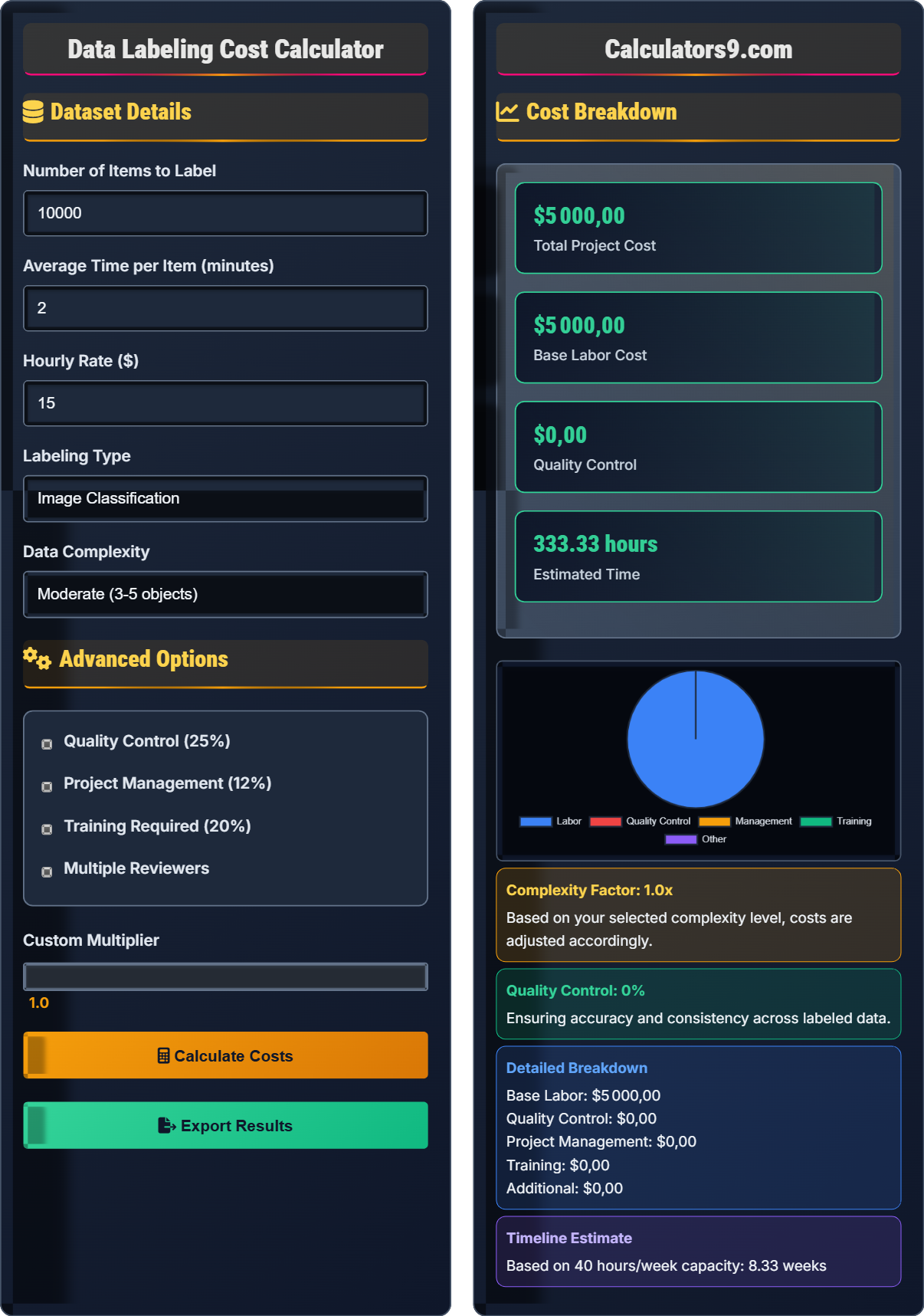
Dataset Details
Advanced Options
Cost Breakdown
Based on your selected complexity level, costs are adjusted accordingly.
Ensuring accuracy and consistency across labeled data.
Base Labor: $5,000.00
Quality Control: $1,250.00
Project Management: $600.00
Training: $1,000.00
Additional: $0.00
Based on 40 hours/week capacity: 0.83 weeks
Data Labeling Cost Guide
Data labeling is the process of annotating raw data (images, text, audio, video) with meaningful tags or labels that machine learning algorithms can learn from. This is a critical step in supervised learning where labeled datasets are used to train AI models. The quality and accuracy of labeled data directly impacts model performance.
The comprehensive data labeling cost calculation uses the following formula:
Where:
- Items = Total number of data items to label
- Time per Item = Average time to label one item (in hours)
- Hourly Rate = Cost per hour of labeling workforce
- QC Costs = Quality control and verification expenses (typically 20-30% of base cost)
- Management Fees = Project management and overhead (typically 10-15% of base cost)
Your data labeling project costs typically include several components:
- Labor Costs: Direct payment to annotators for their work
- Quality Control: Verification, review, and correction processes
- Project Management: Coordination, communication, and oversight
- Training: Initial setup and ongoing guidance for annotators
- Technology: Annotation tools, platforms, and infrastructure
- Overhead: Administrative and operational expenses
- Preprocessing: Clean and organize data before labeling to reduce annotation time
- Active Learning: Use ML to identify most informative samples for labeling
- Batch Processing: Group similar items together for efficiency
- Standardization: Create clear guidelines to reduce ambiguity and corrections
- Hybrid Approach: Combine automated pre-labeling with human verification
Labeling Fundamentals
Process of adding meaningful tags to raw data for machine learning.
\( \text{Total Cost} = (\text{Items} \times \text{Time per Item} \times \text{Hourly Rate}) + \text{QC Costs} + \text{Management Fees} \)
Where Items=data count, Time per Item=average labeling time, Hourly Rate=labor cost.
- Quality control typically adds 20-30% to base costs
- Complexity increases time and cost exponentially
- Training costs are often overlooked
Optimization Strategies
Verification process ensuring accuracy and consistency of labeled data.
- Standardize annotation guidelines
- Use pre-labeling with automation
- Implement efficient workflows
- Batch similar tasks together
- Simple tasks: $0.10-$0.50 per item
- Complex tasks: $2.00-$10.00+ per item
- Quality control is essential
- Training costs apply to complex tasks
Data Labeling Cost Learning Quiz
Which of the following is NOT typically included in the total cost of a data labeling project?
The answer is C) Marketing and advertising expenses. The typical components of a data labeling project cost include direct labor (annotators), quality control, project management, training, and technology costs. Marketing and advertising expenses are business development costs unrelated to the actual labeling process.
Understanding the components of data labeling costs is crucial for accurate budget planning. The total cost typically consists of direct costs (labor) and indirect costs (overhead, quality assurance, management). Many organizations underestimate indirect costs, which can represent 30-50% of the total project expense.
Direct Labor: Payment to annotators for actual labeling work
Quality Control: Process of verifying and validating labeled data accuracy
Overhead: Indirect costs including management, coordination, and administrative expenses
• Quality control typically adds 20-30% to base labor costs
• Project management overhead is usually 10-15% of total cost
• Training costs are often 15-25% of base labor for complex tasks
• Remember: Total cost ≠ direct labor cost
• Factor in quality control and management when budgeting
• Complex labeling tasks require more training and oversight
• Underestimating quality control costs
• Forgetting project management overhead
• Not accounting for training costs on complex tasks
Calculate the total cost for labeling 5,000 images requiring 3 minutes each at $12/hour, with 25% quality control, 10% management fee, and 20% training cost. Show your work.
Step 1: Calculate base labor cost
Time in hours = 5,000 items × 3 minutes/item ÷ 60 minutes/hour = 250 hours
Base cost = 250 hours × $12/hour = $3,000
Step 2: Calculate additional costs
Quality control = $3,000 × 0.25 = $750
Management fee = $3,000 × 0.10 = $300
Training cost = $3,000 × 0.20 = $600
Step 3: Calculate total cost
Total cost = $3,000 + $750 + $300 + $600 = $4,650
This calculation demonstrates how additional costs can significantly impact the total budget. The base labor cost ($3,000) represents only about 64% of the total cost, with additional expenses accounting for the remaining 36%. This highlights the importance of considering all cost components when planning labeling projects.
Base Labor Cost: Direct payment to annotators for labeling work
Quality Control: Process of verifying and validating labeled data
Management Fee: Overhead cost for project coordination and oversight
• Always convert time to consistent units (hours) for calculations
• Apply percentage costs to the base labor cost
• Sum all components to get total project cost
• Remember: 3 minutes = 3/60 = 0.05 hours
• Calculate each component separately then sum
• Percentage costs are applied to base cost, not previous totals
• Forgetting to convert minutes to hours for rate calculations
• Applying percentage costs to incorrect base amounts
• Adding percentages together before applying to base cost
A company needs to label 10,000 images for an object detection model. They have two options: (A) Image classification at $0.25 per image or (B) Object detection with bounding boxes at $1.50 per object. If each image contains an average of 3 objects, which option is more cost-effective and by how much?
Option A: Image Classification
Cost = 10,000 images × $0.25/image = $2,500
Option B: Object Detection
Total objects = 10,000 images × 3 objects/image = 30,000 objects
Cost = 30,000 objects × $1.50/object = $45,000
Difference = $45,000 - $2,500 = $42,500
Therefore, image classification is more cost-effective by $42,500.
This example illustrates the significant cost differences between labeling types. Object detection is considerably more expensive than classification due to the increased time and precision required. The choice of labeling type directly impacts both cost and model capabilities, making it a critical decision in project planning.
Image Classification: Assigning one or more labels to an entire image
Object Detection: Identifying and localizing objects within images using bounding boxes
Cost Efficiency: Achieving desired results at minimal cost
• More granular labeling increases cost exponentially
• Object detection costs are per object, not per image
• Consider project requirements vs. budget constraints
• Calculate total units (objects) for per-unit costs
• Compare different approaches before committing
• Consider hybrid approaches for cost optimization
• Confusing per-image vs. per-object pricing
• Not accounting for multiple objects per image
• Overlooking the relationship between labeling type and cost
A startup has a budget of $10,000 for labeling 20,000 text samples. The base labeling cost is $0.30 per sample. They need to decide whether to implement quality control (25% additional cost) or skip it to stay within budget. Calculate the cost with and without QC, and determine how many samples they can label with QC while staying within budget.
Without QC: 20,000 samples × $0.30/sample = $6,000
With QC: Base cost × 1.25 = $6,000 × 1.25 = $7,500
With QC and $10,000 budget: $10,000 ÷ 1.25 = $8,000 available for base cost
Number of samples = $8,000 ÷ $0.30/sample = 26,666 samples
Wait, that's not right. Let me recalculate:
If X = number of samples with QC within $10,000 budget
Base cost = X × $0.30
Total cost = Base cost × 1.25 = $10,000
So: (X × $0.30) × 1.25 = $10,000
X = $10,000 ÷ (0.30 × 1.25) = $10,000 ÷ 0.375 = 26,666 samples
This problem demonstrates the trade-off between budget constraints and quality assurance. Including QC reduces the number of samples that can be labeled within a fixed budget, but improves data quality. The calculation requires understanding that QC is applied to the base cost, necessitating algebraic rearrangement to find the maximum samples possible within budget.
Quality Assurance: Processes to ensure data accuracy and consistency
Budget Constraint: Maximum allowable expenditure for a project
Cost-Benefit Analysis: Evaluation of trade-offs between cost and quality
• QC costs are calculated as a percentage of base cost
• To find samples within budget: Budget ÷ (rate × (1 + QC%))
• Quality control improves data reliability but increases costs
• Set up equations when dealing with percentage increases
• Work backwards from budget constraints
• Consider alternative quality approaches if budget is tight
• Adding QC percentage to the total budget instead of the base cost
• Forgetting to account for QC when calculating sample capacity
• Not setting up proper equations for budget-constrained problems
Which of the following statements about data labeling complexity factors is TRUE?
The answer is B) Complexity increases both time and cost proportionally. As data complexity increases, the time required per item increases, which directly affects the cost since most labeling is priced based on time or effort. For example, semantic segmentation (pixel-level annotation) is significantly more expensive than simple classification due to the increased precision and time required.
There is a direct correlation between task complexity and labeling costs. More complex tasks require more skilled annotators, longer labeling times, and often more rigorous quality control. Understanding this relationship helps in project planning and budget allocation. The cost scaling is often exponential rather than linear for very complex tasks.
Task Complexity: Measure of difficulty and precision required for labeling
Cost Scaling: How costs change as complexity increases
Annotation Precision: Level of detail required in labeling
• More complex tasks require more time per item
• Higher precision requirements increase costs
• Quality control becomes more critical with complex tasks
• Consider simplifying requirements where possible
• Use automated tools for preprocessing complex data
• Plan for higher costs with granular labeling tasks
• Underestimating time for complex labeling tasks
• Assuming all labeling types cost the same
• Not accounting for skill level requirements
FAQ
Q: How does data complexity affect labeling costs beyond the basic time factor?
A: Data complexity affects labeling costs through multiple dimensions beyond basic time:
1. Training Requirements: Complex tasks require extensive annotator training, increasing upfront costs.
2. Quality Control: More complex tasks need stricter validation processes, often involving expert review.
3. Specialized Skills: Tasks like medical imaging annotation require domain experts commanding higher hourly rates.
4. Error Correction: Complex annotations have higher error rates, requiring more correction cycles.
5. Tool Licensing: Advanced annotation tools for complex tasks (like 3D point cloud labeling) have higher licensing costs.
For example, semantic segmentation might cost 5-10x more than classification not just due to time, but because of these additional complexity factors.
Q: What's the most effective way to reduce data labeling costs without compromising quality?
A: The most effective cost reduction strategies while maintaining quality include:
1. Active Learning: Use ML models to identify the most informative samples, reducing total labeling volume by 30-70%.
2. Pre-labeling: Automate initial labeling with weak supervision or transfer learning, then human verify.
3. Workflow Optimization: Standardize annotation guidelines and provide comprehensive training upfront.
4. Batch Similar Items: Group similar data together to improve annotator efficiency.
5. Iterative Approach: Start with smaller, high-quality datasets and expand based on model performance.
These strategies can reduce labeling costs by 40-60% while maintaining or improving quality.