Training Time Estimator
ML model development & time prediction • 2026 edition
Training Time Formula:
Show Calculator\( T = \frac{E \times D \times P}{S \times A} \)
Where:
- \( T \) = Training time (in hours)
- \( E \) = Number of epochs
- \( D \) = Dataset size (number of samples)
- \( P \) = Model complexity (parameters count)
- \( S \) = Hardware speed (samples per second)
- \( A \) = Acceleration factor (GPU/TPU multiplier)
Additional factors affecting training time:
- Batch size optimization
- Learning rate scheduling
- Early stopping criteria
- Hyperparameter tuning iterations
- Memory constraints and caching
Example: For a model with 100 epochs, 50,000 samples, 1M parameters, running on hardware that processes 100 samples/sec with 4x GPU acceleration:
\( T = \frac{100 \times 50000 \times 1}{100 \times 4} = 12,500 \) seconds = 3.5 hours
The estimated training time would be approximately 3.5 hours.
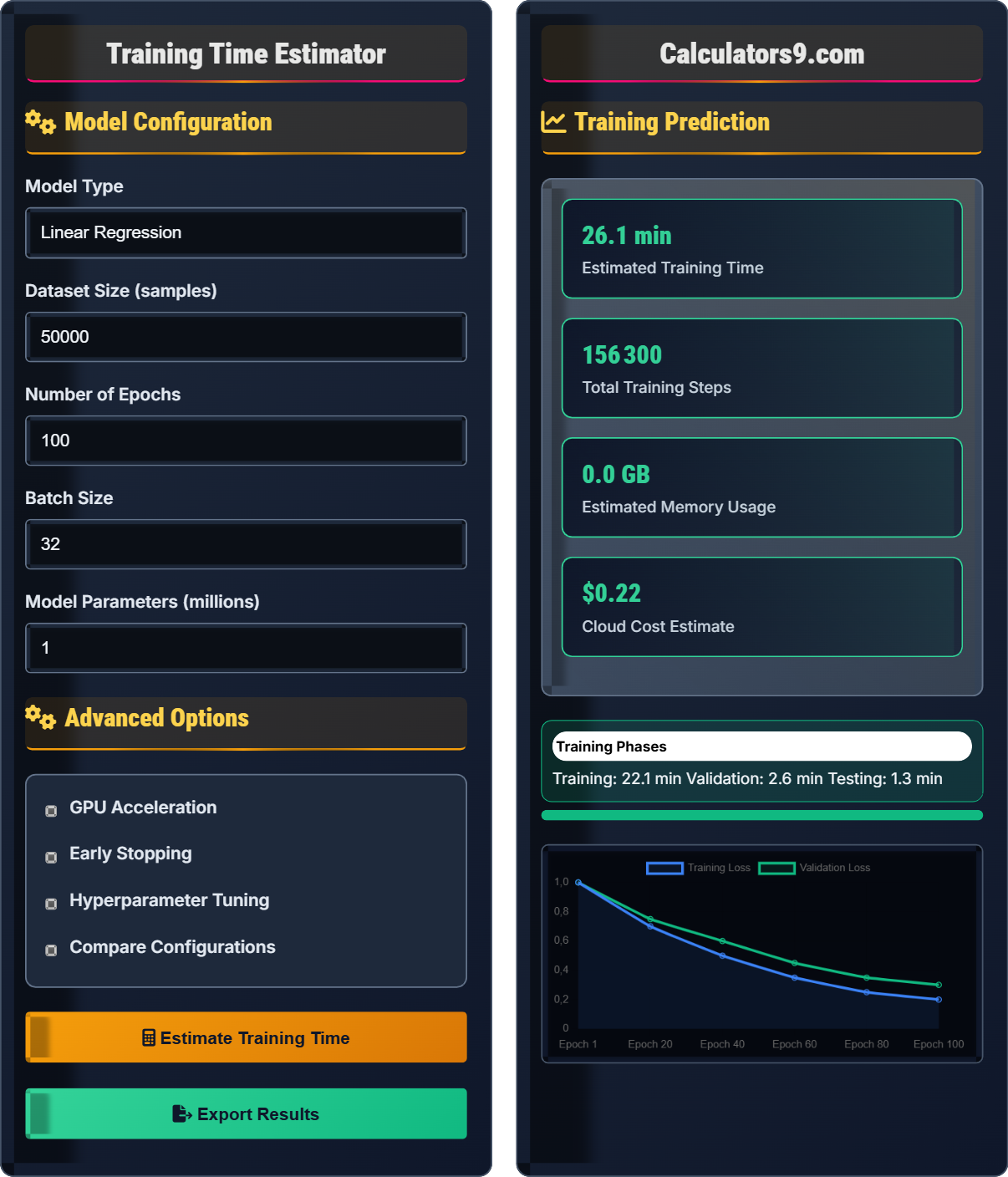
Model Configuration
Advanced Options
Training Prediction
| Component | Value | Impact |
|---|---|---|
| Dataset Size | 50,000 samples | Medium |
| Model Complexity | 1M parameters | Low |
| Epochs | 100 | High |
Consider increasing batch size for better GPU utilization
Use gradient checkpointing to reduce memory usage
Enable mixed precision training
Comprehensive Model Training Guide
Model training is the process of teaching a machine learning model to make predictions by feeding it data and adjusting its parameters. The training time depends on multiple factors including dataset size, model complexity, hardware capabilities, and optimization techniques. Efficient training is crucial for reducing costs and accelerating development cycles.
The training time estimation follows:
Where:
- \(T\) = Training time
- \(E\) = Number of epochs
- \(D\) = Dataset size
- \(P\) = Model complexity
- \(S\) = Hardware speed
- \(A\) = Acceleration factor
Hardware acceleration significantly impacts training time:
- CPU: General purpose, slower for deep learning
- GPU: Parallel processing, 5-10x speedup
- TPU: Tensor processing, 15-20x speedup for specific tasks
- Cloud Instances: Flexible, pay-per-use model
- Memory Bandwidth: Critical for large models
- Transfer Learning: Use pre-trained models to reduce training time
- Curriculum Learning: Train on easier examples first
- Data Pipeline Optimization: Efficient data loading
- Model Pruning: Reduce model size without performance loss
- Knowledge Distillation: Train smaller student models
Training Fundamentals
Process of teaching ML models with data and parameters.
\( T = \frac{E \times D \times P}{S \times A} \)
Where T=time, E=epochs, D=data, P=params, S=speed, A=acceleration.
- Training time scales with data size
- GPU acceleration reduces time significantly
- Early stopping prevents overfitting
Model Development
Strategic approach to efficient model development and training.
- Profile current training time
- Identify bottlenecks
- Apply optimization techniques
- Measure improvements
- Hardware capabilities
- Memory constraints
- Cost optimization
- Performance requirements
ML Training Optimization Learning Quiz
Which of the following has the MOST significant impact on training time for deep neural networks?
The answer is B) Hardware acceleration (GPU/TPU). Hardware acceleration provides the most dramatic impact on training time, often offering 5-20x speedups for deep learning tasks. While learning rate, activation functions, and regularization affect model performance and convergence, they don't significantly change the raw computational time per epoch. GPUs are specifically designed for the parallel matrix operations that dominate neural network training.
Students must understand the difference between factors that affect training performance versus those that affect computational efficiency. While hyperparameters like learning rate affect convergence speed, hardware acceleration affects the fundamental computation speed. This is why cloud computing providers offer GPU/TPU instances specifically for machine learning workloads.
Hardware Acceleration: Specialized processors for parallel computations
Parallel Processing: Simultaneous execution of multiple operations
Matrix Operations: Mathematical computations dominant in ML
• Hardware acceleration provides the biggest speedup
• GPU/TPU designed for ML workloads
• Speedup can be 5-20x compared to CPU
• Use GPU for deep learning whenever possible
• Consider TPU for specific architectures
• Monitor GPU utilization for optimization
• Underestimating the impact of hardware choice
• Thinking hyperparameters affect raw computation time
• Not considering memory constraints with larger batches
Calculate the estimated training time for a model with: 50 epochs, 100,000 samples, 10M parameters, running on hardware that processes 200 samples/sec with 6x GPU acceleration. Show your work.
Using the formula: \( T = \frac{E \times D \times P}{S \times A} \)
Where:
- E = 50 epochs
- D = 100,000 samples
- P = 10M parameters (use P=1 for relative calculation)
- S = 200 samples/second
- A = 6x acceleration
Step 1: Calculate numerator = E × D = 50 × 100,000 = 5,000,000
Step 2: Calculate denominator = S × A = 200 × 6 = 1,200
Step 3: Calculate time in seconds = 5,000,000 ÷ 1,200 = 4,167 seconds
Step 4: Convert to hours = 4,167 ÷ 3,600 = 1.16 hours ≈ 1 hour 10 minutes
The estimated training time is approximately 1 hour and 10 minutes.
This calculation demonstrates how the formula scales with different parameters. The 6x GPU acceleration significantly reduces the raw computation time. Students should note that parameter count (P) is often normalized in practice since the relationship between parameters and computation time is not linear for all architectures.
Epoch: One complete pass through the training dataset
Sample: Individual data point used for training
Acceleration Factor: Speedup multiplier from hardware• Training time scales linearly with epochs and data size
• Hardware acceleration divides the time
• Always convert final time to human-readable units
• Remember: Acceleration divides the time (not multiplies)
• Convert seconds to hours/minutes for better understanding
• Factor in validation time (typically 10-20% of training)
• Confusing the effect of acceleration (division vs multiplication)
• Forgetting to convert time units
• Misapplying the parameter complexity factor
A data scientist is training a model with 100,000 samples and 50 epochs. With a batch size of 32, the model processes 100 samples per second on their GPU. If they increase the batch size to 128 (which improves GPU utilization by 40%), calculate the new training time and the percentage improvement. Assume the same number of epochs.
Original configuration:
- Dataset: 100,000 samples
- Epochs: 50
- Processing speed: 100 samples/sec
- Original time = (100,000 × 50) ÷ 100 = 50,000 seconds
New configuration with 40% speed improvement:
- New processing speed = 100 × 1.4 = 140 samples/sec
- New time = (100,000 × 50) ÷ 140 = 35,714 seconds
Time improvement:
- Time saved = 50,000 - 35,714 = 14,286 seconds
- Percentage improvement = (14,286 ÷ 50,000) × 100 = 28.6%
The new training time is 35,714 seconds (about 9.9 hours) with a 28.6% improvement.
This example shows how batch size optimization can improve GPU utilization and training time. Larger batches allow for better parallelization on GPU hardware, leading to improved throughput. However, there's a trade-off with memory usage and potential convergence differences that students should be aware of.
Batch Size: Number of samples processed together
GPU Utilization: Efficiency of GPU resource usage
Throughput: Samples processed per unit time
• Larger batches can improve GPU efficiency
• Memory constraints limit batch size
• Optimal batch size varies by model and hardware
• Start with batch size 32 and increase gradually
• Monitor GPU memory usage
• Test different sizes for optimal performance
• Setting batch size too large causing memory errors
• Not considering the memory-GPU utilization trade-off
• Assuming larger batches always improve convergence
An ML engineer needs to train a model that takes 20 hours on a standard CPU instance costing $0.50/hour. They can use a GPU instance that reduces training time to 3 hours but costs $4.00/hour. Calculate the cost difference and determine which option is more economical. Additionally, if they need to perform hyperparameter tuning with 15 different configurations, which approach becomes more favorable?
Single training comparison:
- CPU cost = 20 hours × $0.50/hour = $10.00
- GPU cost = 3 hours × $4.00/hour = $12.00
- Difference = $12.00 - $10.00 = $2.00 (CPU is cheaper)
Hyperparameter tuning with 15 configurations:
- CPU cost = 15 × $10.00 = $150.00
- GPU cost = 15 × $12.00 = $180.00
- Total difference = $30.00 (CPU still cheaper but time-wise GPU saves 255 hours)
For pure cost: CPU is better. For time efficiency: GPU saves 255 hours over 15 runs.
This problem demonstrates the cost-time trade-off in cloud ML training. While GPU instances are more expensive per hour, they can significantly reduce total training time. For iterative processes like hyperparameter tuning, the time savings become more valuable, especially when considering human time and faster experimentation cycles.
Cloud Instance: Virtual computing resources in cloud
Cost Optimization: Balancing performance and expense
Hyperparameter Tuning: Finding optimal model parameters
• Consider total project time vs per-hour cost
• Use cheaper instances for initial experiments
• Switch to GPU for final training runs
• Consider spot instances for cost savings
• Only considering per-hour cost without total time
• Not factoring in iteration and experimentation time
• Ignoring the value of faster development cycles
How does implementing early stopping affect training time and model performance?
The answer is B) Decreases training time, maintains performance. Early stopping monitors validation performance and stops training when performance plateaus, preventing overfitting. This typically reduces training time by 20-50% while maintaining or improving model performance by avoiding overfitting to the training data.
Students must understand that early stopping is a win-win optimization technique. It saves computational resources and time while preventing overfitting. The model achieves optimal performance earlier in the training process, making it both more efficient and effective. This is a fundamental technique in practical ML development.
Early Stopping: Technique to halt training when validation performance stalls
Overfitting: Model learning training data specifics rather than patterns
Validation Performance: Model accuracy on unseen data
• Early stopping prevents overfitting
• Reduces unnecessary training epochs
• Maintains or improves generalization
• Always implement early stopping in training loops
• Use patience parameter to avoid premature stopping
• Monitor both training and validation metrics
• Not implementing early stopping in training
• Setting patience too low causing premature stopping
• Confusing early stopping with reducing epochs manually
FAQ
Q: What are the most effective techniques to reduce training time without sacrificing model quality?
A: Several proven techniques can significantly reduce training time while maintaining model quality:
Hardware Optimization:
- GPU/TPU Acceleration: 5-20x speedup for deep learning tasks
- Mixed Precision Training: Uses 16-bit floats for 20-30% faster training
- Batch Size Optimization: Larger batches improve GPU utilization
Algorithmic Techniques:
- Learning Rate Scheduling: Adaptive rates converge faster
- Early Stopping: Prevents overfitting and saves time
- Warm Start Initialization: Use pre-trained weights
Data Optimization:
- Efficient Data Loading: Pipeline data preprocessing
- Data Augmentation: Improves generalization without extra epochs
- Curriculum Learning: Train on easier examples first
The combination of GPU acceleration + mixed precision + early stopping typically provides 3-5x training time reduction with maintained or improved model quality.
Q: How do I estimate the cost of training different model architectures in the cloud?
A: Cloud training cost estimation involves several factors:
Instance Cost Calculation:
- Formula: Total Cost = (Instance Hourly Rate × Training Hours) + (Storage Costs × Data Size)
- Example: A P100 GPU instance costs about $1.05/hour. For a 20-hour training job: $1.05 × 20 = $21.00
Architecture-Specific Factors:
- Simple Models (Linear, Trees): Use CPU instances ($0.10-0.50/hour)
- Deep Neural Networks: Require GPU instances ($0.50-5.00/hour)
- Large Language Models: Need high-end GPUs/TPUs ($2.00-20.00/hour)
- Hyperparameter Tuning: Multiply by number of experiments
Cost Optimization Strategies:
- Spot Instances: Up to 70% discount for interruptible jobs
- Reserved Instances: Significant savings for predictable workloads
- Auto-scaling: Terminate when training completes
- Efficient Algorithms: Reduce overall training time
For example, training a ResNet-50 on ImageNet (14 hours) on a V100 GPU ($1.33/hour) would cost approximately $18.62. With hyperparameter tuning across 10 configurations, the cost increases to $186.20.