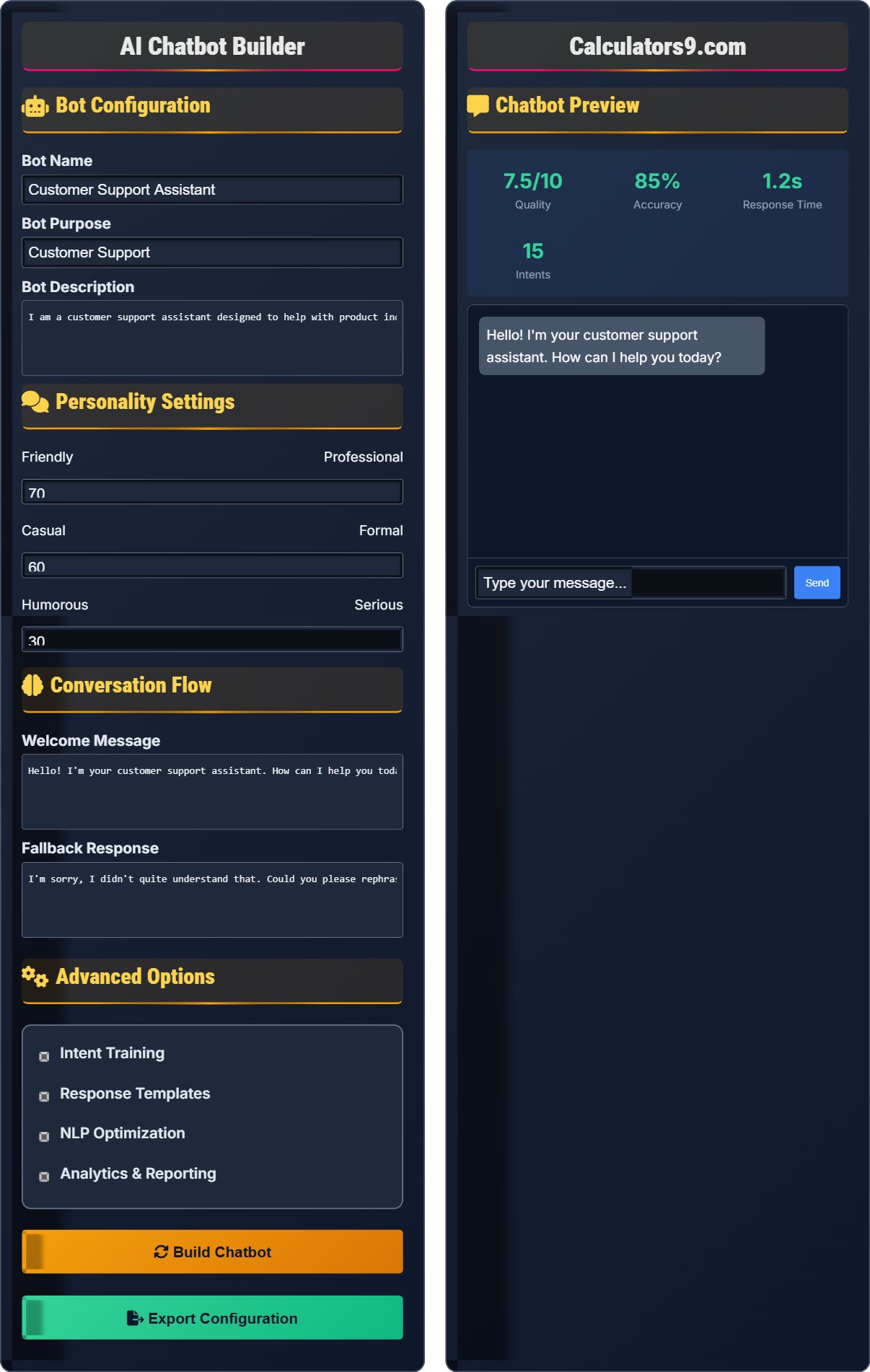
AI Chatbot Builder
Intelligent assistant creator • 2026 edition
Conversation Quality Formula:
Build Bot\( Q = \frac{R \times A \times C}{N + D} \)
Where:
- \( Q \) = Conversation Quality Score
- \( R \) = Relevance of responses (0-1)
- \( A \) = Accuracy of information (0-1)
- \( C \) = Coherence of conversation flow (0-1)
- \( N \) = Number of misunderstood inputs
- \( D \) = Delays in response time
This formula calculates the overall quality of chatbot interactions. Higher scores indicate more effective, human-like conversations.
Example: For a bot with 90% relevance (R=0.9), 85% accuracy (A=0.85), 88% coherence (C=0.88), 2 misunderstandings (N=2), and 1.2s delays (D=1.2): \( Q = \frac{0.9 \times 0.85 \times 0.88}{2 + 1.2} = \frac{0.6732}{3.2} = 0.21 \). Scores above 0.25 indicate high-quality conversations.
Bot Configuration
Personality Settings
Conversation Flow
Advanced Options
Chatbot Preview
Comprehensive AI Chatbot Development Guide
AI-powered chatbots use natural language processing (NLP) and machine learning to understand and respond to user queries conversationally. These systems can handle complex conversations, learn from interactions, and continuously improve their responses. Modern chatbots combine rule-based systems
The fundamental conversation quality calculation uses the following formula:
Where:
- \(Q\) = Conversation Quality Score
- \(R\) = Relevance of responses (0-1)
- \(A\) = Accuracy of information (0-1)
- \(C\) = Coherence of conversation flow (0-1)
- \(N\) = Number of misunderstood inputs
- \(D\) = Delays in response time
Effective AI chatbots should consider these key factors:
- Intent Recognition: Accurately understanding user's purpose
- Context Awareness: Maintaining conversation history and context
- Response Relevance: Providing appropriate and helpful answers
- Personality Consistency: Maintaining character throughout interactions
- Scalability: Handling increased conversation volume
- Integration: Connecting with other systems and databases
- Clear Limitations: Be transparent about what the bot can and cannot do
- Seamless Handoff: Provide smooth transitions to human agents when needed
- Continuous Learning: Implement mechanisms to improve over time
- Privacy Protection: Safeguard user data and privacy
- Error Handling: Gracefully manage unexpected inputs
Chatbot Development Basics
Technology that identifies the purpose behind user messages.
\( Q = \frac{R \times A \times C}{N + D} \)
Where Q=quality, R=relevance, A=accuracy, C=coherence, N=mistakes, D=delays.
- Understand user intent accurately
- Maintain contextual awareness
- Provide relevant responses
Strategies
Maintaining character traits throughout all interactions.
- Define core personality traits
- Create response guidelines
- Establish tone and style
- Test for consistency
- Match personality to use case
- Maintain consistency across all interactions
- Balance personality with professionalism
- Consider cultural sensitivity
AI Chatbot Development Learning Quiz
What is the primary purpose of intent recognition in AI chatbots?
The answer is B) To identify the underlying purpose or goal of user messages. Intent recognition is the core capability that allows chatbots to understand what users are trying to achieve with their input. For example, the phrases "I want to cancel my order", "Can you cancel my purchase?", and "I need to return my item" might all represent the same underlying intent (return/cancellation), even though the wording differs significantly.
Intent recognition is fundamental to natural language understanding. The system must classify user inputs into predefined categories of intent. This allows the chatbot to provide appropriate responses regardless of how the user phrases their request. Effective intent recognition requires training data with various ways users might express the same need, enabling the system to generalize across different linguistic formulations of the same underlying intent.
Intent Recognition: Identifying the purpose behind user messages
Classification: Assigning inputs to predefined categories
Generalization: Understanding different expressions of the same intent
• Train with diverse examples of each intent
• Consider synonyms and alternative phrasings
• Handle ambiguous inputs appropriately
• Use entity recognition alongside intent classification
• Implement confidence scoring for uncertain cases
• Regularly update training data based on real interactions
• Treating every variation as a separate intent
• Not considering context in intent classification
• Insufficient training examples for each intent
Using the conversation quality formula \( Q = \frac{R \times A \times C}{N + D} \), calculate the quality score for a chatbot with 85% relevance (R=0.85), 90% accuracy (A=0.90), 80% coherence (C=0.80), 3 misunderstandings (N=3), and 1.5s response delay (D=1.5). Show your work.
Using the formula: \( Q = \frac{R \times A \times C}{N + D} \)
Given:
- R = 0.85 (relevance)
- A = 0.90 (accuracy)
- C = 0.80 (coherence)
- N = 3 (misunderstandings)
- D = 1.5 (response delay)
Step 1: Calculate the numerator (R × A × C)
0.85 × 0.90 × 0.80 = 0.612
Step 2: Calculate the denominator (N + D)
3 + 1.5 = 4.5
Step 3: Divide numerator by denominator
Q = 0.612 ÷ 4.5 = 0.136
Therefore, the conversation quality score is 0.136.
This calculation demonstrates how different factors affect overall conversation quality. The numerator represents positive attributes (relevance, accuracy, coherence) that multiply together, while the denominator represents negative factors (misunderstandings, delays) that add together. The low score in this example (0.136) indicates room for improvement, particularly in reducing misunderstandings and response delays. Generally, scores above 0.25 indicate high-quality conversations.
Conversation Quality Score: Measure of chatbot interaction effectiveness
Relevance: How well responses address user needs
Coherence: Logical flow of conversation
• Higher scores indicate better conversation quality
• Scores above 0.25 are considered high quality
• Minimize both misunderstandings and delays
• Focus on reducing misunderstandings first
• Optimize response times for better quality
• Balance all quality factors for optimal results
• Not considering the multiplicative effect of positive factors
• Underestimating the impact of response delays
• Ignoring the cumulative effect of misunderstandings
A user asks: "What's my order status?" The chatbot needs to access the user's previous conversation where they provided an order number. If the bot has 85% context retention rate and processes 1000 conversations per day, how many conversations would it fail to maintain context for? How does this affect user satisfaction?
Step 1: Calculate context retention failures
Retention rate = 85% = 0.85
Failure rate = 1 - 0.85 = 0.15 = 15%
Failures per day = 1000 × 0.15 = 150 conversations
Step 2: Impact on user satisfaction
Context failures typically reduce satisfaction by 40-60% as users must repeat information. This results in longer conversations and frustration.
Step 3: Mitigation strategies
Implement context backup systems, prompt users for missing information, and provide seamless handoffs to human agents when context is lost.
This problem illustrates the importance of context awareness in chatbot interactions. Even with an 85% retention rate, which seems high, the absolute number of failures (150 per day) can significantly impact user experience. Context loss forces users to repeat information, leading to frustration and decreased satisfaction. This demonstrates why maintaining conversation state is critical for effective chatbot interactions.
Context Awareness: Understanding conversation history and user state
Conversation State: Information maintained across exchanges
User Satisfaction: Measure of positive interaction experience
• Maintain context throughout conversations
• Implement backup identification methods
• Use persistent storage for conversation context
• Implement context timeouts to prevent stale data
• Ask for clarification when context is uncertain
• Not persisting conversation context properly
• Assuming users will repeat information
• Not having fallback for context loss
A chatbot is designed with a professional, formal personality. However, in 20% of interactions, it responds with casual language like "No worries!" or "Sure thing!". What impact does this inconsistency have on user trust, and how should the bot be retrained to maintain consistency?
Impact on user trust:
1. Reduced Reliability: Users question the bot's competence when responses vary unpredictably
2. Decreased Confidence: Inconsistent personality signals unreliability
3. Poor Brand Alignment: Contradicts intended brand image
4. Increased Friction: Users must constantly adjust expectations
Retraining strategies:
1. Response Templates: Create formal, approved responses for common queries
2. Personality Constraints: Add filters to prevent casual language
3. Quality Assurance: Implement review processes for generated responses
4. Ongoing Monitoring: Track personality consistency metrics
This example highlights the importance of personality consistency in AI chatbots. Users develop expectations based on initial interactions, and deviations can be jarring and damaging to trust. Consistency builds predictability, which is crucial for establishing user confidence. The problem demonstrates that even minor inconsistencies can have significant impact on user perception and trust.
Personality Consistency: Maintaining character traits across interactions
User Trust: Confidence in bot's reliability and competence
Brand Alignment: Consistency with organizational identity
• Maintain consistent tone and language
• Align personality with use case
• Monitor for consistency violations
• Create detailed personality guidelines
• Use template-based responses for consistency
• Regularly audit bot responses for personality
• Not defining personality clearly
• Allowing inconsistent response generation
• Not monitoring for personality drift
Which of the following is the most appropriate trigger for transferring a chatbot conversation to a human agent?
The answer is B) When the bot's confidence in its response falls below a threshold. This is the most appropriate trigger because it indicates when the bot is uncertain about how to respond, which typically happens when the user's query is outside the bot's training scope or particularly complex. Transferring to a human agent at this point prevents providing incorrect information and ensures the user's needs are met.
Effective handoff triggers are based on the bot's certainty and capability rather than arbitrary factors. Confidence scoring is a key metric in NLP systems that indicates how sure the model is about its response. When confidence is low, it's better to transfer to a human than risk providing incorrect information. This creates a seamless experience where users get appropriate assistance without unnecessary transfers.
Handoff Trigger: Condition that initiates transfer to human agent
Confidence Scoring: Metric indicating model certainty
Seamless Experience: Smooth transition between bot and human
• Handoff when confidence is low
• Provide context during handoff
• Ensure smooth transition process
• Set appropriate confidence thresholds
• Preserve conversation context during transfer
• Inform user about the handoff process
• Handoffing too frequently
• Not providing context during transfer
• Not setting appropriate confidence thresholds
FAQ
Q: How do I measure the effectiveness of my AI chatbot?
A: Chatbot effectiveness can be measured using multiple metrics that combine into an overall performance score.
The effectiveness formula:
\( E = \frac{(UR \times RS) + (CS \times AS)}{T + U} \)
Where:
- \( E \) = Effectiveness Score
- \( UR \) = User Resolution rate (percentage of issues resolved)
- \( RS \) = Response Speed (messages per minute)
- \( CS \) = Conversation Satisfaction (user rating)
- \( AS \) = Accuracy Score (correct responses)
- \( T \) = Technical errors encountered
- \( U \) = Uncertainty rate (fallback responses)
Typically, a score above 0.7 indicates a highly effective chatbot. Regular monitoring of these metrics helps identify areas for improvement and ensures the bot continues to meet user needs effectively.
Q: What are the main challenges in developing AI chatbots?
A: The main challenges in AI chatbot development follow this complexity model:
\( C = (LU \times EC) + (CA \times IC) + (TD \times MA) \)
Where:
- \( C \) = Complexity Score
- \( LU \) = Language Understanding difficulty
- \( EC \) = Error Correction requirements
- \( CA \) = Context Awareness needs
- \( IC \) = Integration Complexity
- \( TD \) = Training Data availability
- \( MA \) = Maintenance and Adaptation demands
Key challenges include understanding nuanced human language, maintaining conversation context, integrating with backend systems, and continuously updating the bot based on new interactions. The most successful bots balance sophistication with reliability and are designed for ongoing learning and adaptation.