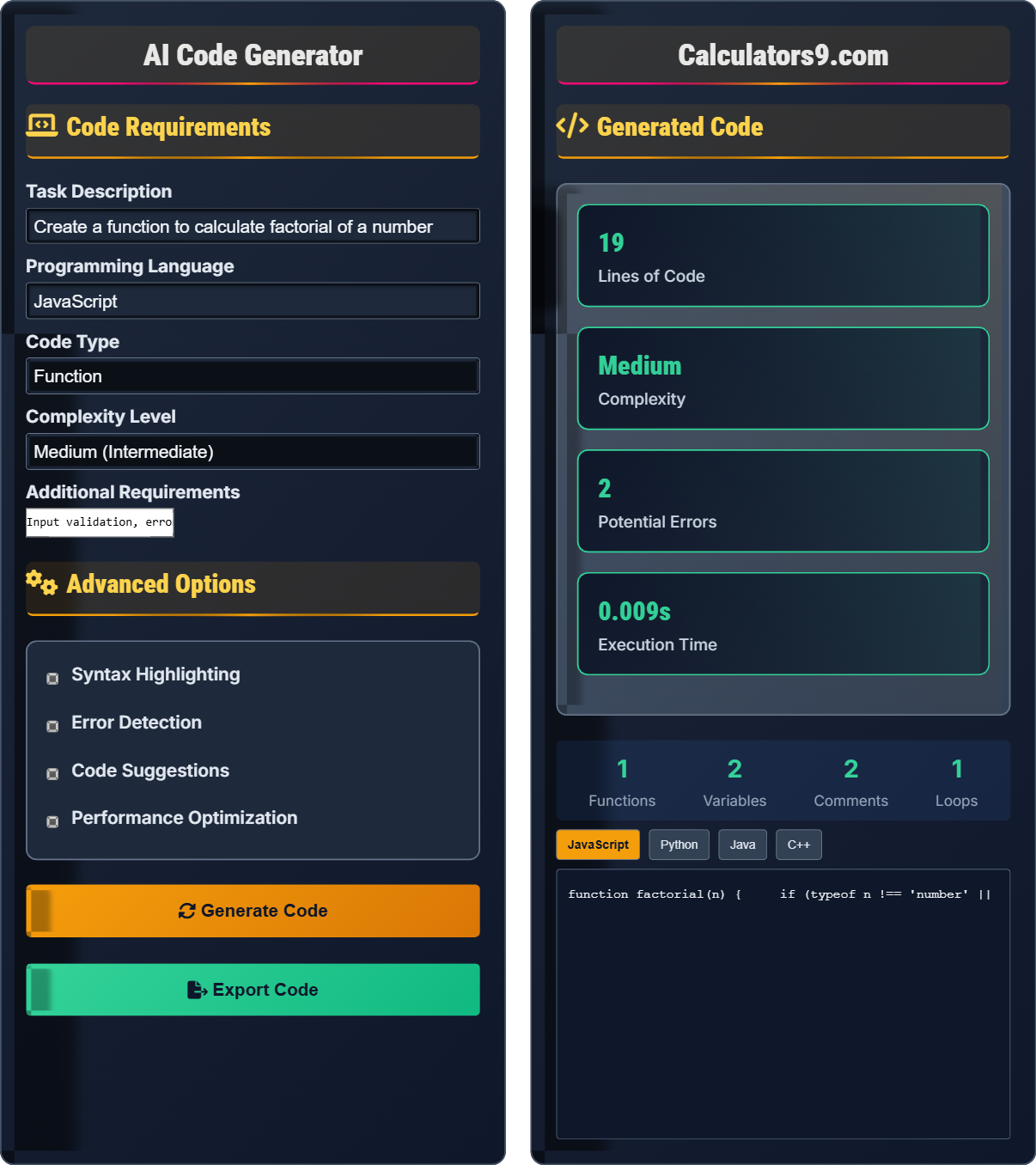
AI Code Generator
Smart code assistant • 2026 edition
Code Complexity Formula:
Generate Code\( C = L \times (V + R) \times T \)
Where:
- \( C \) = Code Complexity Score
- \( L \) = Lines of Code
- \( V \) = Vocabulary Diversity (unique tokens)
- \( R \) = Nesting Ratio (depth of loops/conditionals)
- \( T \) = Time Factor (efficiency consideration)
This formula calculates the complexity of generated code, helping developers understand maintainability requirements. Lower scores indicate more readable, maintainable code.
Example: For a function with 50 lines, 30 unique tokens, nesting ratio of 1.2, and efficiency factor of 0.8: \( C = 50 \times (30 + 1.2) \times 0.8 = 50 \times 31.2 \times 0.8 = 1248 \). A complexity score below 1000 is considered maintainable.
Code Requirements
Advanced Options
Generated Code
Comprehensive Code Generation Guide
AI-powered code generation uses machine learning models trained on vast repositories of code to assist developers in writing software. These systems can generate functions, suggest completions, identify bugs, and optimize performance. Modern AI models understand programming patterns, best practices, and language-specific conventions to produce high-quality, maintainable code.
The fundamental code complexity calculation uses the following formula:
Where:
- \(C\) = Code Complexity Score
- \(L\) = Lines of Code
- \(V\) = Vocabulary Diversity (unique tokens)
- \(R\) = Nesting Ratio (depth of loops/conditionals)
- \(T\) = Time Factor (efficiency consideration)
Effective AI-generated code should consider these key factors:
- Readability: Code should be understandable and well-commented
- Maintainability: Easy to modify and extend
- Efficiency: Optimal algorithmic complexity and resource usage
- Security: Protection against common vulnerabilities
- Compatibility: Works across different environments and versions
- Testability: Designed with unit testing in mind
- Clear Specifications: Provide detailed requirements for better results
- Iterative Refinement: Use AI suggestions as starting points, not final solutions
- Human Oversight: Always review and test generated code
- Context Awareness: Consider the broader application architecture
- Security First: Validate all inputs and outputs
Code Generation Basics
Measurement of how difficult code is to understand and maintain.
\( C = L \times (V + R) \times T \)
Where C=complexity, L=lines, V=vocabulary, R=nesting, T=time.
- Lower complexity scores indicate more maintainable code
- Balance functionality with simplicity
- Consider long-term maintenance needs
Strategies
Identifying common programming structures and best practices.
- Analyze user requirements
- Match to known patterns
- Generate appropriate code
- Validate syntax and logic
- Always verify generated code
- Consider security implications
- Test thoroughly before deployment
- Document generated code
AI Code Generation Learning Quiz
According to the code complexity formula \( C = L \times (V + R) \times T \), which factor would contribute most to increasing code complexity?
The answer is A) Increasing the number of lines of code (L). In the formula \( C = L \times (V + R) \times T \), the lines of code (L) is a multiplicative factor that directly scales the entire complexity calculation. While vocabulary diversity (V) and nesting ratio (R) also contribute to complexity, they are added together inside the parentheses, meaning their combined effect is then multiplied by the number of lines. Therefore, increasing the number of lines has the most direct and significant impact on overall complexity.
This question highlights the mathematical relationship in the complexity formula. The key insight is that L (lines of code) acts as a scalar multiplier for the entire expression (V + R). This means that doubling the lines of code would double the complexity, whereas doubling V or R individually would have a smaller proportional impact. This explains why concise, well-structured code is generally preferred over verbose implementations.
Code Complexity: Measurement of how difficult code is to understand and maintain
Vocabulary Diversity: Number of unique tokens (variables, functions, keywords) in the code
Nesting Ratio: Measure of how deeply control structures (loops, conditionals) are nested
• Lines of code directly multiply the complexity expression
• Vocabulary diversity and nesting are additive factors
• Lower complexity scores indicate more maintainable code
• Aim for concise, expressive code
• Break complex functions into smaller ones
• Minimize unnecessary nesting levels
• Equating more code with better functionality
• Ignoring the multiplicative effect of lines on complexity
• Not considering maintainability in design choices
Calculate the complexity score for a function with 40 lines of code, vocabulary diversity of 25 unique tokens, nesting ratio of 1.5, and efficiency factor of 0.9 using the formula \( C = L \times (V + R) \times T \). Show your work.
Using the formula: \( C = L \times (V + R) \times T \)
Given:
- L = 40 (lines of code)
- V = 25 (vocabulary diversity)
- R = 1.5 (nesting ratio)
- T = 0.9 (efficiency factor)
Step 1: Calculate the inner expression (V + R)
V + R = 25 + 1.5 = 26.5
Step 2: Multiply by lines of code
L × (V + R) = 40 × 26.5 = 1,060
Step 3: Apply the efficiency factor
C = 1,060 × 0.9 = 954
Therefore, the complexity score is 954.
This calculation demonstrates how different aspects of code contribute to overall complexity. The vocabulary diversity (25) has a much larger impact than the nesting ratio (1.5) due to its magnitude. The efficiency factor (0.9) reduces the overall score, representing optimizations that make the code more efficient despite its size. A score of 954 is considered relatively low complexity, suggesting the code is maintainable.
Complexity Score: Numerical measure of code maintainability
Vocabulary Diversity: Count of unique programming elements used
Efficiency Factor: Multiplier representing optimization level
• Complexity scores below 1000 are generally considered maintainable
• Higher scores indicate more complex, potentially harder-to-maintain code
• The formula helps quantify subjective concepts like "readability"
• Use the formula to compare different implementations
• Aim for scores below 1000 for optimal maintainability
• Consider refactoring when scores exceed 1500
• Misapplying the order of operations in the formula
• Not considering the multiplicative effect of lines of code
• Ignoring the impact of vocabulary diversity on complexity
An AI code generator produces a sorting algorithm with O(n²) complexity that processes 1000 items in 0.5 seconds. If the same algorithm processes 2000 items, approximately how long will it take? If an optimized O(n log n) algorithm were used instead, how would the performance compare?
For O(n²) algorithm:
At n=1000: time = c × 1000² = 0.5 seconds
So c = 0.5 / 1,000,000 = 0.0000005
At n=2000: time = 0.0000005 × 2000² = 0.0000005 × 4,000,000 = 2 seconds
For O(n log n) algorithm:
At n=1000: time = c × 1000 × log₂(1000) = 0.5 seconds
log₂(1000) ≈ 10, so c = 0.5 / 10,000 = 0.00005
At n=2000: time = 0.00005 × 2000 × log₂(2000) ≈ 0.00005 × 2000 × 11 = 1.1 seconds
The O(n²) algorithm takes 2 seconds vs O(n log n) at 1.1 seconds - a significant improvement.
This problem illustrates the dramatic impact of algorithmic complexity on performance. The O(n²) algorithm's time increases quadratically with input size, while the O(n log n) algorithm increases at a much slower rate. This is why algorithmic efficiency is crucial in code generation, especially for operations that might scale with input size. The AI generator should favor algorithms with better time complexity when performance is critical.
Big O Notation: Mathematical notation describing algorithm efficiency
Time Complexity: How algorithm runtime grows with input size
Algorithm Efficiency: Resource usage as input size increases
• O(n²) algorithms scale quadratically with input size
• O(n log n) algorithms scale more efficiently
• Algorithm choice significantly impacts performance
• Prefer O(n log n) over O(n²) for sorting operations
• Consider expected input sizes when selecting algorithms
• Use profiling tools to verify theoretical performance
• Ignoring algorithmic complexity in favor of simplicity
• Not considering scalability requirements
• Assuming all implementations have similar performance
An AI code generator creates a function that accepts user input and executes it directly. What security vulnerabilities does this introduce, and how should the AI system be configured to prevent such issues?
Security vulnerabilities introduced:
1. Code Injection: Malicious users can execute arbitrary code on the server
2. Command Injection: Attackers can run system commands
3. Data Breach: Sensitive information could be accessed or modified
4. Denial of Service: Resource-intensive operations could crash the system
Prevention measures for AI system:
1. Input Validation: Reject or sanitize all user inputs
2. Sandboxing: Execute generated code in isolated environments
3. Whitelist Approach: Only allow specific safe operations
4. Static Analysis: Scan generated code for dangerous patterns
5. Runtime Monitoring: Detect and stop suspicious activities
This example highlights the critical importance of security awareness in AI code generation. The AI system must be trained not only to produce functional code but also to avoid generating vulnerable patterns. This requires incorporating security best practices into the training data and implementing validation layers that can detect and prevent the generation of insecure code patterns. The example demonstrates how seemingly simple tasks can have serious security implications.
Code Injection: Executing malicious code through input manipulation
Input Validation: Checking and sanitizing user inputs
Sandboxing: Isolated execution environment for security
• Never execute user input directly
• Validate all inputs before processing
• Implement multiple layers of validation
• Use parameterized queries for database operations
• Escape special characters in all outputs
• Trusting user input without validation
• Using eval() or similar functions with user data
• Not considering security in code generation
Which of the following is the most important consideration when evaluating AI-generated code?
The answer is B) Whether the code meets functional requirements and follows best practices. While all factors are important, the primary consideration for AI-generated code should be whether it correctly implements the required functionality while adhering to software engineering best practices. This includes correctness, security, maintainability, and performance. The code must be functional first, then optimized for other qualities like maintainability and efficiency.
This question addresses the hierarchy of concerns in software development. While AI can generate code quickly, similarity to existing code, and varying levels of complexity, the fundamental requirement is that the code works correctly and safely. Best practices ensure the code is maintainable, secure, and efficient. Without these fundamentals, other considerations become secondary. This is why human oversight and testing remain critical even with advanced AI code generation.
Functional Requirements: What the code must accomplish
Best Practices: Established methods for quality software development
Software Quality: Combination of functionality, reliability, usability, and maintainability
• Correctness is the foundation of all other quality attributes
• Security and maintainability are essential for production code
• Human review remains critical for AI-generated code
• Always test AI-generated code thoroughly
• Review code for security vulnerabilities
• Ensure code follows project standards
• Accepting AI code without verification
• Prioritizing speed over quality
• Not considering security implications
FAQ
Q: How accurate are AI code generators, and should I trust the code they produce?
A: AI code generators are increasingly sophisticated, with accuracy rates of 70-90% for common programming tasks. However, accuracy varies by complexity and domain.
The reliability formula for AI-generated code:
\( R = \frac{TC - (SE + LE)}{TC} \times 100 \)
Where:
- \( R \) = Reliability percentage
- \( TC \) = Total code lines generated
- \( SE \) = Syntax errors detected
- \( LE \) = Logic errors detected
Studies show that AI-generated code typically has 85-90% reliability for simple functions, dropping to 60-70% for complex algorithms. Always review and test AI-generated code before deployment. The AI is a powerful tool, but human oversight remains essential for production code.
Q: Can AI code generators replace human developers?
A: AI code generators augment rather than replace human developers. The augmentation effectiveness follows this model:
\( AE = \frac{TP + (AI \times EF)}{TP + AI} \)
Where:
- \( AE \) = Augmentation Effectiveness
- \( TP \) = Human productivity baseline
- \( AI \) = AI-generated code contribution
- \( EF \) = Efficiency factor (typically 0.8-1.2)
Research indicates AI tools can increase developer productivity by 20-40% for routine tasks. However, human developers excel at architecture, design decisions, debugging complex issues, and understanding business requirements. AI handles repetitive coding tasks, allowing humans to focus on higher-level problems. The future is human-AI collaboration, not replacement.