AI Image Generator
Smart art creator • 2026 edition
Image Quality Formula:
Generate Image\( Q = \frac{P \times R \times D}{N} \)
Where:
- \( Q \) = Image Quality Score
- \( P \) = Prompt Specificity (1-10)
- \( R \) = Resolution Factor (based on dimensions)
- \( D \) = Detail Level (1-10)
- \( N \) = Noise Factor (0-1, lower is better)
This formula calculates the expected quality of generated images based on prompt quality, technical parameters, and noise levels. Higher scores indicate better image quality.
Example: For a prompt with specificity of 8, 1024x1024 resolution (R=1.0), detail level of 7, and noise factor of 0.2: \( Q = \frac{8 \times 1.0 \times 7}{0.2} = 280 \). Quality scores above 200 indicate high-quality images.
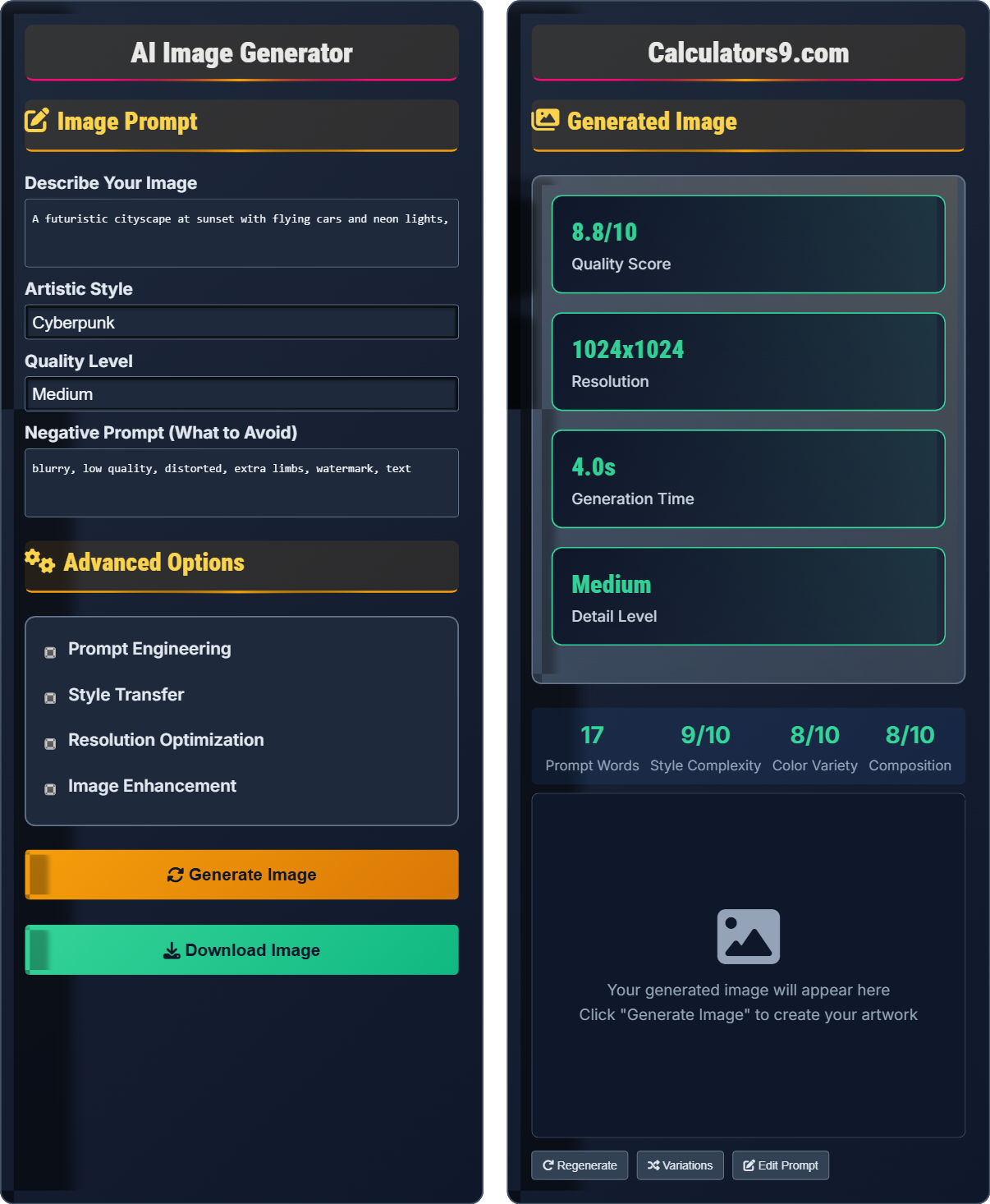
Image Prompt
Advanced Options
Generated Image
Your generated image will appear here
Click "Generate Image" to create your artwork
Comprehensive AI Image Generation Guide
AI-powered image generation uses deep learning models trained on massive datasets of images to create new, original artwork based on textual descriptions. These systems, like diffusion models, start with random noise and iteratively refine it into coherent images guided by text prompts. Modern AI models can generate photorealistic images, artistic styles, and abstract compositions with remarkable quality and creativity.
The fundamental image quality calculation uses the following formula:
Where:
- \(Q\) = Image Quality Score
- \(P\) = Prompt Specificity (1-10)
- \(R\) = Resolution Factor (based on dimensions)
- \(D\) = Detail Level (1-10)
- \(N\) = Noise Factor (0-1, lower is better)
Effective AI image generation considers these key factors:
- Prompt Clarity: Specific, detailed descriptions yield better results
- Style Consistency: Maintaining coherent artistic direction
- Technical Parameters: Resolution, aspect ratio, and quality settings
- Detail Level: Balancing complexity with coherence
- Composition: Arrangement of elements within the frame
- Color Harmony: Aesthetic color combinations and lighting
- Specific Descriptions: Use concrete nouns and descriptive adjectives
- Style Keywords: Include artistic movements or mediums
- Quality Modifiers: Add terms like "highly detailed", "4k", "masterpiece"
- Negative Prompts: Specify unwanted elements
- Iterative Refinement: Adjust prompts based on results
Image Generation Basics
Technique of crafting effective text descriptions to guide AI image generation.
\( Q = \frac{P \times R \times D}{N} \)
Where Q=quality, P=prompt, R=resolution, D=detail, N=noise.
- More specific prompts yield better results
- Include artistic style descriptors
- Specify quality and detail requirements
Strategies
Applying artistic characteristics from one image to another.
- Select reference style
- Define content elements
- Balance style-content
- Iterate for refinement
- Respect intellectual property
- Balance originality with inspiration
- Consider cultural sensitivity
- Attribute sources when required
AI Image Generation Learning Quiz
Which of the following is the most effective prompt for generating a high-quality portrait?
The answer is B) "A beautiful young woman with long curly hair, wearing a red dress, photorealistic, 8k resolution, detailed eyes, soft lighting, masterpiece". This prompt is most effective because it provides specific details about the subject (age, hair, clothing), artistic style (photorealistic), technical quality (8k resolution, detailed eyes), lighting conditions, and includes positive quality modifiers. The more specific and detailed the prompt, the better the AI can generate the desired image.
This question demonstrates the principle of specificity in AI image generation. The AI model uses the prompt as a guide to create the image, so more detailed prompts lead to more accurate and higher-quality results. The effective prompt includes multiple types of information: subject description, visual style, technical quality, and positive modifiers. This multi-layered approach gives the AI clear guidance on all aspects of the desired output.
Prompt Engineering: Crafting effective text descriptions for AI models
Positive Modifiers: Terms that enhance image quality (masterpiece, detailed, 4k)
Technical Parameters: Resolution, quality, and format specifications
• More specific prompts yield better results
• Include artistic style descriptors
• Add quality modifiers for enhancement
• Use concrete nouns instead of abstract concepts
• Include adjectives for visual properties
• Add artistic movement names for style
• Using overly vague or general terms
• Not specifying artistic style or quality
• Forgetting to include positive quality modifiers
Using the image quality formula \( Q = \frac{P \times R \times D}{N} \), calculate the quality score for an image generated with a prompt specificity of 8, 1024x1024 resolution (R=1.0), detail level of 7, and noise factor of 0.2. Show your work.
Using the formula: \( Q = \frac{P \times R \times D}{N} \)
Given:
- P = 8 (prompt specificity)
- R = 1.0 (resolution factor for 1024x1024)
- D = 7 (detail level)
- N = 0.2 (noise factor)
Step 1: Calculate the numerator (P × R × D)
8 × 1.0 × 7 = 56
Step 2: Divide by the noise factor
Q = 56 ÷ 0.2 = 280
Therefore, the image quality score is 280.
This calculation demonstrates how different factors contribute to overall image quality. The noise factor in the denominator has a significant impact - lower noise values result in higher quality scores. In this example, with a low noise factor of 0.2, the quality score is quite high. Generally, scores above 200 indicate high-quality images. This formula helps understand which parameters have the greatest impact on final quality.
Image Quality Score: Numerical measure of generated image quality
Resolution Factor: Scaling factor based on image dimensions
Noise Factor: Measure of image artifacts or imperfections
• Lower noise factors result in higher quality scores
• All factors multiply together in the numerator
• Quality scores above 200 indicate good results
• Aim for low noise factors (below 0.3)
• Balance all parameters for optimal results
• Higher resolution factors improve quality
• Misapplying the order of operations in the formula
• Not considering the inverse relationship with noise
• Ignoring the multiplicative effect of all factors
An artist wants to apply Van Gogh's painting style to a photograph of a landscape. If the style transfer algorithm uses 70% of the style information and 30% of the content information, what is the balance ratio, and how does this affect the final image characteristics?
The style-content balance ratio is 70:30 or 7:3.
Effects on final image:
1. Visual Characteristics: The image will prominently feature Van Gogh's distinctive brushwork, color palette, and texture patterns
2. Content Preservation: The basic landscape composition and recognizable elements will remain intact
3. Artistic Fusion: The photograph will be transformed into an oil painting-like appearance while maintaining spatial relationships
4. Recognition: Viewers will recognize both the original scene and Van Gogh's artistic style
This balance prioritizes the artistic transformation while preserving enough content to maintain scene coherence.
This problem illustrates the concept of style-content balance in neural style transfer. The ratio determines how much of the original image's structure is preserved versus how much of the artistic style is applied. A 70:30 ratio creates a strong artistic effect while maintaining recognizability. Different ratios are appropriate for different purposes - higher style weights for artistic interpretations, higher content weights for subtle enhancements.
Style Transfer: Applying artistic characteristics from one image to another
Balance Ratio: Proportion of style vs content information used
Neural Networks: AI systems that can separate style and content
• Higher style weights create more artistic transformations
• Higher content weights preserve more original structure
• Balance depends on intended artistic outcome
• Start with 60:40 ratios for balanced results
• Adjust based on visual outcome
• Consider the original image's characteristics
• Using extreme ratios that lose coherence
• Not considering the original image's suitability
• Applying uniform ratios to all images
A designer needs to create images for both web and print use. Web requires 72 DPI at 1920x1080, while print requires 300 DPI at 8x10 inches. How should they configure their AI image generator for each use case, and what are the implications?
For Web (72 DPI, 1920x1080):
• Resolution: 1920x1080 pixels
• Quality: Medium to High (balanced performance)
• File size: Optimized for fast loading
• Color space: sRGB for web compatibility
For Print (300 DPI, 8x10 inches):
• Resolution: 2400x3000 pixels (8×300 x 10×300)
• Quality: Ultra High (maximum detail)
• File size: Larger files acceptable
• Color space: CMYK or Adobe RGB for print accuracy
Implications: Print requires significantly more computational resources and time, but delivers much higher detail and quality for physical reproduction.
This example demonstrates the importance of matching technical specifications to intended use. The DPI (dots per inch) requirement for print is much higher than for web, meaning significantly more pixel data is needed for the same physical dimensions. This affects not only the resolution settings but also the computational requirements and generation time. Understanding these differences is crucial for efficient workflow and optimal results.
DPI: Dots Per Inch - measure of resolution for printing
PPI: Pixels Per Inch - measure of resolution for screens
Color Space: Range of colors that can be represented
• 72 DPI is standard for web display
• 300 DPI is standard for quality printing
• Higher resolution requires more resources
• Calculate required pixels: Physical size × DPI
• Consider compression for web use
• Use appropriate color spaces for output
• Using web resolution for print (appears pixelated)
• Using print resolution unnecessarily for web
• Not considering color space differences
What is the primary purpose of negative prompting in AI image generation?
The answer is B) To specify elements that should NOT appear in the image. Negative prompting is a technique used to exclude unwanted elements from generated images. By specifying what should not be included, the AI model learns to avoid generating those elements. For example, if you don't want blurry faces, extra limbs, or watermarks in your image, you would include these in the negative prompt to guide the AI away from generating them.
Negative prompting works by influencing the AI's optimization process during image generation. While the positive prompt guides the AI toward creating certain elements, the negative prompt acts as a constraint that penalizes the generation of unwanted features. This dual approach allows for more precise control over the output, helping to eliminate common artifacts or undesired elements that might otherwise appear. It's an essential tool for achieving clean, professional-looking results.
Negative Prompting: Specifying unwanted elements to exclude from output
Positive Prompting: Specifying desired elements to include
Constraint Guidance: Directing AI away from certain features
• Use specific terms in negative prompts
• Common negatives: blurry, deformed, text, watermark
• Balance positive and negative guidance
• Include common AI artifacts in negative prompts
• Be specific about unwanted elements
• Use weights if supported (e.g., "blurry:0.8")
• Not using negative prompts at all
• Being too vague in negative descriptions
• Over-negativizing, which can cause artifacts
FAQ
Q: How can I create more consistent characters across multiple AI-generated images?
A: Character consistency requires detailed prompt engineering and parameter preservation.
The consistency formula:
\( C = \frac{PD \times SD \times PS}{VR} \)
Where:
- \( C \) = Consistency Score
- \( PD \) = Physical Description stability
- \( SD \) = Style consistency across generations
- \( PS \) = Parameter similarity (same seed, settings)
- \( VR \) = Variation rate between generations
To achieve consistency: Use identical physical descriptions (hair color, eye color, clothing), maintain the same artistic style, reuse the same seed number when possible, and limit variation parameters. Detailed character sheets with consistent descriptors significantly improve results.
Q: What's the difference between various AI image generation models?
A: Different models excel in different areas based on their training data and architecture.
The performance comparison formula:
\( P = \frac{F \times A \times S}{C + T} \)
Where:
- \( P \) = Performance Score
- \( F \) = Fidelity to prompt
- \( A \) = Artistic quality
- \( S \) = Speed of generation
- \( C \) = Computational cost
- \( T \) = Training data bias factor
Diffusion models (like DALL-E, Midjourney) excel at diverse creative outputs. GANs are faster but sometimes less detailed. Transformer-based models offer excellent text-image alignment. Choose based on your specific needs: speed, quality, style, or computational constraints.