AI Prompt Cost Estimator
Calculate your AI model usage costs • 2026 edition
AI Cost Formula:
Show the calculator\( Cost = \left(\frac{Input\_Tokens}{1,000,000} \times Input\_Price\right) + \left(\frac{Output\_Tokens}{1,000,000} \times Output\_Price\right) \)
Where:
- \( Input\_Tokens \) = Number of tokens in your prompt
- \( Output\_Tokens \) = Number of tokens in AI response
- \( Input\_Price \) = Price per million tokens for input
- \( Output\_Price \) = Price per million tokens for output
This formula calculates the exact cost of using AI models based on token consumption. Tokens typically represent chunks of text (about 4 characters each).
Example: For GPT-4 with 1,000 input tokens and 2,000 output tokens:
Input Cost: (1,000 / 1,000,000) × $30 = $0.03
Output Cost: (2,000 / 1,000,000) × $60 = $0.12
Total Cost: $0.03 + $0.12 = $0.15
Thus, this interaction would cost $0.15.
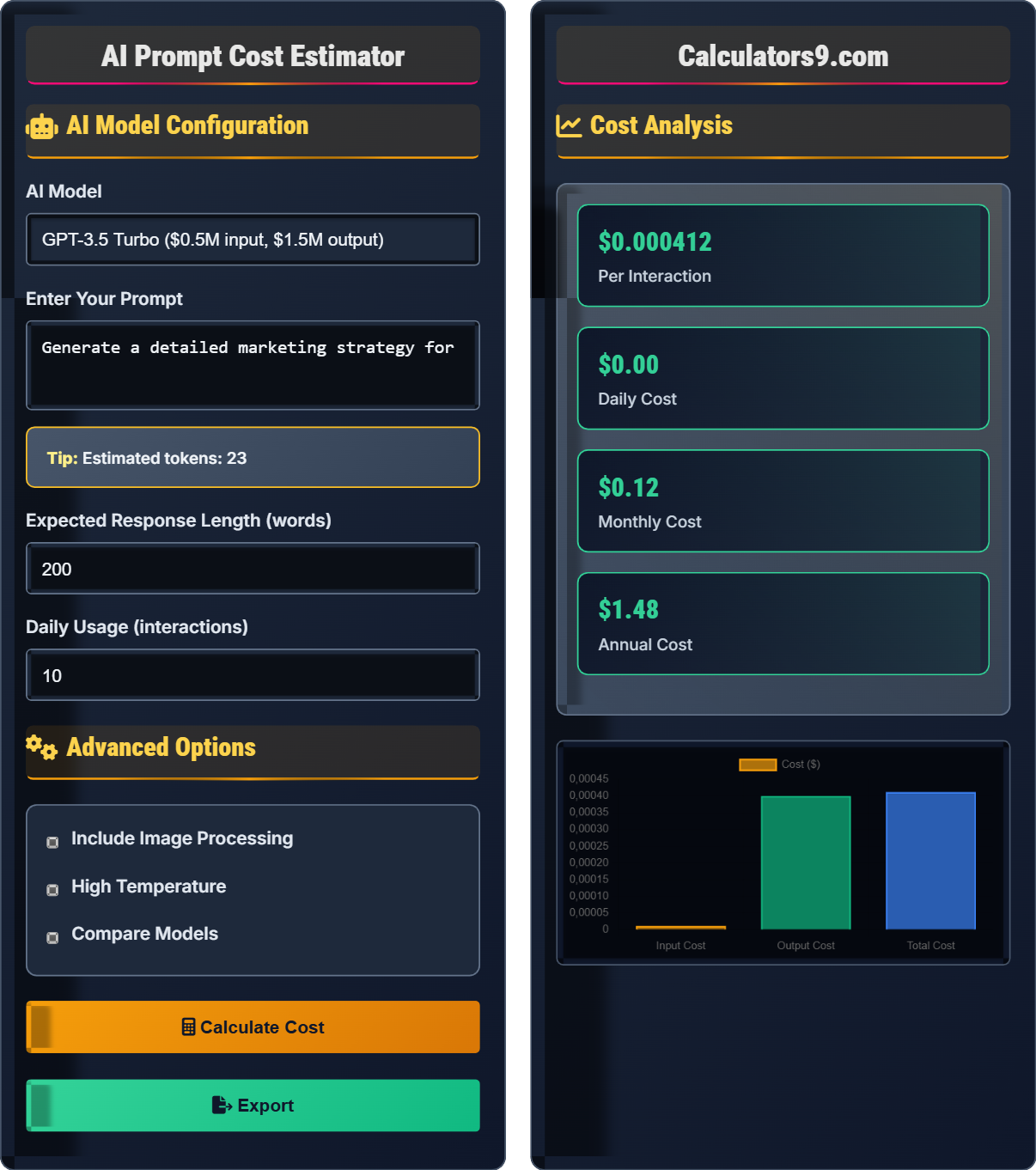
AI Model Configuration
Advanced Options
Cost Analysis
| Component | Details | Cost |
|---|---|---|
| Model Type | GPT-3.5 Turbo | - |
| Input Tokens | 13 | $0.0000065 |
| Output Tokens | 200 | $0.0003 |
| Single Interaction | 1 interaction | $0.15 |
| Daily Usage | 10 interactions | $1.50 |
| Monthly Cost | 30 days | $45.00 |
| Period | Interactions | Cost |
|---|
Comprehensive AI Cost Guide
AI models charge based on token consumption. A token typically represents about 4 characters of text. Input tokens are the text you send to the AI, while output tokens are the AI's response. Costs vary significantly between models and providers.
The standard AI cost calculation uses the following formula:
Where:
- \(Input\_Tokens\) = Number of tokens in your prompt
- \(Output\_Tokens\) = Number of tokens in AI response
- \(Input\_Price\) = Price per million tokens for input
- \(Output\_Price\) = Price per million tokens for output
Ways to reduce AI usage costs:
- Use simpler models: GPT-3.5 for basic tasks instead of GPT-4
- Optimize prompts: Clear, concise prompts require fewer tokens
- Batch operations: Combine multiple requests when possible
- Cache responses: Store results for repeated queries
- Monitor usage: Track costs to identify optimization opportunities
- Set daily limits: Implement spending caps to prevent unexpected costs
- Start small: Test with limited usage before scaling
- Monitor regularly: Track usage patterns to optimize spending
- Plan for growth: Account for increased usage over time
- Compare models: Regularly evaluate cost-effectiveness of different models
AI Cost Fundamentals
Units of text processed by AI models (≈4 characters each).
\(Cost = \left(\frac{Input\_Tokens}{1,000,000} \times Input\_Price\right) + \left(\frac{Output\_Tokens}{1,000,000} \times Output\_Price\right)\)
Where Cost=total cost, Input_Tokens=text sent, Output_Tokens=response received.
- Both input and output are charged
- Prices vary by model
- Output costs are usually higher
Optimization
Select appropriate models for your needs and optimize usage patterns.
- Choose economical models
- Optimize prompt length
- Batch similar requests
- Cache frequent responses
- Complexity vs cost trade-off
- Accuracy requirements
- Volume discounts available
- API rate limits
AI Cost Learning Quiz
Which of the following best describes how AI models charge for usage?
The answer is B) By the number of tokens processed. AI models charge based on token consumption, where tokens represent chunks of text (typically about 4 characters). Both input tokens (your prompt) and output tokens (AI response) are counted separately and charged accordingly.
Understanding token-based pricing is crucial for managing AI costs. Unlike traditional computing resources charged by time or storage, AI models use token-based billing. This means the cost depends on the length of your input and the length of the AI's response. This system encourages efficient prompting and allows for granular cost control.
Token: Unit of text (≈4 characters) processed by AI models
Input Tokens: Text sent to the AI model
Output Tokens: Text generated by the AI model
• Both input and output tokens are charged separately
• Costs are typically priced per million tokens
• Different models have different pricing structures
• Keep prompts concise to minimize input costs
• Assuming costs are based on processing time
• Forgetting that output tokens cost more than input tokens
• Not considering volume discounts for high usage
Calculate the cost of using GPT-3.5 Turbo for a prompt of 150 tokens that generates a 300-token response. Show your work.
Step 1: Identify pricing for GPT-3.5 Turbo
Input Price: $0.50 per million tokens
Output Price: $1.50 per million tokens
Step 2: Calculate input cost
Input Cost = (150 / 1,000,000) × $0.50
Input Cost = 0.00015 × $0.50 = $0.000075
Step 3: Calculate output cost
Output Cost = (300 / 1,000,000) × $1.50
Output Cost = 0.0003 × $1.50 = $0.00045
Step 4: Calculate total cost
Total Cost = Input Cost + Output Cost
Total Cost = $0.000075 + $0.00045 = $0.000525
Therefore, this interaction would cost $0.000525.
This calculation shows the importance of understanding token pricing. Even though the output is twice the length of the input, the cost is significantly higher because output tokens are charged at a higher rate. This demonstrates why it's important to consider both prompt length and expected response length when estimating costs.
Input Cost: Charge for text sent to the AI
Output Cost: Charge for text generated by the AI
Million Token Pricing: Standard pricing unit for AI models
• Always calculate input and output costs separately
• Output prices are typically higher than input prices
• Divide tokens by 1,000,000 for pricing calculations
• Use the formula: (Tokens / 1,000,000) × Price_per_Million
• Calculate input and output separately
• Sum both costs for total
• Forgetting to divide tokens by 1,000,000
• Treating input and output as the same price
• Adding tokens before calculating costs
A company uses GPT-3.5 Turbo for customer support, averaging 50 interactions per day. Each interaction has an average input of 100 tokens and output of 250 tokens. What is the monthly cost (assuming 30 days)?
Step 1: Calculate cost per interaction
Input Cost = (100 / 1,000,000) × $0.50 = $0.00005
Output Cost = (250 / 1,000,000) × $1.50 = $0.000375
Cost per interaction = $0.00005 + $0.000375 = $0.000425
Step 2: Calculate daily cost
Daily Cost = $0.000425 × 50 interactions = $0.02125
Step 3: Calculate monthly cost
Monthly Cost = $0.02125 × 30 days = $0.6375
Therefore, the monthly cost would be approximately $0.64.
This example demonstrates how to scale individual interaction costs to project ongoing expenses. It's important to calculate costs at different time intervals (daily, monthly, annual) to properly budget for AI usage. The example shows that even with 50 daily interactions, the cost remains quite low with GPT-3.5 Turbo.
Scalability: How costs grow with usage volume
Budget Projection: Estimating future costs based on usage patterns
Volume Scaling: Multiplying per-unit costs by frequency
• Calculate per-interaction cost first
• Multiply by daily usage for daily cost
• Scale up to monthly/annual costs
• Calculate daily costs first, then scale up
• Use consistent time periods in calculations
• Monitor actual usage vs. projected usage
• Forgetting to scale up from per-interaction to daily/monthly
• Using inconsistent time periods in calculations
• Not accounting for weekends/holidays in projections
A user needs to decide between GPT-3.5 Turbo ($0.5M input, $1.5M output) and GPT-4 ($30M input, $60M output) for a task requiring 200 input tokens and 500 output tokens. Calculate the cost difference and determine the percentage increase in cost for using GPT-4.
Step 1: Calculate GPT-3.5 Turbo cost
Input Cost = (200 / 1,000,000) × $0.50 = $0.0001
Output Cost = (500 / 1,000,000) × $1.50 = $0.00075
Total GPT-3.5 Cost = $0.0001 + $0.00075 = $0.00085
Step 2: Calculate GPT-4 cost
Input Cost = (200 / 1,000,000) × $30 = $0.006
Output Cost = (500 / 1,000,000) × $60 = $0.03
Total GPT-4 Cost = $0.006 + $0.03 = $0.036
Step 3: Calculate cost difference
Cost Difference = $0.036 - $0.00085 = $0.03515
Step 4: Calculate percentage increase
Percentage Increase = ($0.03515 / $0.00085) × 100 = 4,135%
Therefore, GPT-4 costs $0.03515 more per interaction, representing a 4,135% increase.
This example dramatically illustrates the cost difference between AI models. While GPT-4 offers superior capabilities, the cost premium is substantial. This calculation helps users make informed decisions about when the advanced capabilities justify the higher costs. The percentage increase shows the significant price premium for advanced models.
Cost-Benefit Analysis: Evaluating whether higher costs are justified by better performance
Price Premium: Additional cost for advanced capabilities
Capability Trade-off: Balancing features against cost
• Always compare costs before selecting models
• Consider capability vs. cost trade-offs
• Factor in volume when comparing models
• Test with cheaper models first
• Use advanced models only when necessary
• Calculate cost differences for your specific use case
• Using advanced models without cost justification
• Not comparing costs between models
• Assuming higher cost always means better value
Which of the following is the MOST effective strategy for reducing AI usage costs?
The answer is D) All of the above. All three strategies are effective for reducing AI usage costs. Using cheaper models reduces the per-token cost, limiting response length reduces the number of output tokens (which are typically more expensive), and reducing API calls directly reduces the total number of tokens consumed. The most effective approach combines all these strategies.
Cost optimization in AI usage requires a multi-faceted approach. The most effective strategy combines several techniques: selecting appropriate models, optimizing prompt efficiency, controlling response length, and managing usage frequency. This holistic approach ensures costs are minimized while maintaining the desired functionality.
Cost Optimization: Systematic reduction of expenses while maintaining value
Multi-Faceted Approach: Using multiple strategies simultaneously
Value Preservation: Maintaining quality while reducing costs
• Combine multiple cost-saving strategies
• Balance cost reduction with performance needs
• Monitor costs regularly to identify opportunities
• Start with the cheapest model that works
• Set response length limits
• Batch similar requests when possible
• Relying on a single cost-reduction strategy
• Sacrificing too much quality for cost savings
• Not monitoring costs regularly
FAQ
Q: How can I estimate token count before sending a prompt?
A: You can estimate token count using the rule of thumb that 1 token ≈ 4 characters. For English text, this means about 1 token per word. More precisely:
\( Estimated\_Tokens = \frac{Character\_Count}{4} \)
However, this varies by language and content type. Special characters, code, and punctuation can affect the ratio. For accurate counting, use tokenizer libraries like tiktoken for OpenAI models:
tokens = len(encoding.encode("your text"))
This gives you the exact token count that the model will use for billing purposes.
Q: What's the difference between input and output token costs?
A: Input tokens are the text you send to the AI model (your prompt), while output tokens are the text the AI generates in response. Typically, output tokens cost significantly more than input tokens because generating responses requires more computational resources than processing input.
For example, with GPT-3.5 Turbo:
- Input tokens: $0.50 per million tokens
- Output tokens: $1.50 per million tokens
This means output tokens cost 3 times more than input tokens! When budgeting, consider both costs, but especially watch output token usage since it's the more expensive component.