AI Startup Idea Validator
Business concept assessment • 2026 trends
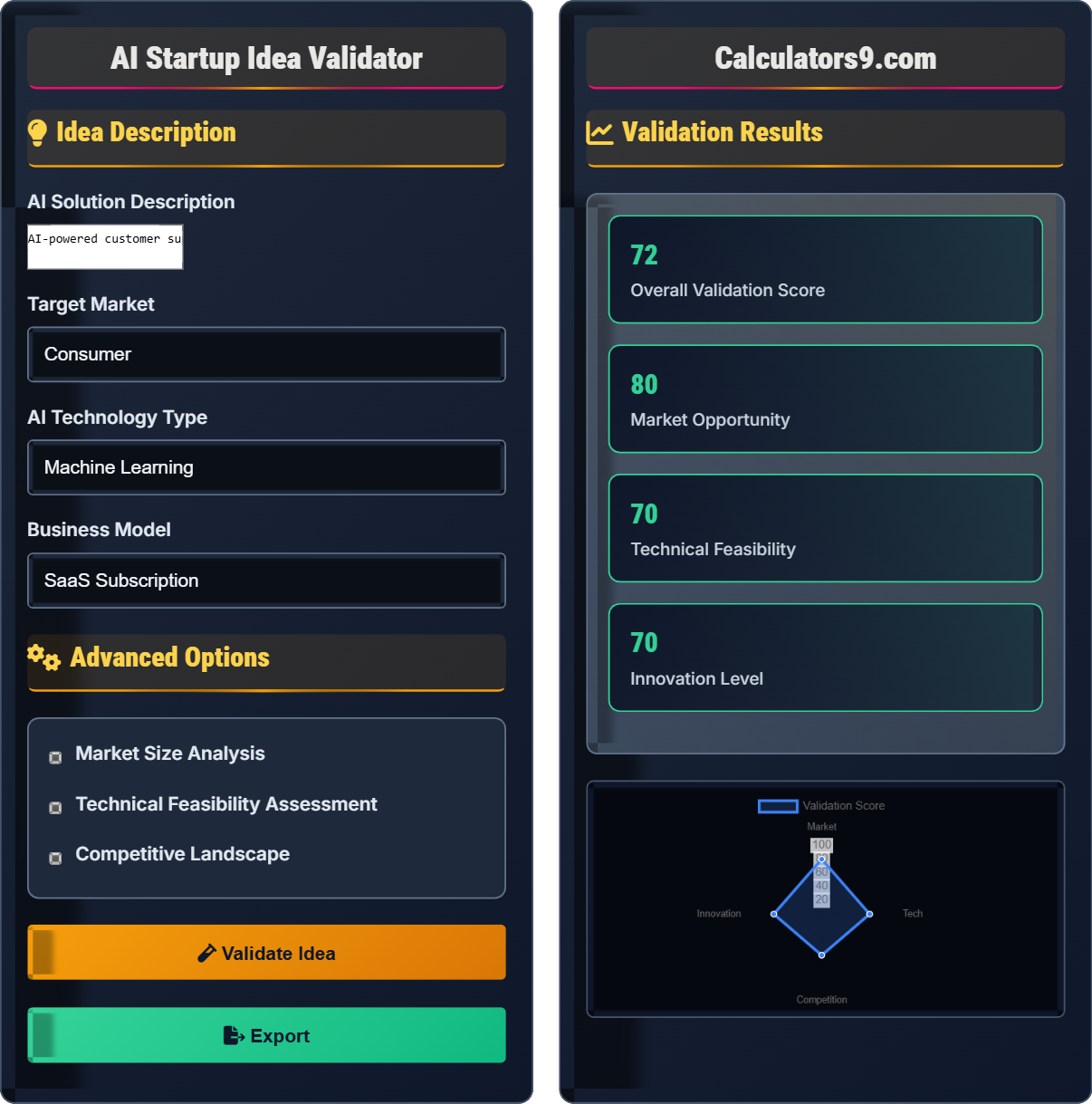
AI Startup Validation Formula:
Show the validator\( V = (M \times 0.4) + (T \times 0.3) + (C \times 0.2) + (I \times 0.1) \)
Where:
- \( V \) = Validation Score (0-100)
- \( M \) = Market Opportunity Score (0-100)
- \( T \) = Technical Feasibility Score (0-100)
- \( C \) = Competitive Advantage Score (0-100)
- \( I \) = Innovation Level Score (0-100)
This formula calculates the overall viability of an AI startup idea based on weighted criteria.
Example: For market score of 80, technical feasibility of 70, competitive advantage of 60, innovation level of 90:
\( V = (80 \times 0.4) + (70 \times 0.3) + (60 \times 0.2) + (90 \times 0.1) \)
\( V = 32 + 21 + 12 + 9 = 74 \)
Therefore, the validation score is 74/100 (Strong potential).
Idea Description
Advanced Options
Validation Results
| Category | Score | Status |
|---|
| Aspect | Details | Recommendation |
|---|
Comprehensive AI Startup Guide
AI startups leverage artificial intelligence technologies to solve complex problems across industries. Success requires balancing technical innovation with market needs and business viability. The AI market is projected to reach $1.8 trillion by 2030, offering significant opportunities.
Successful AI startups evaluate multiple dimensions:
Each dimension contributes to the overall viability assessment.
Top AI sectors by market size:
- Healthcare AI: $45B market with drug discovery and diagnostics
- Financial Services: $44B with fraud detection and robo-advisors
- Autonomous Vehicles: $55B with self-driving technology
- Customer Service: $1.2B with chatbots and virtual assistants
- Supply Chain: $2.3B with optimization and forecasting
- Vertical Focus: Target specific industry initially
- Partnership Model: Collaborate with established players
- Open Source: Build community around technology
- API-First: Offer AI capabilities as services
- Product-Led: Focus on user experience
AI Startup Basics
Various AI approaches for business solutions.
\( V = (M \times 0.4) + (T \times 0.3) + (C \times 0.2) + (I \times 0.1) \)
Where V=validation score, M=market, T=technical, C=competition, I=innovation.
- Data is the core asset
- Technical moats are essential
- Market fit drives success
Strategies
Approaches to capture market share effectively.
- Validate problem-market fit
- Secure quality data
- Build technical moat
- Scale with partnerships
- Ethical AI practices
- Regulatory compliance
- Privacy concerns
- Explainability requirements
AI Startup Learning Quiz
Which of the following is the most critical factor for AI startup success?
The answer is B) Solving a real market problem. While advanced technology, skilled teams, and funding are important, the fundamental success of any startup, especially AI startups, depends on addressing a genuine market need. AI startups that focus on solving real problems with measurable impact tend to succeed regardless of technical sophistication.
This question highlights the fundamental principle of startup success: product-market fit. Many AI startups fail not because of technical limitations, but because they build sophisticated solutions for problems that don't exist or aren't significant enough to warrant the solution. The technology should serve the market need, not the other way around.
Product-Market Fit: When a product satisfies a strong market demand
Market Problem: A pain point significant enough for customers to pay to solve
Customer Validation: Confirming that customers will pay for your solution
• Solve real problems, not imagined ones
• Validate with potential customers early
• Focus on value creation over technical complexity
• Talk to potential customers before building
• Quantify the problem's impact
• Focus on outcomes, not features
• Building solutions without validating problems
• Focusing on technology over market needs
• Assuming everyone needs your solution
Calculate the validation score for an AI startup with: Market opportunity score of 75, Technical feasibility of 85, Competitive advantage of 60, Innovation level of 90. Show your work.
Using the AI startup validation formula: V = (M × 0.4) + (T × 0.3) + (C × 0.2) + (I × 0.1)
Given:
- M = 75 (Market opportunity)
- T = 85 (Technical feasibility)
- C = 60 (Competitive advantage)
- I = 90 (Innovation level)
Step 1: Market contribution = M × 0.4 = 75 × 0.4 = 30
Step 2: Technical contribution = T × 0.3 = 85 × 0.3 = 25.5
Step 3: Competition contribution = C × 0.2 = 60 × 0.2 = 12
Step 4: Innovation contribution = I × 0.1 = 90 × 0.1 = 9
Step 5: Validation score = 30 + 25.5 + 12 + 9 = 76.5
This problem demonstrates how different aspects contribute unequally to the overall validation score. Market opportunity has the highest weight (40%) because even the most innovative technology won't succeed without market demand. Technical feasibility (30%) ensures the solution can be built, while competitive advantage (20%) and innovation (10%) provide differentiation.
Validation Score: Composite measure of startup viability
Weighted Average: Calculation giving different importance to factors
Scoring Criteria: Standardized metrics for evaluation
• Market opportunity has highest weight (40%)
• Technical feasibility is second most important (30%)
• Scores are normalized to 0-100 scale
• Focus on market validation first
• Balance all four dimensions
• Use quantitative measures when possible
• Misapplying weights in calculation
• Overvaluing technical innovation
• Not considering market size adequately
Sarah is developing an AI-powered inventory optimization tool. The total addressable market (TAM) for supply chain AI is $2.3 billion. Her solution targets mid-market retailers with $50M-$1B revenue, representing 15% of the TAM. If she expects to capture 2% of her target segment in 5 years, what is her potential revenue?
Step 1: Calculate target market size = Total TAM × Target percentage
= $2.3B × 0.15 = $345M
Step 2: Calculate potential revenue = Target market × Market capture
= $345M × 0.02 = $6.9M
Therefore, Sarah's potential revenue in 5 years would be $6.9 million.
This example shows how to calculate market potential by narrowing down from TAM to addressable market to potential capture. Realistic market penetration assumptions are crucial for startup planning. The 2% capture rate reflects the challenge of gaining market share against established competitors.
TAM (Total Addressable Market): Total market demand for a product
SAM (Serviceable Addressable Market): Portion of TAM targeted by solution
SOM (Serviceable Obtainable Market): Realistic market share achievable
• TAM > SAM > SOM (progressively smaller)
• Realistic market capture rarely exceeds 5-10%
• Consider competition when estimating market share
• Use industry reports for market size validation
• Be conservative with market capture estimates
• Consider market growth over time
• Confusing TAM with SAM
• Overestimating market capture potential
• Not accounting for competition in estimates
Mike is developing an AI system to predict equipment failure in manufacturing. He needs 2 years of historical sensor data, but the average manufacturing company only stores 6 months of data. His algorithm requires 10,000 data points for training, but he can only access 2,500 points. How might he address this technical feasibility challenge?
Mike faces a data scarcity challenge. Potential solutions include:
Step 1: Data synthesis - Generate synthetic data using domain knowledge and physics-based models
Step 2: Transfer learning - Use pre-trained models and adapt to the specific domain with limited data
Step 3: Partnership approach - Partner with multiple companies to aggregate sufficient data
Step 4: Alternative algorithms - Use data-efficient ML techniques like few-shot learning
Step 5: Data augmentation - Enhance existing data through transformations and simulations
These approaches could help Mike achieve technical feasibility despite data limitations.
This problem illustrates the common challenge of insufficient training data in AI development. Technical feasibility isn't just about having enough computational resources, but also ensuring adequate, quality data. Creative solutions like synthetic data generation and transfer learning can overcome data scarcity while maintaining model performance.
Data Scarcity: Insufficient training data for model development
Transfer Learning: Adapting pre-trained models to new domains
Synthetic Data: Artificially generated data mimicking real patterns
• Data quality often matters more than quantity
• Creative solutions can address data limitations
• Consider regulatory requirements for data use
• Explore public datasets in your domain
• Consider data sharing partnerships
• Use data-efficient algorithms when possible
• Assuming more data always equals better models
• Not considering data privacy regulations
• Overlooking alternative data sources
Which of the following is TRUE about AI startup funding trends?
The answer is B) AI startups typically need more capital for data and compute. AI startups often require significant upfront investment for data acquisition, computational resources, and specialized talent. Training large models can cost millions in cloud computing resources alone, making capital requirements typically higher than traditional software startups.
AI startups face unique capital requirements compared to traditional software companies. The need for large datasets, powerful GPUs for training, and specialized AI talent creates higher initial costs. However, successful AI startups often command premium valuations due to the defensibility of trained models and data assets.
Capital Requirements: Financial resources needed for operations
Computational Resources: Hardware and cloud services for processing
Defensible Assets: Resources difficult for competitors to replicate
• AI startups often need 2-3x more capital than software
• Data and compute are major cost centers
• Successful models can create strong moats
• Plan for significant compute costs
• Consider cloud credits for AI startups
• Focus on data efficiency to reduce costs
• Underestimating computational costs
• Not budgeting for data acquisition
• Overlooking specialized talent costs
FAQ
Q: How do I validate my AI startup idea before investing time and money?
A: Use the validation formula: \( V = (M \times 0.4) + (T \times 0.3) + (C \times 0.2) + (I \times 0.1) \) where M is market opportunity, T is technical feasibility, C is competitive advantage, and I is innovation level.
For example, with market score of 80, technical feasibility of 70, competitive advantage of 60, and innovation of 90:
\( V = (80 \times 0.4) + (70 \times 0.3) + (60 \times 0.2) + (90 \times 0.1) = 74 \)
A score above 70 indicates strong potential. Focus on market validation by talking to potential customers and measuring their willingness to pay.
Q: What are the biggest technical challenges for AI startups?
A: Key technical challenges include:
- Data Acquisition: Securing quality, labeled training data
- Computational Costs: GPU resources for training large models
- Model Performance: Achieving production-level accuracy
- Scalability: Handling increasing data volumes
- Regulatory Compliance: Meeting AI governance requirements
Many startups address data challenges through synthetic data generation, transfer learning, or partnerships. Cloud providers offer startup programs with compute credits to address cost challenges.