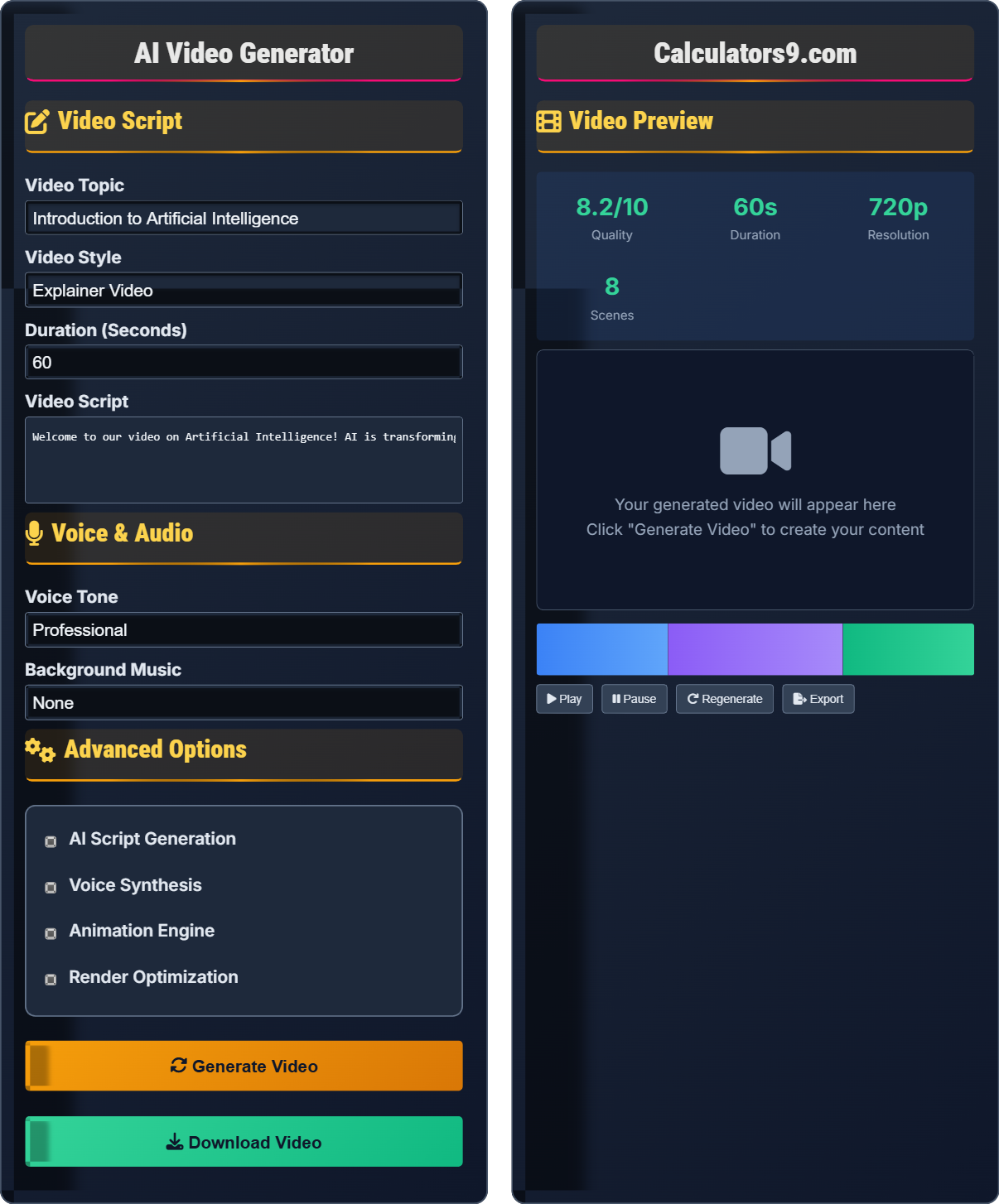
AI Video Generator
Smart video creator • 2026 edition
Video Quality Formula:
Generate Video\( Q = \frac{S \times V \times A \times R}{C + D} \)
Where:
- \( Q \) = Video Quality Score
- \( S \) = Script coherence (0-1)
- \( V \) = Visual quality (0-1)
- \( A \) = Audio synchronization (0-1)
- \( R \) = Rendering quality (0-1)
- \( C \) = Compression artifacts (0-1)
- \( D \) = Distraction level (0-1)
This formula calculates the overall quality of generated videos. Higher scores indicate more professional, engaging content.
Example: For a video with 0.9 script coherence, 0.8 visual quality, 0.9 audio sync, 0.8 rendering, 0.2 compression, and 0.1 distraction: \( Q = \frac{0.9 \times 0.8 \times 0.9 \times 0.8}{0.2 + 0.1} = \frac{0.5184}{0.3} = 1.728 \). Scores above 1.5 indicate high-quality videos.
Video Script
Voice & Audio
Advanced Options
Video Preview
Your generated video will appear here
Click "Generate Video" to create your content
Comprehensive AI Video Generation Guide
AI-powered video generation uses machine learning models to create video content from text descriptions, scripts, or concepts. These systems can synthesize realistic voices, generate animations, create visual scenes, and synchronize audio with visuals. Modern AI video generators combine computer vision, natural language processing, and generative models to produce professional-quality content rapidly and efficiently.
The fundamental video quality calculation uses the following formula:
Where:
- \(Q\) = Video Quality Score
- \(S\) = Script coherence (0-1)
- \(V\) = Visual quality (0-1)
- \(A\) = Audio synchronization (0-1)
- \(R\) = Rendering quality (0-1)
- \(C\) = Compression artifacts (0-1)
- \(D\) = Distraction level (0-1)
Effective AI video generation considers these key factors:
- Script Coherence: Logical flow and clear messaging
- Visual Quality: High-resolution, professional-looking visuals
- Audio Sync: Proper synchronization between audio and visuals
- Engagement: Maintaining viewer interest throughout
- Production Value: Professional polish and finish
- Accessibility: Captions, descriptions, and inclusive design
- Clear Narratives: Structure content with beginning, middle, and end
- Visual Consistency: Maintain consistent styling and branding
- Audio Quality: Ensure clear, well-balanced sound
- Scene Transitions: Use smooth, purposeful transitions
- Engagement Hooks: Start with compelling opening and maintain interest
Video Generation Basics
Logical flow and consistency of the video narrative.
\( Q = \frac{S \times V \times A \times R}{C + D} \)
Where Q=quality, S=script, V=visual, A=audio, R=rendering, C=compression, D=distraction.
- Maintain narrative coherence throughout
- Sync audio with visual elements
- Minimize compression artifacts
Strategies
Maintaining unified styling and design throughout the video.
- Define visual style guide
- Choose consistent color palette
- Use matching fonts and typography
- Apply uniform animation styles
- Align with brand identity
- Consider target audience
- Maintain accessibility
- Ensure readability
AI Video Generation Learning Quiz
What is the most effective structure for an AI-generated video script?
The answer is B) Introduction, main content, conclusion with clear transitions. This classic three-part structure provides a logical flow that helps viewers follow and retain information. The introduction sets expectations, the main content delivers the key information, and the conclusion reinforces key points. Clear transitions between sections maintain engagement and coherence, which is essential for AI-generated content to feel professionally produced.
This question addresses the fundamental structure of effective communication. The three-part structure (introduction, body, conclusion) is a proven method for organizing information that works well with human cognitive patterns. For AI video generation, this structure is crucial because it helps the AI understand how to sequence visual elements and audio narration coherently. Clear transitions are particularly important in video because they help maintain viewer attention and comprehension.
Script Coherence: Logical flow and consistency of narrative
Transition: Connection between different parts of content
Engagement: Maintaining viewer interest and attention
• Follow traditional storytelling structure
• Use clear transitions between sections
• Maintain logical flow of information
• Start with a hook to grab attention
• Use signposting to indicate structure
• End with a clear call to action
• Lack of clear structure or organization
• Jumping between unrelated topics
• Not providing adequate transitions
Using the video quality formula \( Q = \frac{S \times V \times A \times R}{C + D} \), calculate the quality score for a video with 0.9 script coherence (S), 0.8 visual quality (V), 0.9 audio sync (A), 0.8 rendering quality (R), 0.2 compression artifacts (C), and 0.1 distraction level (D). Show your work.
Using the formula: \( Q = \frac{S \times V \times A \times R}{C + D} \)
Given:
- S = 0.9 (script coherence)
- V = 0.8 (visual quality)
- A = 0.9 (audio synchronization)
- R = 0.8 (rendering quality)
- C = 0.2 (compression artifacts)
- D = 0.1 (distraction level)
Step 1: Calculate the numerator (S × V × A × R)
0.9 × 0.8 × 0.9 × 0.8 = 0.5184
Step 2: Calculate the denominator (C + D)
0.2 + 0.1 = 0.3
Step 3: Divide numerator by denominator
Q = 0.5184 ÷ 0.3 = 1.728
Therefore, the video quality score is 1.728.
This calculation demonstrates how different quality factors interact in the video generation process. The numerator represents positive attributes that multiply together, meaning a weakness in any one area significantly impacts the overall score. The denominator represents negative factors that add together, so minimizing both compression artifacts and distractions is important. A score of 1.728 indicates high-quality video, as scores above 1.5 are considered excellent.
Video Quality Score: Measure of overall video production quality
Compression Artifacts: Visual distortions from video compression
Audio Synchronization: Proper timing between audio and visuals
• Scores above 1.5 indicate high quality
• All positive factors multiply together
• Negative factors add together
• Focus on the weakest quality factor first
• Balance all quality aspects for best results
• Minimize both compression and distractions
• Not considering the multiplicative effect of positive factors
• Underestimating the impact of compression artifacts
• Ignoring the cumulative effect of distractions
An AI video generator creates narration with 85% naturalness and 90% clarity. If the system processes 10,000 words of script and achieves 88% accuracy in pronunciation, how does this affect the overall video quality? What are the implications for viewer engagement?
Step 1: Calculate audio quality metrics
Naturalness: 85% = 0.85
Clarity: 90% = 0.90
Pronunciation accuracy: 88% = 0.88
Step 2: Impact on overall video quality
Audio quality contributes to the A (audio synchronization) factor in the video quality formula. High audio quality significantly improves the overall score.
Step 3: Implications for viewer engagement
With 85% naturalness and 90% clarity, viewers are more likely to stay engaged. Poor audio quality is a primary reason for video abandonment. The high accuracy (88%) ensures correct information delivery.
Estimated impact: These quality levels contribute positively to the overall video quality score and viewer retention.
This problem illustrates the importance of audio quality in video production. Voice synthesis quality directly affects the A (audio synchronization) component of the video quality formula. Naturalness and clarity are critical for maintaining viewer attention and comprehension. The high accuracy rate ensures that the information conveyed is correct, which is essential for educational or informational content.
Naturalness: How human-like the synthesized voice sounds
Clarity: How clearly the speech is articulated
Pronunciation Accuracy: Correctness of spoken words
• Audio quality significantly impacts overall video quality
• Naturalness affects viewer engagement
• Accuracy is essential for informational content
• Test different voice options for naturalness
• Ensure clear pronunciation of technical terms
• Match voice tone to content type
• Not optimizing for naturalness
• Ignoring pronunciation of specialized terms
• Mismatching voice tone to content
A video script is 90 seconds long with 180 words of narration. If the AI system synchronizes animations to occur every 5 seconds, how many animation events will occur? How does this timing affect the visual rhythm and viewer engagement?
Step 1: Calculate animation events
Video duration: 90 seconds
Animation interval: every 5 seconds
Number of events: 90 ÷ 5 = 18 animation events
Step 2: Analyze visual rhythm
With 180 words in 90 seconds, there are 2 words per second of narration. The animation events occur every 5 seconds, creating a steady visual rhythm that complements the narration pace.
Step 3: Engagement implications
This timing creates a balanced rhythm - frequent enough to maintain visual interest but not so frequent as to distract from the content. The 5-second interval allows viewers to process visual information before the next animation event.
This example demonstrates the importance of timing in video production. The animation rhythm should complement the narration pace to create a cohesive viewing experience. Too frequent animations can be distracting, while too infrequent animations may cause visual monotony. The 5-second interval in this case creates a comfortable rhythm that supports the content without overwhelming it.
Visual Rhythm: Pattern of visual changes throughout video
Animation Timing: Frequency and duration of animated elements
Viewer Engagement: Maintaining audience attention
• Synchronize animations with narration pace
• Maintain consistent visual rhythm
• Balance visual interest with content focus
• Match animation timing to content beats
• Use consistent animation styles
• Allow time for visual processing
• Animations that don't sync with content
• Too frequent visual changes
• Inconsistent animation timing
Which of the following is the most important consideration when optimizing video rendering for AI-generated content?
The answer is B) Balancing quality with rendering time and file size. This approach considers the practical needs of both creators and viewers. High-quality rendering is important, but it must be balanced with reasonable processing times and file sizes that can be easily shared and viewed. This balance affects the R (rendering quality) component of the video quality formula while keeping C (compression artifacts) at an acceptable level.
This question addresses the practical realities of video production. The optimal approach involves finding the sweet spot between quality and efficiency. This balance directly impacts the R (rendering quality) factor in the video quality formula. Too high quality increases rendering time exponentially, while too low quality affects the final product. The goal is to achieve the highest quality possible within practical constraints.
Render Optimization: Balancing quality with processing efficiency
Compression Artifacts: Distortions from file compression
Quality-Time Tradeoff: Relationship between quality and processing time
• Balance quality with practical constraints
• Consider viewer's playback capabilities
• Optimize for intended distribution platform
• Test different quality settings
• Consider target platform requirements
• Balance file size with quality
• Prioritizing quality over practicality
• Not considering playback platforms
• Ignoring file size limitations
FAQ
Q: How can I make AI-generated videos more engaging for viewers?
A: Engagement depends on multiple synchronized elements in AI video generation.
The engagement formula:
\( E = (S \times A) + (V \times T) + (I \times R) \)
Where:
- \( E \) = Engagement Score
- \( S \) = Storytelling quality
- \( A \) = Audio-visual synchronization
- \( V \) = Visual appeal
- \( T \) = Timing precision
- \( I \) = Interactive elements
- \( R \) = Relevance to audience
Focus on creating coherent narratives, maintaining perfect audio-visual sync, using visually appealing elements, and ensuring content relevance. The most engaging videos score above 0.8 on this scale, combining storytelling with technical excellence.
Q: What are the key differences between various AI video generation approaches?
A: Different approaches have distinct advantages based on their underlying technology.
The effectiveness comparison formula:
\( F = \frac{Q \times S \times C}{T + R} \)
Where:
- \( F \) = Feasibility Score
- \( Q \) = Quality potential
- \( S \) = Speed of generation
- \( C \) = Cost efficiency
- \( T \) = Technical complexity
- \( R \) = Resource requirements
Diffusion-based models excel at creative content but require more computation. GAN-based approaches are faster but sometimes less detailed. Transformer-based systems offer excellent text-video alignment. Choose based on your specific needs: quality, speed, or resource constraints.