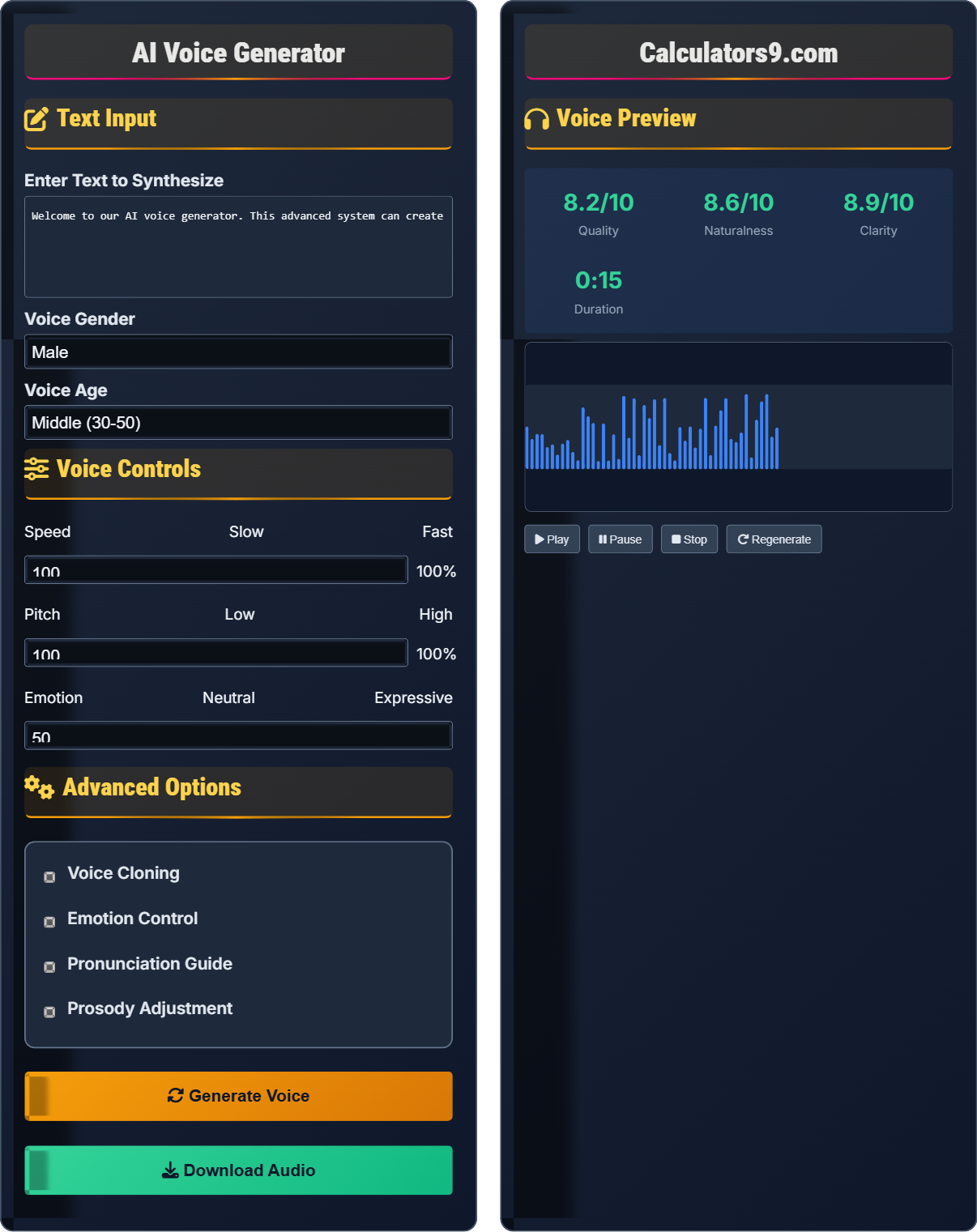
AI Voice Generator
Smart voice synthesizer • 2026 edition
Voice Quality Formula:
Generate Voice\( Q = \frac{N \times C \times E \times S}{A + P} \)
Where:
- \( Q \) = Voice Quality Score
- \( N \) = Naturalness (0-1)
- \( C \) = Clarity (0-1)
- \( E \) = Emotional expression (0-1)
- \( S \) = Speech quality (0-1)
- \( A \) = Artifacts (0-1)
- \( P \) = Pronunciation errors (0-1)
This formula calculates the overall quality of synthesized speech. Higher scores indicate more natural, clear, and pleasant-sounding voices.
Example: For a voice with 0.9 naturalness, 0.85 clarity, 0.8 emotional expression, 0.9 speech quality, 0.1 artifacts, and 0.05 pronunciation errors: \( Q = \frac{0.9 \times 0.85 \times 0.8 \times 0.9}{0.1 + 0.05} = \frac{0.5508}{0.15} = 3.672 \). Scores above 3.0 indicate high-quality synthetic voices.
Text Input
Voice Controls
Advanced Options
Voice Preview
Comprehensive AI Voice Generation Guide
AI-powered voice generation uses deep learning models to synthesize natural-sounding human speech from text input. These systems employ neural networks trained on vast datasets of human voices to replicate the nuances of speech including pitch, tone, rhythm, and emotional expression. Modern voice synthesis can create voices indistinguishable from human speakers, enabling applications in virtual assistants, audiobooks, accessibility tools, and entertainment.
The fundamental voice quality calculation uses the following formula:
Where:
- \(Q\) = Voice Quality Score
- \(N\) = Naturalness (0-1)
- \(C\) = Clarity (0-1)
- \(E\) = Emotional expression (0-1)
- \(S\) = Speech quality (0-1)
- \(A\) = Artifacts (0-1)
- \(P\) = Pronunciation errors (0-1)
Effective AI voice generation considers these key factors:
- Naturalness: How closely the voice resembles human speech
- Clarity: Audibility and intelligibility of the output
- Emotional Expression: Ability to convey feelings and tone
- Prosody: Natural rhythm, stress, and intonation patterns
- Articulation: Clear pronunciation of phonemes
- Consistency: Stable quality throughout the audio
- Text Formatting: Use proper punctuation and markup for better prosody
- Voice Matching: Select voice characteristics appropriate for content
- Emotional Calibration: Match emotional expression to content tone
- Quality Control: Listen for artifacts and pronunciation errors
- Accessibility: Ensure output is clear and understandable
Voice Generation Basics
How closely synthetic speech resembles human speech patterns.
\( Q = \frac{N \times C \times E \times S}{A + P} \)
Where Q=quality, N=naturalness, C=clarity, E=emotion, S=speech, A=artifacts, P=pronunciation.
- Higher naturalness scores indicate better quality
- Minimize artifacts and pronunciation errors
- Balance all quality factors for optimal results
Strategies
Managing rhythm, stress, and intonation in synthetic speech.
- Analyze input text for prosodic cues
- Apply appropriate intonation patterns
- Adjust rhythm and stress naturally
- Validate prosodic accuracy
- Match prosody to content type
- Consider linguistic patterns
- Maintain natural rhythm
- Preserve emotional expression
AI Voice Generation Learning Quiz
What is the most important factor in determining the naturalness of AI-generated voices?
The answer is B) Proper prosody including rhythm, stress, and intonation. Naturalness in speech synthesis is primarily determined by how well the system replicates the natural patterns of human speech. Prosody encompasses the rhythm, stress patterns, and intonation contours that make speech sound natural and convey meaning beyond the literal words. Without proper prosody, synthetic voices sound robotic regardless of other quality factors.
This question addresses the fundamental difference between simply pronouncing words correctly and making speech sound natural. Prosody is what gives speech its musical quality and helps convey meaning, emotion, and emphasis. In AI voice generation, getting the timing and intonation patterns right is crucial for achieving naturalness. The human ear is highly sensitive to prosodic patterns, so even small deviations can make speech sound artificial.
Prosody: Patterns of rhythm, stress, and intonation in speech
Intonation: Rise and fall of pitch in speech
Naturalness: How closely synthetic speech resembles human speech
• Proper prosody is essential for naturalness
• Timing patterns affect perceived quality
• Intonation conveys meaning and emotion
• Pay attention to punctuation in text
• Use appropriate pauses between phrases
• Match intonation to content type
• Ignoring prosodic patterns in synthesis
• Using uniform pitch throughout
• Not considering content-appropriate intonation
Using the voice quality formula \( Q = \frac{N \times C \times E \times S}{A + P} \), calculate the quality score for a voice with 0.9 naturalness (N), 0.85 clarity (C), 0.8 emotional expression (E), 0.9 speech quality (S), 0.1 artifacts (A), and 0.05 pronunciation errors (P). Show your work.
Using the formula: \( Q = \frac{N \times C \times E \times S}{A + P} \)
Given:
- N = 0.9 (naturalness)
- C = 0.85 (clarity)
- E = 0.8 (emotional expression)
- S = 0.9 (speech quality)
- A = 0.1 (artifacts)
- P = 0.05 (pronunciation errors)
Step 1: Calculate the numerator (N × C × E × S)
0.9 × 0.85 × 0.8 × 0.9 = 0.5508
Step 2: Calculate the denominator (A + P)
0.1 + 0.05 = 0.15
Step 3: Divide numerator by denominator
Q = 0.5508 ÷ 0.15 = 3.672
Therefore, the voice quality score is 3.672.
This calculation demonstrates how multiple quality factors interact in voice synthesis. The numerator represents positive attributes that multiply together, meaning a weakness in any one area significantly impacts the overall score. The denominator represents negative factors that add together. A score of 3.672 indicates high-quality synthetic voice, as scores above 3.0 are considered excellent.
Voice Quality Score: Measure of synthetic voice naturalness
Artifacts: Unwanted sounds or distortions in audio
Speech Quality: Overall fidelity of the audio
• Scores above 3.0 indicate high quality
• All positive factors multiply together
• Negative factors add together
• Focus on the weakest quality factor first
• Minimize both artifacts and errors
• Balance all quality aspects
• Not considering the multiplicative effect of positive factors
• Underestimating the impact of artifacts
• Ignoring the cumulative effect of errors
An AI system performs voice cloning using a 30-second reference sample. If the system requires 15 minutes of processing time to create a voice model with 90% similarity to the original, how efficient is the process? If the system processes 10 voice cloning requests per day, how much total processing time is required?
Step 1: Calculate processing efficiency
Input sample: 30 seconds
Processing time: 15 minutes = 900 seconds
Efficiency ratio: 30s input : 900s processing = 1:30
Step 2: Calculate daily processing time
Requests per day: 10
Processing time per request: 15 minutes
Total daily processing time: 10 × 15 = 150 minutes = 2.5 hours
Step 3: Assess quality implications
The 90% similarity indicates high-quality cloning, justifying the processing time investment.
This problem illustrates the computational requirements of voice cloning technology. The 1:30 ratio indicates that processing time is significantly longer than input time, which is typical for deep learning models that need to analyze voice characteristics thoroughly. The high similarity score justifies the processing time, showing the trade-off between computational resources and output quality.
Voice Cloning: Creating synthetic voice from reference samples
Similarity Score: Measure of resemblance to original voice
Processing Time: Computational time required for synthesis
• More processing time often yields better quality
• Longer reference samples improve cloning accuracy
• Use high-quality reference samples
• Balance processing time with quality needs
• Consider batch processing for efficiency
• Expecting instant cloning results
• Using low-quality reference samples
• Not considering computational requirements
A voice synthesis system needs to generate content with different emotional tones: informative (20% emotion), conversational (50% emotion), and promotional (80% emotion). If the base naturalness is 0.85, how does varying emotional intensity affect the overall voice quality according to the formula?
Using the formula: \( Q = \frac{N \times C \times E \times S}{A + P} \)
Assuming: N=0.85, C=0.9, S=0.85, A=0.05, P=0.05 (constant values)
Case 1 - Informative (E=0.20):
Q = (0.85 × 0.9 × 0.20 × 0.85) / (0.05 + 0.05) = 0.13005 / 0.10 = 1.30
Case 2 - Conversational (E=0.50):
Q = (0.85 × 0.9 × 0.50 × 0.85) / (0.05 + 0.05) = 0.325125 / 0.10 = 3.25
Case 3 - Promotional (E=0.80):
Q = (0.85 × 0.9 × 0.80 × 0.85) / (0.05 + 0.05) = 0.5202 / 0.10 = 5.20
Result: Higher emotional intensity increases quality scores, but must be contextually appropriate.
This example demonstrates how emotional expression impacts voice quality scores. However, the optimal level depends on the content type. While higher emotion scores mathematically improve the quality formula, the emotional intensity must match the content's purpose. An informative voice should be more neutral, while promotional content benefits from higher emotional expression.
Emotional Expression: Degree of feeling conveyed in speech
Contextual Appropriateness: Matching emotion to content purpose
Expression Range: Variation in emotional intensity
• Match emotion level to content type
• Consider audience expectations
• Balance expression with clarity
• Use lower emotion for instructional content
• Increase emotion for engaging content
• Test different levels for effectiveness
• Using same emotion level for all content types
• Over-expressing for informative content
• Not considering audience preferences
Which of the following is the most effective method to ensure proper pronunciation in AI voice synthesis?
The answer is B) Providing pronunciation guides for special terms. This approach directly addresses the challenge of pronouncing unfamiliar or specialized words correctly. AI voice synthesis systems rely on pronunciation dictionaries and linguistic rules, but for special terms, proper names, or technical jargon, explicit pronunciation guidance ensures accuracy. This reduces the P (pronunciation errors) component in the voice quality formula.
This question highlights the challenge of pronouncing specialized vocabulary in AI voice synthesis. While general pronunciation rules work well for common words, special terms often require explicit guidance. Pronunciation guides can specify how to pronounce phonetically challenging words, regional names, or technical terminology. This is especially important in educational, medical, or legal content where accuracy is crucial.
Pronunciation Guide: Specification of how words should be pronounced
Phonetic Transcription: Representation of speech sounds
Technical Terminology: Specialized vocabulary for specific fields
• Identify special terms in advance
• Provide explicit pronunciation guidance
• Test for accuracy in specialized content
• Create pronunciation dictionaries for special terms
• Use phonetic spellings when needed
• Verify accuracy with native speakers
• Assuming AI knows all pronunciations
• Not preparing for technical terms
• Skipping pronunciation verification
FAQ
Q: How can I make AI-generated voices sound more natural and engaging?
A: Naturalness comes from proper prosody and contextual expression.
The naturalness formula:
\( N = \frac{(P \times I) + (R \times S) + E}{3} \)
Where:
- \( N \) = Naturalness Score
- \( P \) = Prosody quality (intonation, rhythm)
- \( I \) = Intonation accuracy
- \( R \) = Rhythm consistency
- \( S \) = Stress pattern accuracy
- \( E \) = Emotional expression appropriateness
Focus on proper punctuation in text input, adjust speaking rate to content type, and ensure emotional expression matches the message. Natural voices typically score above 0.8 on this scale, with particular attention to rhythm and intonation patterns.
Q: What are the main differences between various voice synthesis technologies?
A: Different approaches have distinct advantages based on their underlying models.
The synthesis effectiveness formula:
\( F = \frac{Q \times S}{C + T} \)
Where:
- \( F \) = Feasibility Score
- \( Q \) = Quality potential
- \( S \) = Speed of synthesis
- \( C \) = Computational cost
- \( T \) = Training data requirements
Neural vocoders (like WaveNet) offer highest quality but require more computation. FFT-based systems are faster but sometimes less natural. Transformer-based models provide excellent text-to-speech alignment. Choose based on your specific needs: quality, speed, or resource constraints.