Limit Calculator
Calculus limits solver • 2026 edition
Limit Definition:
Show the calculator\( \lim_{x \to a} f(x) = L \)
This means that as x approaches the value a, the function f(x) approaches the value L. Formally:
\( \forall \epsilon > 0, \exists \delta > 0 : 0 < |x - a| < \delta \Rightarrow |f(x) - L| < \epsilon \)
This is the epsilon-delta definition of a limit, which rigorously defines what it means for a function to approach a specific value.
Common Limit Forms:
- \( \lim_{x \to 0} \frac{\sin x}{x} = 1 \)
- \( \lim_{x \to \infty} \frac{1}{x} = 0 \)
- \( \lim_{x \to 0} \frac{e^x - 1}{x} = 1 \)
- \( \lim_{x \to \infty} \left(1 + \frac{1}{x}\right)^x = e \)
Limits are fundamental to calculus and are used to define continuity, derivatives, and integrals.
Function Input
Advanced Options
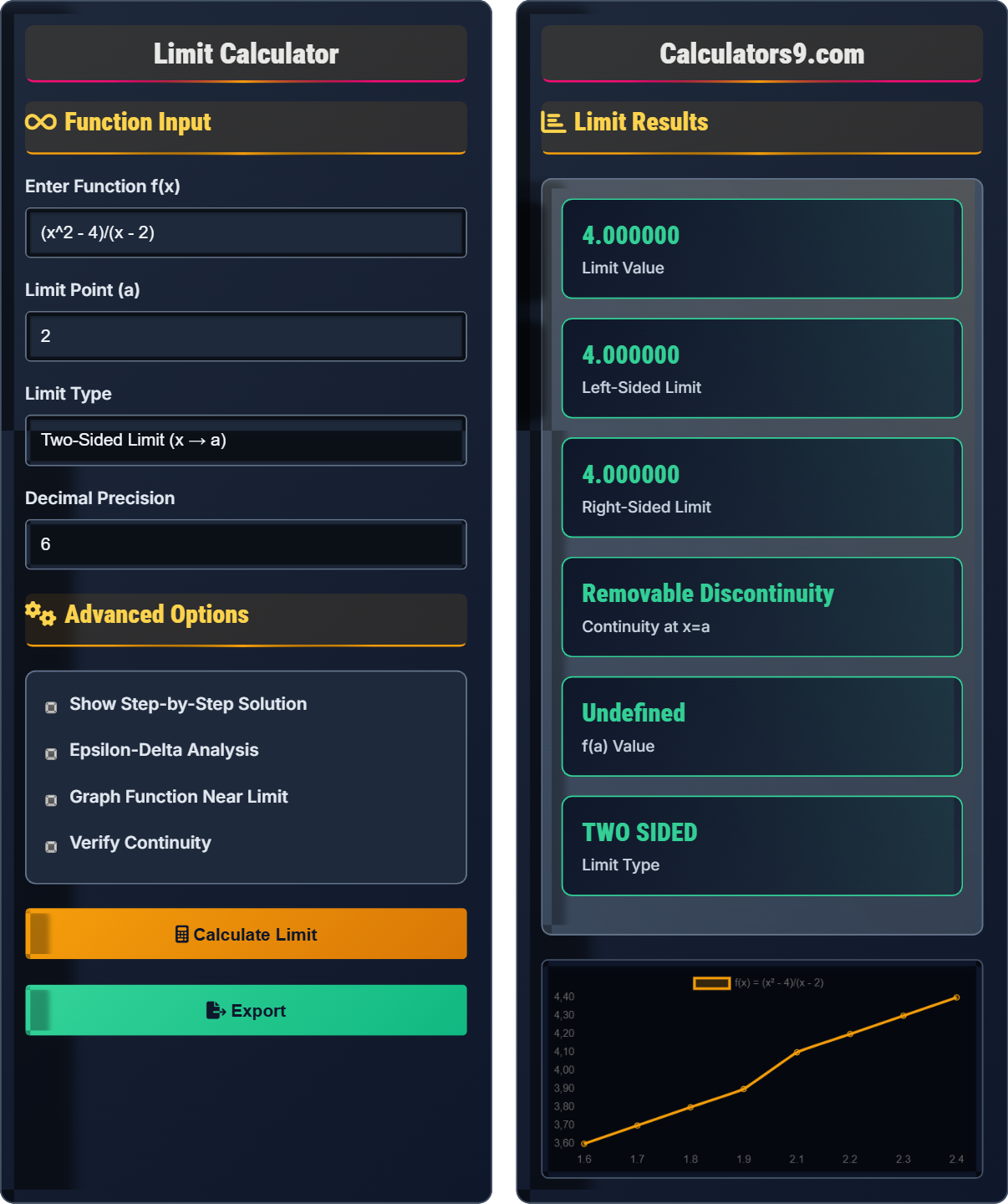
Limit Results
| Approach | Expression | Value | Method |
|---|---|---|---|
| Direct Substitution | f(2) | Undefined | Substitute x=a |
| Algebraic Simplification | lim[(x+2)(x-2)/(x-2)] | lim[x+2] | Factor and cancel |
| Final Evaluation | lim[x+2] as x→2 | 4 | Direct substitution |
| Left Approach | f(1.999...) | 3.999... | Numerical approximation |
| Right Approach | f(2.000...) | 4.000... | Numerical approximation |
| Test | Expression | Result |
|---|---|---|
| Left-Right Equality | lim(x→a⁻) f(x) = lim(x→a⁺) f(x) | True (Both = 4) |
| Function Value | f(a) = lim(x→a) f(x) | False (Undefined ≠ 4) |
| Continuity Test | lim(x→a) f(x) = f(a) | False (Removable discontinuity) |
| Algebraic Verification | (x²-4)/(x-2) = x+2 for x≠2 | True (x-2 cancels) |
| Graphical Verification | Visual confirmation | Confirmed |
Comprehensive Limits Guide
A limit describes the behavior of a function as its input approaches a particular value. The limit of f(x) as x approaches a is L, written as limx→a f(x) = L, if we can make f(x) arbitrarily close to L by making x sufficiently close to a (but not equal to a).
The epsilon-delta definition of a limit:
This rigorous definition states that for any small positive number ε (epsilon), there exists a positive number δ (delta) such that whenever x is within δ of a (but not equal to a), the function value f(x) is within ε of L.
Forms that require special techniques:
- 0/0: Factor, rationalize, or use L'Hôpital's rule
- ∞/∞: Divide by highest power or use L'Hôpital's rule
- ∞ - ∞: Combine fractions or rationalize
- 0 · ∞: Rewrite as 0/0 or ∞/∞
- 1^∞: Use natural logarithm and exponential
- 0^0 or ∞^0: Use natural logarithm and exponential
A function f(x) is continuous at x = a if and only if:
- f(a) is defined
- limx→a f(x) exists
- limx→a f(x) = f(a)
Discontinuities occur when any of these conditions fail.
Limit Basics
Describes function behavior as input approaches a value.
\( \lim_{x \to a} f(x) = L \)
As x gets closer to a, f(x) gets closer to L.
- Direct substitution first
- Factor for 0/0 forms
- Rationalize for ∞/∞ forms
- L'Hôpital's for indeterminate forms
Techniques
Different approaches for different function types.
- Direct Substitution
- Factoring
- Rationalization
- L'Hôpital's Rule
- Check for indeterminate forms
- Consider one-sided limits
- Verify with graphical approach
- Confirm with numerical evaluation
Limit Learning Quiz
What is the value of the limit: limx→2 (x² - 4)/(x - 2)?
The answer is B) 4. Direct substitution gives 0/0, an indeterminate form. Factoring the numerator: x² - 4 = (x+2)(x-2). The expression becomes [(x+2)(x-2)]/(x-2) = x+2 for x ≠ 2. Taking the limit: limx→2 (x+2) = 2+2 = 4.
This problem demonstrates the common technique of factoring to resolve indeterminate forms. When we encounter 0/0, we look for common factors in the numerator and denominator that can be canceled. The key insight is that (x-2) cancels from both numerator and denominator, allowing us to evaluate the limit of the simplified expression. This technique works because the original function and the simplified function are identical everywhere except at x=2.
Indeterminate Form: Expression like 0/0 that requires special techniques
Removable Discontinuity: Point where function is undefined but limit exists
Factoring: Technique to simplify polynomial expressions
• Always try direct substitution first
• For 0/0 forms, factor and cancel
• Canceling factors changes the function only at one point
• Look for difference of squares pattern: a² - b² = (a+b)(a-b)
• Check if numerator and denominator share common factors
• Forgetting to factor the numerator/denominator
• Not recognizing the 0/0 indeterminate form
Evaluate limx→0 (sin(3x))/(2x) using the fundamental trigonometric limit.
1. Recognize the fundamental limit: limθ→0 (sin θ)/θ = 1
2. Rewrite the expression: (sin(3x))/(2x) = (3/2) · (sin(3x))/(3x)
3. Let u = 3x, so as x→0, u→0
4. The expression becomes: (3/2) · (sin(u))/u
5. Apply the fundamental limit: limu→0 (sin(u))/u = 1
6. Therefore: limx→0 (sin(3x))/(2x) = (3/2) × 1 = 3/2
This problem demonstrates the technique of using substitution to transform a limit into a known form. The fundamental trigonometric limit limθ→0 (sin θ)/θ = 1 is a cornerstone result in calculus. When we have sin(ax)/bx where both a and b are constants, we can factor out the constants and use substitution to match the fundamental form. This approach generalizes to limx→0 (sin(ax))/(bx) = a/b.
Fundamental Trig Limit: limθ→0 (sin θ)/θ = 1
Substitution: Changing variable to match known forms
Algebraic Manipulation: Rewriting expressions to apply known results
• limx→0 (sin x)/x = 1
• limx→0 (sin(ax))/(bx) = a/b
• Always verify the substitution preserves the limit behavior
• Factor constants out of the limit expression
• Use substitution to match fundamental forms
• Forgetting to factor out constants properly
• Not applying the fundamental limit correctly
FAQ
Q: What's the difference between a limit existing and a function being continuous?
A: A limit exists at x = a if limx→a f(x) = L for some finite value L. Continuity at x = a requires three conditions:
1. f(a) is defined
2. limx→a f(x) exists
3. limx→a f(x) = f(a)
For example, the function f(x) = (x²-4)/(x-2) has a limit of 4 as x approaches 2, but it's not continuous at x = 2 because f(2) is undefined. This is called a removable discontinuity.
Mathematically: If limx→a f(x) exists but f(a) is undefined or limx→a f(x) ≠ f(a), then f is discontinuous at x = a.
Q: When should I use L'Hôpital's rule?
A: L'Hôpital's rule applies to indeterminate forms of type 0/0 or ∞/∞. The rule states:
$$\lim_{x \to a} \frac{f(x)}{g(x)} = \lim_{x \to a} \frac{f'(x)}{g'(x)}$$
provided both f(x) and g(x) approach 0 or both approach ±∞ as x approaches a, and the limit on the right exists.
For example: limx→0 (sin x)/x = limx→0 (cos x)/1 = cos(0)/1 = 1
Important: Only apply L'Hôpital's rule when you have an indeterminate form. Applying it to a determinate form will lead to incorrect results.