Quadratic Equation Solver
Parabola calculator • 2026 edition
Quadratic Formula:
Show the calculator\( x = \frac{-b \pm \sqrt{b^2 - 4ac}}{2a} \)
For the general quadratic equation: \( ax^2 + bx + c = 0 \)
Where:
- \( a \) = Coefficient of x² (a ≠ 0)
- \( b \) = Coefficient of x
- \( c \) = Constant term
The discriminant: \( \Delta = b^2 - 4ac \) determines the nature of roots:
- Δ > 0: Two distinct real roots
- Δ = 0: One repeated real root
- Δ < 0: Two complex conjugate roots
Quadratic Coefficients
Advanced Options
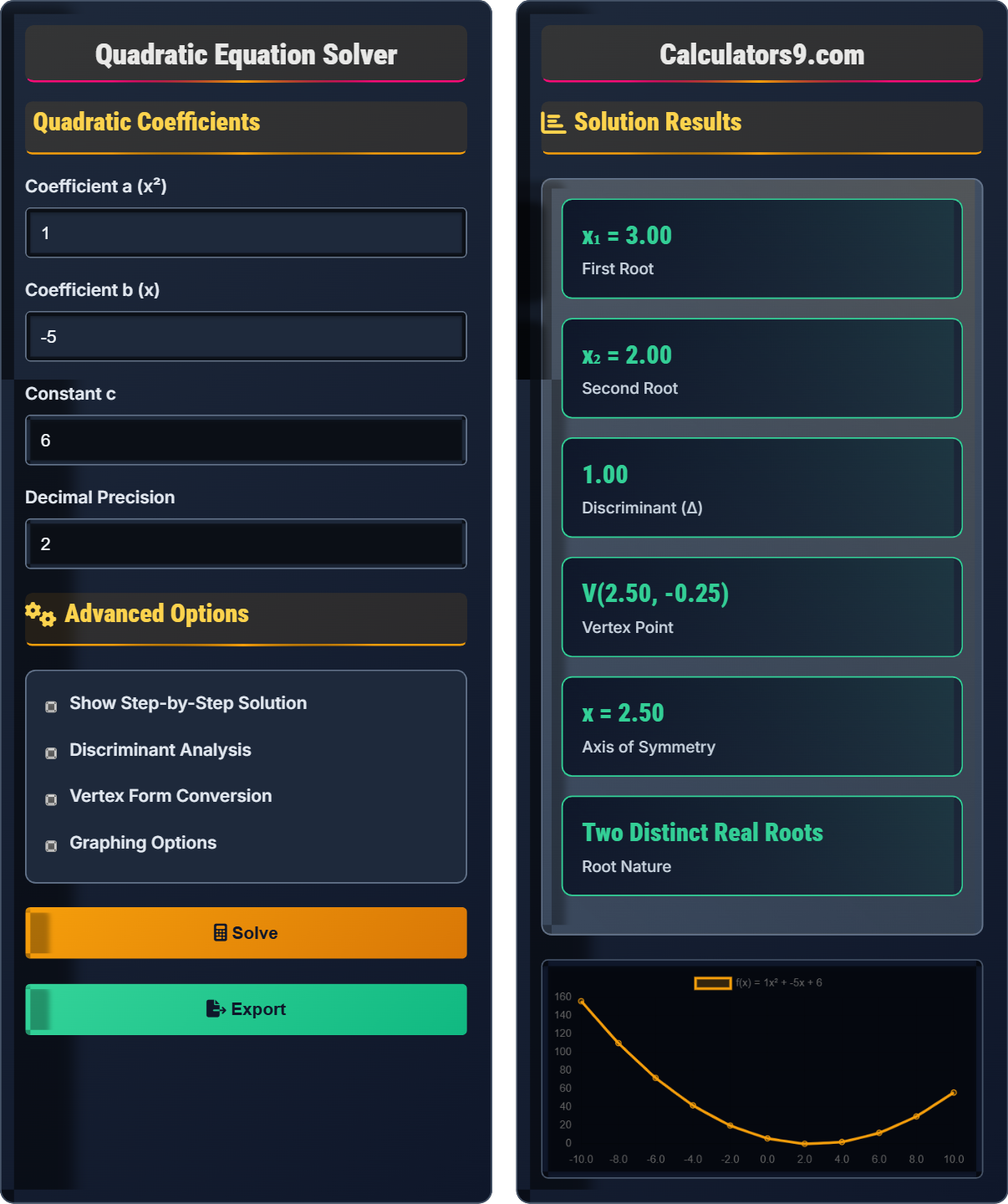
Solution Results
| Root | Value | Type |
|---|---|---|
| Root 1 | 3.00 | Real |
| Root 2 | 2.00 | Real |
| Parameter | Value | Description |
|---|---|---|
| Discriminant | 1.00 | Δ = b² - 4ac |
| Vertex X | 2.50 | x = -b/(2a) |
| Vertex Y | -0.25 | f(vertexX) |
| Y-Intercept | 6.00 | f(0) = c |
| Direction | Upward | a > 0 |
Comprehensive Quadratic Equation Guide
A quadratic equation is a polynomial equation of degree 2, typically written in the standard form ax² + bx + c = 0, where a ≠ 0. The solutions to a quadratic equation are called roots or zeros, and they represent the x-intercepts of the corresponding parabola when graphed.
The quadratic formula provides the exact solutions to any quadratic equation:
Where:
- \(a\) is the coefficient of x²
- \(b\) is the coefficient of x
- \(c\) is the constant term
- \(\Delta = b^2 - 4ac\) is the discriminant
Key characteristics of quadratic functions:
- Vertex: Point of maximum/minimum value at (-b/2a, f(-b/2a))
- Axis of Symmetry: Vertical line x = -b/2a
- Y-Intercept: Point (0, c)
- Direction: Upward if a > 0, downward if a < 0
- X-Intercepts: Points where the parabola crosses x-axis (roots)
- Quadratic Formula: Universal method for any quadratic
- Factoring: When the quadratic is factorable
- Completing the Square: Derives the vertex form
- Graphing: Visual representation of solutions
- Discriminant: Predicts nature of solutions
Quadratic Basics
Polynomial equation of degree 2: ax² + bx + c = 0, where a ≠ 0.
\( x = \frac{-b \pm \sqrt{b^2 - 4ac}}{2a} \)
Where a, b, c are coefficients.
- Coefficient a must be non-zero
- Maximum 2 real roots possible
- Discriminant determines root nature
- Vertex at x = -b/2a
Properties
Geometric properties of quadratic functions.
- Vertex: (-b/2a, f(-b/2a))
- Axis of symmetry: x = -b/2a
- Y-intercept: (0, c)
- Direction: Upward if a > 0, downward if a < 0
- Discriminant: b² - 4ac
- Δ > 0: Two real roots
- Δ = 0: One real root
- Δ < 0: Complex roots
Quadratic Equation Learning Quiz
What is the discriminant of the quadratic equation 2x² - 4x + 1 = 0?
The answer is A) 8. For the equation 2x² - 4x + 1 = 0, we have a=2, b=-4, c=1. The discriminant is calculated as: Δ = b² - 4ac = (-4)² - 4(2)(1) = 16 - 8 = 8. Since Δ > 0, the equation has two distinct real roots.
The discriminant is a critical concept in quadratic equations as it determines the nature of the roots without having to solve the equation completely. Students often confuse the signs when identifying coefficients, especially when the equation is not in standard form. It's important to correctly identify a, b, and c from ax² + bx + c = 0.
Discriminant: The expression b² - 4ac under the square root in the quadratic formula
Roots: Solutions to the quadratic equation
Standard Form: ax² + bx + c = 0
• Discriminant: Δ = b² - 4ac
• Δ > 0: Two distinct real roots
• Δ = 0: One repeated real root
• Always write equation in standard form first
• Pay attention to signs of coefficients
• Forgetting to multiply by 4 in the discriminant formula
• Misidentifying the coefficients a, b, c
Find the vertex of the parabola represented by f(x) = 2x² - 8x + 6 and determine if it represents a maximum or minimum value.
For the function f(x) = 2x² - 8x + 6:
1. Identify coefficients: a = 2, b = -8, c = 6
2. Find x-coordinate of vertex: x = -b/(2a) = -(-8)/(2×2) = 8/4 = 2
3. Find y-coordinate by substituting x = 2: f(2) = 2(2)² - 8(2) + 6 = 8 - 16 + 6 = -2
4. Vertex: (2, -2)
5. Since a = 2 > 0, the parabola opens upward, so the vertex represents a minimum value.
The vertex is (2, -2) and represents the minimum value of -2.
This problem combines multiple concepts about quadratic functions. Finding the vertex requires understanding the formula x = -b/(2a) and then substituting back into the function to find the y-coordinate. The sign of 'a' determines whether the parabola opens upward (minimum) or downward (maximum). This connects algebraic and geometric properties of quadratics.
Vertex: The highest or lowest point on a parabola
Minimum/Maximum: The y-value at the vertexDirection: Whether parabola opens up or down
• Vertex x-coordinate: x = -b/(2a)
• If a > 0: Parabola opens upward (minimum)
• If a < 0: Parabola opens downward (maximum)
• Remember: a determines direction
• Always substitute x-value back to find y
• Forgetting to substitute x-value to find y-coordinate
• Confusing maximum/minimum based on sign of a
FAQ
Q: Why can't 'a' equal zero in a quadratic equation?
A: If \( a = 0 \) in the equation \( ax^2 + bx + c = 0 \), the quadratic term disappears, leaving us with \( bx + c = 0 \). This is a linear equation, not a quadratic equation. The definition of a quadratic equation requires that the highest power of the variable is 2, which means the coefficient of \( x^2 \) (that is, \( a \)) must be non-zero.
Mathematically: If \( a = 0 \), then \( ax^2 = 0 \) for all values of \( x \), so the equation becomes linear: \( bx + c = 0 \).
Q: What happens when the discriminant is negative?
A: When the discriminant \( \Delta = b^2 - 4ac < 0 \), the quadratic equation has no real solutions. Instead, it has two complex conjugate roots.
For example, if \( \Delta = -4 \), then \( \sqrt{\Delta} = \sqrt{-4} = 2i \), where \( i = \sqrt{-1} \).
The roots become: \( x = \frac{-b \pm 2i}{2a} \)
Graphically, this means the parabola does not intersect the x-axis, so there are no real x-intercepts.