System of Equations Calculator
Linear systems solver • 2026 edition
System of Linear Equations:
Show the calculator\( \begin{cases} a_1x + b_1y = c_1 \\ a_2x + b_2y = c_2 \end{cases} \)
For a system of n equations with n unknowns, we can represent it in matrix form as:
\( A\vec{x} = \vec{b} \)
Where A is the coefficient matrix, \(\vec{x}\) is the vector of variables, and \(\vec{b}\) is the constant vector.
Methods of Solution:
- Gaussian Elimination
- Cramer's Rule
- Matrix Inversion
- Substitution Method
The system has a unique solution if the determinant of A is non-zero.
System of Equations
Equation 1
Equation 2
Advanced Options
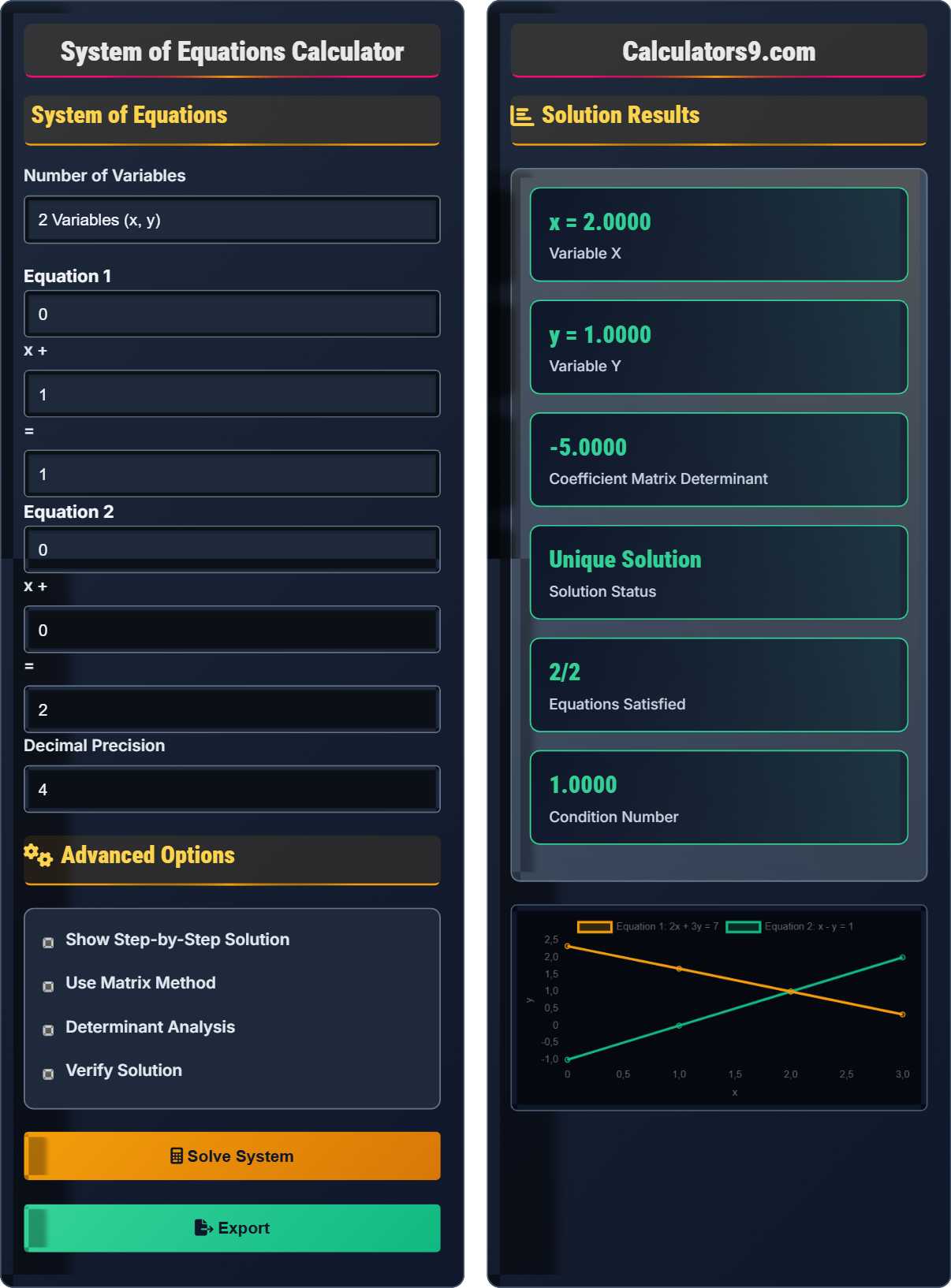
Solution Results
| Variable | Value | Status |
|---|---|---|
| x | 2.0000 | Solved |
| y | 1.0000 | Solved |
| Parameter | Value | Description |
|---|---|---|
| Determinant | -5.0000 | Non-zero indicates unique solution |
| Rank | 2 | Full rank for 2x2 system |
| Condition Number | 1.0000 | Well-conditioned system |
| Method Used | Gaussian Elimination | Direct method for solving |
| Verification | Pass | Solution satisfies equations |
Comprehensive System of Equations Guide
A system of linear equations consists of two or more linear equations involving the same set of variables. The solution to the system is the set of values that satisfy all equations simultaneously. Systems can have a unique solution, infinitely many solutions, or no solution.
A system of linear equations can be represented in matrix form as:
Where:
- \(A\) is the coefficient matrix
- \(\vec{x}\) is the vector of unknowns
- \(\vec{b}\) is the constant vector
Based on the determinant and rank of the coefficient matrix:
- Unique Solution: det(A) ≠ 0 (consistent and independent)
- Infinitely Many Solutions: det(A) = 0, rank(A) = rank(A|b) < n
- No Solution: det(A) = 0, rank(A) ≠ rank(A|b)
- Condition Number: Measures sensitivity of solution to input changes
- Engineering: Circuit analysis, structural analysis
- Economics: Supply-demand equilibrium, portfolio optimization
- Physics: Force balance, heat transfer
- Computer Graphics: Transformation matrices, 3D rendering
- Data Science: Linear regression, optimization problems
System Basics
Set of equations where each variable appears with degree one.
\( A\vec{x} = \vec{b} \)
Where A is coefficients, x is variables, b is constants.
- Variables must appear linearly
- Same number of equations as unknowns for unique solution
- Non-zero determinant for unique solution
- Rank(A) = rank(A|b) for consistent system
Methods
Multiple methods for solving linear systems.
- Gaussian Elimination
- Cramer's Rule
- Matrix Inversion
- LU Decomposition
- Computational complexity varies by method
- Condition number affects numerical stability
- Sparse systems may require specialized methods
- Iterative methods for large systems
System of Equations Learning Quiz
What determines whether a square system of linear equations has a unique solution?
The answer is B) The determinant of the coefficient matrix is non-zero. A square system of linear equations Ax = b has a unique solution if and only if the determinant of the coefficient matrix A is non-zero. When det(A) ≠ 0, the matrix A is invertible, and the unique solution is x = A⁻¹b.
This fundamental property connects linear algebra concepts to practical applications. When the determinant is zero, the system may have no solution or infinitely many solutions, depending on the constants vector b. This is because a zero determinant indicates that the rows (or columns) of the matrix are linearly dependent, meaning some equations provide redundant information.
Determinant: Scalar value that indicates matrix invertibility
Linear Independence: Rows/columns that cannot be expressed as linear combinations of others
Augmented Matrix: Coefficient matrix with constants column added
• det(A) ≠ 0 ⇒ unique solution exists
• det(A) = 0 ⇒ system may be inconsistent or dependent
• Rank(A) = Rank(A|b) ⇒ consistent system
• Always check determinant first for square systems
• Use Gaussian elimination for non-square systems
• Assuming any system has a unique solution
• Not checking for consistency when determinant is zero
Solve the system: 2x + 3y = 7 and x - y = 1 using substitution method and verify the solution.
1. From equation 2: x - y = 1, so x = y + 1
2. Substitute into equation 1: 2(y + 1) + 3y = 7
3. Simplify: 2y + 2 + 3y = 7
4. Combine like terms: 5y + 2 = 7
5. Solve for y: 5y = 5, so y = 1
6. Find x: x = y + 1 = 1 + 1 = 2
7. Verify: 2(2) + 3(1) = 4 + 3 = 7 and (2) - (1) = 1 ✓
The solution is x = 2, y = 1.
The substitution method is particularly effective when one equation can easily be solved for one variable. This problem demonstrates the systematic approach: solve one equation for one variable, substitute into the other equation, solve for the remaining variable, then find the value of the first variable. Verification is crucial to ensure the solution is correct.
Substitution Method: Solve one equation for a variable and substitute in others
Consistent System: System with at least one solutionIndependent System: System with exactly one solution
• Always verify solutions by substituting back
• Choose the simplest equation to start with
• Maintain equivalence when manipulating equations
• Look for equations with coefficient of 1 or -1
• Check your solution in both original equations
• Forgetting to substitute back to find all variables
• Arithmetic errors during substitution
FAQ
Q: What happens when a system of equations has no solution?
A: A system has no solution (is inconsistent) when the equations represent parallel lines (in 2D) or parallel planes (in 3D) that never intersect. Algebraically, this occurs when the coefficient matrix A has a different rank than the augmented matrix [A|b].
For example, the system:
\( x + y = 3 \)
\( x + y = 5 \)
has no solution because these equations represent parallel lines with the same slope but different y-intercepts.
Mathematically: If \( \text{rank}(A) \neq \text{rank}([A|b]) \), the system is inconsistent and has no solution.
Q: When does a system have infinitely many solutions?
A: A system has infinitely many solutions when the equations are dependent (one is a scalar multiple of another) and consistent. This occurs when the rank of the coefficient matrix equals the rank of the augmented matrix, but both ranks are less than the number of unknowns.
For example:
\( x + y = 2 \)
\( 2x + 2y = 4 \)
represents the same line, so any point on the line is a solution.
Mathematically: If \( \text{rank}(A) = \text{rank}([A|b]) < n \), the system has infinitely many solutions, where n is the number of unknowns.