Fish Tank Stocking Calculator
Optimal fish population & maintenance calculator • Safe aquarium planning
Stocking Density & Bioload Formulas:
Show the calculatorOne-Inch Rule: \( \text{Max Fish} = \frac{\text{Gallons}}{1} \)
Surface Area Rule: \( \text{Inches} = \frac{\text{Length} \times \text{Width}}{12} \)
Biomass Calculation: \( \text{Biomass} = \sum(\text{Fish Weight}) \)
Where:
- \( \text{Gallons} \) = tank volume in gallons
- \( \text{Length} \) = tank length in inches
- \( \text{Width} \) = tank width in inches
- \( \text{Fish Weight} \) = average weight of each fish species
- \( \text{Biomass} \) = total biological load in grams
These formulas calculate safe fish populations based on tank volume and surface area. The one-inch rule suggests one inch of adult fish per gallon, while the surface area rule considers the oxygen exchange capacity of the water surface. Biomass calculations help determine the biological load on the filtration system.
Example: For a 55-gallon tank:
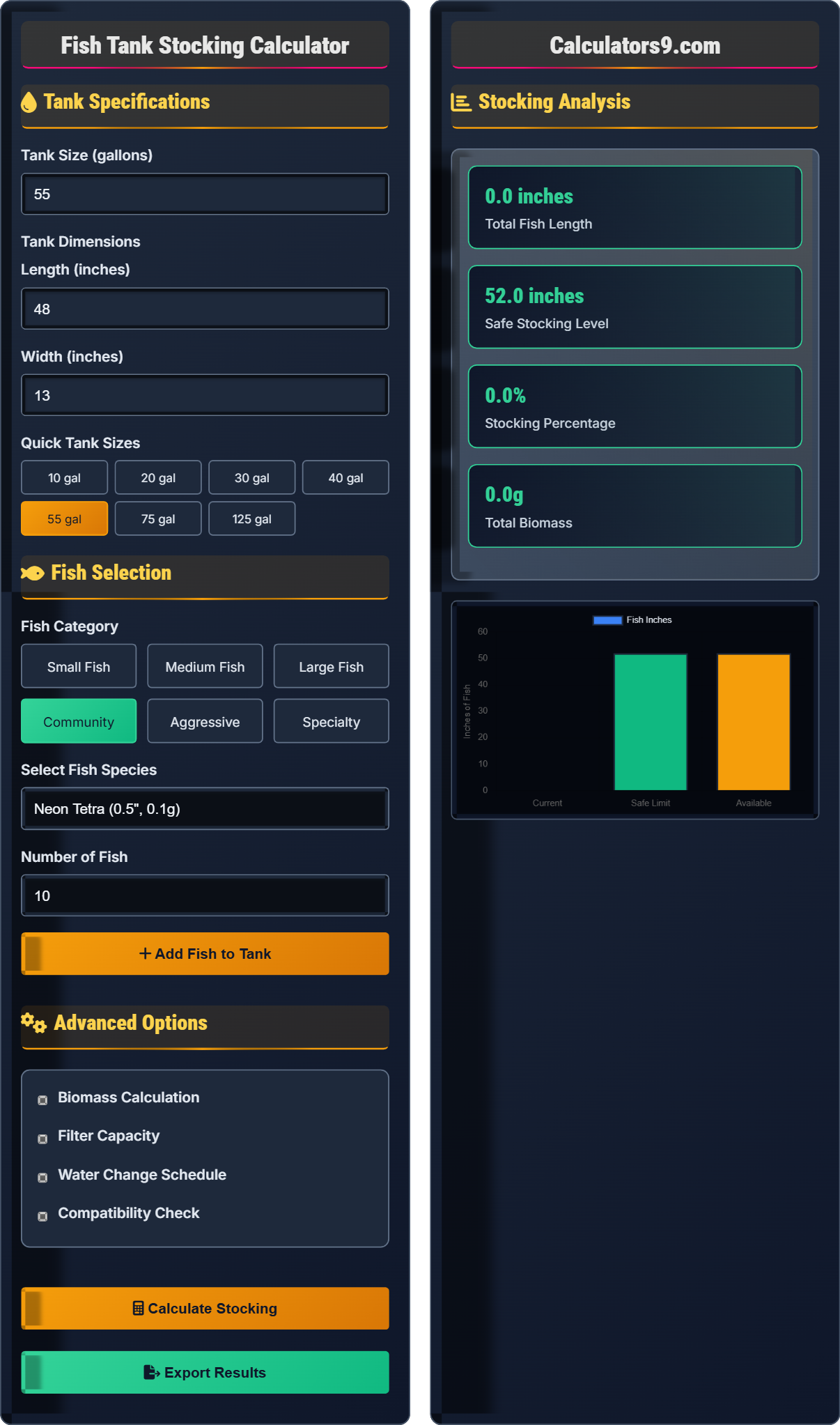
One-inch rule: Up to 55 inches of adult fish
If tank dimensions are 48" × 13" (surface area = 624 sq in):
Surface area rule: 624 ÷ 12 = 52 inches of fish
For 10 Neon Tetras (0.5" each, 0.1g each):
Biomass = 10 × 0.1g = 1g
Thus, the safe population would be 52 inches of fish with 1g biomass.
Tank Specifications
Fish Selection
Advanced Options
Stocking Analysis
Comprehensive Fish Tank Stocking Guide
Proper fish stocking is crucial for maintaining a healthy aquarium ecosystem. Overstocking leads to poor water quality, stress, disease, and shortened lifespans. The goal is to maintain a balance between aesthetics and biological sustainability.
Several methods calculate safe fish populations:
Where:
- \(\text{Gallons}\) = tank volume in gallons
- \(\text{Length}\) = tank length in inches
- \(\text{Width}\) = tank width in inches
- \(\text{Inches}\) = total length of fish
Multiple factors influence safe fish populations:
- Filtration: More efficient filters support higher bioloads
- Water Changes: Regular changes reduce waste accumulation
- Feeding: More feeding increases waste production
- Temperature: Warmer water holds less dissolved oxygen
- Decorations: Live plants consume waste, decorations reduce space
- Start Low: Begin with fewer fish and add gradually
- Monitor Parameters: Test ammonia, nitrite, nitrate regularly
- Consider Behavior: Account for territorial and schooling needs
- Plan Ahead: Consider adult fish sizes, not juvenile sizes
- Research Compatibility: Ensure fish have similar requirements
Aquarium Science Fundamentals
The metabolic load placed on biological filtration by fish waste and uneaten food.
\(\text{Max Fish} = \frac{\text{Gallons}}{1}\)
Where Gallons=tank volume in gallons.
- Account for adult fish sizes, not current sizes
- Consider behavioral compatibility
- Factor in filtration capacity
Maintenance Guidelines
Maintaining stable water parameters through proper stocking and maintenance.
- Weekly: 25% for heavily stocked tanks
- Bi-weekly: 25% for moderately stocked tanks
- Monthly: 10-15% for lightly stocked tanks
- More fish = more frequent water changes
- Heavier feeders require more maintenance
- Efficient filtration extends maintenance intervals
Fish Tank Stocking Learning Quiz
According to the one-inch rule, how many inches of adult fish can be safely kept in a 55-gallon aquarium?
The answer is B) 55 inches. The one-inch rule states that you can keep one inch of adult fish per gallon of water. Therefore, a 55-gallon tank can safely house 55 inches of adult fish.
The one-inch rule is a simplified guideline for determining safe fish populations. It's important to note that this rule assumes average-sized fish and doesn't account for differences in bioload between species. Larger or more active fish produce more waste and require more space.
One-Inch Rule: Guideline suggesting one inch of adult fish per gallon of water
Bioload: The metabolic burden placed on biological filtration by fish waste
Adult Size: Final size fish will reach, not current size
• Use adult fish sizes, not current sizes
• Consider fish activity level and waste production
• The rule is a starting point, not absolute
• Research adult sizes before purchasing fish
• Start with fewer fish and add gradually
• Consider the surface area rule for additional guidance
• Counting juvenile fish instead of adult sizes
Calculate the safe fish population for a 75-gallon tank using the one-inch rule. If you want to add 5 Discus fish (8 inches each), how many additional 2-inch fish can you add?
Using the one-inch rule: 75 gallons = 75 inches of fish
Discus fish total: 5 × 8 inches = 40 inches
Remaining capacity: 75 - 40 = 35 inches
Additional 2-inch fish: 35 ÷ 2 = 17.5, so 17 fish
Therefore, you can add 17 additional 2-inch fish.
This calculation demonstrates how to plan fish additions by subtracting the bioload of existing fish from the total capacity. It's important to leave room for growth and ensure the tank isn't overstocked.
Safe Capacity: Maximum fish size the tank can support
Bioload: Waste production and oxygen consumption
Overstocking: Exceeding safe fish population limits
• Always account for existing fish when adding new ones
• Consider growth when calculating capacity
• Leave buffer room for safety
• Keep a running tally of fish lengths
• Plan fish additions in advance
• Consider compatibility with existing fish
• Forgetting to account for existing fish
• Not considering growth of current fish
You have a 40-gallon tank that is 36 inches long and 18 inches wide. Using the surface area rule (1 inch of fish per 12 square inches of surface area), what is the safe fish population? How does this compare to the one-inch rule?
Step 1: Calculate surface area = 36 × 18 = 648 square inches
Step 2: Calculate safe population = 648 ÷ 12 = 54 inches of fish
Step 3: One-inch rule gives 40 inches (equal to gallons)
Step 4: Surface area rule allows 54 inches vs 40 inches from one-inch rule
The surface area rule suggests 54 inches of fish is safe, which is more generous than the one-inch rule's 40 inches.
This example shows how different calculation methods can yield different results. The surface area rule focuses on oxygen exchange capacity, while the one-inch rule considers overall bioload. Using multiple methods provides a more comprehensive assessment.
Surface Area Rule: One inch of fish per 12 square inches of surface area
Oxygen Exchange: Process by which oxygen enters and carbon dioxide exits water
Water Surface: Critical area for gas exchange in aquarium
• Surface area rule is more accurate for oxygen-dependent fish
• Both rules should be considered together
• Actual safe population may be lower than calculated
• Use the more conservative of the two calculations
• Consider fish oxygen requirements when choosing calculation method
• Factor in tank decorations that reduce surface area
• Relying on only one calculation method
• Not accounting for tank decorations that reduce surface area
Your 55-gallon tank currently houses 20 Neon Tetras (0.1g each) and 5 Guppies (0.2g each). If you want to maintain a total biomass under 10g, how many 5g Angelfish can you add? (Assume the recommended limit is 10g for a 55-gallon tank)
Step 1: Calculate current biomass = (20 × 0.1g) + (5 × 0.2g) = 2g + 1g = 3g
Step 2: Calculate remaining capacity = 10g - 3g = 7g
Step 3: Calculate maximum Angelfish = 7g ÷ 5g = 1.4, so 1 Angelfish
Step 4: Verify: 3g + (1 × 5g) = 8g, which is under the 10g limit
Therefore, you can add 1 Angelfish while staying within the biomass limit.
Biomass calculation provides a more scientific approach to stocking by quantifying the actual biological load. Different fish species produce different amounts of waste based on their size, metabolism, and feeding habits. This method is particularly useful for heavily stocked tanks.
Biomass: Total weight of living organisms in the aquarium
Metabolic Load: Waste production based on fish mass
Biological Filtration: Process of converting toxic ammonia to less harmful substances
• Larger fish have higher metabolic rates
• Consider fish diet when calculating bioload
• Track biomass as you add fish
• Research approximate weights for different species
• Consider upgrading filtration for higher biomass
• Underestimating the bioload of larger fish
• Not accounting for fish growth in biomass calculations
Which factor is MOST important when determining if fish are compatible for the same tank?
The answer is B) Similar water parameter requirements. Fish with incompatible water parameter needs (temperature, pH, hardness) cannot coexist long-term regardless of other factors. Water chemistry is fundamental to fish health and survival.
Water parameters are the foundation of fish compatibility. Temperature, pH, and hardness requirements must be compatible for all fish in the tank. Other factors like temperament and size are important but secondary to water chemistry.
Water Parameters: Chemical and physical characteristics of aquarium water
pH: Measure of water acidity/alkalinity
Hardness: Concentration of dissolved minerals in water
• Water parameters must be suitable for all fish
• Temperature tolerance ranges must overlap
• pH requirements should match closely
• Research water parameter requirements before purchasing fish
• Group fish with similar requirements together
• Monitor parameters regularly after adding fish
• Adding fish with incompatible water requirements
• Not testing water parameters before adding fish
FAQ
Q: How do I calculate the safe number of fish for my tank?
A: Several methods exist for calculating safe fish populations. The traditional one-inch rule suggests one inch of adult fish per gallon of water: \( \text{Max Fish} = \frac{\text{Gallons}}{1} \).
However, a more accurate approach considers surface area: \( \text{Inches} = \frac{\text{Length} \times \text{Width}}{12} \).
For example, in a 55-gallon tank (48" × 13" surface area):
One-inch rule: 55 inches of fish
Surface area rule: \( \frac{48 \times 13}{12} = 52 \) inches of fish
The more conservative 52-inch recommendation is safer. Additionally, consider fish size: small fish (0-2") use 1:1 ratio, medium fish (2-4") use 1:2 ratio, and large fish (4"+) use 1:3 to 1:5 ratio.
Q: What's the relationship between fish biomass and water quality?
A: Fish biomass directly impacts water quality through waste production. The relationship follows: \( \text{Ammonia Production} = \sum(\text{Fish Weight} \times \text{Metabolic Rate}) \).
Each gram of fish produces approximately 0.1-0.2mg of ammonia daily. A 55-gallon tank might safely accommodate 100g of fish biomass. Exceeding this leads to elevated ammonia and nitrite levels.
For example, 20 neon tetras (0.1g each) produce about 0.2-0.4mg ammonia daily, while 5 discus (10g each) produce 0.5-1.0mg daily. The biological filter must process all this waste efficiently.
Regular water changes (25% weekly for stocked tanks) help maintain water quality by removing accumulated nitrates and replenishing trace elements.