Light
Moderate
Heavy
Cycled
New Setup
Aquarium water change volume & schedule calculator • Maintenance optimized
Volume Calculation: \( V = T \times P \)
Cumulative Removal: \( R = 1 - (1 - P)^N \)
Parameter Reduction: \( C_n = C_0 \times (1 - P)^n \)
Where:
These formulas calculate the exact volume of water to remove during each change and the cumulative effect of repeated water changes. The volume calculation determines how much water to extract based on tank size and desired percentage. The cumulative formula shows how repeated water changes progressively reduce pollutant concentrations in the aquarium.
Example: For a 55-gallon tank with 25% water changes:
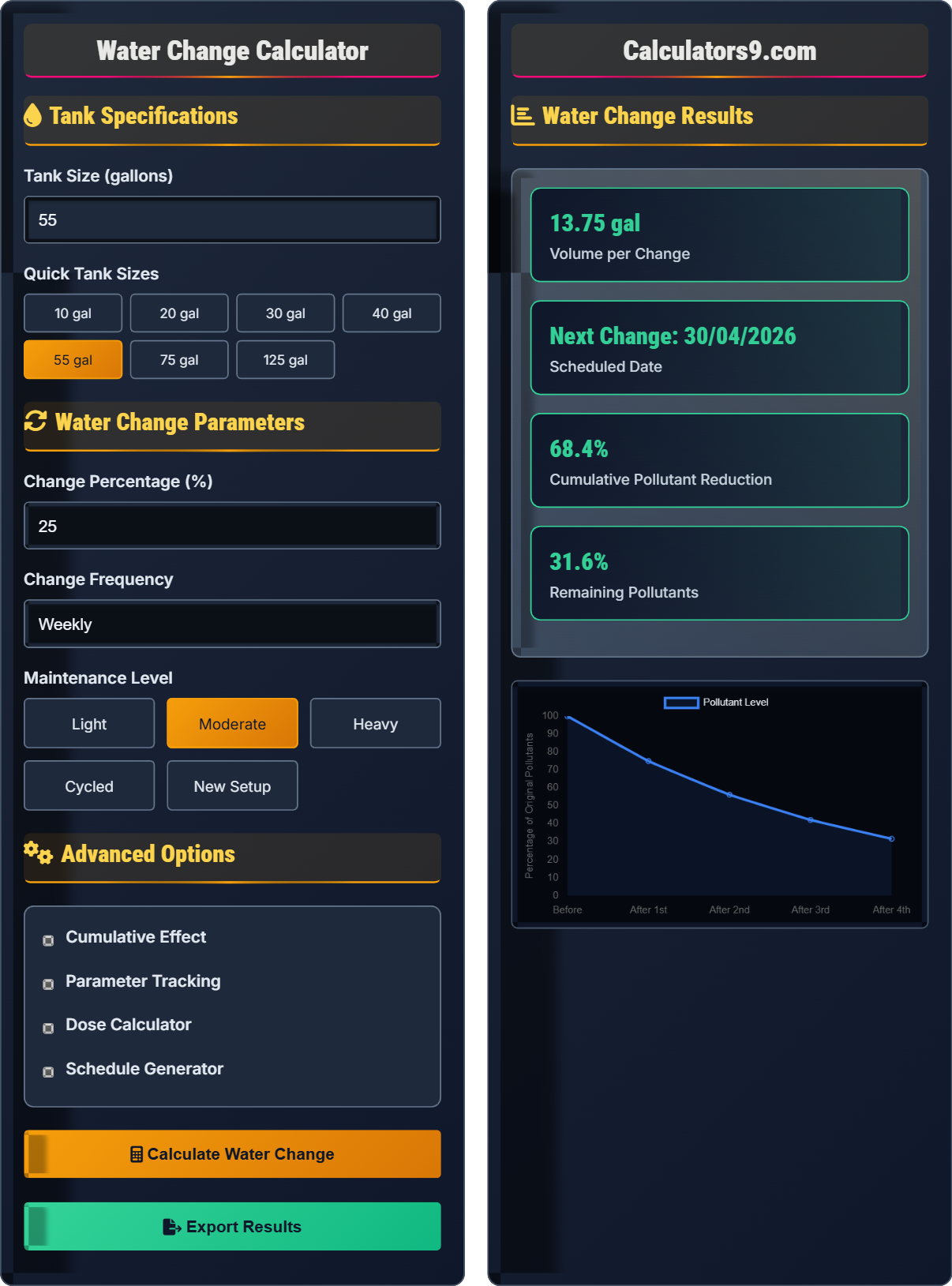
Volume per change = 55 × 0.25 = 13.75 gallons
After 4 consecutive changes:
Cumulative removal = 1 - (1 - 0.25)^4 = 1 - (0.75)^4 = 1 - 0.316 = 0.684 or 68.4%
Thus, you need to remove 13.75 gallons per change, achieving 68.4% cumulative pollutant reduction after 4 changes.
Regular water changes are the most important aspect of aquarium maintenance. They remove accumulated nitrates, phosphates, and other dissolved organics while replenishing essential minerals and maintaining water chemistry stability. Without regular water changes, these compounds build up and can harm fish health over time.
Key calculations for effective water changes:
Where:
Water changes effectively reduce various harmful compounds:
Repeated water changes progressively reduce pollutant concentrations in the aquarium.
\(V = T \times P\)
Where V=volume, T=tank size, P=percentage.
Regular intervals maintain stable water parameters and prevent sudden changes.
For a 55-gallon aquarium with a 25% water change, how many gallons should be removed?
The answer is B) 13.75 gallons. Using the formula \(V = T \times P\):
V = 55 gallons × 0.25 = 13.75 gallons
Therefore, 13.75 gallons should be removed during the water change.
This calculation is fundamental to proper water change execution. The volume formula helps aquarists determine exactly how much water to remove based on their tank size and desired percentage. Accurate measurements ensure consistent maintenance practices.
Water Change Volume: Amount of water removed and replaced during maintenance
Percentage: Fraction of total tank volume being changed
Tank Volume: Total capacity of the aquarium in gallons
• Calculate volume before each water change
• Use consistent percentages for routine maintenance
• Never exceed 50% change in a single session
• Mark water level with tape to track volume removed
• Use a measuring container for accuracy
• Calculate in advance and prepare containers
• Estimating volume instead of calculating
• Changing too much water at once
After 4 consecutive 25% water changes, what percentage of the original pollutants will remain in the aquarium? Use the cumulative formula: \(R = 1 - (1 - P)^N\)
Given:
Step 1: Calculate cumulative removal: \(R = 1 - (1 - 0.25)^4\)
Step 2: \(R = 1 - (0.75)^4\)
Step 3: \(R = 1 - 0.316\)
Step 4: \(R = 0.684\) or 68.4%
Step 5: Remaining pollutants = 100% - 68.4% = 31.6%
Therefore, 31.6% of the original pollutants will remain after 4 consecutive 25% water changes.
This demonstrates the exponential effect of repeated water changes. Each change removes a percentage of what remains, not a fixed amount. The cumulative effect shows how regular maintenance progressively improves water quality over time.
Cumulative Effect: Progressive reduction of pollutants through repeated changes
Exponential Decay: Reduction pattern where each change removes a percentage of remaining pollutants
Remaining Pollutants: Concentration left after water changes
• Each change affects remaining pollutants, not original amount
• Consistency amplifies cumulative benefits
• More changes yield greater pollutant reduction
• Regular changes are more effective than sporadic large changes
• Track cumulative effects over time
• Maintain consistent schedule for maximum benefit
• Expecting immediate results from single changes
• Not maintaining consistent schedule
Your 75-gallon tank currently has 60 ppm nitrates. You perform a 30% water change. If the new water has 0 ppm nitrates, what will be the expected nitrate level after the change? (Use the formula: \(C_n = C_0 \times (1 - P)\))
Given:
Step 1: Apply formula: \(C_n = 60 \times (1 - 0.30)\)
Step 2: \(C_n = 60 \times 0.70\)
Step 3: \(C_n = 42\) ppm
Therefore, the expected nitrate level after the change will be 42 ppm.
This calculation shows how water changes dilute existing pollutants. The formula accounts for the percentage of old water remaining after the change. Since 30% of water is replaced, 70% of the original concentration remains.
Parameter Tracking: Monitoring water chemistry changes over time
Dilution Effect: Reduction in concentration through mixing with clean water
Initial Concentration: Parameter level before water change
• Water changes dilute, not eliminate, pollutants
• Monitor parameters before and after changes
• Test water parameters before and after changes
• Track trends over multiple changes
• Adjust change percentage based on results
• Assuming water changes completely eliminate pollutants
• Not testing source water parameters
You need to dose water conditioner at a rate of 5ml per 10 gallons of water. If you're doing a 25% water change on a 60-gallon tank, how much conditioner should you add to the new water? (Remember to only dose the volume of new water being added)
Step 1: Calculate volume of new water = 60 × 0.25 = 15 gallons
Step 2: Calculate conditioner dosage rate = 5ml per 10 gallons
Step 3: Calculate conditioner needed = (15 ÷ 10) × 5ml = 1.5 × 5ml = 7.5ml
Therefore, you should add 7.5ml of water conditioner to the 15 gallons of new water.
This example demonstrates the importance of dosing products based on the actual volume of new water being added, not the total tank volume. Over-dosing can harm fish, while under-dosing may not adequately treat the water.
Dose Calculation: Determining appropriate product amounts based on water volume
Water Conditioner: Product that neutralizes chlorine/chloramines in tap water
Product Rate: Manufacturer's recommended dosage per volume
• Always dose products based on actual water volume being treated
• Follow manufacturer's instructions precisely
• Only dose new water during water changes
• Use syringes or measuring spoons for accuracy
• Pre-mix products in separate container
• Keep dosing log for consistency
• Dosing based on total tank volume instead of new water volume
• Guessing measurements instead of using proper tools
Which factor should have the greatest influence on determining water change frequency?
The answer is B) Bioload (number and size of fish). The bioload determines how quickly pollutants accumulate in the tank. More fish and larger fish produce more waste, increasing the rate at which nitrates and other compounds build up, thus requiring more frequent water changes.
Bioload is the primary factor affecting water quality degradation rate. Fish produce ammonia through respiration and waste, which converts to nitrates through the nitrogen cycle. The amount of waste produced directly correlates to the number and size of fish in the tank.
Bioload: Metabolic burden placed on the aquarium by fish and other organisms
Pollutant Accumulation: Buildup of waste compounds over time
Waste Production: Amount of ammonia/nitrites/nitrates produced by fish
• Heavily stocked tanks need more frequent changes
• Feeding amount affects bioload and change frequency
• Filtration efficiency influences required frequency
• Monitor nitrate levels to adjust frequency
• Increase frequency when adding new fish
• Reduce feeding to decrease bioload impact
• Using same schedule for all tanks regardless of bioload
• Not adjusting frequency when bioload changes
Q: How do I calculate the exact volume for water changes?
A: The basic formula is: \( V = T \times P \), where \( V \) is the volume to change, \( T \) is total tank volume, and \( P \) is the percentage as a decimal.
For example, in a 55-gallon tank with 25% water changes: \( V = 55 \times 0.25 = 13.75 \) gallons.
The cumulative effect follows: \( R = 1 - (1 - P)^N \), where \( R \) is cumulative removal and \( N \) is the number of consecutive changes. After 4 changes of 25%: \( R = 1 - (0.75)^4 = 0.684 \) or 68.4% removal.
This means 68.4% of pollutants are removed and 31.6% remain after 4 consecutive 25% changes.
Q: How does the cumulative effect of water changes work?
A: The cumulative effect follows an exponential decay model: \( C_n = C_0 \times (1 - P)^n \), where \( C_n \) is concentration after n changes, \( C_0 \) is initial concentration, \( P \) is change percentage, and \( n \) is number of changes.
For example, starting with 40 ppm nitrates and doing 25% changes:
Each change removes 25% of what remains, not 25% of the original amount. This is why consistency is more important than large individual changes.