Light Year Converter
Space distance calculator • 2026 astronomy
Light Year Conversion Formula:
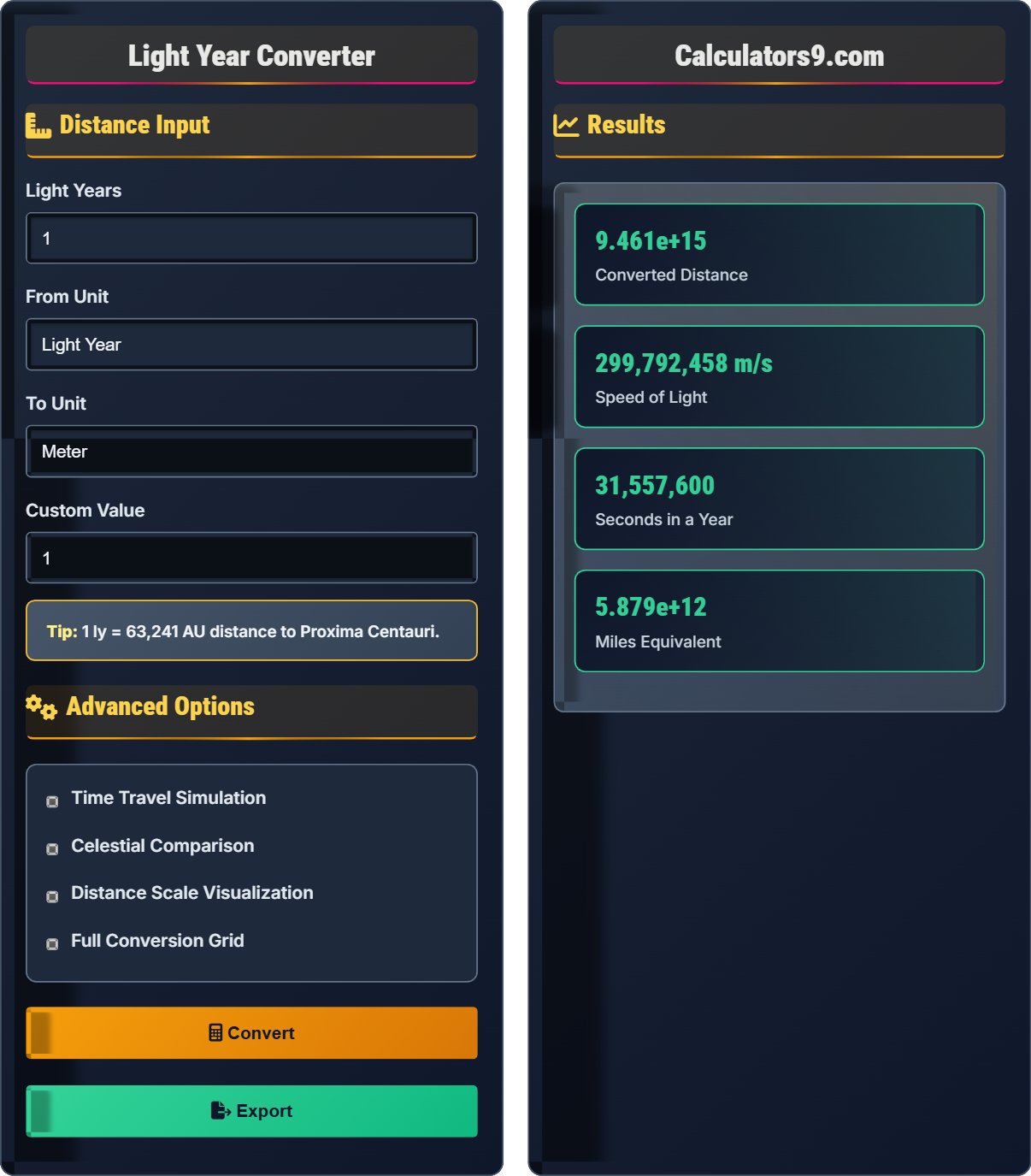
Show the calculator\( 1 \text{ Light Year} = 9.461 \times 10^{15} \text{ meters} \)
Where:
- \( c \) = speed of light (\( 299,792,458 \) m/s)
- \( t \) = time in seconds for 1 year (\( 31,557,600 \) s)
- \( d = c \times t \) = distance traveled by light in one year
A light year is the distance that light travels in one Julian year (365.25 days) in a vacuum. It's a unit of distance, not time, commonly used in astronomy to measure vast cosmic distances.
Example: To convert 5 light years to kilometers:
\( 5 \text{ ly} = 5 \times 9.461 \times 10^{15} \text{ m} = 4.731 \times 10^{16} \text{ m} = 4.731 \times 10^{13} \text{ km} \)
Thus, 5 light years equals approximately 47.31 trillion kilometers.
Distance Input
Advanced Options
Results
Comprehensive Astronomy Guide
A light year is a unit of distance, not time, representing how far light travels in one Julian year (365.25 days) in a vacuum. It equals approximately 9.461 trillion kilometers or 5.879 trillion miles. This measurement is essential in astronomy for expressing vast interstellar and intergalactic distances that would be impractical to express in smaller units.
The light year conversion uses the speed of light constant:
Where:
- \(c\) = speed of light in vacuum
- \(t\) = seconds in a Julian year
- \(1 \text{ ly} = 9.461 \times 10^{15} \text{ meters}\)
- Proxima Centauri: 4.24 light years away (closest star to our Sun)
- Center of Milky Way: ~26,000 light years from Earth
- Andromeda Galaxy: ~2.5 million light years away
- Observable Universe: ~46.5 billion light years radius
- Light Travel Time: When we observe distant objects, we see them as they were in the past
- Cosmic Distance Ladder: Series of methods to determine distances to celestial objects
- Redshift: Expansion of the universe affects observed wavelengths of light
- Parallax: Apparent shift in position due to observer's location change
Light Year Basics
Distance light travels in one year in vacuum.
\(1 \text{ ly} = c \times t\)
Where c=speed of light, t=time in seconds for 1 year.
- 1 ly = 9.461×10¹⁵ meters
- Used for interstellar distances
- Not a measure of time
Cosmic Distances
Closest star to our solar system at 4.24 light years.
- Identify starting unit
- Apply conversion factor
- Calculate final value
- Verify scientific notation
- Vacuum light speed: 299,792,458 m/s
- Julian year: 365.25 days
- Relativistic effects at near-light speeds
Astronomy Learning Quiz
What does a light year measure?
The answer is B) Distance. A light year is a unit of distance, not time. It represents how far light travels in one Julian year (365.25 days) in a vacuum. Specifically, 1 light year equals approximately 9.461 trillion kilometers or 5.879 trillion miles.
This is a common misconception - despite having "year" in its name, a light year measures distance, not time. The name comes from the concept of how far light can travel in a year's time. This unit is practical for astronomy because the distances in space are so vast that smaller units like kilometers or miles become unwieldy.
Light Year: Distance light travels in one Julian year in vacuum
Julian Year: 365.25 days (used for astronomical calculations)
Speed of Light: 299,792,458 meters per second in vacuum
• A light year is a distance measurement, not a time measurement
• 1 light year = 9.461×10¹⁵ meters
• Used for expressing interstellar and intergalactic distances
• Remember: "Light year" = "Light distance in one year"
• Think of it as a ruler for measuring cosmic distances
• Confusing light years with time measurement
• Forgetting that it's based on the Julian year (365.25 days)
Calculate the distance in meters for 3.5 light years. Use the speed of light as 299,792,458 m/s and 1 year = 31,557,600 seconds. Show your work.
Using the light year formula: \(d = c \times t\)
Where:
- c = speed of light = 299,792,458 m/s
- t = time in seconds for 1 year = 31,557,600 s
- Distance for 1 light year = 299,792,458 × 31,557,600 = 9.461×10¹⁵ m
Step 1: Calculate 1 light year in meters
299,792,458 × 31,557,600 = 9,460,730,472,580,800 ≈ 9.461×10¹⁵ m
Step 2: Multiply by 3.5
3.5 × 9.461×10¹⁵ = 3.311×10¹⁶ m
Therefore, 3.5 light years equals approximately 3.311×10¹⁶ meters.
This calculation demonstrates the enormous scale of cosmic distances. Even multiplying a single light year by just 3.5 results in an almost incomprehensible number of meters. This is why astronomers use light years - to make these distances more manageable in terms of human understanding.
Scientific Notation: Method to express very large or small numbers (e.g., 9.461×10¹⁵)
Speed of Light: Maximum speed at which all energy, matter, and information can travel
Julian Year: 365.25 days used in astronomical calculations
• Always use scientific notation for large astronomical distances
• Use the Julian year (365.25 days) for astronomical calculations
• The speed of light is constant in vacuum
• Remember: 1 ly ≈ 9.461×10¹⁵ meters
• Use scientific notation to handle large numbers efficiently
• Double-check your exponent calculations
• Incorrectly calculating the number of seconds in a year
• Arithmetic errors with large numbers
• Forgetting to use scientific notation for final answers
Proxima Centauri is the closest star to our solar system at a distance of 4.24 light years. If a spacecraft could travel at 20% the speed of light, how long would it take to reach Proxima Centauri? Express your answer in years.
Step 1: Determine spacecraft speed
Speed of light = 299,792,458 m/s
Spacecraft speed = 20% of light speed = 0.20 × 299,792,458 = 59,958,491.6 m/s
Step 2: Calculate distance to Proxima Centauri
Distance = 4.24 light years = 4.24 × 9.461×10¹⁵ = 4.012×10¹⁶ meters
Step 3: Calculate travel time
Time = Distance ÷ Speed = 4.012×10¹⁶ ÷ 59,958,491.6
Time = 6.692×10⁸ seconds
Convert to years: 6.692×10⁸ ÷ 31,557,600 ≈ 21.2 years
Alternatively, using ratios: 4.24 light years ÷ 0.20c = 21.2 years
Therefore, it would take approximately 21.2 years to reach Proxima Centauri.
This problem illustrates the immense challenges of interstellar travel. Even traveling at 20% the speed of light - which is currently beyond our technological capabilities - would take over two decades to reach our nearest stellar neighbor. This demonstrates why interstellar travel remains a significant challenge for humanity.
Proxima Centauri: Closest known star to our Solar System
Space Travel: Journey through outer spaceSpeed Ratio: Fraction of the speed of light
• Time = Distance ÷ Speed
• When dealing with fractions of light speed, use ratios
• Current technology limits spacecraft speeds significantly
• Use ratios when dealing with fractions of light speed
• 4.24 light years at 0.20c = 4.24/0.20 = 21.2 years
• Convert units consistently throughout calculations
• Forgetting to convert percentage to decimal
• Inconsistent unit conversions
• Arithmetic errors with large numbers
The observable universe has a radius of approximately 46.5 billion light years. If the universe has been expanding since the Big Bang 13.8 billion years ago, explain why the radius is larger than the age of the universe. How does this relate to the expansion of space itself?
Step 1: Understand the apparent contradiction
Age of universe: 13.8 billion years
Observable universe radius: 46.5 billion light years
Step 2: Recognize that space itself expands
The expansion of space is not limited by the speed of light. As space expands, galaxies move away from each other not through space but because space itself stretches.
Step 3: Light travel and expansion
Light from distant galaxies has been traveling toward us for billions of years, but during that time, the space between us and those galaxies has continued to expand. So the galaxies that emitted that light are now much farther away than the light travel time would suggest.
Step 4: Cosmic inflation
During cosmic inflation shortly after the Big Bang, space expanded faster than the speed of light, allowing regions to become causally disconnected.
Therefore, the observable universe is larger than expected because space expansion allows distances to grow faster than light can travel.
This demonstrates a fundamental concept in cosmology - that space itself can expand faster than the speed of light, while objects within space cannot exceed light speed. This resolves the apparent paradox of the observable universe being larger than its age would suggest. The metric expansion of space means that distant objects are receding from us faster than light speed, which is allowed because it's space itself that's moving, not the objects through space.
Observable Universe: Region of the universe from which we can receive light
Cosmic Expansion: Increase in distance between parts of the universe over time
Big Bang: Beginning of the observable universe
• Space expansion is not limited by light speed
• Objects in space cannot exceed light speed
• Light travel time differs from current distance
• Think of space as stretching rubber fabric
• Galaxies are like dots on expanding balloon
• The universe's age is not the same as its size
• Assuming the universe's radius equals its age
• Forgetting that space itself can expand
• Confusing object movement with space expansion
Which of the following correctly orders these distance units from smallest to largest?
The answer is C) AU, Light Year, Parsec. Here are the approximate conversions:
- 1 Astronomical Unit (AU) = 149.6 million km (Earth-Sun distance)
- 1 Light Year ≈ 63,241 AU
- 1 Parsec ≈ 3.26 Light Years ≈ 206,265 AU
So the correct order from smallest to largest is: AU < Light Year < Parsec
These three units represent different scales of astronomical distance measurement. The AU is appropriate for solar system distances, the light year for interstellar distances, and the parsec for galactic and intergalactic distances. The parsec is based on parallax measurements and is actually slightly larger than a light year, contrary to what some might expect from the names.
AU (Astronomical Unit): Earth-Sun average distance
Light Year: Distance light travels in one year
Parsec: Distance at which 1 AU subtends 1 arcsecond
• 1 AU = 149,597,870.7 km
• 1 light year ≈ 63,241 AU
• 1 parsec ≈ 3.26 light years
• Remember: AU for solar system, LY for stars, PC for galaxies
• 1 pc ≈ 3.26 ly (not exactly 3)
• AU is based on Earth's orbit
• Confusing the relative sizes of these units
• Thinking parsec is smaller than light year
• Forgetting that AU is Earth-Sun distance
FAQ
Q: Why do astronomers use light years instead of kilometers for cosmic distances?
A: Astronomers use light years because cosmic distances are so vast that expressing them in kilometers becomes unwieldy. For example, Proxima Centauri is 40,000,000,000,000 kilometers away, but only 4.24 light years. The light year makes these numbers more manageable.
Mathematically, if we consider the distance to Proxima Centauri:
\( d_{km} = 4.24 \times 9.461 \times 10^{12} \approx 4.01 \times 10^{13} \text{ km} \)
Compared to:
\( d_{ly} = 4.24 \text{ ly} \)
The light year also has conceptual value - it tells us how long light from an object has been traveling to reach us, giving us information about the object's past state.
Q: What's the difference between a light year and a parsec?
A: Both are units of distance used in astronomy, but they're derived differently:
- Light Year: Distance light travels in one year = \( 9.461 \times 10^{15} \) meters
- Parsec: Distance at which 1 AU subtends 1 arcsecond = \( 3.086 \times 10^{16} \) meters
Conversion: 1 parsec ≈ 3.26 light years
The parsec is based on parallax measurements, which is how astronomers measure distances to nearby stars. When Earth orbits the Sun, nearby stars appear to shift position against the background of more distant stars. A star with a parallax of 1 arcsecond is defined as being 1 parsec away.