Fuel Burn Calculator
Aviation fuel planning • Flight efficiency
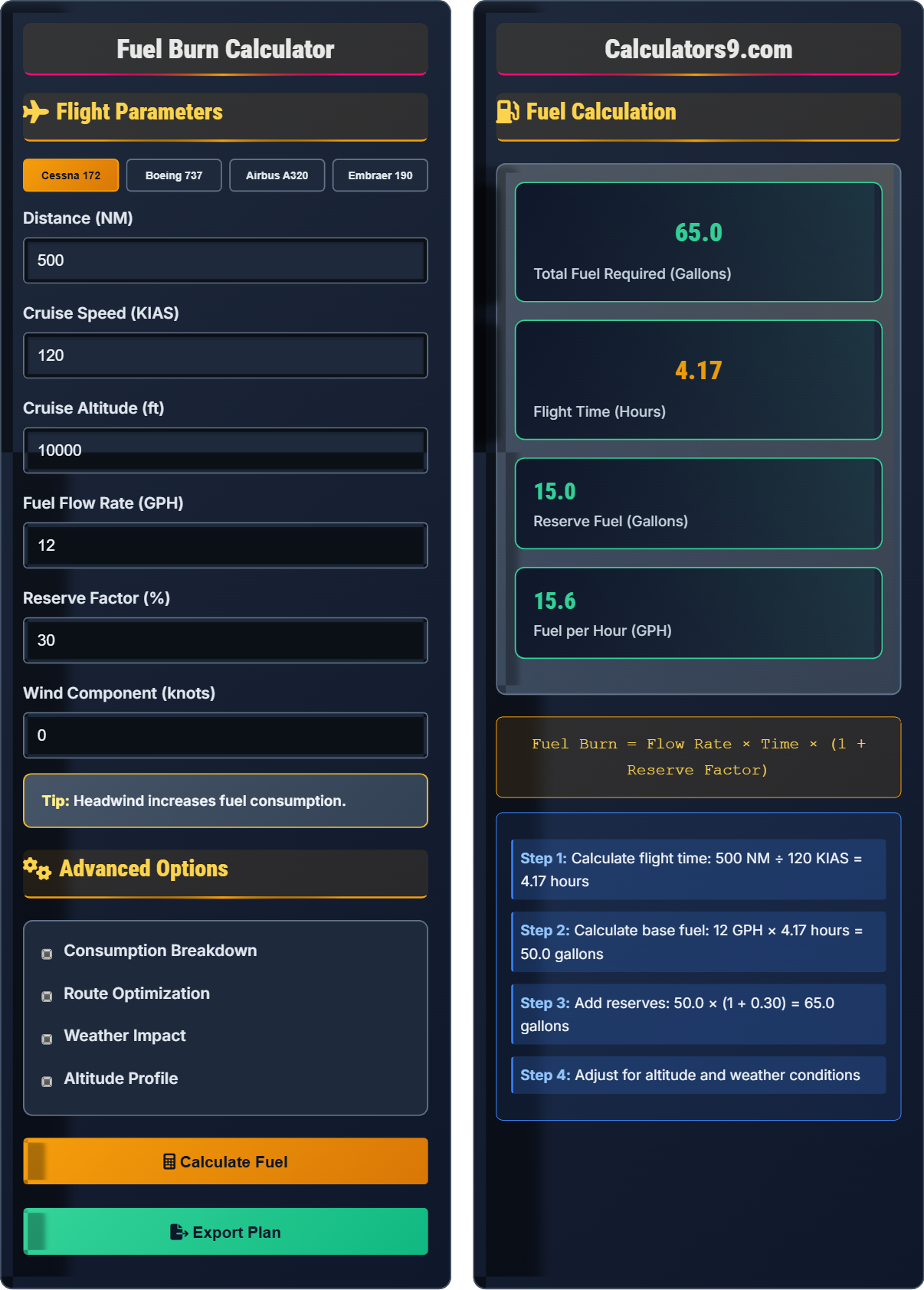
Fuel Burn Formula:
Show the calculator\( \text{Fuel Burn} = \text{Fuel Flow Rate} \times \text{Flight Time} \times (1 + \text{Reserve Factor}) \)
Where:
- \( \text{Fuel Flow Rate} \) = Gallons per hour (GPH) or pounds per hour (PPH)
- \( \text{Flight Time} \) = Total duration of flight in hours
- \( \text{Reserve Factor} \) = Additional percentage for safety reserves (typically 10-45%)
Additional factors affecting fuel consumption:
- Altitude: Higher altitudes generally improve fuel efficiency
- Weather: Headwinds increase fuel consumption, tailwinds decrease it
- Weight: Heavier aircraft consume more fuel
- Temperature: Hotter temperatures reduce engine efficiency
Example: For a Cessna 172 flying 3 hours with 12 GPH fuel flow rate and 30% reserve:
Fuel Burn = 12 GPH × 3 hours × (1 + 0.30) = 46.8 gallons
Thus, the pilot should plan for approximately 47 gallons of fuel.
Flight Parameters
Advanced Options
Fuel Calculation
Aviation Fuel & Flight Planning Guide
Aviation fuel consumption is critical for safe flight operations. Pilots must accurately calculate fuel requirements considering multiple factors including distance, aircraft performance, weather conditions, and regulatory requirements. The Federal Aviation Administration (FAA) mandates specific fuel reserves for different types of flights.
Aviation gasoline (avgas) and jet fuel (Jet A, Jet A-1) have different energy densities and consumption characteristics. Proper fuel planning prevents in-flight emergencies and ensures compliance with safety regulations.
The basic fuel calculation formula considers multiple phases of flight:
Where:
- \(\text{Trip Fuel} = \text{Fuel Flow Rate} \times \text{Flight Time}\)
- \(\text{Reserve Fuel} = \text{Trip Fuel} \times \text{Reserve Percentage}\)
- \(\text{Flight Time} = \text{Distance} \div \text{Ground Speed}\)
- \(\text{Ground Speed} = \text{True Airspeed} + \text{Wind Component}\)
Altitude: Higher altitudes typically offer better fuel efficiency due to reduced air density and drag, though engine performance may vary.
Weight: Heavier aircraft require more thrust and consume more fuel. Fuel burn decreases as fuel is consumed during flight.
Weather: Headwinds increase ground distance and fuel consumption, while tailwinds reduce both. Temperature affects engine performance and air density.
Aircraft Configuration: Landing gear down, flaps extended, and other configurations increase drag and fuel consumption.
- Optimal Altitude: Climb to most efficient altitude for aircraft weight and conditions
- Continuous Descent: Reduce fuel consumption during descent phase
- Weather Routing: Avoid headwinds, seek tailwinds when possible
- Weight Management: Remove unnecessary items to reduce fuel burn
- Engine Management: Operate engines in most efficient settings
Fuel Planning Basics
Systematic calculation of required fuel for safe flight completion.
\( \text{Total Fuel} = \text{Trip Fuel} + \text{Reserves} \)
Consider altitude, weather, and aircraft performance.
- Always carry required reserves
- Account for weather effects
- Consider aircraft weight
- Plan for contingencies
Efficiency Factors
Higher altitudes generally improve fuel efficiency.
- Heavier = more fuel consumption
- Fuel burn decreases as fuel is consumed
- Optimize load for efficiency
- Monitor fuel burn throughout flight
- Engine performance varies with altitude
- Weather routing can save fuel
- Configuration affects consumption
- Temperature impacts efficiency
Aviation Fuel Learning Quiz
According to FAA regulations, what is the minimum fuel reserve required for a VFR flight during daylight hours?
The answer is B) 30 minutes of fuel after reaching destination. According to FAR 91.151, pilots operating under Visual Flight Rules (VFR) during daylight hours must carry enough fuel to reach their destination and then fly for an additional 30 minutes at normal cruising speed. For night VFR flights, the requirement increases to 45 minutes of reserve fuel.
These fuel reserve requirements are safety measures designed to provide pilots with adequate time to deal with unexpected circumstances such as weather changes, navigation errors, or air traffic delays. The additional fuel ensures pilots have options if they need to divert to an alternate airport or circle while waiting for conditions to improve.
VFR: Visual Flight Rules - flight conducted with visual reference to the ground
FAR 91.151: Federal Aviation Regulation specifying fuel requirements
Fuel Reserves: Additional fuel beyond trip fuel for safety margins
• VFR Day: 30 minutes reserve fuel
• VFR Night: 45 minutes reserve fuel
• IFR: 45 minutes after reaching alternate
• Always calculate fuel reserves based on normal cruise speed
• Consider actual weather conditions when planning
• Account for potential diversions in fuel planning
• Confusing day and night fuel requirements
• Not accounting for wind effects on fuel consumption
• Underestimating fuel needs for diversions
Calculate the total fuel required for a flight of 600 nautical miles with a fuel flow rate of 15 GPH, cruise speed of 150 knots, and 25% reserve factor. Show your work.
Step 1: Calculate flight time = Distance ÷ Speed = 600 NM ÷ 150 knots = 4.0 hours
Step 2: Calculate trip fuel = Fuel flow rate × Flight time = 15 GPH × 4.0 hours = 60.0 gallons
Step 3: Calculate total fuel = Trip fuel × (1 + Reserve factor) = 60.0 × (1 + 0.25) = 60.0 × 1.25 = 75.0 gallons
Therefore, the total fuel required is 75.0 gallons for this flight.
This calculation demonstrates the three-step process for fuel planning: first determine flight time based on distance and speed, then calculate the fuel needed for the trip itself, and finally add reserves as a safety margin. The reserve factor is applied as a multiplier to ensure adequate safety margins are maintained.
Fuel Flow Rate: Amount of fuel consumed per unit time (GPH)
Flight Time: Duration of flight from departure to destination
Reserve Factor: Safety margin expressed as a percentage
• Always calculate flight time first
• Use ground speed (accounting for wind) for time calculations
• Higher reserve factors provide greater safety margins
• Consider fuel system limitations when planning
• Forgetting to account for wind in flight time calculations
• Adding reserve percentage as a separate amount instead of multiplying
• Using indicated airspeed instead of ground speed for time calculations
A pilot is planning a 400 NM flight with an aircraft that burns 10 GPH at normal cruise. The forecast shows a 20-knot headwind component. If the aircraft's normal cruise speed is 120 knots, how much additional fuel should the pilot plan for due to the headwind? Assume a 30-minute legal reserve is required.
Step 1: Calculate ground speed with headwind = 120 knots - 20 knots = 100 knots
Step 2: Calculate flight time with headwind = 400 NM ÷ 100 knots = 4.0 hours
Step 3: Calculate fuel with headwind = 10 GPH × 4.0 hours = 40.0 gallons
Step 4: Calculate fuel without headwind = 10 GPH × (400 ÷ 120) = 10 × 3.33 = 33.3 gallons
Step 5: Additional fuel due to headwind = 40.0 - 33.3 = 6.7 gallons
Therefore, the pilot should plan for an additional 6.7 gallons of fuel due to the headwind.
This example illustrates how wind significantly impacts fuel consumption. Headwinds not only slow the aircraft but also require it to remain airborne longer, consuming more fuel. The relationship between wind and fuel consumption is not linear - even moderate headwinds can substantially increase fuel requirements, especially on longer flights.
Ground Speed: Actual speed over the ground (airspeed ± wind)
Headwind: Wind blowing against the direction of flight
Tailwind: Wind blowing in the direction of flight
• Ground speed = True airspeed + Tailwind or - Headwind
• Headwinds increase fuel consumption
• Tailwinds decrease fuel consumption
• Always use ground speed for time calculations
• Check updated weather forecasts before departure
• Consider alternative routes to minimize headwinds
• Using true airspeed instead of ground speed for time calculations
• Not updating fuel plans when weather conditions change
• Underestimating the impact of wind on fuel consumption
An aircraft burns 15 GPH at sea level but improves to 12 GPH at 10,000 feet due to better engine efficiency and reduced air density. For a 500 NM flight at 10,000 feet with a cruise speed of 140 knots, calculate the fuel savings compared to flying at sea level. Also calculate the fuel per nautical mile for both altitudes.
Step 1: Calculate flight time at 10,000 ft = 500 NM ÷ 140 knots = 3.57 hours
Step 2: Calculate fuel at 10,000 ft = 12 GPH × 3.57 hours = 42.8 gallons
Step 3: Calculate fuel at sea level = 15 GPH × 3.57 hours = 53.6 gallons
Step 4: Calculate fuel savings = 53.6 - 42.8 = 10.8 gallons
Step 5: Fuel per NM at 10,000 ft = 42.8 gallons ÷ 500 NM = 0.086 GPNM
Step 6: Fuel per NM at sea level = 53.6 gallons ÷ 500 NM = 0.107 GPNM
Therefore, flying at 10,000 feet saves 10.8 gallons and achieves 0.086 GPNM compared to 0.107 GPNM at sea level.
This demonstrates the significant fuel efficiency gains available at higher altitudes. The reduced air density decreases drag, allowing the aircraft to fly more efficiently. However, pilots must consider the fuel required for climb and the aircraft's performance capabilities at altitude. The optimal altitude depends on aircraft type, weight, and mission profile.
GPNM: Gallons per nautical mile - fuel efficiency measure
Drag Reduction: Decreased resistance at higher altitudes
Optimal Altitude: Best efficiency altitude for given conditions
• Higher altitudes generally improve fuel efficiency
• Optimal altitude changes with aircraft weight
• Climb fuel must be considered in planning
• Calculate fuel per nautical mile for efficiency comparisons
• Consider step climbs for long flights
• Account for oxygen requirements above 12,500 ft
• Not accounting for climb fuel in efficiency calculations
• Flying too high for aircraft performance capabilities
• Ignoring oxygen requirements for high-altitude flight
How does aircraft weight affect fuel consumption during flight?
The answer is B) Heavier aircraft consume more fuel due to increased lift requirements. To maintain flight, an aircraft must generate enough lift to equal its weight. The heavier the aircraft, the more lift is required, which typically requires more thrust and thus more fuel. Additionally, heavier aircraft often fly at higher angles of attack, increasing drag and further increasing fuel consumption.
This relationship is fundamental to flight mechanics. As fuel is consumed during flight, the aircraft becomes lighter, which reduces the required lift and can improve fuel efficiency. This is why fuel calculations must account for changing aircraft weight throughout the flight. Pilots can optimize fuel efficiency by reducing unnecessary weight before departure.
Lift Requirement: Equal to aircraft weight in steady flight
Angle of Attack: Angle between wing chord and relative wind
Thrust-to-Weight Ratio: Critical for performance
• More weight = more lift required = more fuel consumed
• Fuel consumption decreases as fuel is burned
• Weight affects takeoff and landing performance
• Remove unnecessary items to reduce fuel consumption
• Plan fuel stops to optimize weight
• Consider fuel burn-off in performance planning
• Not accounting for weight reduction as fuel is consumed
• Loading unnecessary items that increase fuel burn
• Ignoring weight effects on takeoff and landing distances
FAQ
Q: How does altitude affect fuel consumption in aircraft, and what is the optimal altitude for fuel efficiency?
A: Altitude significantly affects fuel consumption through two main mechanisms:
Reduced Drag: At higher altitudes, air density decreases, reducing parasitic drag. The fuel flow equation shows this relationship:
\( \text{Fuel Flow} = \text{TSFC} \times \text{Thrust Required} \)
Where Thrust Required is proportional to drag, which decreases with air density.
Engine Efficiency: Jet engines become more efficient at higher altitudes due to improved compression ratios and cooler air temperatures.
The optimal altitude depends on aircraft weight and type. Generally, for light aircraft, 6,000-10,000 feet offers good efficiency, while commercial jets operate efficiently at 35,000-41,000 feet. The optimal altitude increases as the aircraft becomes lighter during flight.
Q: How do I account for wind when calculating fuel requirements for a cross-country flight?
A: Wind affects fuel consumption through its impact on ground speed and flight time:
- Ground Speed: GS = TAS + Tailwind Component or GS = TAS - Headwind Component
- Flight Time: Time = Distance ÷ Ground Speed
- Fuel Required: Fuel = Fuel Flow Rate × Flight Time
For example, if your aircraft has a true airspeed of 120 knots and you encounter a 20-knot headwind, your ground speed becomes 100 knots. For a 500 NM flight, this increases flight time from 4.17 hours (no wind) to 5.0 hours, requiring 20% more fuel.
Always check updated weather forecasts before departure and consider alternative routes to minimize headwinds.