Takeoff Distance Calculator
Aviation performance • Flight safety
Takeoff Distance Formula:
Show the calculator\( \text{Takeoff Distance} = \text{Accelerate-Stop Distance} + \text{Obstacle Clearance Margin} \)
\( \text{Ground Roll} = \frac{V_R^2}{2 \times a} \)
\( \text{Airborne Distance} = \frac{V_2^2 - V_R^2}{2 \times g \times \sin(\gamma)} \)
Where:
- \( V_R \) = Rotation speed (knots)
- \( V_2 \) = Takeoff safety speed (knots)
- \( a \) = Acceleration (ft/s²)
- \( g \) = Gravitational acceleration (32.2 ft/s²)
- \( \gamma \) = Climb gradient (typically 2.4° for single-engine)
Additional factors affecting takeoff performance:
- Temperature: Higher temperatures reduce air density and engine performance
- Pressure Altitude: Higher altitudes reduce engine and aerodynamic performance
- Weight: Heavier aircraft require longer distances to accelerate
- Runway Slope: Uphill slope increases distance, downhill decreases it
- Wind: Headwinds decrease distance, tailwinds increase it
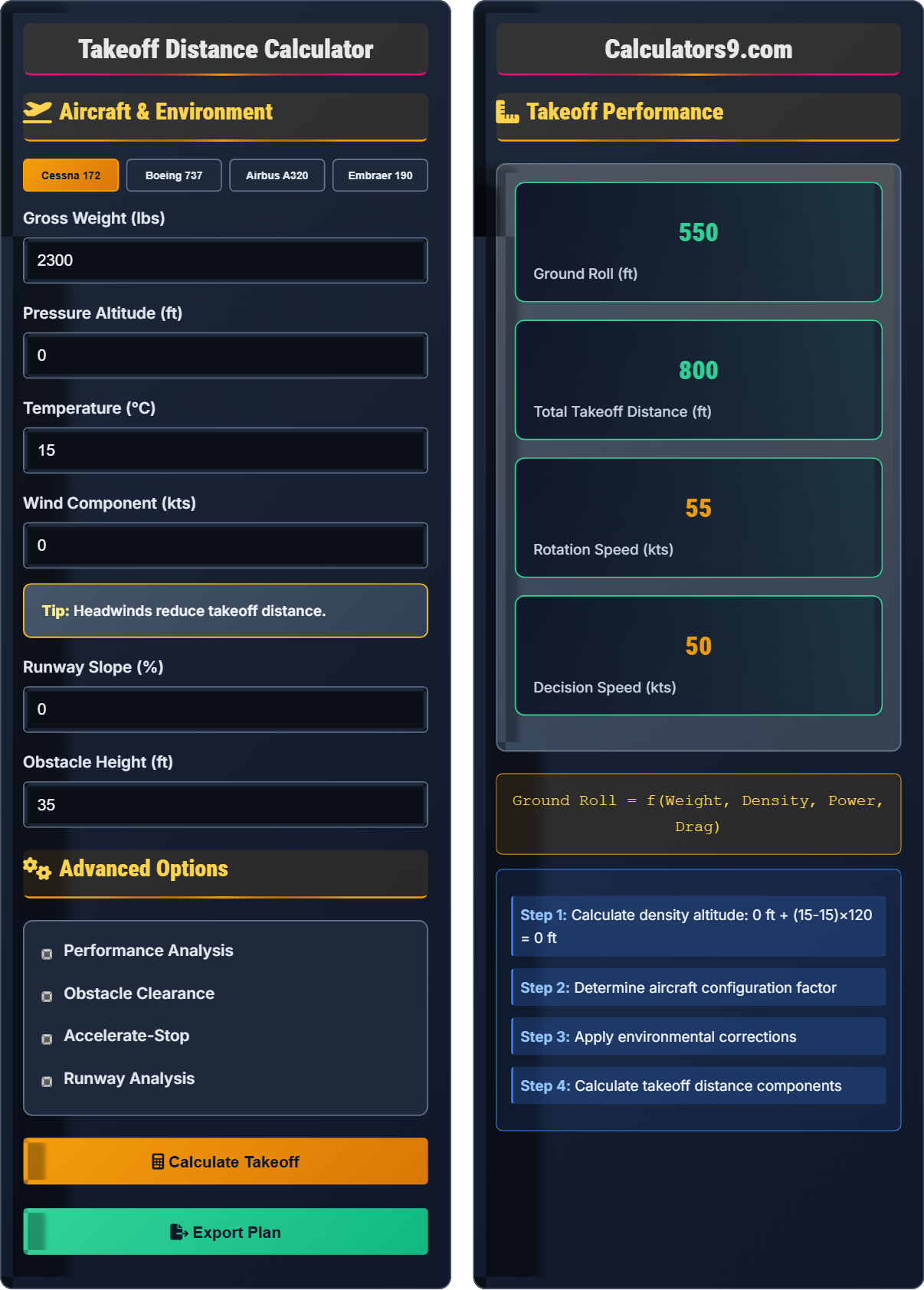
Example: For a Cessna 172 with gross weight of 2,300 lbs, at sea level, 15°C, calm winds:
Ground Roll ≈ 550 ft, Total Distance ≈ 800 ft
With 10°C temperature increase: Total Distance ≈ 900 ft (+12.5%)
Aircraft & Environment
Advanced Options
Takeoff Performance
Aviation Takeoff Performance & Safety Guide
Takeoff performance is critical for aviation safety, requiring careful consideration of aircraft weight, atmospheric conditions, runway characteristics, and obstacle clearance requirements. The Federal Aviation Administration (FAA) and International Civil Aviation Organization (ICAO) establish specific performance criteria that aircraft must meet during takeoff operations.
Key takeoff speeds include V1 (decision speed), VR (rotation speed), and V2 (takeoff safety speed). These speeds are determined through extensive flight testing and are documented in aircraft flight manuals.
The takeoff distance consists of two main components:
Where:
- \(W\) = Aircraft weight
- \(\rho\) = Air density
- \(C_L\) = Lift coefficient
- \(S\) = Wing area
- \(T\) = Thrust
- \(D\) = Drag
Density Altitude: Combined effect of pressure altitude and temperature. High density altitude significantly degrades performance.
Humidity: Increases effective density altitude by reducing air density.
Runway Surface: Soft or contaminated surfaces increase rolling resistance.
Obstacle Clearance: Aircraft must clear obstacles by specified margins (typically 35 feet).
- Conservative Calculations: Use actual conditions, not standard day assumptions
- Runway Assessment: Verify sufficient runway length for conditions
- Contingency Planning: Plan for rejected takeoffs
- Performance Monitoring: Verify acceleration during takeoff roll
- Go/No-Go Decisions: Establish decision points during takeoff
Takeoff Performance Basics
Distance required for aircraft to accelerate and climb to safe altitude.
\( \text{Takeoff Distance} = \text{Ground Roll} + \text{Airborne Distance} \)
Consider weight, density, and environmental factors.
- Always verify runway length
- Consider density altitude
- Account for obstacles
- Plan for rejected takeoff
Performance Factors
Pressure altitude corrected for non-standard temperature.
- Higher DA reduces engine power
- Higher DA reduces aerodynamic performance
- Higher DA increases takeoff distance
- Higher DA decreases climb rate
- Weight affects acceleration
- Wind affects ground distance
- Temperature affects density
- Slope affects acceleration
Aviation Takeoff Performance Learning Quiz
How does an increase in density altitude affect takeoff performance?
The answer is B) Degrades takeoff performance by reducing air density. Density altitude is pressure altitude corrected for non-standard temperature. As density altitude increases (due to high temperature or high pressure altitude), air density decreases. Lower air density reduces engine power output and aerodynamic performance, requiring longer takeoff distances.
Density altitude is a critical concept in aviation performance. Think of it as "how the airplane thinks the air density is." At high density altitude, the airplane performs as if it were at a higher altitude than its actual physical altitude. This is why hot summer days at airports at elevation require careful performance calculations.
Density Altitude: Pressure altitude corrected for non-standard temperature
Air Density: Mass of air per unit volume
Performance Degradation: Reduced efficiency due to environmental conditions
• Higher density altitude = worse performance
• Lower air density reduces engine power
• Lower air density reduces lift generation
• Calculate density altitude before every takeoff
• Use conservative performance figures
• Consider alternatives for high DA conditions
• Assuming standard day performance regardless of conditions
• Not accounting for humidity effects
• Using pressure altitude instead of density altitude
If an aircraft requires 800 feet of ground roll at sea level standard conditions, estimate the ground roll required at 2,000 feet density altitude. Show your work.
Takeoff distance generally increases with density altitude. A common rule of thumb is that takeoff distance increases by approximately 10% for each 1,000 feet of density altitude above sea level.
Given:
- Sea level distance = 800 ft
- Density altitude = 2,000 ft
Step 1: Calculate distance increase = 2,000 ft ÷ 1,000 ft = 2 increments
Step 2: Calculate total increase = 2 × 10% = 20%
Step 3: Calculate new distance = 800 ft × 1.20 = 960 ft
Therefore, the estimated ground roll at 2,000 feet density altitude is 960 feet.
This demonstrates the exponential relationship between density altitude and takeoff performance. The 10% rule is an approximation; actual performance data from aircraft manuals should be used for precise calculations. The relationship exists because both engine power and aerodynamic performance decrease with reduced air density.
Ground Roll: Distance from brake release to liftoff
Rule of Thumb: Approximate calculation method
Exponential Relationship: Performance degrades faster than linearly
• Performance decreases with higher density altitude
• 10% increase per 1,000 ft DA (approximate)
• Always verify with POH data
• Use POH for exact performance data
• Add safety margins to calculations
• Consider reduced power settings
• Using rule of thumb instead of POH data
• Not accounting for runway slope
• Ignoring wind effects
An aircraft has a takeoff distance of 1,200 feet at its maximum certified weight of 2,500 pounds. If the aircraft is loaded to 2,200 pounds (12% below maximum), estimate the takeoff distance. Assume distance varies proportionally to the square root of weight.
Step 1: Calculate weight ratio = 2,200 ÷ 2,500 = 0.88
Step 2: Apply square root relationship for distance = √0.88 = 0.938
Step 3: Calculate new distance = 1,200 ft × 0.938 = 1,126 ft
Therefore, the takeoff distance at 2,200 pounds is approximately 1,126 feet, representing a 6.2% reduction from the maximum weight distance.
The relationship between weight and takeoff distance follows the square root law because acceleration distance is proportional to weight but lift is also proportional to weight. This means distance changes with the square root of weight changes. A 12% weight reduction results in only about a 6% distance reduction.
Maximum Certified Weight: Highest weight allowed by certification
Square Root Law: Distance varies with square root of weight
Weight Reduction: Benefit to takeoff performance
• Distance ∝ √(Weight)
• Lighter aircraft perform better
• Weight affects multiple performance factors
• Consider weight reduction when possible
• Load factor affects stall speed
• Balance weight with fuel requirements
• Assuming linear relationship between weight and distance
• Not accounting for load factor effects
• Forgetting to check center of gravity
An aircraft requires 1,000 feet of takeoff distance in still air conditions. How would a 10-knot headwind affect the takeoff distance? How would a 10-knot tailwind affect it? Assume a 10% change in distance per 10-knot wind component.
For headwind (opposite to takeoff direction):
Step 1: Headwinds reduce takeoff distance
Step 2: Distance reduction = 1,000 ft × 0.10 = 100 ft
Step 3: New distance = 1,000 - 100 = 900 ft
For tailwind (same as takeoff direction):
Step 1: Tailwinds increase takeoff distance
Step 2: Distance increase = 1,000 ft × 0.20 = 200 ft (tailwinds typically have double effect)
Step 3: New distance = 1,000 + 200 = 1,200 ft
Therefore, a 10-knot headwind reduces distance to 900 ft, while a 10-knot tailwind increases it to 1,200 ft.
Wind effects on takeoff distance are significant. Headwinds provide additional airflow over wings during ground roll, allowing the aircraft to achieve lift-off at lower ground speeds. Tailwinds have the opposite effect and are particularly detrimental because they require higher ground speeds to achieve the same airspeed. Tailwind effects are often considered twice as severe as headwind benefits.
Headwind: Wind opposing takeoff direction
Tailwind: Wind in takeoff direction
Ground Speed: Speed relative to ground
• Headwinds reduce takeoff distance
• Tailwinds increase takeoff distance
• Tailwind effects often 2x headwind effects
• Always take off into prevailing winds
• Consider runway selection for wind
• Check for wind gusts
• Taking off with tailwinds unnecessarily
• Not accounting for wind gusts
• Ignoring wind direction changes
What are the three critical speeds that define takeoff performance?
The answer is A) V1, VR, V2. These are the three critical takeoff speeds: V1 (decision speed) is the latest speed at which a takeoff can be safely aborted; VR (rotation speed) is the speed at which the pilot begins to raise the nose wheel; and V2 (takeoff safety speed) is the minimum speed at which the aircraft can safely climb with an engine failure.
These speeds are calculated for each takeoff based on aircraft weight, atmospheric conditions, and runway characteristics. They represent critical decision points during takeoff. V1 is particularly important as it defines the point of no return - after V1, the takeoff must continue even if an engine fails. These speeds ensure obstacle clearance and safe flight path.
V1: Decision speed (abort/reject threshold)
VR: Rotation speed (lift-off initiation)
V2: Takeoff safety speed (minimum climb speed)
• V1 is go/no-go decision point
• VR initiates rotation
• V2 ensures obstacle clearance
• Calculate V speeds for each takeoff
• Brief crew on V speeds
• Monitor acceleration during takeoff
• Not calculating V speeds for conditions
• Rotating before reaching VR
• Not maintaining V2 after engine failure
FAQ
Q: How do I calculate density altitude without an electronic calculator during flight planning?
A: You can use the density altitude approximation formula:
\( \text{DA} = \text{PA} + 120 \times (\text{OAT} - \text{ISA}) \)
Where PA is pressure altitude, OAT is outside air temperature in Celsius, and ISA is the International Standard Atmosphere temperature for that altitude (15°C - 2°C per 1,000 ft).
For example, at 2,000 feet pressure altitude with 25°C temperature:
ISA temp = 15 - (2 × 2) = 11°C
DA = 2,000 + 120 × (25 - 11) = 2,000 + 1,680 = 3,680 feet
For rough estimates, remember that for every 10°C above standard, add approximately 1,000 feet to pressure altitude.
Q: What is the difference between accelerate-stop distance and accelerate-go distance, and why are both important?
A: These distances represent the two critical scenarios at V1 (decision speed):
Accelerate-Stop Distance: Distance required to accelerate to V1 and then abort the takeoff, bringing the aircraft to a complete stop. This includes acceleration distance plus braking distance.
Accelerate-Go Distance: Distance required to continue takeoff after engine failure at V1, achieving V2 speed and clearing obstacles.
Both must be less than available runway length. The balanced field length concept ensures that at V1, the aircraft can either stop safely or continue takeoff safely. This is why V1 is called the "decision speed."