Wind Correction Calculator
Aviation wind analysis • Flight navigation
Wind Correction Formulas:
Show the calculator\( \text{Crosswind Component} = \text{Wind Speed} \times \sin(\text{Wind Angle} - \text{Runway Heading}) \)
\( \text{Headwind/Tailwind} = \text{Wind Speed} \times \cos(\text{Wind Angle} - \text{Runway Heading}) \)
\( \text{Drift Angle} = \arcsin\left(\frac{\text{Crosswind Component}}{\text{True Airspeed}}\right) \)
Where:
- \( \text{Wind Speed} \) = Velocity of wind in knots
- \( \text{Wind Angle} \) = Direction wind is coming FROM (true)
- \( \text{Runway Heading} \) = Magnetic heading of runway
- \( \text{True Airspeed} \) = Aircraft speed through air mass
Additional wind correction calculations:
- \( \text{Ground Speed} = \sqrt{(\text{TAS} \times \cos(\text{Drift}))^2 + (\text{TAS} \times \sin(\text{Drift}))^2 + \text{Headwind Component}^2} \)
- \( \text{Wind Correction Angle} = \text{Drift Angle} \)
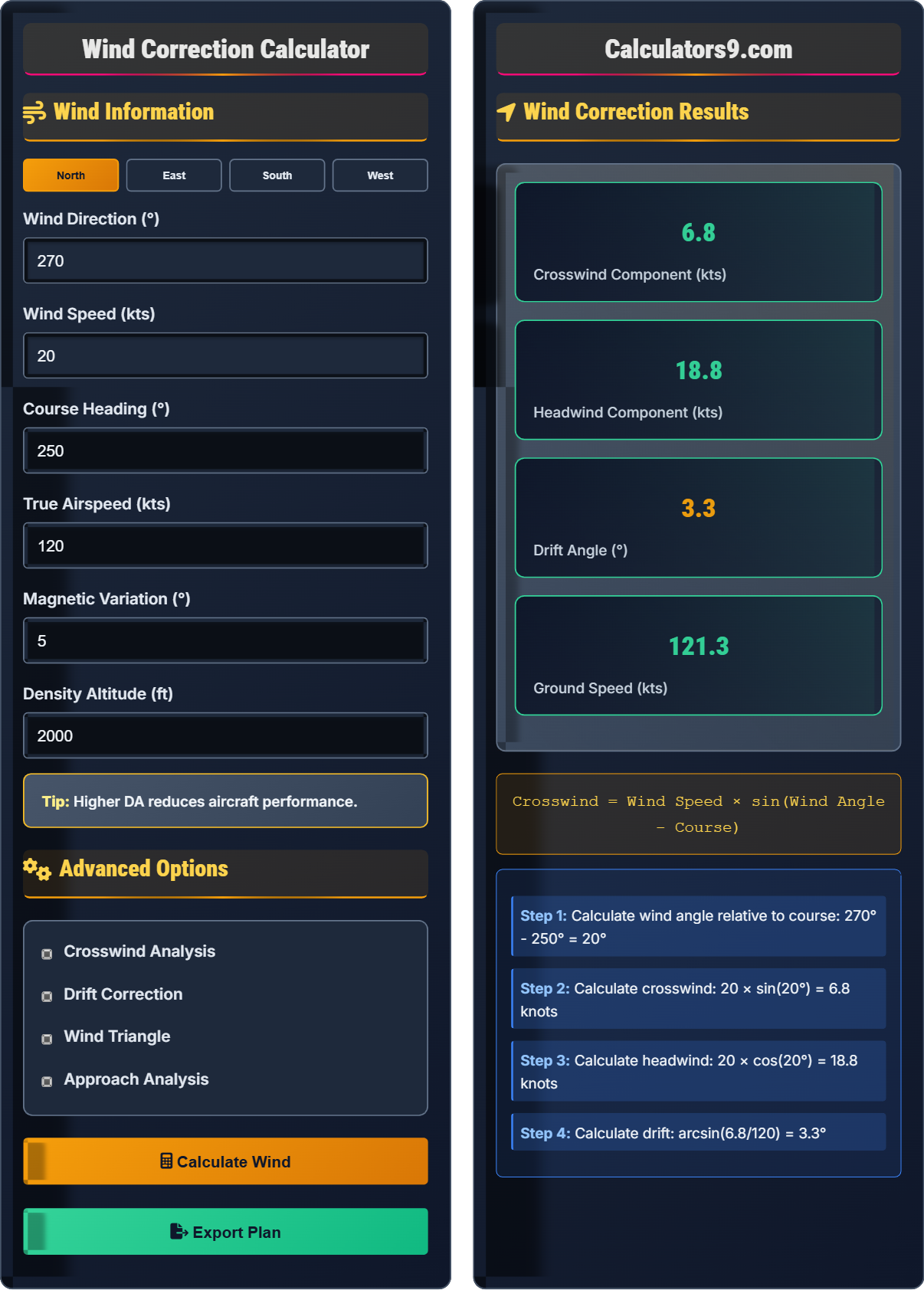
Example: For wind from 270° at 20 knots with runway 25 (250° magnetic) and TAS of 120 knots:
Crosswind = 20 × sin(270° - 250°) = 20 × sin(20°) = 6.84 knots
Headwind = 20 × cos(20°) = 18.79 knots
Drift Angle = arcsin(6.84/120) = 3.26°
Thus, the pilot should apply 3.26° drift correction and expect a headwind of 18.79 knots.
Wind Information
Advanced Options
Wind Correction Results
Aviation Wind Correction & Navigation Guide
Wind correction is critical for safe and efficient flight operations. Pilots must account for wind effects to maintain desired ground tracks and arrival times. The wind triangle is a fundamental concept that relates true airspeed, wind velocity, and ground speed. Understanding wind components allows pilots to calculate necessary corrections for heading, ground speed, and fuel consumption.
Wind correction becomes increasingly important for cross-country flights where maintaining precise navigation is essential for safety and efficiency.
The fundamental wind correction calculations:
Where:
- \(W\) = Wind speed in knots
- \(\theta\) = Angle between wind direction and course
- \(\text{Crosswind}\) = Lateral wind component
- \(\text{Headwind}\) = Longitudinal wind component
Crosswind Limits: Most general aviation aircraft have maximum demonstrated crosswind limits of 15-20 knots. Exceeding these limits increases landing difficulty and risk.
Headwind Benefits: Headwinds reduce ground speed and landing distance, improving safety margins.
Tailwind Hazards: Tailwinds increase ground speed and landing distance, potentially exceeding runway length.
Wind Shear: Sudden changes in wind direction/speed can affect aircraft performance and control.
- Pre-flight Planning: Check winds aloft and surface observations
- Continuous Monitoring: Update corrections as wind conditions change
- Visual References: Use landmarks to verify ground track
- GPS Assistance: Modern avionics provide real-time wind data
- Backup Methods: Maintain traditional wind correction skills
Wind Correction Basics
Adjustment to aircraft heading to compensate for wind drift.
\( \text{WCA} = \arcsin\left(\frac{\text{Crosswind}}{\text{TAS}}\right) \)
Apply correction opposite to drift direction.
- Correct for drift direction
- Update corrections in flight
- Consider wind shear
- Check runway limits
Navigation Factors
Vector relationship between TAS, wind, and ground speed.
- Determine wind components
- Calculate drift angle
- Apply wind correction
- Verify ground track
- Wind varies with altitude
- Density altitude affects performance
- Weather changes affect calculations
- Instrument approach procedures
Aviation Wind Correction Learning Quiz
For a wind from 270° at 20 knots and a runway oriented 250°, what is the crosswind component?
The answer is A) 6.8 knots from the right. First, calculate the angle between wind and runway: 270° - 250° = 20°. Then calculate crosswind: 20 × sin(20°) = 20 × 0.342 = 6.84 knots. Since the wind is from the right of the runway (270° is clockwise from 250°), the crosswind component is from the right.
This calculation uses trigonometry to determine the lateral component of wind. The sine function gives the crosswind component when the angle between wind direction and runway is known. Remember that wind direction is always given as the direction the wind is coming FROM, not going TO.
Crosswind Component: Lateral wind force perpendicular to runway/course
Wind Direction: Compass bearing wind is coming FROM
Runway Orientation: Magnetic heading of runway
• Crosswind = Wind Speed × sin(Angle Difference)
• Wind direction is always FROM
• Right crosswind requires left correction
• Use the 1-in-60 rule for quick estimates
• Crosswind increases with angle to wind
• 90° angle gives maximum crosswind
• Using cosine instead of sine for crosswind
• Confusing wind direction (TO vs FROM)
• Wrong sign for crosswind direction
Calculate the drift angle for an aircraft flying with a true airspeed of 120 knots with a crosswind component of 15 knots. Show your work.
Drift angle = arcsin(Crosswind Component / True Airspeed)
Given:
- Crosswind Component = 15 knots
- True Airspeed = 120 knots
Step 1: Calculate ratio = 15 ÷ 120 = 0.125
Step 2: Calculate drift angle = arcsin(0.125) = 7.18°
Therefore, the drift angle is approximately 7.2°.
The drift angle represents how much the aircraft's heading must be adjusted to maintain the desired ground track. The stronger the crosswind relative to the aircraft's speed, the larger the required drift correction. This inverse relationship between airspeed and drift angle means slower aircraft require larger corrections.
Drift Angle: Angle between aircraft heading and ground track
True Airspeed (TAS): Aircraft speed through air mass
Ground Track: Actual path over ground
• Drift = arcsin(Crosswind/TAS)
• Slower aircraft require larger corrections
• Stronger crosswinds require larger corrections
• 1° drift for every 2 knots crosswind at 120 kts TAS
• Double the correction for half the airspeed
• Use wind correction angle in opposite direction
• Applying correction in same direction as drift
• Using ground speed instead of true airspeed
• Forgetting to convert to degrees if calculator is in radians
A pilot is flying a 300 NM course with a true airspeed of 150 knots. The wind is from 180° at 25 knots, and the course is 200°. Calculate the ground speed and the time difference compared to still air conditions.
Step 1: Calculate wind angle = 200° - 180° = 20°
Step 2: Calculate headwind component = 25 × cos(20°) = 25 × 0.940 = 23.5 knots
Step 3: Calculate ground speed = 150 - 23.5 = 126.5 knots
Step 4: Calculate time in still air = 300 NM ÷ 150 kts = 2.0 hours
Step 5: Calculate time with headwind = 300 NM ÷ 126.5 kts = 2.37 hours
Step 6: Calculate time difference = 2.37 - 2.0 = 0.37 hours = 22.2 minutes
Therefore, the ground speed is 126.5 knots and the flight will take 22 minutes longer than in still air.
This demonstrates how headwinds significantly increase flight time and fuel consumption. The cosine function gives the longitudinal wind component. A 25-knot headwind reduced the ground speed by 23.5 knots, increasing flight time by 18.5%. This effect is particularly important for fuel planning and scheduling.
Headwind Component: Wind component opposing flight direction
Ground Speed: Actual speed over ground
Longitudinal Wind: Wind parallel to flight direction
• Headwind reduces ground speed and increases time
• 10% headwind reduces ground speed by ~10%
• Plan extra fuel for headwind conditions
• Consider routing around strong headwinds
• Adding headwind instead of subtracting it
• Forgetting to account for wind in time calculations
• Not updating fuel plans for wind conditions
An aircraft needs to fly a course of 090° with a true airspeed of 140 knots. The wind is from 120° at 30 knots. Calculate the required heading and ground speed using vector analysis. What is the wind correction angle?
Step 1: Calculate wind angle = 120° - 90° = 30°
Step 2: Calculate crosswind component = 30 × sin(30°) = 30 × 0.5 = 15 knots (from right)
Step 3: Calculate headwind component = 30 × cos(30°) = 30 × 0.866 = 26.0 knots
Step 4: Calculate drift angle = arcsin(15/140) = arcsin(0.107) = 6.1°
Step 5: Calculate required heading = 90° - 6.1° = 83.9° ≈ 84°
Step 6: Calculate ground speed = √[(140×cos(6.1°))² + (140×sin(6.1°))² + 26.0²]
Step 7: Simplified ground speed = 140×cos(6.1°) + 26.0 = 139.2 + 26.0 = 165.2 knots
Therefore, required heading is 84°, ground speed is 165.2 knots, and wind correction angle is 6.1° left.
This problem demonstrates the complete wind triangle solution. The aircraft must turn into the wind (to the left in this case) to maintain the desired course. The wind correction angle is applied in the opposite direction of the drift. Ground speed increases with a tailwind component.
Wind Triangle: Vector diagram showing TAS, wind, and ground speed
Wind Correction Angle (WCA): Adjustment to heading to maintain track
True Course: Desired direction over ground
• WCA applied opposite to drift direction
• Turn into the wind to correct for crosswind
• Ground speed affected by headwind/tailwind
• Draw the wind triangle to visualize the problem
• Apply WCA in opposite direction of drift
• Check that ground speed makes sense
• Applying WCA in same direction as drift
• Not accounting for both crosswind and headwind components
• Confusing heading with course
What is the significance of crosswind components exceeding an aircraft's demonstrated crosswind capability?
The answer is C) Potential loss of directional control during landing. Aircraft have demonstrated crosswind limits established during certification testing. Exceeding these limits can result in loss of directional control, inability to maintain runway alignment, or structural damage. Crosswind landing requires coordinated use of rudder and ailerons to maintain directional control and prevent side loads on the landing gear.
Crosswind limits are safety margins established during aircraft certification. They account for factors like landing gear strength, control authority, and pilot workload. Exceeding these limits can compromise safety and potentially cause structural damage to the aircraft. Pilots should always consider alternate airports when crosswind components approach or exceed limits.
Demonstrated Crosswind: Maximum tested crosswind for safe operation
Control Authority: Ability of controls to maintain aircraft attitude
Side Loads: Forces applied perpendicular to landing gear
• Never exceed demonstrated crosswind limits
• Consider gust factors in crosswind calculations
• Have alternate airports ready for high winds
• Subtract gust factor from reported wind
• Consider runway width for crosswind landings
• Practice crosswind techniques regularly
• Attempting landings beyond aircraft limits
• Not considering gust factors
• Forgetting to check runway orientation
FAQ
Q: How do I calculate wind correction angle during flight when I don't have access to a calculator?
A: You can use the 1-in-60 rule and mental estimation techniques:
1-in-60 Rule: For every 60 nautical miles, 1 degree of drift will displace you 1 nautical mile. So if you're drifting 2 miles off course after 60 NM, you need a 2-degree correction.
Crosswind Estimation: For crosswinds at 30°, 45°, 60°, 90° to your course, multiply wind speed by 0.5, 0.7, 0.85, 1.0 respectively to get the crosswind component.
Drift Calculation: Divide crosswind component by true airspeed in hundreds, then multiply by 60. For example, 15 knot crosswind at 120 knots TAS: (15/120) × 60 ≈ 7.5° drift.
Always verify your ground track using visual references or GPS to confirm your corrections.
Q: What's the difference between wind correction angle and crab angle, and when do I use each?
A: Wind correction angle and crab angle are essentially the same thing - both refer to the angle by which you turn your aircraft's nose into the wind to maintain your desired ground track.
During en route flight, you maintain a crab angle to counteract drift and stay on course. During final approach, you may transition from a crab to a slip or wing-low technique to align with the runway while still compensating for crosswind.
Mathematically: \( \text{WCA} = \arctan\left(\frac{\text{Crosswind Component}}{\text{TAS}}\right) \)
For example, with a 15-knot crosswind component and 120-knot TAS: \( \text{WCA} = \arctan(15/120) = 7.1° \)
Always remember to turn the aircraft's nose into the wind (toward the wind source) to correct for drift.