Breast Milk Calculator
Daily intake calculator • 2026 guidelines
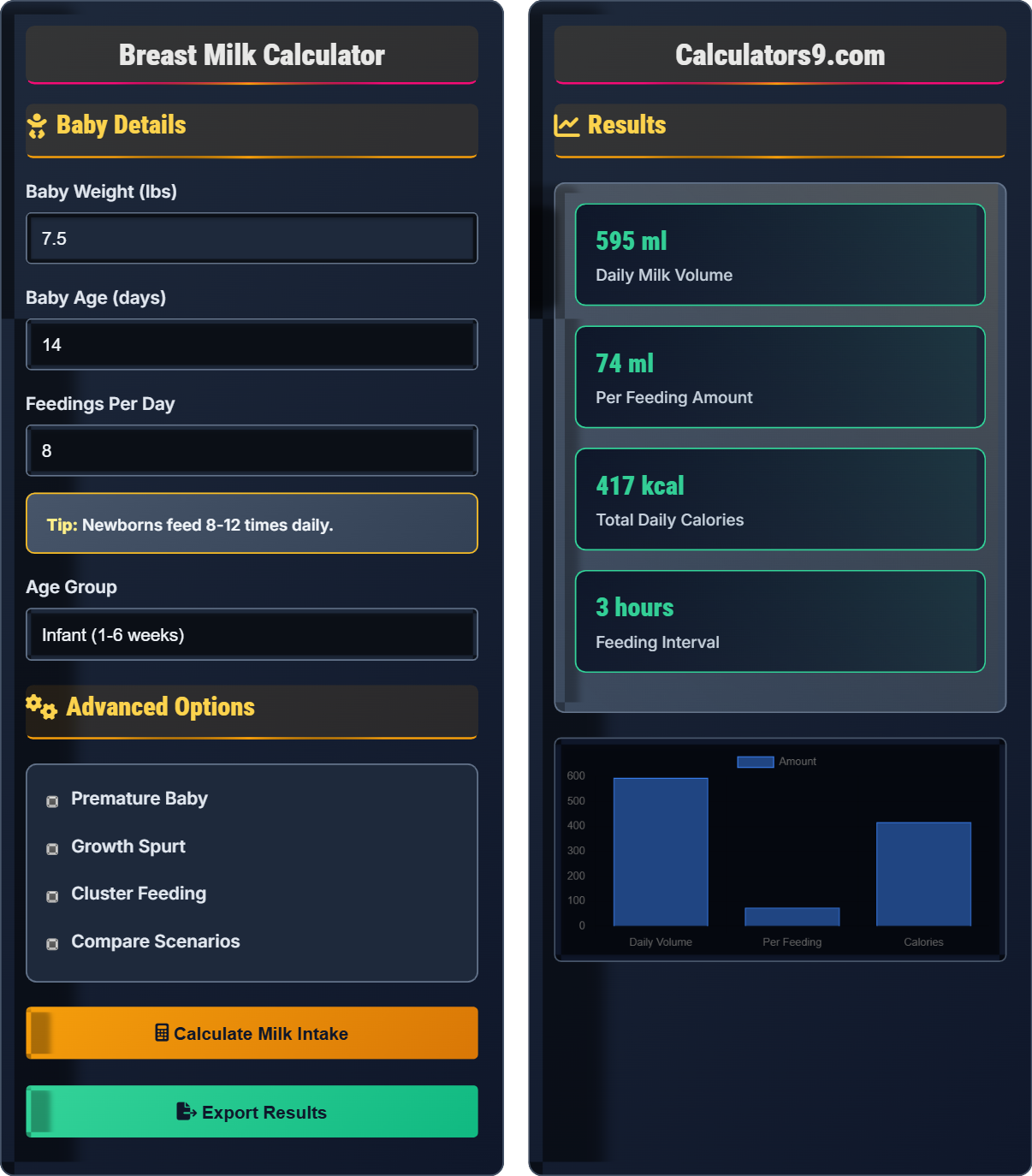
Breast Milk Formula:
Show the calculator\( \text{Daily Milk Volume} = \text{Weight (kg)} \times \text{Age Factor} \)
Where:
- Age Factor varies by age group:
- Newborn (0-1 week): 15-20 ml per kg per day
- 1-6 weeks: 150-200 ml per kg per day
- 6-12 weeks: 150-180 ml per kg per day
- 3-6 months: 120-150 ml per kg per day
This formula calculates the estimated daily breast milk requirement based on the baby's weight and age, following AAP and WHO guidelines.
Example: For a 4 kg newborn (0-1 week old), the daily requirement would be:
\( 4 \, \text{kg} \times 18 \, \text{ml/kg/day} = 72 \, \text{ml/day} \)
Thus, the baby would need approximately 72 ml per day of breast milk.
Baby Details
Advanced Options
Results
| Time | Amount (ml) | Calories | Notes |
|---|
| Day | Total (ml) | Calories | Feeding Count |
|---|
Comprehensive Breast Milk Guide
Breast milk is a complex fluid that provides complete nutrition for infants. It contains proteins, fats, carbohydrates, vitamins, minerals, and antibodies that support immune system development. The composition changes over time to meet the growing needs of the baby, adapting to provide optimal nutrition and protection.
The standard breast milk calculation follows the formula:
Where:
- \(V\) = Daily milk volume (ml)
- \(W\) = Baby's weight in kilograms
- \(F\) = Age-specific factor (ml/kg/day)
Breast milk contains several key components:
- Proteins: Whey and casein proteins, easily digestible
- Fats: Essential fatty acids for brain development
- Carbohydrates: Lactose and oligosaccharides
- Antibodies: IgA, IgG, and IgM for immune protection
- On-demand feeding: Respond to baby's hunger cues
- Cluster feeding: Frequent feeds during growth spurts
- Responsive feeding: Adjust amounts based on baby's needs
- Watch for satiation: Recognize when baby is full
Breast Milk Basics
Based on baby's weight and age group.
\(V = W \times F\)
Where V=daily volume, W=weight in kg, F=age factor.
- Younger babies need more frequent feeds
- Amounts vary based on individual needs
- Trust baby's hunger and fullness cues
Feeding Patterns
Newborns: 8-12 feeds/day; Older infants: 6-8 feeds/day.
- Respond to hunger cues
- Allow flexible timing
- Monitor baby's satisfaction
- Adjust based on growth
- Each baby is unique
- Growth spurts increase demand
- Healthcare provider guidance
Breast Milk Learning Quiz
According to AAP guidelines, what is the approximate daily milk requirement for a 4-month-old baby weighing 6 kg?
The answer is C) 720-900 ml per day. For a 4-month-old baby, the recommended daily milk volume is 120-150 ml per kg of body weight. For a 6 kg baby: 6 kg × 120 ml/kg = 720 ml (minimum) and 6 kg × 150 ml/kg = 900 ml (maximum). Therefore, the daily requirement is 720-900 ml.
Understanding how to calculate daily milk requirements is essential for ensuring adequate nutrition. The formula V = W × F (Volume = Weight × Factor) helps determine appropriate feeding amounts. The age factor varies because babies' nutritional needs change as they grow. Younger babies have higher metabolic needs relative to their size compared to older babies.
Daily Milk Requirement: The amount of breast milk or formula needed per day to meet a baby's nutritional needs
Age Factor: A multiplier used to calculate milk volume based on the baby's developmental stage
Metabolic Needs: The energy and nutrients required for growth and bodily functions
• Daily requirements decrease as babies age and grow
• Individual variations exist within the recommended ranges
• Monitor baby's growth and satisfaction to adjust amounts
• Remember the age factor ranges: Newborn (150-200), Older infant (150-180), Baby (120-150)
• Use the formula V = W × F consistently
• Always round to the nearest 10 ml for practical feeding
• Using the wrong age factor for the baby's developmental stage
• Forgetting to convert pounds to kilograms if needed
• Applying adult nutrition rules to infant feeding
A 3-month-old baby weighs 5.5 kg and is feeding 8 times per day. Calculate the daily milk volume, per-feeding amount, and feeding interval. Also explain how this compares to AAP guidelines.
Step 1: Calculate daily milk volume
For a 3-month-old baby (age group: baby), the factor is 120-150 ml/kg/day
Minimum: 5.5 kg × 120 ml/kg/day = 660 ml/day
Maximum: 5.5 kg × 150 ml/kg/day = 825 ml/day
Average: 5.5 kg × 135 ml/kg/day = 742.5 ml/day ≈ 743 ml/day
Step 2: Calculate per-feeding amount
743 ml ÷ 8 feeds = 92.9 ml per feeding ≈ 93 ml per feeding
Step 3: Calculate feeding interval
24 hours ÷ 8 feeds = 3 hours between feeds
Step 4: Compare to AAP guidelines
AAP recommends 120-150 ml/kg/day for babies 3-6 months old
Our calculation (743 ml/day) falls within the recommended range
This is appropriate for the baby's age and weight
This problem demonstrates the practical application of the breast milk formula. The process involves multiple steps: calculating total daily volume, distributing that volume across feedings, and determining timing intervals. It also requires understanding how to interpret and apply AAP guidelines to ensure the calculated amounts fall within safe and effective ranges.
Feeding Interval: The time between consecutive feedings
AAP Guidelines: American Academy of Pediatrics recommendations for infant feeding
Age-Specific Factors: Multipliers that adjust nutritional requirements based on developmental stage
• Follow age-appropriate volume recommendations
• Distribute daily volume evenly across feedings
• Maintain consistent intervals between feeds
• Always verify calculations against established guidelines
• Consider the baby's individual needs within the recommended ranges
• Round to practical feeding volumes (multiples of 5 or 10 ml)
• Using the wrong age factor in calculations
• Forgetting to divide the total daily volume by the number of feedings
• Not comparing results to established guidelines for verification
FAQ
Q: How do I know if my baby is getting enough breast milk?
A: There are several signs that indicate your baby is getting adequate breast milk:
1. Wet diapers: At least 6-8 wet diapers per day after the first week
2. Stools: Regular, soft stools (especially in first few weeks)
3. Weight gain: Consistent weight gain as measured at pediatric visits
4. Satisfaction: Baby appears content after feeds
5. Feeding cues: Baby releases the breast naturally when satisfied
Mathematically, if a baby is consuming the recommended volume (120-150 ml/kg/day for babies 3-6 months), and showing these signs, they are likely receiving adequate nutrition. For example, a 5 kg baby should consume 600-750 ml per day across all feedings.
Q: My premature baby was born at 34 weeks gestation. How does this affect milk requirements?
A: Premature babies have different nutritional needs compared to full-term babies. For a 34-week premature baby, the milk requirements are typically higher due to increased metabolic demands and rapid catch-up growth.
Instead of the standard 120-150 ml/kg/day, premature babies often need 150-180 ml/kg/day initially, and sometimes even higher (up to 200 ml/kg/day) in the first few weeks. This is because:
1. Higher metabolic rate due to immature organs
2. Need for accelerated growth to reach normal milestones
3. Increased caloric needs for tissue development
For example, if a 34-week premature baby weighs 2.5 kg, the daily requirement might be 2.5 kg × 160 ml/kg/day = 400 ml/day, distributed across 10-12 feedings. This would be approximately 33-40 ml per feeding, which is much smaller than what a full-term baby would consume per feeding but more frequent.