Height Predictor for Kids
Genetic height potential calculator • 2026 standards
Height Prediction Formulas:
Show the calculatorMid-Parental Method: \( \text{Predicted Height} = \frac{\text{Father's Height} + \text{Mother's Height}}{2} \pm 2.5 \text{ inches} \)
Regression Method: \( \text{Predicted Height} = \text{Mid-Parental Height} + \text{Age Correction Factor} \)
Where:
- For boys: Add 2.5 inches to mid-parental height
- For girls: Subtract 2.5 inches from mid-parental height
- Accuracy: ±2-4 inches in 68% of cases
These formulas predict adult height based on parental heights, accounting for genetic potential. The mid-parental method is most reliable for children aged 2-10, while regression methods incorporate current growth patterns.
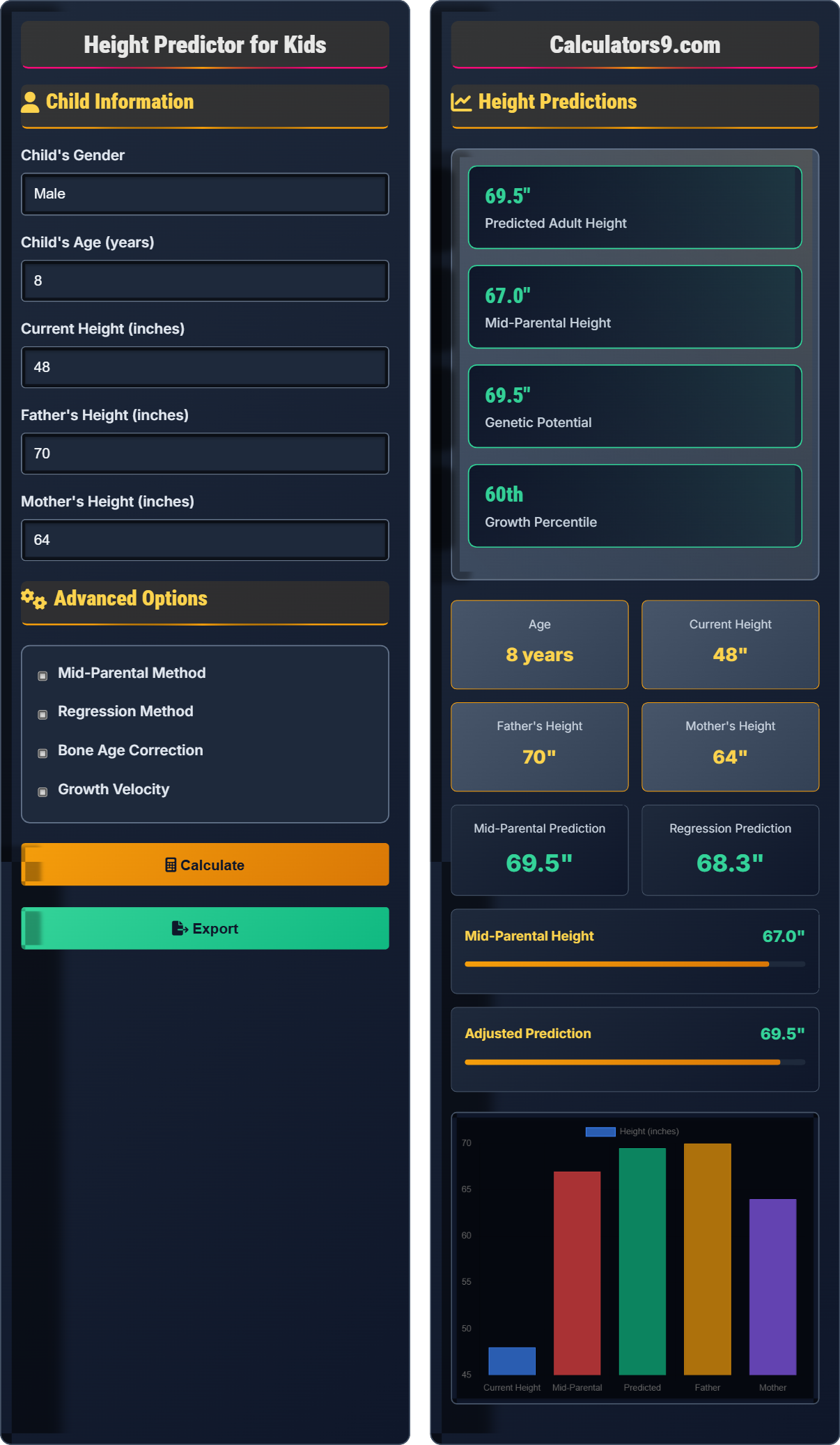
Example: For a boy with father height 70 inches and mother height 64 inches: Mid-parental height = (70 + 64) / 2 = 67 inches. Predicted height = 67 + 2.5 = 69.5 inches (5'9.5").
Child Information
Advanced Options
Height Predictions
| Method | Prediction | Accuracy | Notes |
|---|
| Formula | Calculation | Result |
|---|
| Factor | Value | Impact |
|---|
Height Prediction Fundamentals
Height prediction is the estimation of a child's future adult height based on genetic potential, current growth patterns, and parental heights. It uses mathematical formulas to calculate the likely adult height range, helping parents and healthcare providers monitor growth and identify potential growth disorders.
Where:
- For boys: Add 2.5 inches to mid-parental height
- For girls: Subtract 2.5 inches from mid-parental height
- Accuracy: ±2-4 inches in 68% of cases
- Most Accurate: Between ages 2-10 years for mid-parental method
- Precision: ±2-4 inches in 68% of cases
- Factors: Genetics (60-80%), nutrition, hormones, environment
- Monitoring: Combine with growth chart tracking
Prediction Methods Explained
Prediction Accuracy Factors
- Age of Child: Predictions become more accurate as child approaches puberty
- Genetic Diversity: Mixed heritage may affect predictions
- Nutrition: Adequate nutrition supports genetic potential
- Hormonal Status: Growth hormone affects final height
- Health Conditions: Chronic illnesses may impact growth
- Using current height instead of growth velocity
- Ignoring parental heights in favor of averages
- Not accounting for pubertal timing differences
- Expecting exact predictions rather than ranges
- Overlooking environmental factors
Height Prediction Quiz
Using the mid-parental method, what is the predicted adult height for a 7-year-old girl whose father is 68 inches tall and mother is 62 inches tall?
The answer is B) 62.5 inches. For girls, the mid-parental method uses: (Father's height + Mother's height) ÷ 2 - 2.5 inches. Calculation: (68 + 62) ÷ 2 = 65 inches. Then subtract 2.5 inches: 65 - 2.5 = 62.5 inches.
The mid-parental method accounts for the general observation that daughters tend to be shorter than sons. The 2.5-inch adjustment represents the average difference between male and female heights. This method is most accurate for children between ages 2-10 when genetic potential is most clearly expressed.
Mid-Parental Height: Average of parental heights before gender adjustment
Gender Adjustment: 2.5-inch addition for boys, subtraction for girls
Genetic Potential: Height determined primarily by inherited genes
• Add 2.5 inches to mid-parental height for boys
• Subtract 2.5 inches from mid-parental height for girls
• Most accurate for children aged 2-10 years
• Remember: "Boys add, girls subtract" for the 2.5-inch adjustment
• Mid-parental method works best when both parents are near average height
• Applying the same gender adjustment to both boys and girls
A 10-year-old boy is currently 52 inches tall. His father is 72 inches tall and his mother is 66 inches tall. His bone age is 11 years (advanced). Using the mid-parental method and accounting for advanced bone age, predict his adult height. Explain the impact of bone age advancement on height prediction.
Mid-parental height: (72 + 66) ÷ 2 = 69 inches. For boys: 69 + 2.5 = 71.5 inches. Since the boy has advanced bone age (11 years vs 10 chronological), he may finish growing earlier than average. Advanced bone age suggests rapid early growth but potentially shorter overall growth period. Adjusted prediction: 71.5 - 0.5 = 71.0 inches (accounting for slightly reduced growth time).
Bone age advancement means the skeleton is maturing faster than chronological age. This often results in early puberty onset and accelerated growth initially, but the growth plates close earlier, potentially limiting final adult height. The prediction should account for this shortened growth period.
Bone age is a critical factor in height prediction as it reflects biological maturity. Children with advanced bone age often experience earlier growth spurts but may have shorter overall growth periods. The correlation between bone age and final height is strong, making it an important consideration in predictions. Medical professionals often use bone age X-rays to refine height predictions.
Bone Age: Skeletal maturity as determined by X-ray comparison to standard charts
Advanced Bone Age: Bone age exceeds chronological age
Growth Plates: Cartilage areas at ends of bones that determine final height
• Bone age more accurately reflects biological maturity than chronological age
• Advanced bone age often correlates with earlier puberty and shorter growth period
• Growth plates close when bone age reaches maturity
• Consider bone age when predicting height for children with unusual growth patterns
• Advanced bone age may indicate need for endocrinological evaluation
• Bone age X-rays should be interpreted by qualified professionals
• Ignoring bone age when it significantly differs from chronological age
• Assuming all children grow at the same rate regardless of biological maturity
• Not adjusting predictions for advanced or delayed bone age
Pediatric Q&A
Q: My 6-year-old daughter is in the 90th percentile for height. Does this mean she'll be very tall as an adult?
A: Being in the 90th percentile for height at age 6 is encouraging for future adult height, but it's not definitive. The percentile indicates she's taller than 90% of girls her age. To predict adult height, we'd use the mid-parental method: average of parental heights with a gender adjustment.
If her parents are tall, she's likely to reach an adult height consistent with her genetic potential. However, growth patterns can change during puberty, and environmental factors also play a role. Continue regular pediatric checkups to monitor her growth trajectory.
Q: How accurate are height prediction methods?
A: The mid-parental method is accurate to within 2-4 inches in about 68% of cases. This means that 68% of children will reach an adult height within 2-4 inches of the predicted value. The accuracy improves as children get closer to puberty.
More sophisticated methods like bone age assessment can improve accuracy. However, height prediction is not an exact science. Factors like nutrition, chronic illness, hormonal disorders, and genetic variations can influence final adult height. The prediction should be viewed as a likely range rather than an exact number.