Power Consumption Calculator
Device energy monitoring • 2026 edition
Power Consumption Formula:
Show Calculator\( P = V \times I \times \cos(\phi) \)
Where:
- \( P \) = Power consumption (Watts)
- \( V \) = Voltage (Volts)
- \( I \) = Current (Amperes)
- \( \cos(\phi) \) = Power factor
For DC circuits: \( P = V \times I \)
For AC circuits: \( P = V \times I \times \cos(\phi) \) where \(\cos(\phi)\) is the power factor.
Example: For a device operating at 12V drawing 2A with a power factor of 0.9:
\( P = 12 \times 2 \times 0.9 = 21.6 \) Watts
To calculate energy consumption over time: \( E = P \times t \) where E is energy (Wh) and t is time (hours).
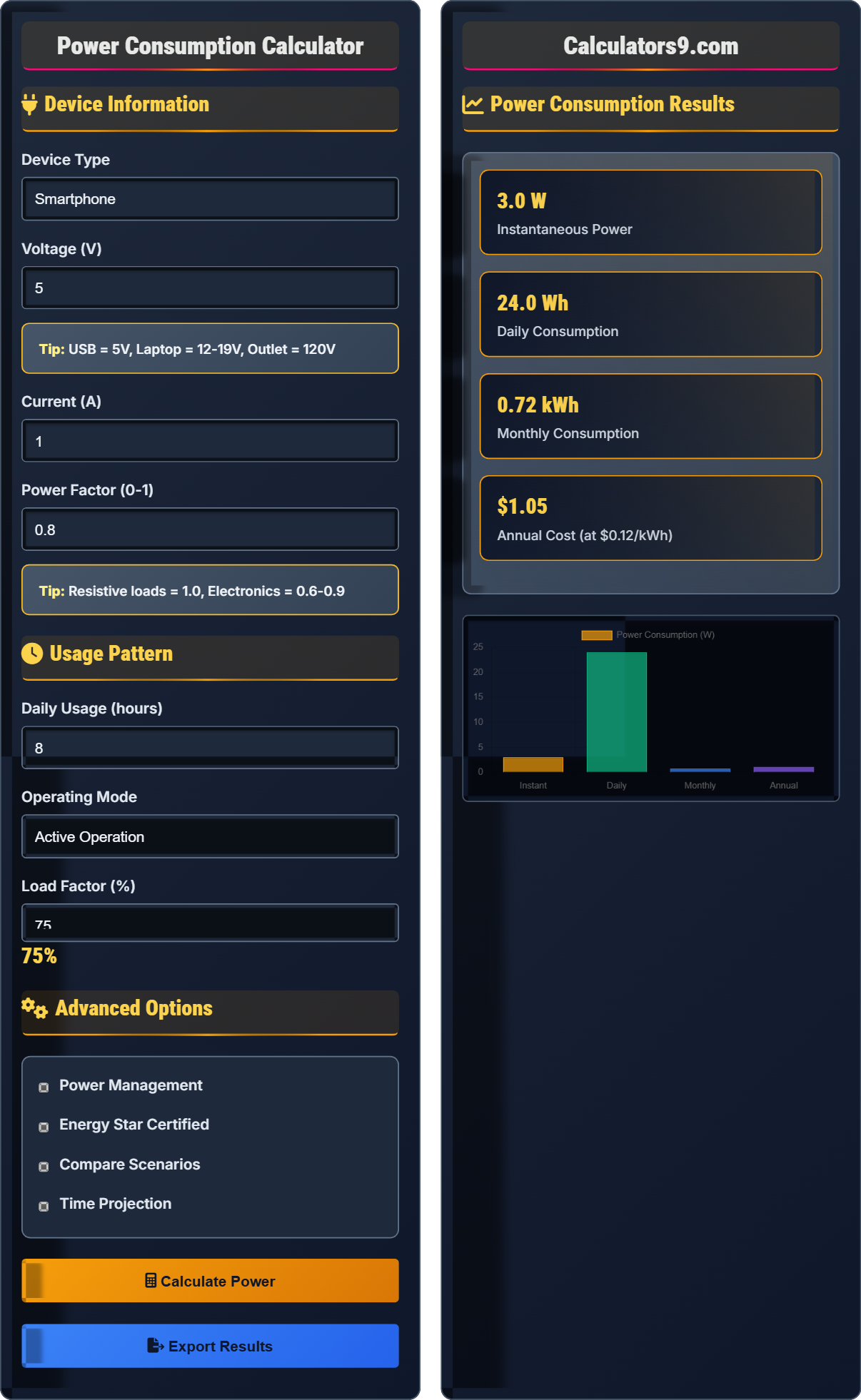
Device Information
Usage Pattern
Advanced Options
Power Consumption Results
| Parameter | Value | Unit | Description |
|---|
| Optimization | Potential Savings | Implementation |
|---|
Power Consumption Guide
Power consumption refers to the rate at which electrical energy is consumed by a device. It's measured in watts (W) and represents the amount of energy converted from electrical to other forms (heat, light, mechanical work) per unit time. Understanding power consumption helps optimize energy use and reduce costs.
The power consumption is calculated using the following formulas:
For DC circuits:
Where:
- \(P\) = Power (Watts)
- \(V\) = Voltage (Volts)
- \(I\) = Current (Amperes)
- \(\cos(\phi)\) = Power factor (for AC circuits)
Power consumption varies significantly by device type:
- Smartphones: 2-6W during active use, 0.1-0.5W in standby
- Laptops: 15-60W depending on performance mode
- Desktop Computers: 60-300W depending on configuration
- Monitors: 15-100W depending on size and technology
- TVs: 50-400W depending on size and technology
- Network Equipment: 5-50W for routers and modems
- Chargers: 0.5-2W in standby, 5-100W during charging
- Power Management: Enable sleep modes and automatic shutdown
- Efficient Hardware: Choose Energy Star certified devices
- Load Optimization: Match power supply to actual load requirements
- Power Factor Correction: Improve power factor in industrial applications
- Regular Maintenance: Clean fans, update software for efficiency
Power Consumption Quiz
What is the correct formula for calculating power in a DC circuit?
The answer is D) Both B and C are correct. For DC circuits, power can be calculated using P = V × I (voltage times current) or P = V²/R (voltage squared divided by resistance). The formula with cos(φ) is used only for AC circuits.
Power calculations differ between DC and AC circuits. In DC circuits, voltage and current are constant, so power is simply their product. In AC circuits, voltage and current vary sinusoidally, introducing phase differences that require the power factor (cos φ) for accurate calculations.
Direct Current (DC): Current flows in one direction only
Alternating Current (AC): Current alternates direction periodically
Power Factor: Ratio of real power to apparent power in AC circuits
• DC circuits: P = V × I
• AC circuits: P = V × I × cos(φ)
• Power factor only applies to AC circuits
• Remember: DC circuits don't need power factor
• Power factor ranges from 0 to 1
• Applying AC formulas to DC circuits
• Forgetting power factor in AC calculations
Calculate the power consumption of a device operating at 12V with a current draw of 2.5A. If this device runs for 5 hours daily, calculate the daily energy consumption in Wh.
Step 1: Calculate instantaneous power
\(P = V \times I = 12V \times 2.5A = 30W\)
Step 2: Calculate daily energy consumption
\(E = P \times t = 30W \times 5h = 150Wh\)
Therefore, the device consumes 30W of power and 150Wh of energy daily.
This problem demonstrates the relationship between power (rate of energy consumption) and energy (total consumption over time). Power is measured in watts (W) while energy is measured in watt-hours (Wh). The relationship is: Energy = Power × Time.
Power: Rate of energy consumption (Watts)
Energy: Total consumption over time (Watt-hours)
Watt-hour: Unit of energy equal to 1W for 1 hour
• Power is instantaneous, energy is cumulative
• E = P × t (energy equals power times time)
• Units must be consistent (Watts, hours)
• Remember: Power is rate, energy is total
• kWh is 1000 Wh (common utility unit)
• Confusing power and energy units
• Forgetting to multiply by time for energy
A computer monitor consumes 45W of power and runs 10 hours per day. If electricity costs $0.15 per kWh, calculate the monthly cost of operating this monitor (assume 30 days).
Step 1: Calculate daily energy consumption
\(E_{daily} = 45W \times 10h = 450Wh = 0.45kWh\)
Step 2: Calculate monthly energy consumption
\(E_{monthly} = 0.45kWh/day \times 30days = 13.5kWh\)
Step 3: Calculate monthly cost
\(Cost = 13.5kWh \times \$0.15/kWh = \$2.03\)
Therefore, the monthly cost of operating the monitor is $2.03.
This example shows how to convert power consumption to monetary costs. The process involves: 1) Calculate energy consumption (Wh or kWh), 2) Multiply by electricity rate ($/kWh), 3) Account for time period. Note that 1 kWh = 1000 Wh.
Kilowatt-hour (kWh): 1000 watt-hours, common utility billing unit
Electricity Rate: Cost per unit of energy consumed
Energy Cost: Monetary value of consumed energy
• Convert Wh to kWh for utility calculations
• Cost = Energy × Rate
• 1 kWh = 1000 Wh
• Always check utility units (kWh vs Wh)
• Time conversions: 1 day = 24 hours
• Forgetting to convert Wh to kWh
• Using incorrect time periods in calculations
An industrial motor draws 10A at 240V with a power factor of 0.8. Calculate the real power, apparent power, and reactive power. Also find the phase angle φ.
Step 1: Calculate apparent power
\(S = V \times I = 240V \times 10A = 2400VA\)
Step 2: Calculate real power
\(P = V \times I \times \cos(\phi) = 240V \times 10A \times 0.8 = 1920W\)
Step 3: Calculate reactive power
\(Q = \sqrt{S^2 - P^2} = \sqrt{2400^2 - 1920^2} = \sqrt{5760000 - 3686400} = \sqrt{2073600} = 1440VAR\)
Step 4: Calculate phase angle
\(\cos(\phi) = 0.8 \Rightarrow \phi = \arccos(0.8) = 36.87°\)
Therefore: Real Power = 1920W, Apparent Power = 2400VA, Reactive Power = 1440VAR, Phase Angle = 36.87°.
This problem demonstrates the relationship between real, reactive, and apparent power in AC circuits. The power triangle shows: S² = P² + Q², where S is apparent power, P is real power, and Q is reactive power. The power factor is cos(φ), where φ is the phase angle between voltage and current.
Real Power (P): Power that performs useful work (Watts)
Reactive Power (Q): Power that oscillates without doing work (VAR)
Apparent Power (S): Vector sum of real and reactive power (VA)
• S² = P² + Q² (power triangle)
• PF = P/S = cos(φ)
• Reactive power causes phase shift
• Use power triangle for AC calculations
• Power factor correction improves efficiency
• Confusing real power with apparent power
• Forgetting to account for power factor in AC calculations
Which of the following has the greatest impact on reducing energy consumption?
The answer is B) Reducing operating time. Since energy consumption is calculated as E = P × t, reducing the time (t) has a direct linear impact on energy consumption. While using efficient devices (D) also has significant impact, reducing operating time can achieve immediate and proportional savings.
This demonstrates the mathematical relationship E = P × t. For maximum energy savings, focus on reducing either power consumption (P) or time (t). Reducing operating time is often the easiest and most immediate way to achieve energy savings, especially for devices that aren't always needed.
Energy Efficiency: Optimizing energy use to minimize consumption
Power Reduction: Decreasing the rate of energy consumption
Time Optimization: Reducing duration of operation
• E = P × t (energy depends on both power and time)
• Reducing either P or t reduces energy consumption
• Time reduction gives immediate proportional savings
• Implement automatic shutdown features
• Use timers and scheduling
• Focusing only on power reduction and ignoring time
• Assuming higher voltage always means more power
Power Consumption Basics
Rate at which electrical energy is consumed by a device (Watts).
\(P = V \times I \times \cos(\phi)\)
For DC: \(P = V \times I\), for AC: include power factor.
- Power = Voltage × Current
- Energy = Power × Time
- Power factor matters in AC circuits
Optimization Strategies
Reducing power consumption while maintaining functionality.
- Reduce operating time
- Use efficient devices
- Implement power management
- Improve power factor
- Cost vs. efficiency trade-offs
- Performance requirements
- Environmental impact
- System compatibility
FAQ
Q: How accurate are power consumption calculations?
A: Power consumption calculations using \( P = V \times I \times \cos(\phi) \) are highly accurate when actual parameters are known. For example, a device with \( V = 120V \), \( I = 2A \), and \( \cos(\phi) = 0.9 \) consumes exactly:
\( P = 120 \times 2 \times 0.9 = 216 \) Watts
Actual measurements may vary due to load fluctuations, temperature effects, and component aging. However, calculations provide excellent estimates for planning and optimization purposes.
Q: What's the biggest energy drain in office equipment?
A: Office equipment power consumption typically breaks down as:
- Computers: 40-60W each (active), 2-5W (sleep)
- Monitors: 15-100W depending on size
- Printers: 300-600W during printing, 5-10W standby
- Networking: 10-50W for routers and switches
For a typical office with 20 computers running 10 hours/day:
\( 20 \times 50W \times 10h = 10,000Wh = 10kWh/day \)
Annual cost: \( 10kWh/day \times 250 days \times \$0.12/kWh = \$300 \)
Implementing power management can reduce this by 60-80%.