Blood Alcohol Content Calculator
BAC estimator • Intoxication levels • Safety tool
Widmark Formula for BAC Calculation:
Show CalculatorThe Widmark formula estimates Blood Alcohol Content (BAC) based on:
\( BAC = \frac{A \times 5.14}{W \times r} - (0.015 \times H) \)
Where:
- \( A \) = total alcohol consumed (in ounces)
- \( W \) = body weight (in pounds)
- \( r \) = gender constant (0.68 for men, 0.55 for women)
- \( H \) = hours since drinking began
- 5.14 converts ounces to pounds
- 0.015 = average alcohol elimination rate per hour
This formula accounts for body composition differences between genders and alcohol metabolism over time.
Example: 150 lb man drinks 3 beers (12 oz each, 5% ABV) over 2 hours:
\( A = 3 \times 12 \times 0.05 = 1.8 \) oz pure alcohol
\( BAC = \frac{1.8 \times 5.14}{150 \times 0.68} - (0.015 \times 2) = 0.09 - 0.03 = 0.06\% \)
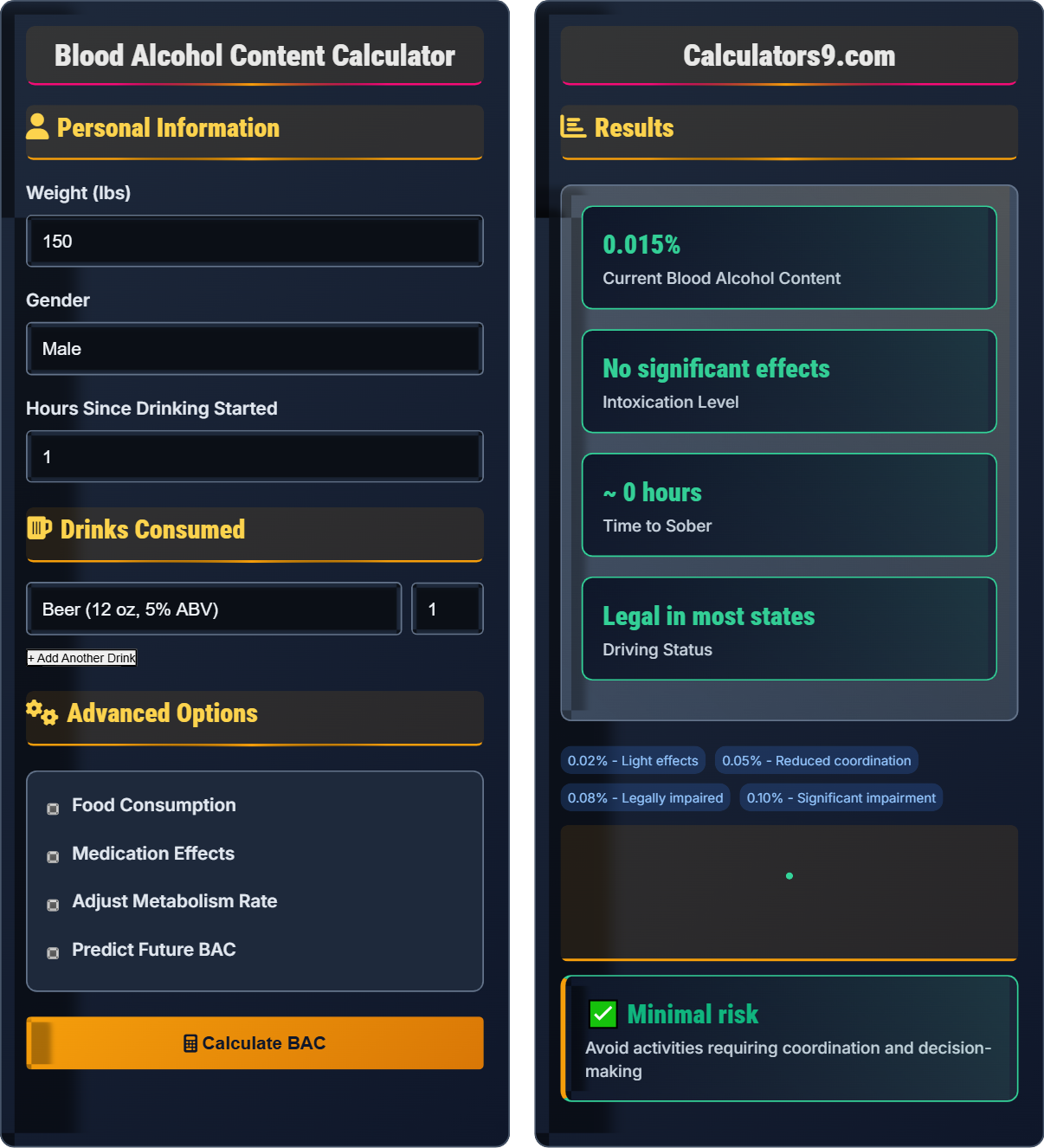
Personal Information
Drinks Consumed
Advanced Options
Results
BAC Fundamentals
Blood Alcohol Content (BAC) measures the percentage of alcohol in your bloodstream. It reflects the amount of alcohol in your blood by weight per volume. BAC levels are used to determine legal intoxication and impairment levels.
The Widmark formula estimates BAC based on:
This formula accounts for body weight, gender differences in body composition, and alcohol metabolism over time.
- Body weight affects alcohol distribution
- Gender affects body water content
- Food slows alcohol absorption
- Metabolism rate varies between individuals
Health Implications
Different BAC levels produce varying effects on the human body, from mild euphoria to severe impairment:
- 0.02%: Mild effects, slight loss of judgment
- 0.05%: Reduced coordination, lowered alertness
- 0.08%: Legally impaired in most jurisdictions
- 0.10%: Significant impairment of motor coordination
- 0.15%: Gross motor impairment and nausea
The liver metabolizes alcohol at an average rate of 0.015 BAC per hour. This rate is relatively constant regardless of BAC level or consumption amount. Factors affecting metabolism include:
- Liver health and enzyme activity
- Genetic variations in alcohol dehydrogenase
- Age and overall health
- Presence of food in stomach
- 0.08% is the legal limit in most US states
- Commercial drivers have lower limits (0.04%)
- Zero tolerance for drivers under 21
- Penalties vary by jurisdiction
Blood Alcohol Content Learning Quiz
A 180 lb male drinks 4 standard beers (12 oz, 5% ABV) over 3 hours. Calculate his approximate BAC using the Widmark formula. Show all steps and explain the significance of each variable.
Step 1: Calculate total alcohol consumed
Step 2: Apply Widmark formula
Variables explained:
- A = alcohol consumed (2.4 oz)
- W = body weight (180 lbs)
- r = gender constant (0.68 for males)
- H = hours since drinking (3 hours)
This calculation demonstrates how body weight affects BAC - heavier individuals will have lower BAC values for the same amount of alcohol consumed. The gender constant accounts for differences in body water content between males and females.
The 5.14 factor converts ounces of alcohol to pounds and accounts for the density of alcohol. The 0.015 represents the average rate of alcohol elimination from the body per hour.
At 0.056%, this person would experience reduced coordination and lowered alertness, which could impair driving ability.
Blood Alcohol Content (BAC): Percentage of alcohol in blood by weight per volume
Standard Drink: Contains about 0.6 oz of pure alcohol
Alcohol Metabolism: Process by which the liver breaks down alcohol
• Body weight inversely affects BAC (higher weight = lower BAC)
• Gender affects BAC due to different body water content
• Food consumption slows alcohol absorption
• The liver processes alcohol at a relatively constant rate
• Remember: 1 standard drink = 12 oz beer, 5 oz wine, or 1.5 oz spirits
• The 0.015 elimination rate means it takes about 1 hour to process 1 standard drink
• BAC continues to rise even after drinking stops due to delayed absorption
• Forgetting to account for gender differences in the formula
• Using incorrect volume measurements for standard drinks
• Not considering the time factor in BAC calculations
• Assuming BAC drops immediately after stopping drinking
A 130 lb female consumed 3 glasses of wine (5 oz each, 12% ABV) over 2 hours. She plans to drive home in 1 hour. Is this safe? Calculate her BAC now and predict her BAC in 1 hour. What factors might affect these calculations?
Current BAC calculation:
BAC in 1 hour:
Safety assessment: At 0.084%, she would still be above the legal limit of 0.08% in most jurisdictions and should not drive.
Factors affecting calculations:
- Food consumption (would slow absorption)
- Medications (could affect metabolism)
- Individual metabolic variations
- Rate of consumption
This problem illustrates why BAC calculations should only be used as estimates. The female's BAC is significantly higher than a male's would be due to the lower gender constant (0.55 vs 0.68), reflecting less body water content.
The calculation shows that even after waiting 1 hour, she would still be over the legal limit. This emphasizes that the body eliminates alcohol at a constant rate, regardless of BAC level.
Real-world factors like food, medications, and individual variation mean these calculations provide only approximations.
Legal Limit: Maximum BAC allowed for driving (typically 0.08%)
Zero Tolerance: Strict limits for young or commercial drivers
Impaired Driving: Operating vehicle under influence of alcohol
• BAC elimination rate is approximately constant (0.015/hour)
• Legal limits vary by jurisdiction and driver type
• Individual factors can significantly affect BAC
• Never rely solely on calculations for driving decisions
• Always plan ahead for transportation when drinking
• The "one drink per hour" rule is overly simplistic
• BAC continues to rise for 30-90 minutes after drinking stops
• Use this calculator as an educational tool, not for driving decisions
• Assuming BAC drops immediately after stopping drinking
• Ignoring the effect of food on alcohol absorption
• Believing that coffee or cold showers sober you up
• Using BAC calculations to justify driving decisions
Health FAQ
Q: How does food affect BAC calculations and alcohol absorption?
A: Food significantly affects alcohol absorption in several ways:
Slower Absorption: Food in the stomach delays alcohol passage to the small intestine, where most absorption occurs. This spreads absorption over a longer time, resulting in a lower peak BAC.
Peak Timing: On an empty stomach, BAC peaks in 30-90 minutes. With food, peak BAC may take 1-6 hours depending on the meal's composition.
Reduction Amount: A substantial meal can reduce peak BAC by 20-25% compared to drinking on an empty stomach.
Mechanism: Food causes the pyloric sphincter to close, keeping alcohol in the stomach longer. Additionally, food provides alternative energy sources, slowing alcohol metabolism.
However, food doesn't prevent intoxication - it only delays and moderates the effects.
Q: Can you speed up alcohol metabolism to sober up faster?
A: No, you cannot significantly speed up alcohol metabolism. The liver processes alcohol at a relatively constant rate of about 0.015 BAC per hour, regardless of:
• Drinking coffee or energy drinks
• Taking cold showers
• Exercising
• Drinking water (though hydration helps)
• Eating food (only affects absorption timing)
The liver's alcohol dehydrogenase enzyme system operates at near-maximum capacity when processing alcohol. Attempts to accelerate metabolism can be dangerous and ineffective.
The only way to sober up is time. Each standard drink takes approximately 1 hour to metabolize completely. Patience is the only effective "cure" for intoxication.