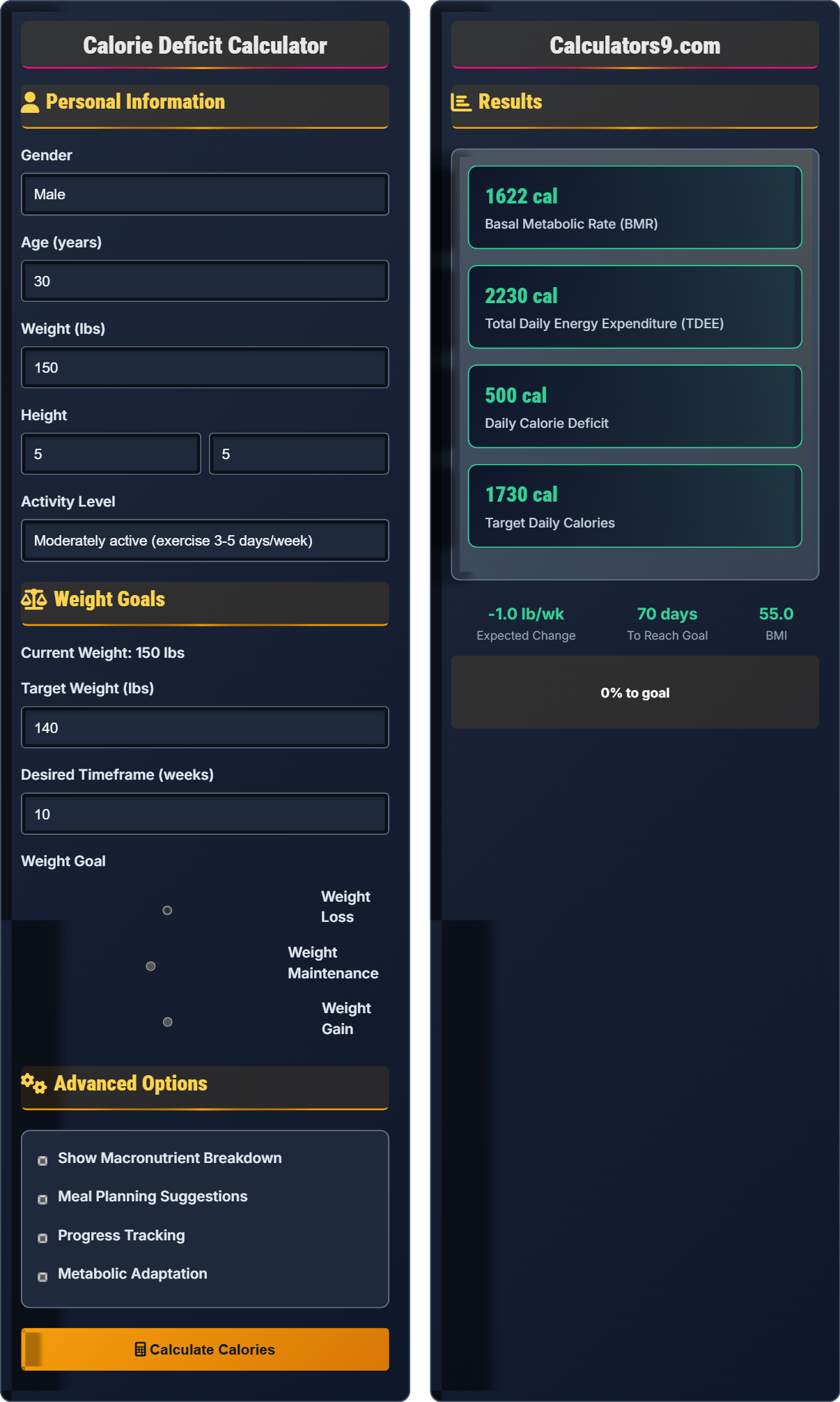
Calorie Deficit Calculator
Weight loss planner • TDEE & BMI tool
Harris-Benedict Equation for TDEE Calculation:
Show CalculatorThe Harris-Benedict equation estimates Basal Metabolic Rate (BMR), then multiplies by an activity factor:
Males: BMR = 88.362 + (13.397 × weight in kg) + (4.799 × height in cm) - (5.677 × age in years)
Females: BMR = 447.593 + (9.247 × weight in kg) + (3.098 × height in cm) - (4.330 × age in years)
TDEE = BMR × Activity Factor
Activity factors: Sedentary (1.2), Light (1.375), Moderate (1.55), Active (1.725), Very Active (1.9)
Example: 30-year-old female, 150 lbs (68 kg), 5'5" (165 cm), moderately active:
BMR = 447.593 + (9.247 × 68) + (3.098 × 165) - (4.330 × 30) = 1,384 calories/day
TDEE = 1,384 × 1.55 = 2,145 calories/day
For 1 lb/week weight loss: 2,145 - 500 = 1,645 calories/day
Personal Information
Weight Goals
Advanced Options
Results
Calorie Deficit Fundamentals
Calorie deficit occurs when you consume fewer calories than your body burns in a day. This forces your body to use stored fat for energy, leading to weight loss. A deficit of 3,500 calories typically results in 1 pound of fat loss.
The revised Harris-Benedict equation calculates Basal Metabolic Rate (BMR) and Total Daily Energy Expenditure (TDEE):
TDEE = BMR × Activity Factor
- 1 lb of fat = ~3,500 calories
- Safe deficit: 500-1,000 calories/day
- Minimum intake: 1,200 cal (women), 1,500 cal (men)
- Combine diet with exercise for better results
Nutrition & Health
Optimal macronutrient ratios support weight loss while maintaining muscle mass:
- Protein: 25-35% of calories (preserves lean mass)
- Carbohydrates: 30-50% of calories (provides energy)
- Fat: 20-35% of calories (supports hormone production)
Healthy weight loss strategies include:
- Gradual changes (1-2 lbs/week)
- Focus on whole foods
- Regular physical activity
- Adequate sleep and stress management
- Consult healthcare provider before starting
- Monitor for signs of nutritional deficiencies
- Adjust as progress plateaus
- Focus on long-term lifestyle changes
Calorie Deficit Learning Quiz
A 35-year-old woman weighs 165 lbs, is 5'4" tall, and exercises moderately 3-4 times per week. She wants to lose 20 lbs in 10 weeks. Calculate her BMR, TDEE, required daily calorie deficit, and target daily intake. Show all steps and explain the reasoning.
Step 1: Convert measurements to metric
Step 2: Calculate BMR using Harris-Benedict equation (female)
Step 3: Calculate TDEE using activity factor
Step 4: Calculate required weekly and daily deficit
Step 5: Calculate target daily intake
Results: BMR = 1,491 cal, TDEE = 2,312 cal, Target = 1,312 cal
This calculation demonstrates how personal characteristics affect energy needs. The woman's BMR represents calories needed at rest, while TDEE accounts for her activity level.
The 1,000 calorie daily deficit is aggressive but achievable for rapid weight loss. However, it approaches the minimum recommended intake for women (1,200 calories), so medical supervision is advised.
The calculation assumes a linear relationship between calorie deficit and weight loss, though metabolism may adapt over time.
Basal Metabolic Rate (BMR): Calories burned at rest to maintain vital functions
Total Daily Energy Expenditure (TDEE): BMR plus calories burned through activity
Calorie Deficit: Consuming fewer calories than TDEE
• 1 lb of fat = ~3,500 calories deficit
• Safe deficit: 500-1,000 calories/day
• Minimum intake: 1,200 cal (women), 1,500 cal (men)
• Adjust for metabolic adaptation over time
• Track food with a scale for accuracy
• Combine cardio with strength training
• Plan meals in advance
• Stay hydrated to manage hunger
• Underestimating portion sizes
• Not accounting for activity level properly
• Setting deficits too aggressive for long-term adherence
• Ignoring protein intake during weight loss
A person has a TDEE of 2,500 calories and wants to lose weight at a rate of 1.5 lbs per week. They decide on a 40% protein, 35% carbohydrate, and 25% fat diet. Calculate their daily calorie intake and the grams of each macronutrient. How does this macronutrient distribution support their weight loss goals?
Step 1: Calculate daily calorie intake for 1.5 lbs/week loss
Step 2: Calculate calories from each macronutrient
Step 3: Convert calories to grams
Results: 1,750 calories with 175g protein, 153g carbs, 49g fat
This high-protein diet (40%) supports weight loss by preserving lean muscle mass and increasing satiety. Protein has the highest thermic effect, meaning more calories are burned during digestion.
The moderate carbohydrate intake (35%) provides sufficient energy for workouts while supporting ketosis. The adequate fat intake (25%) maintains hormone production and vitamin absorption.
This macronutrient distribution creates a sustainable approach to weight loss while minimizing muscle loss.
Thermic Effect of Food (TEF): Calories burned during digestion
Lean Body Mass: Body weight excluding fat tissue
Ketosis: Metabolic state using fat for fuel
• Protein: 4 calories per gram
• Carbohydrates: 4 calories per gram
• Fat: 9 calories per gram
• Maintain adequate protein during weight loss
• Aim for 0.8-1g protein per lb body weight during loss
• Focus on nutrient-dense whole foods
• Monitor progress beyond just the scale
• Adjust as needed based on progress
• Too little protein leading to muscle loss
• Excessive restriction causing metabolic slowdown
• Focusing only on calories ignoring nutrition quality
• Not adjusting for changes in body weight over time
Health FAQ
Q: Is it safe to have a large calorie deficit to lose weight faster?
A: While a larger calorie deficit leads to faster initial weight loss, it comes with risks:
Risks of excessive deficits:
- Muscle mass loss along with fat
- Metabolic slowdown (adaptive thermogenesis)
- Nutritional deficiencies
- Gallstones and other health issues
- Increased risk of binge eating
Safe approach:
A deficit of 500-750 calories per day is generally considered safe for most people, leading to 1-1.5 lbs of weight loss per week. Women should not go below 1,200 calories per day, and men should not go below 1,500 calories without medical supervision.
Long-term success is better achieved through moderate, sustainable changes rather than extreme short-term restrictions.
Q: Why does weight loss slow down over time even with the same calorie intake?
A: Weight loss plateaus occur due to several metabolic adaptations:
Decreased BMR: As you lose weight, your body requires fewer calories to maintain the smaller frame. Each pound lost reduces daily calorie needs by about 2-3 calories.
Adaptive Thermogenesis: Your metabolism slows down as a survival mechanism, burning fewer calories at rest and during activity.
Non-Exercise Activity Thermogenesis (NEAT): People unconsciously move less when in a calorie deficit, further reducing energy expenditure.
Changes in hormones: Leptin decreases and ghrelin increases, affecting appetite and metabolism regulation.
To overcome plateaus, you may need to adjust your calorie intake or increase physical activity. Recalculating your TDEE every 10-15 lbs of weight loss helps maintain progress.