Gestation Calculator
Pregnancy tracker • Due date & development tool
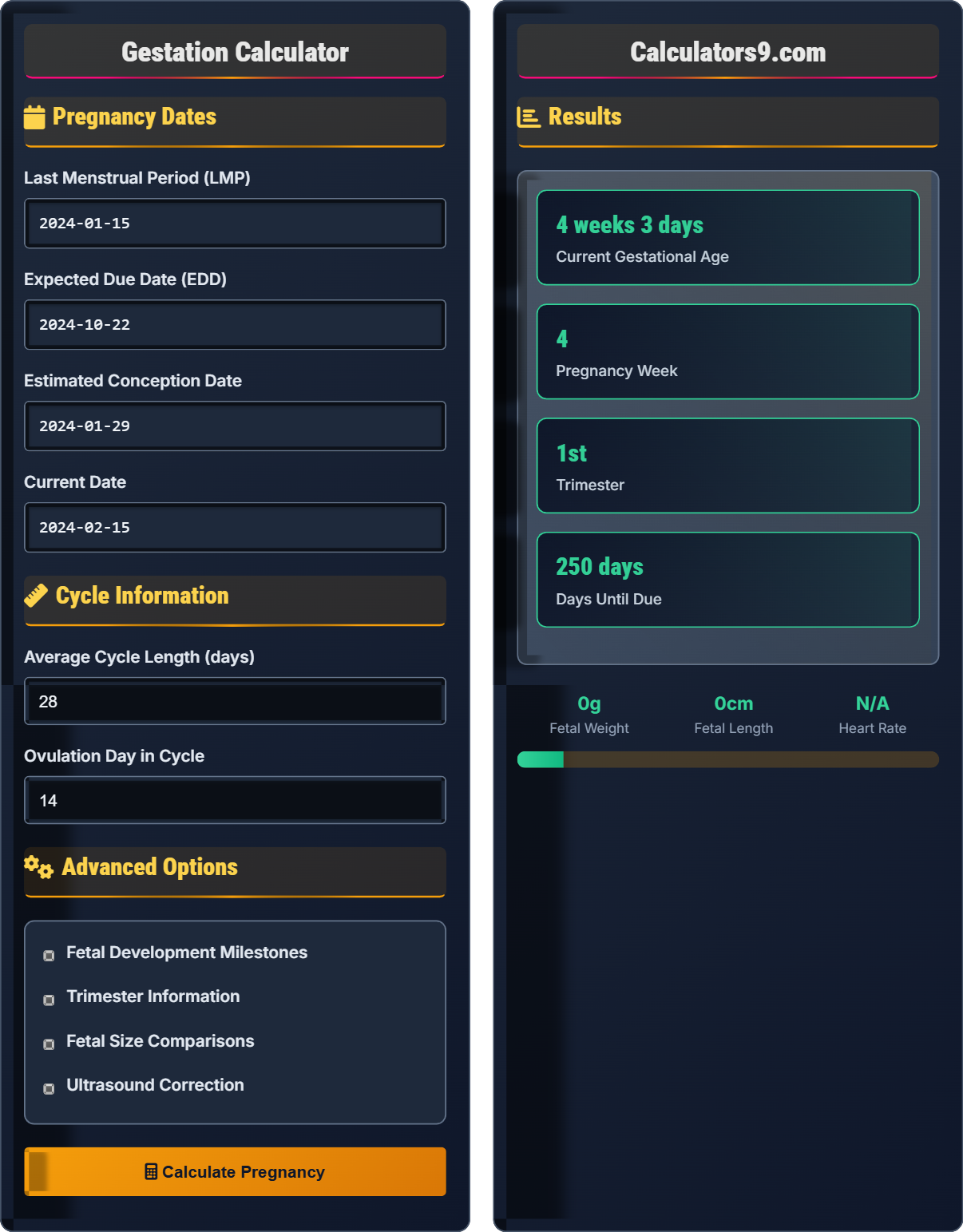
Naegele's Rule for Due Date Calculation:
Show CalculatorNaegele's rule estimates the expected date of delivery (EDD):
\( EDD = LMP + 7 \text{ days} - 3 \text{ months} + 1 \text{ year} \)
Where LMP is the first day of the Last Menstrual Period.
Example: If LMP is January 15, 2024:
\( EDD = January 15 + 7 \text{ days} = January 22 \)
\( January 22 - 3 \text{ months} = October 22 \)
\( Add 1 year if crossing calendar year = October 22, 2024 \)
Alternative formula: EDD = LMP + 280 days (40 weeks)
Gestational age is calculated from LMP, not conception date, adding approximately 2 weeks to the actual fetal age.
Pregnancy Dates
Cycle Information
Advanced Options
Results
Pregnancy Fundamentals
Gestational age is the time elapsed since the first day of the last menstrual period (LMP), not from conception. It's measured in weeks and days, with full-term pregnancy being 40 weeks (280 days) from LMP.
The standard method for calculating due date:
This assumes a 28-day cycle and ovulation on day 14.
- First: Weeks 1-12 (organ formation)
- Second: Weeks 13-26 (growth phase)
- Third: Weeks 27-40 (maturation phase)
Fetal Development
Fetal development follows a predictable pattern with critical milestones at specific gestational ages:
- Week 4: Heart begins beating
- Week 6: Brain and spinal cord develop
- Week 8: All major organs formed
- Week 12: Fingers and toes fully developed
- Week 20: Baby can hear sounds
- Week 28: Eyes can open
Ultrasounds provide more accurate dating than LMP in early pregnancy:
- First trimester: ±5-7 days accuracy
- Second trimester: ±10-14 days accuracy
- Third trimester: ±21+ days accuracy
- Every 4 weeks until week 28
- Every 2 weeks from week 28-36
- Weekly from week 36 until delivery
Gestation Learning Quiz
A woman's last menstrual period began on March 15, 2024. Using Naegele's rule, calculate her estimated due date. Show all calculation steps and explain why this method is used in clinical practice.
Step 1: Identify the LMP
Step 2: Add 7 days
Step 3: Subtract 3 months
Step 4: Add 1 year
Result: Estimated Due Date = December 22, 2024
Clinical Significance: Naegele's rule provides a standardized method for estimating due dates, which is essential for scheduling prenatal visits, monitoring fetal growth, and planning delivery.
Naegele's rule is based on a 28-day menstrual cycle with ovulation occurring on day 14. It adds 280 days (40 weeks) to the LMP to estimate the due date. The rule accounts for the fact that conception typically occurs around day 14 of the cycle, so gestational age is 2 weeks ahead of fetal age.
This method is widely used because it's simple, reproducible, and provides a consistent reference point across healthcare providers. It's most accurate for women with regular 28-day cycles.
The rule assumes that pregnancy lasts 10 lunar months (280 days) from the LMP, which is why we add 7 days and subtract 3 months.
Gestational Age: Time from LMP, not conception
EDD: Expected Date of Delivery
Naegele's Rule: Standard method for due date calculation
• Gestational age starts from LMP, not conception
• Standard cycle assumed to be 28 days
• Accuracy decreases with irregular cycles
• Confirm with early ultrasound when possible
• Use calendar apps to track LMP
• Early ultrasounds are more accurate than LMP
• Consider cycle length variations
• Calculating from conception date instead of LMP
• Forgetting to add the year when subtracting months
• Not accounting for irregular cycles
• Relying solely on LMP for dating
A pregnant woman is currently 22 weeks and 4 days gestation. Classify her pregnancy by trimester, describe the key developments occurring at this stage, and calculate how many days remain until the end of the second trimester. Explain the significance of this developmental stage.
Trimester Classification:
Key Developments at 22 Weeks:
- Baby is about the size of a coconut (1.1 lbs, 11 inches)
- Lungs are developing air sacs
- Baby can swallow and taste flavors from amniotic fluid
- Sleep and wake cycles are established
- Baby's skin is covered with vernix caseosa
Days to End of Second Trimester:
Significance: This is the halfway point of pregnancy and often considered the most comfortable trimester for mothers.
At 22 weeks, the fetus is entering the third quarter of the second trimester. This stage is significant because the baby is becoming viable (able to survive outside the womb with intensive care) and is developing sensory capabilities.
The second trimester is often called the "golden period" of pregnancy because morning sickness typically subsides and energy returns. The mother can usually feel regular fetal movements at this stage.
Developmental milestones at 22 weeks include the maturation of organ systems and the beginning of lung development, which is crucial for post-birth survival.
Viability: Ability of fetus to survive outside womb
Vernix Caseosa: Protective waxy coating on baby's skin
Crown-Rump Length: Measurement from head to bottom
• Viability typically begins around 22-24 weeks
• Regular prenatal visits continue throughout pregnancy
• Fetal movement should be monitored after 20 weeks
• Proper nutrition is critical for development
• Count fetal movements daily after 28 weeks
• Maintain proper posture to reduce back pain
• Continue prenatal vitamins
• Confusing gestational weeks with fetal age
• Not recognizing the significance of trimester boundaries
• Neglecting proper nutrition in second trimester
• Stopping prenatal care thinking danger has passed
Pregnancy FAQ
Q: How accurate is the due date calculated from my last period?
A: The due date calculated from your last menstrual period (LMP) is an estimate with a margin of error:
Accuracy by Stage:
- LMP method: ±1-2 weeks accuracy
- First trimester ultrasound: ±5-7 days accuracy
- Second trimester ultrasound: ±10-14 days accuracy
- Third trimester ultrasound: ±21+ days accuracy
Factors Affecting Accuracy:
- Irregular menstrual cycles
- Uncertain LMP date
- Variations in ovulation timing
- Differences in fetal growth rates
Most healthcare providers will use the earliest ultrasound for dating if it differs significantly from LMP calculations, especially if your cycles are irregular.
Q: What's the difference between gestational age and fetal age?
A: The key differences are:
Gestational Age:
- Measured from the first day of your last menstrual period (LMP)
- Standard clinical measurement
- Includes 2 weeks before conception
- Used for due date calculation
Fetal Age:
- Actual age of the developing baby
- Measured from conception date
- About 2 weeks less than gestational age
- More accurate for developmental milestones
For example, at 10 weeks gestational age, the baby is actually about 8 weeks old. Healthcare providers use gestational age because the exact conception date is rarely known.