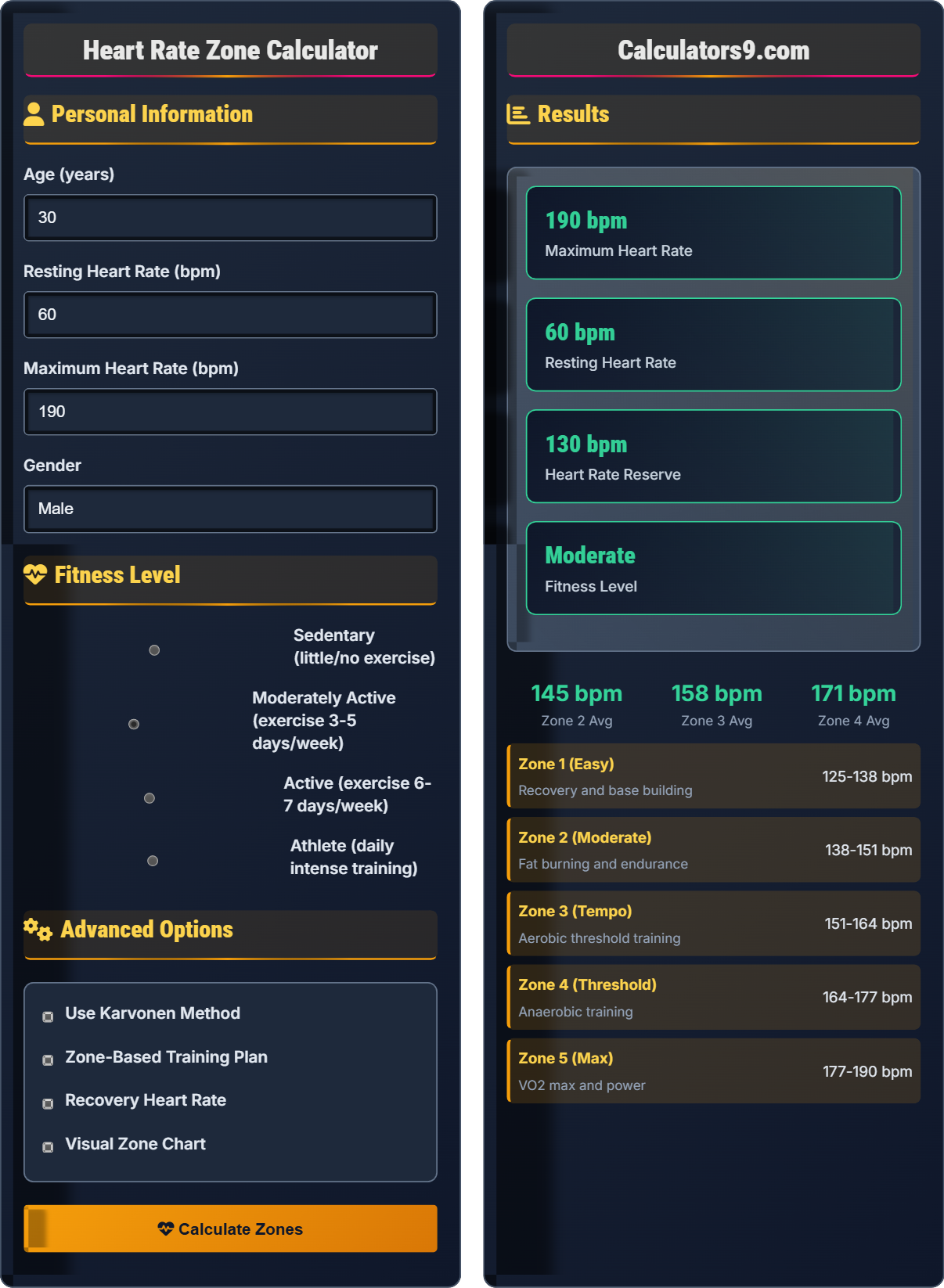
Heart Rate Zone Calculator
Cardio training zones • Fitness tracker
Karvonen Method for Heart Rate Zones:
Show CalculatorThe Karvonen method calculates heart rate zones based on heart rate reserve (HRR):
\( HR_{target} = (HR_{max} - HR_{rest}) \times \%Intensity + HR_{rest} \)
Where:
- \( HR_{max} \) = Maximum heart rate (220 - age)
- \( HR_{rest} \) = Resting heart rate
- \( HR_{target} \) = Target heart rate for specific zone
- \( \%Intensity \) = Percentage intensity for the zone
This method accounts for individual fitness levels by incorporating resting heart rate.
Example: 30-year-old with resting HR of 60 bpm:
\( HR_{max} = 220 - 30 = 190 \) bpm
\( HRR = 190 - 60 = 130 \) bpm
Zone 2 (60-70%): \( HR = (130 \times 0.65) + 60 = 144.5 \) bpm
Personal Information
Fitness Level
Advanced Options
Results
Heart Rate Zone Fundamentals
Heart rate zones are specific ranges of heart rate intensity that correspond to different physiological responses during exercise. Training in specific zones targets different energy systems and adaptations, optimizing fitness gains.
The Karvonen method calculates heart rate zones based on heart rate reserve (HRR):
This method accounts for individual fitness levels by incorporating resting heart rate.
- Zone 1: 50-60% (Recovery)
- Zone 2: 60-70% (Aerobic base)
- Zone 3: 70-80% (Tempo)
- Zone 4: 80-90% (Threshold)
- Zone 5: 90-100% (Max effort)
Training Applications
Each heart rate zone provides distinct training benefits:
- Zone 1-2: Builds aerobic base, improves fat oxidation
- Zone 3: Develops lactate threshold
- Zone 4: Improves VO2 max
- Zone 5: Develops speed and power
Effective training distribution: 80% in zones 1-2, 20% in zones 4-5. This approach maximizes fitness gains while minimizing injury risk.
- Consult physician before intense training
- Gradually increase zone intensity
- Monitor for warning symptoms
- Allow adequate recovery between sessions
Heart Rate Zone Learning Quiz
A 35-year-old athlete has a resting heart rate of 45 bpm and wants to train in Zone 3 (70-80% intensity). Calculate their heart rate range for this zone using the Karvonen method. Show all steps and explain the physiological significance of this zone.
Step 1: Calculate maximum heart rate
Step 2: Calculate heart rate reserve
Step 3: Calculate Zone 3 range (70-80% intensity)
Result: Zone 3 range is 143-157 bpm
Physiological Significance: Zone 3 corresponds to tempo training, where lactate begins to accumulate in the blood. This zone develops the lactate threshold, improving the body's ability to clear lactate and maintain higher intensities for longer periods.
The Karvonen method accounts for individual fitness levels by incorporating resting heart rate. Athletes typically have lower resting heart rates due to improved cardiac efficiency, which affects their zone calculations.
Zone 3 training is critical for endurance athletes as it builds the aerobic base while introducing some anaerobic stress. This zone improves both aerobic and anaerobic energy systems.
The heart rate reserve calculation (HRR = max - rest) represents the usable range of heart rate for exercise, making the zone calculations more personalized.
Heart Rate Reserve (HRR): Difference between max and resting heart rate
Lactate Threshold: Point where lactate accumulates faster than cleared
VO2 Max: Maximum oxygen consumption during exercise
• Always use heart rate reserve in zone calculations
• Lower resting HR = higher training zones
• Zone 3 is the transition zone between aerobic and anaerobic
• Consistent training improves heart rate efficiency
• Measure resting HR upon waking for accuracy
• Recalculate zones every 4-6 weeks as fitness changes
• Use heart rate monitor for precise training
• Using max HR alone without considering rest HR
• Not accounting for fitness level in calculations
• Staying too long in high-intensity zones
• Ignoring recovery zones in training
An endurance runner with a max HR of 195 bpm and resting HR of 40 bpm wants to follow a polarized training approach (80% low intensity, 20% high intensity). Calculate the heart rate ranges for their low and high intensity training. How should they distribute their weekly 10-hour training schedule?
Step 1: Calculate heart rate reserve
Step 2: Define polarized training zones
Step 3: Calculate heart rate ranges
High intensity:
Weekly distribution:
Polarized training is scientifically proven to maximize endurance performance. The 80/20 split allows for sufficient recovery while providing high-intensity stimulus.
Low-intensity training (Zones 1-2) builds the aerobic base and improves fat oxidation, while high-intensity training (Zones 4-5) improves VO2 max and speed.
This approach prevents overuse injuries and burnout while maximizing fitness adaptations. The heart rate ranges ensure proper intensity distribution.
Polarized Training: 80% low intensity, 20% high intensity approach
Aerobic Base: Foundation of cardiovascular fitness
Overload Principle: Gradually increasing training stress
• Follow 80/20 intensity distribution
• Allow 48 hours between high-intensity sessions
• Monitor heart rate to maintain proper zones
• Adjust as fitness improves
• Use heart rate monitor during all training
• Schedule high-intensity sessions early in week
• Include recovery sessions between intense workouts
• Spending too much time in moderate intensity (Zone 3)
• Not enough recovery between high-intensity sessions
• Ignoring heart rate during training
• Increasing volume too quickly
Health FAQ
Q: How do I accurately measure my resting heart rate?
A: For the most accurate resting heart rate measurement:
Timing: Measure immediately upon waking, before getting out of bed or consuming caffeine.
Method: Place two fingers on your wrist or neck and count beats for 15 seconds, then multiply by 4. Alternatively, use a chest strap monitor.
Consistency: Take measurements over 3-5 consecutive mornings and calculate the average.
Conditions: Ensure you've had adequate sleep and aren't experiencing stress, illness, or dehydration.
A normal resting heart rate ranges from 60-100 bpm for adults, though athletes may have rates as low as 40-60 bpm.
Q: How often should I recalculate my heart rate zones?
A: Recalculate your heart rate zones every 4-6 weeks as your fitness improves. As you become more aerobically fit:
• Your resting heart rate may decrease
• Your maximum heart rate may change slightly
• Your heart rate at submaximal efforts will decrease
Signs to recalculate:
• Your current zone feels easier than it used to
• You're consistently exceeding zone boundaries
• You've made significant fitness improvements
• You're training for a new sport or distance
Some athletes also reassess their zones seasonally or when changing training focus.