Body Frame Size Calculator
Anthropometric frame size determination • Wrist circumference method
Frame Size Formula:
Show the calculator\( \text{Frame Size Index} = \frac{\text{Wrist Circumference (cm)}}{\text{Height (cm)}} \times 100 \)
Alternative method using wrist circumference thresholds:
- Men: Small frame: <3.6", Medium: 3.6"-4.0", Large: >4.0"
- Women: Small frame: <5.5", Medium: 5.5"-5.75", Large: >5.75"
Example: For a woman who is 5'4" (162.56 cm) tall with a wrist circumference of 14.5 cm:
Frame Size Index = (14.5 / 162.56) × 100 ≈ 8.92
Alternatively, using wrist circumference: 14.5 cm ≈ 5.7" which indicates a medium frame size.
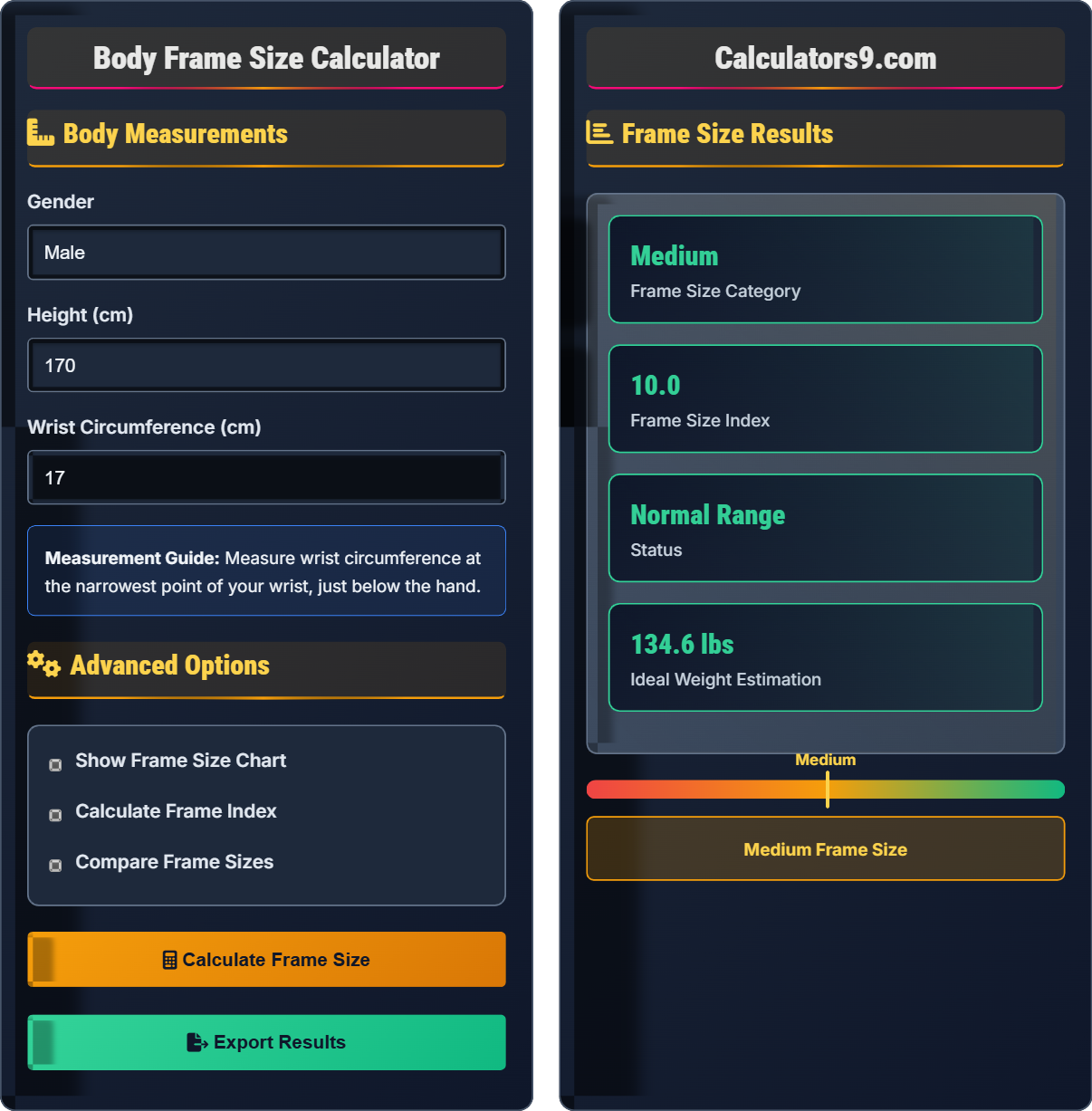
Body Measurements
Advanced Options
Frame Size Results
| Frame Size | Wrist Range (cm) | Wrist Range (in) | Characteristics |
|---|---|---|---|
| Small | < 15.2 cm | < 6.0 in | Delicate bones, narrow shoulders |
| Medium | 15.2 - 17.8 cm | 6.0 - 7.0 in | Average build, proportional features |
| Large | > 17.8 cm | > 7.0 in | Broad shoulders, robust build |
| Measurement | Your Value | Standard Range |
|---|---|---|
| Height | 170.0 cm | Varies by gender |
| Wrist Circumference | 17.0 cm | 15.2-17.8 cm (avg) |
| Frame Index | 10.0 | 8.5-11.0 (avg) |
Body Frame Size & Anthropometric Guide
Body frame size refers to the skeletal structure of an individual, determined primarily by bone dimensions. It's an important anthropometric measurement used in fitness, nutrition, and medical assessments. Frame size influences ideal weight calculations, exercise prescriptions, and body composition interpretations.
There are two primary methods for determining frame size:
These methods account for the relationship between skeletal structure and overall body proportions.
Frame size classifications differ by gender due to natural anatomical differences:
- Men: Small: <3.6", Medium: 3.6"-4.0", Large: >4.0"
- Women: Small: <5.5", Medium: 5.5"-5.75", Large: >5.75"
- Wrist measurements taken at the narrowest point of the wrist
- Measurements may vary slightly between different protocols
- Nutrition: Adjust ideal weight calculations based on frame size
- Fitness: Tailor exercise programs to skeletal structure
- Medical: Assess body composition and health risks
- Research: Standardize anthropometric comparisons
- Healthcare: Evaluate nutritional status
Frame Size Basics
Skeletal structure classification based on bone dimensions.
Wrist circumference relative to height.
Frame Index = (Wrist/Height) × 100
- Measured at narrowest wrist point
- Gender-specific standards
- Independent of muscle mass
Applications
Weight estimation, exercise planning, health assessments.
- Direct wrist measurement
- Frame size index
- Height-to-wrist ratios
- Joint diameter measurements
- Does not account for muscle mass
- Standards vary by population
- Used for general estimations
- Not diagnostic of health status
Body Frame Size Learning Quiz
According to standard anthropometric classifications, what wrist circumference range indicates a medium frame size for women?
The answer is B) 5.5 to 5.75 inches. For women, a medium frame size is defined as having a wrist circumference between 5.5 and 5.75 inches. This represents the average skeletal structure classification for females.
Understanding frame size categories is important because they help establish baseline expectations for body composition and weight. The wrist circumference method is a simple, reliable way to assess skeletal structure, which remains relatively constant regardless of muscle or fat mass changes.
Frame Size: Classification of skeletal structure based on bone dimensions
Wrist Circumference: Measurement around the narrowest part of the wrist
Medium Frame: Average skeletal structure classification
• Frame size is determined by bone structure, not muscle
• Standards differ for men and women
• Measured at the narrowest wrist point
• Measure on non-dominant hand for consistency
• Use soft measuring tape for accuracy
• Take measurement at rest, not during exercise
• Measuring at the wrong location on the wrist
• Using rigid measuring tools instead of flexible tape
• Not accounting for gender-specific standards
Calculate the frame size index for a man who is 180 cm tall with a wrist circumference of 18.5 cm. What category does this indicate?
Step 1: Apply the frame size index formula:
Frame Size Index = (Wrist Circumference / Height) × 100
Step 2: Calculate: (18.5 / 180) × 100 = 0.1028 × 100 = 10.28
Step 3: Interpretation: A frame size index of 10.28 indicates a large frame size for men, as it exceeds the typical threshold of 10.0.
The frame size index provides a normalized measure that accounts for height variations. This makes it easier to compare frame sizes across individuals of different heights. The index represents the proportion of wrist circumference relative to overall stature.
Frame Size Index: Normalized ratio of wrist circumference to height
Large Frame: Skeletal structure above average size
Normalized Measure: Adjusted for height differences
• Frame index accounts for height differences
• Higher index indicates larger frame
• Index >10.0 typically indicates large frame for men
• Remember: Index = (Wrist/Height) × 100
• Men: >10.0 = large frame
• Women: >9.0 = large frame
• Forgetting to multiply by 100 in the formula
• Using wrong gender-specific thresholds
• Confusing units between centimeters and inches
A 5'6" (167.64 cm) woman with a small frame size wants to determine her ideal weight range. How does her frame size influence the calculation, and what would be a reasonable estimate?
Step 1: Identify frame size - Small frame (wrist circumference <5.5")
Step 2: Understand impact - Small frames typically have lower ideal weight ranges
Step 3: Calculate base weight: 100 lbs for first 5 feet + 5 lbs per inch = 100 + (6×5) = 130 lbs
Step 4: Adjust for frame size - Small frame: subtract 10% = 130 × 0.9 = 117 lbs
Step 5: Reasonable range: Approximately 110-125 lbs
Frame size significantly impacts ideal weight calculations because it reflects the structural foundation of the body. Small-framed individuals have less bone mass and smaller organ systems, requiring less body weight to maintain health. This adjustment prevents setting unrealistic weight goals.
Ideal Weight: Estimated healthy weight range based on height and frame
Base Weight: Starting point for weight calculations
Frame Adjustment: Modification based on skeletal structure
• Small frame: subtract 10% from base weight
• Medium frame: no adjustment needed
• Large frame: add 10% to base weight
• Remember: 100 lbs + 5 lbs per inch over 5 ft
• Small: -10%, Medium: 0%, Large: +10%
• Use frame size for weight goal setting
• Not adjusting weight calculations for frame size
• Using generic weight charts without frame consideration
• Confusing frame size with body fat percentage
A fitness trainer needs to design a resistance training program for a large-frame male client. How should the client's frame size influence the exercise prescription, particularly regarding load selection and progression?
Step 1: Recognize large frame characteristics - robust bone structure, higher bone density
Step 2: Consider implications - able to handle heavier loads safely
Step 3: Adjust prescription:
- Start with higher initial loads than small-frame clients
- Use heavier weights for strength training
- Allow for greater load progression
- Focus on compound movements
- Monitor for proper form with increased loads
Step 4: Benefits - large-frame individuals often excel in strength sports due to structural advantages.
Frame size should influence exercise programming because skeletal structure determines the capacity to handle mechanical stress. Large-frame individuals have greater bone density and joint stability, allowing for higher training loads. This personalized approach optimizes training effectiveness and safety.
Exercise Prescription: Structured plan for physical activity
Load Selection: Choice of resistance or weight for exercises
Progression: Gradual increase in training demands
• Larger frames can typically handle heavier loads
• Large frame: Start with higher percentages of max
• Small frame: Focus on form and technique first
• Medium frame: Standard progression protocols
• Using same starting weights for all frame sizes
• Not considering structural differences
• Applying generic training programs
Which of the following statements about body frame size assessment is TRUE?
The answer is C) Frame size is primarily determined by bone structure. Body frame size reflects the skeletal dimensions of an individual, particularly bone density and joint diameters. It is genetically determined and remains relatively constant throughout adulthood, unlike muscle mass which can be altered through exercise.
This concept is fundamental to understanding anthropometric assessments. Frame size represents the structural foundation of the body and is independent of muscle or fat mass. Recognizing this distinction is crucial for accurate body composition assessments and health evaluations.
Frame Size: Classification of skeletal structure dimensions
Bone Structure: Genetic determinants of skeletal dimensions
Anthropometric: Measurement of human body dimensions
• Frame size is genetically determined
• Independent of muscle and fat mass
• Remains relatively constant in adulthood
• Remember: Bone structure ≠ Muscle mass
• Frame size is largely genetic
• Does not change significantly with training
• Confusing frame size with body composition
• Thinking frame size can be altered through exercise
• Not distinguishing between bone and muscle mass
FAQ
Q: How does knowing someone's frame size help in designing a workout program?
A: Knowing someone's frame size is crucial for safe and effective exercise programming. Large-frame individuals typically have greater bone density and joint stability, allowing them to handle heavier loads safely. They may benefit from higher-intensity resistance training and can often progress more rapidly.
Small-frame individuals, conversely, may need to focus more on technique and form initially, with gradual load progression. Their joints may be more susceptible to injury with excessive loading, so exercise selection and intensity need careful consideration.
Mathematically, the relationship can be expressed as:
\( \text{Safe Load Factor} = \text{Base Load} \times (1 + \text{Frame Adjustment}) \)
Where frame adjustment might be -0.1 for small frames, 0 for medium frames, and +0.1 for large frames.
Q: How is frame size used in calculating ideal body weight?
A: Frame size is used to adjust ideal body weight calculations to account for individual variations in skeletal structure. The standard formula is:
\( \text{Base Weight} = 100\ lbs\ for\ first\ 5'\ +\ 5\ lbs\ per\ inch\ over\ 5' \)
Then adjust based on frame size:
- Small frame: Subtract 10% from base weight
- Medium frame: No adjustment needed
- Large frame: Add 10% to base weight
For example, a 5'6" medium-frame woman: Base = 100 + (6×5) = 130 lbs. Ideal weight = 130 lbs.
For a small-frame woman of the same height: 130 × 0.9 = 117 lbs.