Skinfold Body Fat Calculator
Advanced body composition • Body fat percentage
Skinfold Body Fat Formulas:
Show the calculatorDurnin-Womersley Formula (4-site):
\( \text{Log}_{10}(\text{Sum of 4 sites}) = \log_{10}(\text{Triceps} + \text{Biceps} + \text{Subscapular} + \text{Suprailiac}) \)
\( \text{Density} = 1.1533 - (0.0643 \times \log_{10}(\text{Sum})) \)
\( \text{Body Fat \%} = \frac{495}{\text{Density}} - 450 \)
Jackson-Pollock Formula (3-site):
\( \text{Body Fat \%} = 495/(1.112 - (0.00043499 \times \text{Sum}) + (0.00000055 \times \text{Sum}^2) - (0.00028826 \times \text{Age})) - 450 \)
Where:
- Measurements: Skinfold thickness in millimeters
- Sum: Total of all measured sites
- Age: In years (for Jackson-Pollock)
- Body Fat %: Percentage of body weight that is fat
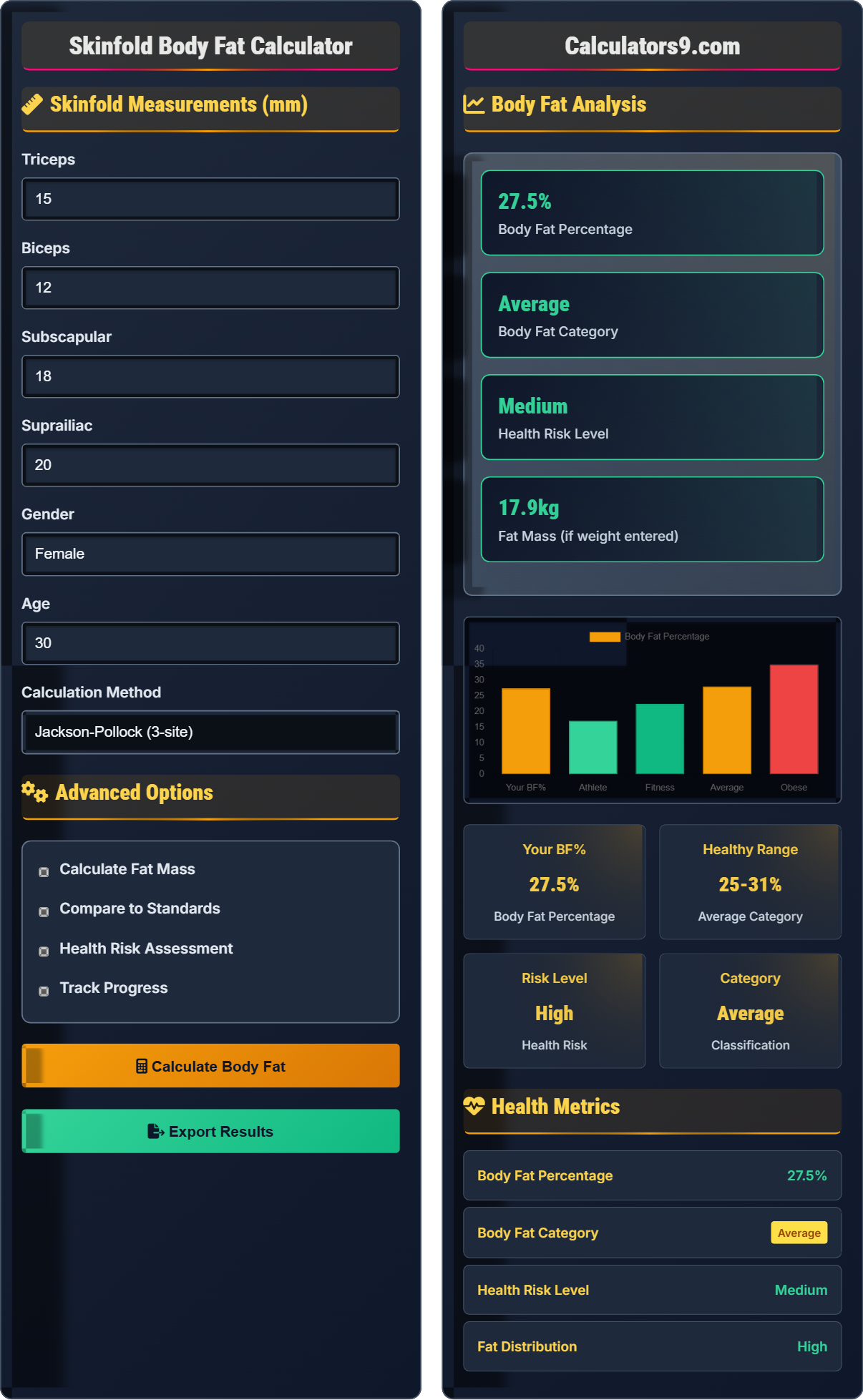
Skinfold measurements are a practical and cost-effective method for estimating body fat percentage. The Durnin-Womersley method uses four sites and is accurate within 3-4% of underwater weighing. The Jackson-Pollock method incorporates age for more precise results. For men: Essential fat <3%, Athletes 6-13%, Fitness 14-17%, Average 18-24%, Obese >25%. For women: Essential fat 10-13%, Athletes 14-20%, Fitness 21-24%, Average 25-31%, Obese >32%.
Skinfold Measurements (mm)
Advanced Options
Body Fat Analysis
Health Metrics
Skinfold Body Fat Analysis Methodology
Skinfold testing is a method of estimating body fat percentage by measuring the thickness of subcutaneous fat at specific anatomical sites using calipers. This technique is based on the principle that approximately 50% of total body fat is located beneath the skin. When performed correctly by a trained professional, skinfold measurements can predict body fat percentage within 3-4% of the gold standard methods like underwater weighing.
Common formulas for converting skinfold measurements to body fat percentage:
\( \text{Density} = 1.1533 - (0.0643 \times \log_{10}(\text{Sum of 4 sites})) \)
\( \text{Body Fat \%} = \frac{495}{\text{Density}} - 450 \)
\( \text{Body Fat \%} = \frac{495}{1.112 - (0.00043499 \times \text{Sum}) + (0.00000055 \times \text{Sum}^2) - (0.00028826 \times \text{Age})} - 450 \)
Standard body fat percentage ranges:
- Men - Essential Fat: <3%
- Men - Athletes: 6-13%
- Men - Fitness: 14-17%
- Men - Average: 18-24%
- Men - Obese: >25%
- Women - Essential Fat: 10-13%
- Women - Athletes: 14-20%
- Women - Fitness: 21-24%
- Women - Average: 25-31%
- Women - Obese: >32%
- Assessment: Determine body composition and health risks
- Monitoring: Track changes in body fat during weight loss/gain
- Program Design: Create appropriate exercise and nutrition plans
- Research: Accurate population studies and fitness tracking
- Performance: Optimize athletic performance and body composition
Skinfold Fundamentals
Measurement of subcutaneous fat thickness using calipers to estimate total body fat percentage.
Common formulas convert skinfold sums to body fat % using logarithmic regressions.
- Measure in mm using calibrated calipers
- Take measurements at standardized sites
- Use appropriate gender-specific equations
- Take multiple readings for accuracy
Clinical Applications
Standardized ranges for health and performance classification.
- Locate standardized measurement sites
- Pinch skin and subcutaneous fat
- Measure with calipers at 90° angle
- Record measurements in mm
- Calculate using appropriate formula
- Requires training for accuracy
- Best performed by certified professionals
- Consider hydration and recent activity
- Multiple measurements improve reliability
Skinfold Body Fat Learning Quiz
When performed correctly by a trained professional, skinfold measurements can predict body fat percentage within what range of the gold standard methods?
The answer is B) Within 3-4%. When performed correctly by a trained professional, skinfold measurements can predict body fat percentage within 3-4% of gold standard methods like underwater weighing. This level of accuracy makes skinfold testing a valuable tool for body composition assessment in clinical and fitness settings.
Understanding the accuracy of skinfold testing is crucial for appreciating its role in body composition assessment. The 3-4% accuracy range positions skinfold testing as a reliable alternative to more expensive and time-consuming gold standard methods, making it accessible for regular monitoring and assessment.
Skinfold Testing: Method of estimating body fat by measuring subcutaneous fat thickness
Gold Standard: Most accurate method available for comparison
Accuracy Range: Acceptable margin of error for the measurement method
• Skinfold accuracy: within 3-4% of gold standard
• Requires trained professional for accuracy
• Multiple measurements improve reliability
• Seek certified professionals for measurements
• Take multiple readings at each site
• Compare to standardized equations
• Expecting laboratory-level accuracy from field methods
• Not considering the need for professional training
• Using improper technique or equipment
Using the Durnin-Womersley formula, calculate the body fat percentage for a woman with the following measurements: Triceps=15mm, Biceps=12mm, Subscapular=18mm, Suprailiac=20mm. Show your work.
Step 1: Calculate sum of 4 sites = 15 + 12 + 18 + 20 = 65mm
Step 2: Calculate log₁₀(sum) = log₁₀(65) = 1.813
Step 3: Calculate density = 1.1533 - (0.0643 × 1.813) = 1.1533 - 0.1166 = 1.0367
Step 4: Calculate body fat % = (495 ÷ 1.0367) - 450 = 477.4 - 450 = 27.4%
The body fat percentage for this woman is approximately 27.4%
This calculation demonstrates the logarithmic nature of skinfold equations. The Durnin-Womersley formula uses a logarithmic transformation of the sum of skinfold measurements to predict body density, which is then converted to body fat percentage using Siri's equation. The logarithmic relationship accounts for the non-linear relationship between skinfold thickness and total body fat.
Durnin-Womersley Formula: Regression equation for predicting body fat from 4 skinfold sites
Body Density: Mass per unit volume of the body
Siri Equation: Formula to convert body density to body fat percentage
• Sum all 4 measurement sites
• Use logarithmic transformation
• Apply gender-specific equations
• Use calculator for logarithmic functions
• Ensure consistent units (mm for measurements)
• Verify measurements before calculation
• Adding measurements incorrectly
• Forgetting logarithmic transformation
• Using wrong constants for gender
John, a 35-year-old male, has the following skinfold measurements: Triceps=10mm, Biceps=8mm, Subscapular=12mm, Suprailiac=15mm. Calculate his body fat percentage and determine which category he falls into. The standard ranges for men are: Essential Fat: <3%, Athletes: 6-13%, Fitness: 14-17%, Average: 18-24%, Obese: >25%.
Step 1: Calculate sum of 4 sites = 10 + 8 + 12 + 15 = 45mm
Step 2: Calculate log₁₀(45) = 1.653
Step 3: Calculate density = 1.1533 - (0.0643 × 1.653) = 1.1533 - 0.1063 = 1.047
Step 4: Calculate body fat % = (495 ÷ 1.047) - 450 = 472.8 - 450 = 22.8%
Step 5: Compare to male ranges: 22.8% falls in the "Average" category (18-24%)
John's body fat percentage is 22.8%, which places him in the Average category for men.
This example demonstrates how to interpret body fat percentages within established categories. The 22.8% result for John indicates he falls within the "Average" range for men, which is considered acceptable but not optimal for health. Understanding these categories helps individuals set appropriate fitness and health goals.
Body Fat Categories: Standardized ranges for health and performance classification
Reference Standards: Established ranges for comparison purposes
Health Classification: Categorization based on health implications
• Use gender-specific reference ranges
• Consider age and fitness level
• Compare to standardized categories
• Know standard ranges for your demographic
• Track changes over time
• Set realistic goals based on categories
• Using wrong gender-specific ranges
• Not considering age-related changes
• Comparing to inappropriate standards
Sarah, a 28-year-old female athlete, has a body fat percentage of 24% based on her skinfold measurements. According to standards, female athletes typically have 14-20% body fat. Calculate how much her body fat percentage needs to decrease to reach the upper limit of the athlete category, and discuss the health implications of her current level.
Step 1: Current body fat % = 24%
Step 2: Upper limit of athlete category = 20%
Step 3: Required decrease = 24% - 20% = 4 percentage points
Step 4: Percentage reduction = (4 ÷ 24) × 100 = 16.7%
Health implications:
- Currently in "Fitness" category (21-24%) rather than "Athlete" (14-20%)
- Still within healthy range but above athlete standards
- May need to adjust training/nutrition to reach athlete category
- Current level is still healthy and functional
This demonstrates how to use body fat categories for goal setting. Sarah's 24% body fat is still healthy but above the athlete range. The 4% reduction needed represents a 16.7% decrease from her current level, which would require targeted interventions in training and nutrition to achieve the athlete category.
Fitness Goal Setting: Establishing targets based on body composition standards
Percentage Point: Arithmetic difference between two percentages
Target Reduction: Desired change in body composition
• Set realistic goals based on standards
• Consider safety and health implications
• Monitor progress over time
• Calculate absolute and relative changes
• Set incremental goals
• Consider overall health, not just numbers
• Setting unrealistic goals based on extremes
• Not considering safety margins
• Focusing only on numbers without context
Which of the following is the correct location for the suprailiac skinfold measurement?
The answer is A) Above the iliac crest, in line with the axilla. The suprailiac skinfold is measured above the iliac crest (the top of the hip bone) and in line with the axilla (armpit). This is a standard anatomical landmark that ensures consistency in measurements across different individuals and technicians.
Understanding anatomical landmarks is crucial for accurate skinfold measurements. The suprailiac site is located at a specific anatomical position to ensure standardized measurements. Consistency in location is essential for reliable comparisons over time and between different technicians.
Anatomical Landmarks: Specific reference points on the body for measurements
Iliac Crest: The curved upper border of the hip bone
Axilla: The armpit region
• Use standardized anatomical locations
• Pinch perpendicular to muscle fibers
• Measure on relaxed muscles
• Learn anatomical landmarks thoroughly
• Practice on yourself first
• Take multiple measurements at each site
• Measuring at incorrect anatomical locations
• Including muscle in the pinch
• Measuring on tense muscles
FAQ
Q: How accurate is skinfold testing compared to other body composition methods?
A: When performed by a trained professional, skinfold testing is accurate within 3-4% of the gold standard methods like underwater weighing. The accuracy depends on:
- Technician skill and experience
- Quality of calipers used
- Consistency in measurement technique
- Appropriateness of the prediction equation
Compared to DEXA scans, skinfold testing is less accurate but more accessible and cost-effective.
Q: What are the standard body fat percentage ranges for different categories?
A: Standard body fat percentage ranges are:
Men:
- Essential Fat: <3%
- Athletes: 6-13%
- Fitness: 14-17%
- Average: 18-24%
- Obese: >25%
Women:
- Essential Fat: 10-13%
- Athletes: 14-20%
- Fitness: 21-24%
- Average: 25-31%
- Obese: >32%