Katch-McArdle BMR Calculator
Lean body mass based metabolic rate • Body composition
Katch-McArdle Formula:
Show Calculator\( BMR = 370 + (21.6 \times LBM) \)
Where:
- \( BMR \) = Basal Metabolic Rate (calories/day)
- \( LBM \) = Lean Body Mass (kg)
- \( LBM = Weight \times (1 - BodyFat\%) \)
The Katch-McArdle formula is considered the most accurate BMR equation because it accounts for lean body mass rather than total body weight. It's particularly accurate for individuals with known body fat percentage.
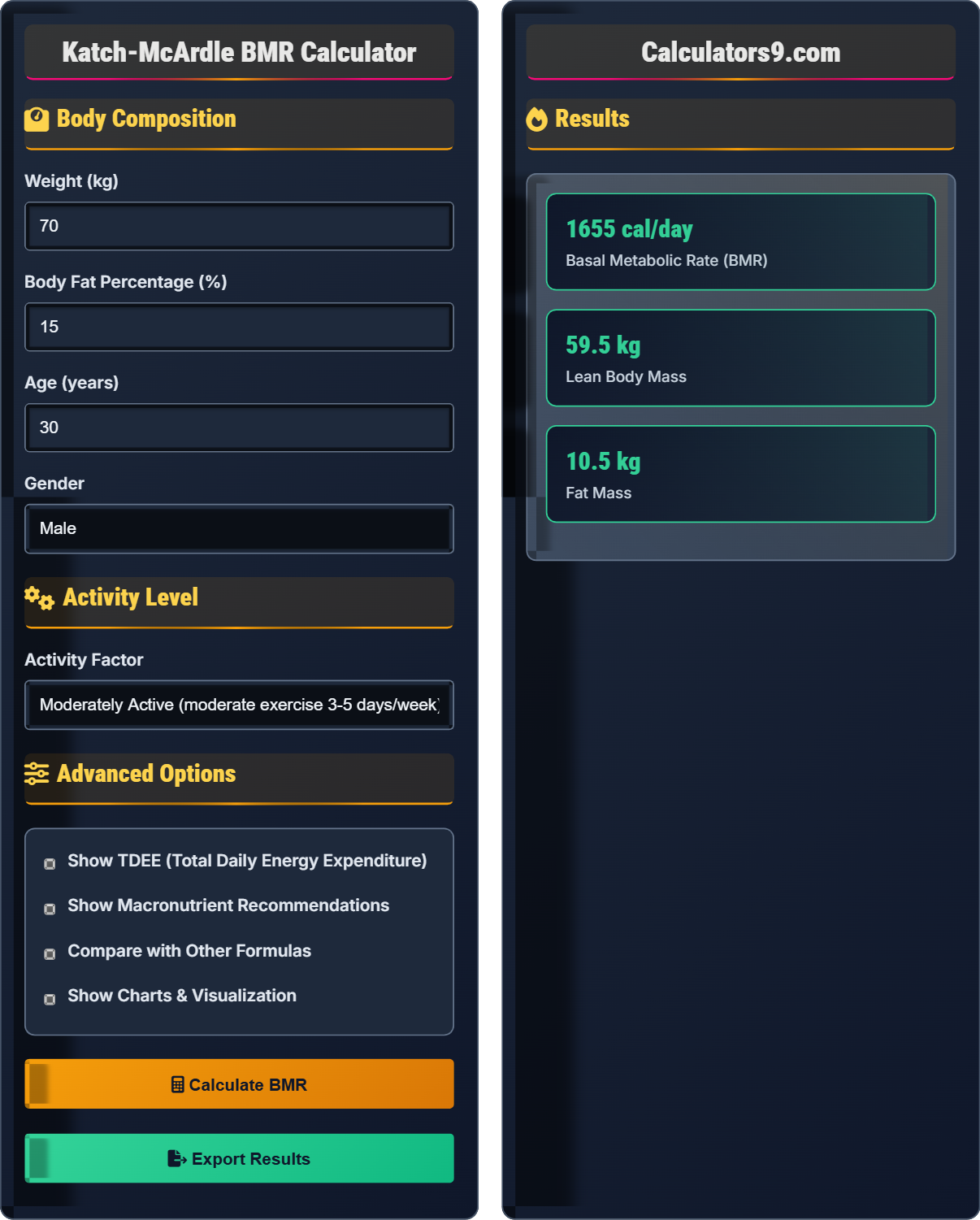
Example: For a person weighing 70 kg with 15% body fat:
LBM = 70 × (1 - 0.15) = 70 × 0.85 = 59.5 kg
BMR = 370 + (21.6 × 59.5) = 370 + 1,285.2 = 1,655.2 calories/day
Thus, the person burns approximately 1,655 calories per day at rest.
Body Composition
Activity Level
Advanced Options
Results
Katch-McArdle Formula Explained
The Katch-McArdle formula is a scientifically validated equation that calculates Basal Metabolic Rate (BMR) based on lean body mass rather than total body weight. This makes it more accurate than other formulas for individuals with known body composition.
Where LBM (Lean Body Mass) = Weight × (1 - Body Fat Percentage)
- Accounts for muscle mass vs. fat mass
- Most accurate for individuals with known body fat
- Doesn't vary by gender or age
- Higher muscle mass = higher BMR
Body Composition & Metabolism
Lean body mass (muscle, bone, organs) is metabolically active tissue that burns calories even at rest. Muscle tissue burns approximately 6 calories per pound per day, while fat tissue burns only 2 calories per pound per day.
- Measure body weight in kilograms
- Determine body fat percentage (via calipers, DEXA, or BIA)
- Calculate fat mass = weight × (body fat %)
- Calculate lean mass = weight - fat mass
- Muscle mass increases metabolic rate
- Age affects metabolism (declines ~2% per decade)
- Thyroid hormones regulate metabolism
- Activity level multiplies BMR
Metabolic Rate Learning Quiz
What makes the Katch-McArdle formula more accurate than other BMR equations?
The answer is B) It accounts for lean body mass. The Katch-McArdle formula is unique because it uses lean body mass (LBM) rather than total body weight to calculate BMR. Since muscle tissue is metabolically active and burns more calories than fat tissue, accounting for lean mass provides a more accurate metabolic rate estimation.
Traditional BMR formulas like Harris-Benedict treat all body weight equally, but muscle and fat have different metabolic properties. Muscle tissue burns approximately 6 calories per pound per day at rest, while fat tissue burns only 2 calories per pound per day. By using lean body mass, the Katch-McArdle formula recognizes that two people of the same weight but different body compositions will have different metabolic rates.
Basal Metabolic Rate (BMR): Calories burned at complete rest (fasting, lying down, thermoneutral environment)
Lean Body Mass (LBM): Total body weight minus fat mass (includes muscle, bone, organs, water)
Metabolic Rate: Speed at which the body burns calories for energy
• Muscle tissue is 3 times more metabolically active than fat tissue
• BMR accounts for 60-75% of daily calorie expenditure
• Higher lean body mass = higher BMR
• Remember: "Muscle burns more than fat" when thinking about BMR accuracy
• The Katch-McArdle formula is most accurate when you know your body fat percentage
• Assuming all body weight contributes equally to metabolic rate
• Using total weight instead of lean mass in calculations
• Not considering body composition when estimating BMR
Calculate the BMR using the Katch-McArdle formula for a person who weighs 80 kg with 20% body fat. Show all steps and explain the significance of the result.
Using the Katch-McArdle formula: BMR = 370 + (21.6 × LBM)
Step 1: Calculate Lean Body Mass (LBM)
LBM = Weight × (1 - Body Fat %)
LBM = 80 × (1 - 0.20) = 80 × 0.80 = 64 kg
Step 2: Apply the Katch-McArdle formula
BMR = 370 + (21.6 × 64)
BMR = 370 + 1,382.4 = 1,752.4 calories/day
Step 3: Calculate Fat Mass
Fat Mass = 80 × 0.20 = 16 kg
Significance: This person burns approximately 1,752 calories per day at complete rest. Their high muscle mass (64 kg) contributes significantly to their metabolic rate.
This calculation demonstrates the importance of body composition in metabolic rate. A person with 64 kg of lean mass has a significantly higher BMR than someone with the same weight but less muscle. The 21.6 coefficient represents the approximate calories burned per kilogram of lean mass per day. This explains why athletes often have higher BMRs despite similar weights to non-athletes.
Calorie: Unit of energy used to measure food energy and metabolic processes
Metabolically Active Tissue: Tissue that burns calories even at rest (muscle, organs, brain)
Body Composition: The proportion of fat, muscle, bone, and other tissues in the body
• LBM = Total Weight × (1 - Body Fat %)
• BMR = 370 + (21.6 × LBM)
• Higher muscle mass increases BMR significantly
• Remember: 21.6 represents the average calories burned per kg of lean mass per day
• The 370 constant represents baseline metabolic processes
• Always convert body fat percentage to decimal (20% = 0.20)
• Forgetting to convert body fat percentage to decimal
• Using total weight instead of lean mass in the formula
• Mixing up units (kg vs lbs) in calculations
Two people weigh the same (75 kg) but have different body compositions: Person A has 12% body fat and Person B has 25% body fat. Calculate the difference in their BMRs using the Katch-McArdle formula. How does this difference impact their daily calorie needs?
Person A (12% body fat):
LBM = 75 × (1 - 0.12) = 75 × 0.88 = 66 kg
BMR = 370 + (21.6 × 66) = 370 + 1,425.6 = 1,795.6 calories/day
Person B (25% body fat):
LBM = 75 × (1 - 0.25) = 75 × 0.75 = 56.25 kg
BMR = 370 + (21.6 × 56.25) = 370 + 1,215 = 1,585 calories/day
Difference: 1,795.6 - 1,585 = 210.6 calories/day
Impact: Person A burns approximately 211 more calories per day at rest due to higher muscle mass. Over a week, this equals 1,478 extra calories burned, which could account for 0.4 pounds of fat loss without additional effort.
This example illustrates the significant impact of body composition on metabolism. Despite identical total weight, the person with higher muscle mass has a substantially higher BMR. This explains why two people of the same weight may have different dietary needs and weight management challenges. The metabolic advantage of muscle mass becomes more pronounced over time.
Metabolic Advantage: Higher calorie burn due to increased lean body mass
Body Recomposition: Process of increasing muscle while decreasing fat
Metabolic Flexibility: Ability to adapt energy expenditure to changing conditions
• Same weight ≠ same metabolic rate
• Muscle mass drives metabolic rate more than fat mass
• Small daily differences compound over time
• Focus on body composition, not just total weight
• Resistance training preserves/increases lean mass
• Track progress with body composition measurements
• Judging metabolic health based on total weight alone
• Ignoring the impact of muscle mass on calorie needs
• Assuming everyone of the same weight has identical BMR
A fitness competitor weighs 65 kg with 10% body fat and has a moderately active lifestyle (activity factor 1.55). They want to lose 0.5 kg of fat per week. Calculate their daily caloric intake needs and explain how their body composition affects this target.
Step 1: Calculate BMR using Katch-McArdle formula
LBM = 65 × (1 - 0.10) = 65 × 0.90 = 58.5 kg
BMR = 370 + (21.6 × 58.5) = 370 + 1,263.6 = 1,633.6 calories/day
Step 2: Calculate TDEE (Total Daily Energy Expenditure)
TDEE = BMR × Activity Factor = 1,633.6 × 1.55 = 2,532.1 calories/day
Step 3: Calculate caloric deficit for fat loss
To lose 0.5 kg fat per week: 0.5 × 7,700 = 3,850 calories/week
Daily deficit needed: 3,850 ÷ 7 = 550 calories/day
Step 4: Calculate target daily intake
Target Intake = TDEE - Daily Deficit = 2,532.1 - 550 = 1,982.1 calories/day
Impact of body composition: Their high lean mass (58.5 kg) gives them a higher BMR, allowing for a higher caloric intake while still maintaining a significant deficit. Their muscle preservation is crucial for maintaining metabolic rate during fat loss.
This problem demonstrates how body composition influences diet planning. The competitor's high muscle mass provides a metabolic advantage, allowing for a higher caloric intake compared to someone with the same weight but lower muscle mass. Maintaining lean mass during fat loss is critical for preserving metabolic rate and achieving sustainable results.
Total Daily Energy Expenditure (TDEE): Total calories burned including activity
Caloric Deficit: Consuming fewer calories than expended
Metabolic Preservation: Maintaining muscle mass during weight loss
• 1 kg of fat ≈ 7,700 calories
• TDEE = BMR × Activity Factor
• Preserve muscle to maintain metabolic rate
• Calculate weekly deficit targets first, then divide by 7
• Higher muscle mass allows higher caloric intake during deficit
• Monitor body composition changes, not just weight
• Using generic BMR formulas instead of body composition-based ones
• Not accounting for activity level when calculating TDEE
• Ignoring the impact of muscle mass on caloric needs
Why is the Katch-McArdle formula particularly valuable for individuals trying to build muscle or lose fat?
The answer is B) It accounts for changes in lean body mass. As individuals build muscle or lose fat, their lean body mass changes, which directly affects their metabolic rate. The Katch-McArdle formula allows for recalculating BMR based on updated body composition, providing more accurate calorie needs as body composition changes occur.
Traditional BMR formulas assume static body weight, but body recomposition (building muscle while losing fat) changes the metabolic equation. The Katch-McArdle formula is dynamic because it incorporates lean body mass, which fluctuates with training and nutrition. This makes it ideal for tracking metabolic changes during fitness transformations.
Body Recomposition: Simultaneous fat loss and muscle gain
Metabolic Adaptation: Changes in energy expenditure due to body composition shifts
Dynamic BMR: BMR that changes with body composition
• BMR changes as body composition changes
• Muscle gain increases metabolic rate
• Fat loss decreases metabolic rate
• Reassess body composition monthly during transformations
• Adjust caloric intake as BMR changes
• Use Katch-McArdle for tracking metabolic adaptations
• Using static BMR calculations during body recomposition
• Not adjusting caloric intake as body composition changes
• Assuming BMR remains constant throughout fitness journey
FAQ
Q: Why is the Katch-McArdle formula more accurate than other BMR equations?
A: The Katch-McArdle formula is more accurate because it specifically accounts for lean body mass (LBM) rather than total body weight. Since muscle tissue is metabolically active and burns more calories than fat tissue, using LBM provides a more precise estimate of metabolic rate.
The formula is: \( BMR = 370 + (21.6 \times LBM) \), where \( LBM = Weight \times (1 - BodyFat\%) \).
Traditional formulas like Harris-Benedict treat all body weight equally, which can significantly under or overestimate metabolic needs for individuals with high or low muscle mass respectively.
Q: How does body composition affect my daily calorie needs?
A: Body composition significantly impacts calorie needs because different tissues have different metabolic rates:
- Muscle tissue: Burns ~6 calories per pound per day at rest
- Fat tissue: Burns ~2 calories per pound per day at rest
- Organ tissue: Burns ~10-20 calories per pound per day
For example, a 150-pound person with 20% body fat has 120 pounds of lean mass burning ~720 calories/day, while the same weight person with 10% body fat has 135 pounds of lean mass burning ~810 calories/day - a 90-calorie difference!
This explains why two people of identical weight can have significantly different metabolic rates.