Metabolic Rate Estimator
BMR calculation • 2026 edition
Mifflin-St Jeor Formula:
Show the calculatorFor Men: BMR = (10 × Weight in kg) + (6.25 × Height in cm) - (5 × Age) + 5
For Women: BMR = (10 × Weight in kg) + (6.25 × Height in cm) - (5 × Age) - 161
Where:
- BMR: Basal Metabolic Rate (calories/day)
- Weight: Body weight in kilograms
- Height: Body height in centimeters
- Age: Chronological age in years
This formula estimates the calories needed for basic bodily functions at rest. It's more accurate than the older Harris-Benedict equation for most individuals. To calculate Total Daily Energy Expenditure (TDEE), multiply BMR by an activity factor (1.2-1.9).
Example: For a 30-year-old woman weighing 65kg and 165cm tall:
BMR = (10 × 65) + (6.25 × 165) - (5 × 30) - 161
= 650 + 1031.25 - 150 - 161 = 1370.25 calories/day
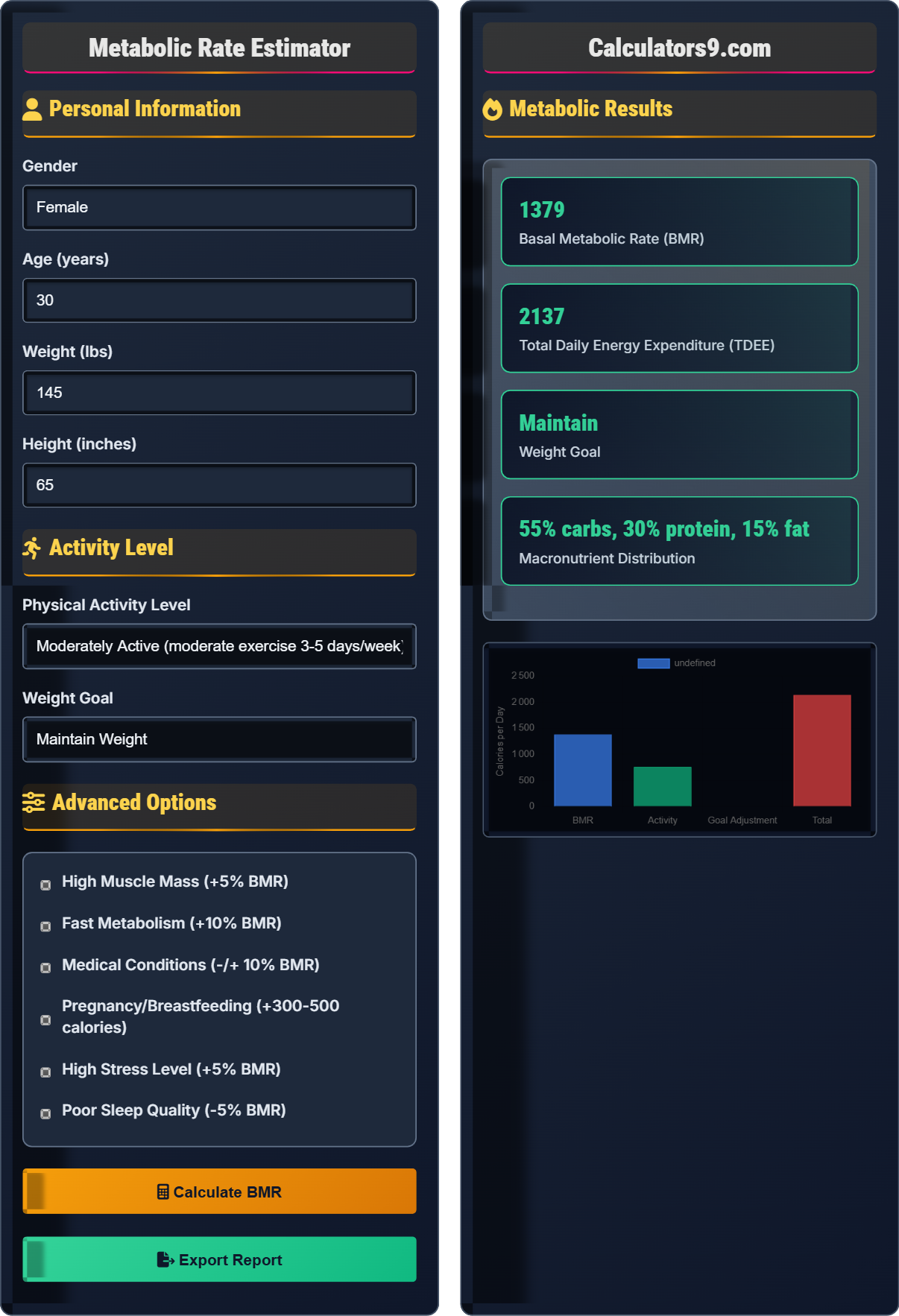
Personal Information
Activity Level
Advanced Options
Metabolic Results
| Category | Calories | Percentage | Notes |
|---|
| Macronutrient | Grams | Calories | Percentage |
|---|
Metabolic Rate Guide
Basal Metabolic Rate (BMR) is the number of calories your body needs to perform basic life-sustaining functions at complete rest. This includes breathing, circulation, cell production, and maintaining body temperature. BMR accounts for about 60-75% of total daily energy expenditure and varies based on age, gender, weight, height, and muscle mass.
The Mifflin-St Jeor equation is the most accurate method for calculating BMR:
For Women: BMR = (10 × Weight) + (6.25 × Height) - (5 × Age) - 161
Where:
- Weight: Measured in kilograms
- Height: Measured in centimeters
- Age: Chronological age in years
Recommended macronutrient distribution based on BMR:
- Carbohydrates: 45-65% of total calories
- Protein: 10-35% of total calories
- Fats: 20-35% of total calories
- Age: Metabolism decreases 2-3% per decade after age 30
- Gender: Men typically have 10-15% higher BMR than women
- Muscle Mass: More muscle increases metabolic rate
- Genetics: Inherited metabolic tendencies
- Hormones: Thyroid, insulin, and other hormone levels
Metabolic Basics
Calories needed for basic body functions at rest.
For Men: BMR = (10 × W) + (6.25 × H) - (5 × A) + 5
For Women: BMR = (10 × W) + (6.25 × H) - (5 × A) - 161
Where W=Weight(kg), H=Height(cm), A=Age(years)
- BMR accounts for 60-75% of total energy needs
- Muscle mass increases metabolic rate
- Metabolism decreases with age
Strategies
Increasing lean mass to boost metabolism.
- Calculate BMR using Mifflin-St Jeor
- Determine activity level multiplier
- Calculate TDEE (BMR × Activity)
- Adjust for goals (maintenance/loss/gain)
- Medical conditions
- Stress levels
- Sleep quality
- Hormonal factors
Metabolic Rate Learning Quiz
According to the Mifflin-St Jeor equation, what is the constant added to the male BMR calculation?
The answer is B) 5. In the Mifflin-St Jeor equation for men, the formula is: BMR = (10 × Weight) + (6.25 × Height) - (5 × Age) + 5. The constant added is +5 for men, while for women it's -161.
The Mifflin-St Jeor equation was developed in 1990 and is now considered the most accurate method for calculating BMR. The different constants for men (+5) and women (-161) account for differences in body composition and metabolic rates between genders. The equation is more accurate than the older Harris-Benedict formula because it better reflects modern body compositions.
BMR: Basal Metabolic Rate - calories at rest
Mifflin-St Jeor: Modern BMR calculation method
Constant: Fixed value in mathematical equation
• Men: Add 5 to the equation
• Women: Subtract 161 from the equation
• Use kg for weight, cm for height
• Remember: Male = +5, Female = -161
• Always convert pounds to kg
• Always convert inches to cm
• Using wrong constant for gender
• Forgetting unit conversions
• Confusing Mifflin-St Jeor with Harris-Benedict
Calculate the BMR for a 25-year-old woman who weighs 65kg and is 165cm tall. Show your work.
Using the female Mifflin-St Jeor equation:
BMR = (10 × Weight) + (6.25 × Height) - (5 × Age) - 161
Given:
- Weight = 65kg
- Height = 165cm
- Age = 25 years
Step 1: Calculate weight component = 10 × 65 = 650
Step 2: Calculate height component = 6.25 × 165 = 1031.25
Step 3: Calculate age component = 5 × 25 = 125
Step 4: Calculate BMR = 650 + 1031.25 - 125 - 161 = 1395.25
Therefore, the woman's BMR is approximately 1395 calories per day.
This calculation demonstrates how each variable contributes to the final BMR value. Weight and height both positively contribute to BMR (higher values mean higher metabolic rate), while age negatively contributes (older age means lower metabolic rate). The gender-specific constant (-161 for women) accounts for differences in body composition. This example shows a young woman with a moderate BMR of about 1400 calories per day.
Basal Metabolic Rate: Calories needed at complete rest
Body Mass: Total weight of the body
Chronological Age: Time elapsed since birth
• Use kilograms for weight
• Use centimeters for height
• Apply age as negative factor
• Remember: kg for weight, cm for height
• Age is subtracted from the sum
• Women have lower base BMR than men
• Using pounds instead of kilograms
• Using inches instead of centimeters
• Adding the age factor instead of subtracting
A man with a BMR of 1800 calories per day wants to lose weight. He exercises moderately 4 days per week. What should his daily caloric intake be to lose 1 pound per week?
Step 1: Determine TDEE multiplier for moderate exercise = 1.55
Step 2: Calculate TDEE = BMR × Activity Factor = 1800 × 1.55 = 2790 calories
Step 3: Calculate caloric deficit for 1 lb/week = 3500 calories ÷ 7 days = 500 calories/day
Step 4: Calculate target intake = TDEE - Deficit = 2790 - 500 = 2290 calories
Therefore, he should consume 2290 calories per day to lose 1 pound per week.
This example demonstrates the practical application of BMR in weight management. The calculation shows how to combine BMR with activity level to determine total energy needs, then adjust for weight loss goals. The 3500-calorie rule is based on the approximate energy content of 1 pound of body fat. This approach provides a scientifically-based method for caloric intake planning.
Total Daily Energy Expenditure: Total calories burned per day
Activity Multiplier: Factor to account for physical activity
Caloric Deficit: Consuming fewer calories than burned
• 1 pound of fat = 3500 calories
• BMR is base, activity is added
• Use 500 cal/day for 1 lb/week loss
• Don't go below BMR for daily intake
• Combine diet and exercise for best results
• Not accounting for activity level in TDEE
• Creating deficits that are too large
• Going below BMR for extended periods
If a person's BMR decreases by 2% per decade after age 30, and they were 1500 calories at age 30, what would their BMR be at age 50? How does this affect their daily caloric needs if they maintain the same activity level? (Hint: Calculate the cumulative decrease)
Step 1: Calculate number of decades = (50 - 30) ÷ 10 = 2 decades
Step 2: Calculate total decrease = 2 decades × 2%/decade = 4%
Step 3: Calculate new BMR = 1500 × (1 - 0.04) = 1500 × 0.96 = 1440 calories
Step 4: Calculate difference = 1500 - 1440 = 60 calories/day
Step 5: For TDEE at moderate activity: Old = 1500 × 1.55 = 2325, New = 1440 × 1.55 = 2232
Therefore, at age 50, their BMR is 1440 calories (60 fewer than at 30), and their TDEE is 2232 calories (93 fewer than at 30).
This demonstrates the gradual decline in metabolic rate with age, which explains why many people gain weight as they get older without changing their eating habits. The 2% per decade decrease is cumulative, meaning the effect becomes more pronounced over time. This biological change necessitates adjustments in caloric intake or activity level to maintain weight.
Metabolic Decline: Gradual decrease in metabolic rate with age
Cumulative Effect: Compounded changes over time
Biological Changes: Natural aging effects on metabolism
• Metabolism decreases 2% per decade after 30
• Effects are cumulative over time
• Adjust caloric intake with age
• Monitor weight changes with age
• Adjust caloric intake as needed
• Increase activity to counteract decline
• Not accounting for age-related metabolic changes
• Maintaining same caloric intake with age
• Assuming metabolism stays constant
According to dietary guidelines, what percentage of daily calories should come from protein for an adult with a 2000-calorie diet?
The answer is B) 10-35%. Dietary guidelines recommend that 10-35% of daily calories come from protein. For a 2000-calorie diet, this means 200-700 calories from protein (50-175 grams of protein).
Macronutrient distribution guidelines provide ranges to accommodate individual needs and preferences. The 10-35% range for protein allows for different activity levels, health conditions, and dietary goals. Athletes and individuals recovering from injury may need protein at the higher end of the range, while sedentary individuals may need less.
Macronutrients: Carbohydrates, proteins, and fats
Recommended Ranges: Scientific guidelines for intake
Individual Variation: Different needs based on circumstances
• Protein: 10-35% of calories
• Carbohydrates: 45-65% of calories
• Fats: 20-35% of calories
• Higher protein for active individuals
• Adjust ranges based on goals
• Balance all three macronutrients
• Too little protein (below 10%)
• Too much protein (above 35%)
• Ignoring other macronutrients
FAQ
Q: How accurate is the Mifflin-St Jeor equation for calculating BMR?
A: The Mifflin-St Jeor equation is considered the most accurate BMR calculation method, with approximately 90-95% accuracy for most people. It was validated against indirect calorimetry measurements and outperforms the older Harris-Benedict equation.
For example, for a person with high muscle mass (vs. average):
Predicted BMR: 1500 calories
Actual BMR: 1500-1650 calories (10-15% higher)
Mathematically: If \( B \) is actual BMR and \( P \) is predicted BMR:
\( B = P \pm (P \times \text{adjustment factor}) \)
The equation accounts for gender differences and age-related metabolic changes, making it suitable for diverse populations.
Q: How does muscle mass affect basal metabolic rate?
A: Muscle tissue is metabolically active and burns calories even at rest. Each pound of muscle burns approximately 6-7 calories per day, while fat tissue burns only 2-3 calories per day.
For example:
- Standard BMR: 1500 calories/day
- With 10 lbs extra muscle: +60-70 calories/day
- Total BMR: 1560-1570 calories/day
This is why strength training is important for maintaining metabolic rate during weight loss and aging. Muscle preservation helps maintain energy expenditure even when body weight decreases.