Baby Diaper Usage Calculator
Daily needs • Cost estimates • Supply planning
Diaper Usage Formula:
Show the calculator\( D = N \times U \times T \)
Where:
- \( D \) = Total diapers needed
- \( N \) = Number of babies
- \( U \) = Diapers used per day
- \( T \) = Time period in days
This formula calculates the total number of diapers needed based on the number of babies, daily usage, and duration.
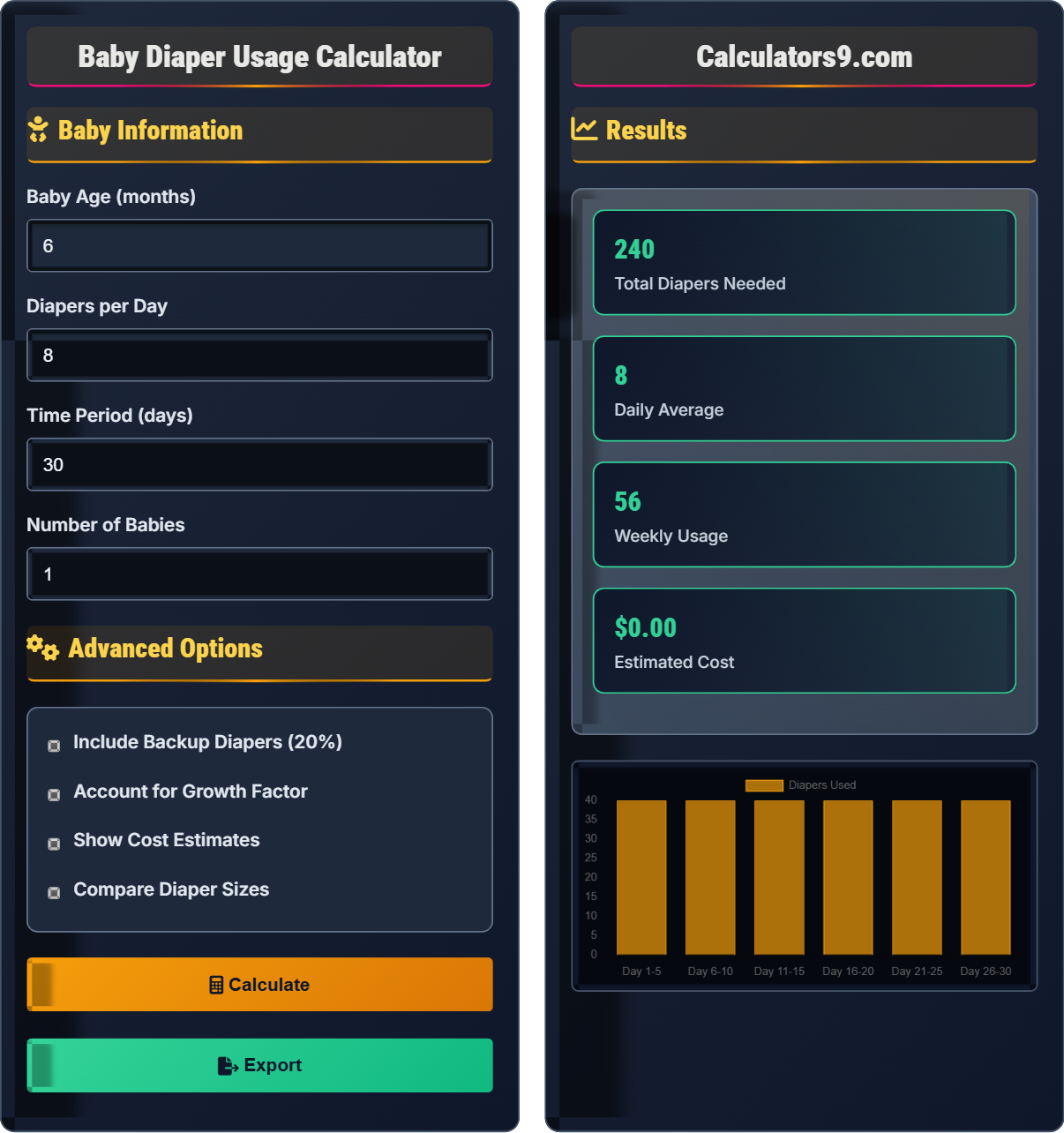
Example: For 1 baby at 8 diapers per day over 30 days:
\( D = 1 \times 8 \times 30 = 240 \) diapers
Additional considerations include growth factors, frequency changes, and backup supplies.
Baby Information
Advanced Options
Results
| Day | Diapers | Cumulative |
|---|
| Week | Diapers | Cumulative |
|---|
| Month | Diapers | Cumulative |
|---|
Comprehensive Baby Diaper Guide
Baby diaper usage varies significantly by age, with newborns requiring more frequent changes than older infants. Understanding diaper needs helps parents plan and budget effectively. Newborns typically need 10-12 diapers per day, while babies around 6 months old average 6-8 per day.
The standard diaper calculation uses the following formula:
Where:
- \(D\) = Total diapers needed
- \(N\) = Number of babies
- \(U\) = Diapers used per day
- \(T\) = Time period in days
Diaper sizes correspond to baby weight ranges:
- Size 1: Up to 14 lbs (newborns)
- Size 2: 12-18 lbs (2-4 months)
- Size 3: 16-28 lbs (3-12 months)
- Size 4: 22-37 lbs (9+ months)
- Size 5: 27+ lbs (12+ months)
- Stock up: Buy diapers in bulk when on sale
- Size up: Go up a size if you notice red marks
- Backup supply: Keep extra diapers in diaper bag
- Try samples: Test different brands before buying large quantities
- Consider subscription: Automatic delivery saves time and money
Baby Diaper Learning Quiz
How many diapers does a typical newborn (0-1 month) need per day?
The answer is C) 8-12 diapers. Newborns have smaller bladders and digestive systems that process milk quickly, leading to frequent urination and bowel movements. They typically need changing every 2-3 hours, resulting in 8-12 diaper changes per day.
Understanding age-specific diaper needs is crucial for proper planning. Newborns have underdeveloped digestive systems and small bladders, requiring more frequent changes. As babies grow, their systems mature, and the frequency decreases. This knowledge helps parents prepare adequately without overbuying or running out.
Newborn: Baby from birth to 1 month old
Bladder capacity: The amount of liquid the bladder can hold before needing to void
Digestive system: Organs responsible for processing food and eliminating waste
• Newborns need more frequent diaper changes than older babies
• Diaper frequency decreases as babies age
• Breastfed babies may have more frequent stools
• Remember: Newborns = 8-12 diapers per day
• Track wet diapers to ensure adequate hydration
• Change immediately after bowel movements
• Underestimating newborn diaper needs
• Not accounting for frequent changes during growth spurts
• Confusing normal newborn stool patterns with problems
Calculate the total number of diapers needed for 2 babies, each using 7 diapers per day, over a 3-month period. Show your work.
Using the diaper formula: \(D = N \times U \times T\)
Given:
- N = 2 babies
- U = 7 diapers per day per baby
- T = 3 months = 90 days (assuming 30 days per month)
Calculation: D = 2 × 7 × 90 = 1,260 diapers
Therefore, 1,260 diapers are needed for 2 babies over 3 months.
This problem demonstrates how to scale diaper needs across multiple children and extended time periods. The formula remains consistent regardless of the number of babies, making it easy to calculate needs for twins, multiples, or childcare situations. The calculation shows the importance of planning for the long-term needs of infants.
Diaper formula: D = N × U × T where D is total diapers, N is number of babies, U is diapers per day, T is time in days
Scaling: Adjusting calculations based on multiple factors
Extended period: Timeframes longer than a few weeks requiring careful planning
• Multiply by the number of babies to scale calculations
• Convert months to days for accurate calculations
• Plan for additional diapers beyond basic needs
• Always round up to ensure adequate supply
• Add 20% extra for unexpected needs
• Consider bulk purchasing for cost savings
• Forgetting to multiply by the number of babies
• Using incorrect time conversions
• Not accounting for growth-related changes in usage
Sarah has a 4-month-old baby who uses 7 diapers per day. She wants to budget for 6 months of diapers. If diapers cost $0.25 each, what is her total expected cost? If she finds a bulk discount of 15% for purchases over 500 diapers, how much will she save?
Step 1: Calculate total diapers needed = 1 baby × 7 diapers/day × 180 days = 1,260 diapers
Step 2: Calculate regular cost = 1,260 × $0.25 = $315
Step 3: Apply bulk discount = $315 × 0.15 = $47.25 savings
Step 4: Calculate discounted cost = $315 - $47.25 = $267.75
Therefore, Sarah will save $47.25 with the bulk discount.
This example shows how diaper costs can add up significantly over time, making bulk purchasing strategies valuable. At $0.25 per diaper, the annual cost for one baby can exceed $500. Understanding bulk discounts helps parents optimize their spending while ensuring adequate supply. The calculation demonstrates the economic benefits of planning ahead.
Bulk discount: Reduced price offered for large quantity purchases
Cost optimization: Strategy to minimize expenses while meeting needs
Annual cost: Total expense over a 12-month period
• Diaper costs can represent a significant monthly expense
• Bulk purchasing often offers substantial savings
• Consider storage space when buying in bulk
• Look for seasonal sales and promotions
• Join baby product loyalty programs
• Compare unit prices across brands
• Underestimating the cumulative cost of diapers
• Missing opportunities for bulk discounts
• Not comparing prices per diaper across brands
Mark's 2-month-old baby currently uses 9 diapers per day. He knows that diaper usage typically decreases by 15% at 4 months and another 20% at 6 months. If he wants to plan for the next 6 months (from now), how should he adjust his diaper calculations?
Step 1: Current usage (months 1-2) = 9 diapers/day × 60 days = 540 diapers
Step 2: Usage at 4 months = 9 × (1 - 0.15) = 7.65 ≈ 8 diapers/day
Step 3: Usage at 6 months = 8 × (1 - 0.20) = 6.4 ≈ 6 diapers/day
Step 4: Total for months 3-4 = 8 × 60 = 480 diapers
Step 5: Total for months 5-6 = 6 × 60 = 360 diapers
Step 6: Total estimated = 540 + 480 + 360 = 1,380 diapers
Therefore, Mark should plan for approximately 1,380 diapers over the next 6 months.
This demonstrates the importance of accounting for developmental changes when planning diaper needs. As babies grow, their digestive systems mature, and they develop better bladder control, leading to decreased diaper usage. Factoring in these changes prevents over-purchasing and ensures adequate supply during transition periods. The calculation shows how usage patterns evolve predictably.
Growth factor: Adjustment for changes in diaper usage due to development
Developmental milestone: Physical or cognitive achievement indicating maturation
Transition period: Time when diaper needs are changing
• Diaper usage typically decreases as babies grow
• Account for growth factors in long-term planning
• Maintain buffer supply during transition periods
• Plan for gradual decreases in usage
• Keep some extra diapers of previous size during transitions
• Monitor actual usage to refine future estimates
• Assuming constant diaper usage throughout infancy
• Not accounting for developmental changes
• Buying too many diapers of the wrong size
Which of the following statements about diaper sizing is TRUE?
The answer is B) Diaper size is determined by the baby's weight. Diaper sizes are based on weight ranges rather than age, as babies grow at different rates. For example, Size 1 fits babies up to 14 lbs, Size 2 fits 12-18 lbs, and so on. Proper sizing is crucial for comfort and effectiveness.
Weight-based sizing accommodates the natural variation in baby growth patterns. Some babies may be ready for the next size at 2 months, while others may stay in the same size until 4 months. Understanding this helps parents select appropriately fitting diapers. Proper fit prevents leaks and skin irritation while ensuring comfort.
Weight-based sizing: Determining clothing/diaper size by body weight rather than age
Fit assessment: Evaluating whether a garment or diaper fits properly
Leakage prevention: Ensuring proper containment of bodily fluids
• Diaper size is based on weight, not age
• Proper fit prevents leaks and skin irritation
• Different brands may have different sizing
• Check the weight range on diaper packages
• Go up a size if you see red marks from elastics
• Test fit before buying large quantities
• Sizing diapers by age instead of weight
• Not checking for proper fit regularly
• Assuming all brands size identically
Diaper Basics
Absorbent garments for babies and incontinent individuals.
\(D = N \times U \times T\)
Where D=diapers needed, N=babies, U=diapers per day, T=time in days.
- Newborns need more frequent changes
- Size by weight, not age
- Plan for growth changes
Planning Strategies
Diapers can cost $500-1000 annually per baby.
- Bulk purchasing
- Look for sales
- Subscribe for discounts
- Try generics
- Check for irritation
- Monitor usage patterns
- Prepare for growth changes
- Store properly
FAQ
Q: How do I know when my baby needs a new diaper size?
A: You should consider sizing up when you notice any of these signs:
- Red marks from the diaper elastic around your baby's legs or waist
- Difficulty getting the tabs to fasten comfortably
- Leaking frequently despite good fit elsewhere
- Your baby has reached the weight limit for the current size
Most importantly, use the weight guidelines provided on diaper packages rather than age. For example, if your baby is approaching 14 lbs, they may need to move from Size 1 (up to 14 lbs) to Size 2 (12-18 lbs). The goal is a snug but comfortable fit that prevents leaks while allowing free movement.
Q: How can I calculate diaper needs for multiple babies in daycare?
A: For multiple babies, use the formula: \( D = \sum(N_i \times U_i \times T) \) where each baby may have different usage rates.
For example, if you have 3 babies: one newborn using 10 diapers/day, one 4-month-old using 7/day, and one 8-month-old using 5/day, for a 30-day period:
\( D = (1 \times 10 \times 30) + (1 \times 7 \times 30) + (1 \times 5 \times 30) \)
\( D = 300 + 210 + 150 = 660 \) diapers
It's advisable to add 20% for unexpected needs, bringing the total to approximately 792 diapers. This ensures you won't run out during busy periods or when babies have irregular schedules.