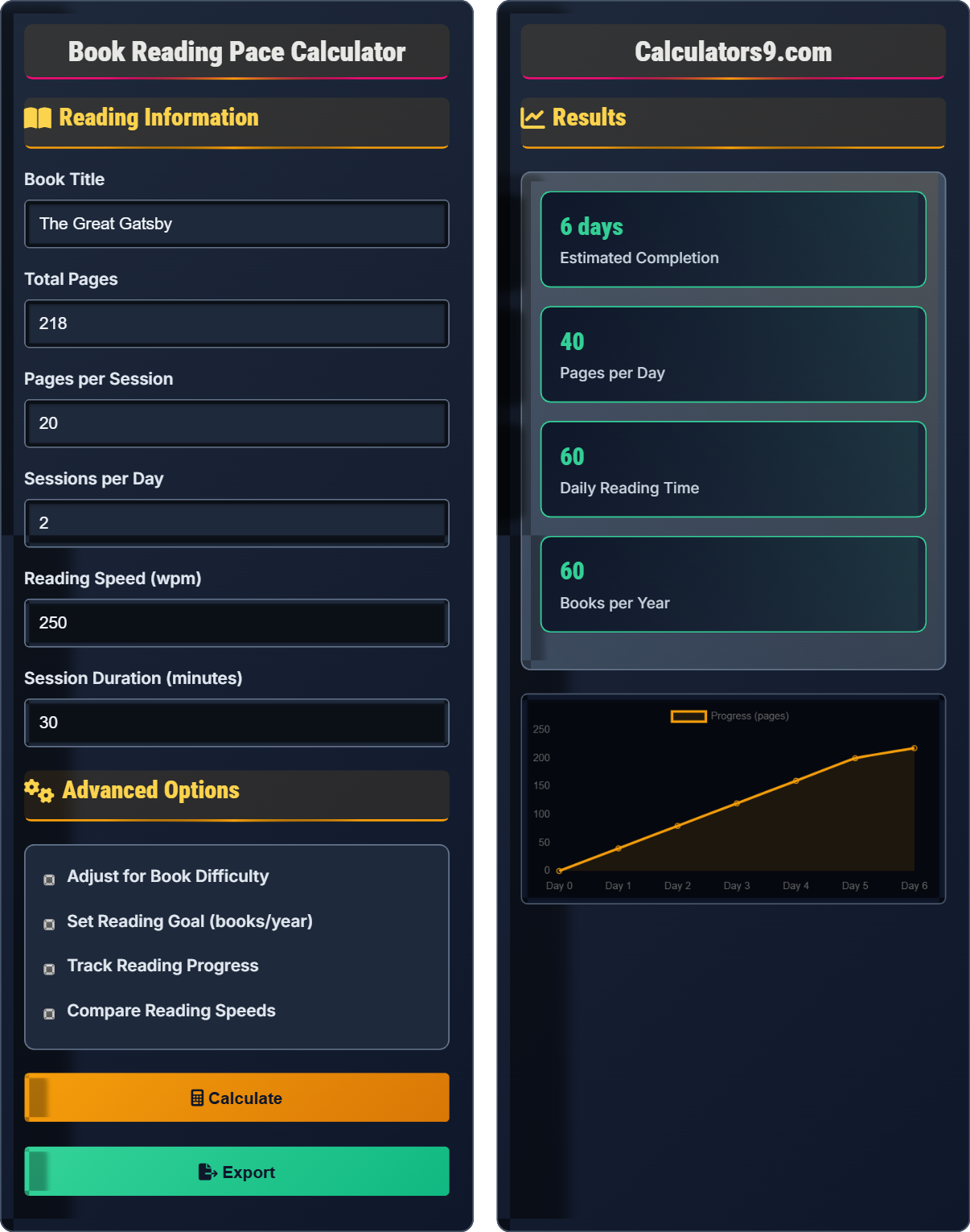
Book Reading Pace Calculator
Reading speed tracker • Literary progress monitor • Reading goal planner
Reading Pace Formula:
Show the calculator\( T = \frac{P}{W \times D} \)
Where:
- \( T \) = Time to finish book (days)
- \( P \) = Total pages in book
- \( W \) = Pages read per session
- \( D \) = Sessions per day
This formula calculates how long it will take to finish a book based on reading habits.
Example: For a 300-page book, reading 20 pages per session, 2 sessions per day: T = 300/(20×2) = 7.5 days.
Adjust for reading speed, book complexity, and available time.
Reading Information
Advanced Options
Results
| Day | Pages | Progress |
|---|
| Book | Progress | Time Left |
|---|
| Milestone | Target | Status |
|---|
Comprehensive Reading Pace Guide
Reading pace significantly impacts how many books you can read annually. Understanding your reading speed and developing effective reading habits can help you achieve your reading goals. The average adult reads 200-300 words per minute, though this varies based on factors like text complexity, reading purpose, and familiarity with the subject matter.
The standard reading time calculation uses the following formula:
Where:
- \(T\) = Time to finish book (days)
- \(P\) = Total pages in book
- \(W\) = Pages read per session
- \(D\) = Sessions per day
Several factors influence reading speed:
- Text Complexity: Academic texts vs. fiction
- Reading Purpose: Skimming vs. deep analysis
- Familiarity: Known vs. unknown topics
- Environment: Distractions and lighting
- Physical State: Fatigue and concentration levels
- Set a routine: Read at the same time daily
- Eliminate distractions: Find a quiet space
- Use a timer: Pomodoro technique for focus
- Track progress: Keep a reading log
- Adjust for content: Slower for complex material
Reading Pace Learning Quiz
What is the typical reading speed for an average adult?
The answer is C) 200-300 wpm. The average adult reading speed falls within this range, though it can vary significantly based on factors like text complexity, reading purpose, and familiarity with the subject matter.
This question tests knowledge of standard reading speed benchmarks. Understanding your position within these categories helps set realistic reading goals and identify areas for improvement. The 200-300 wpm range represents comfortable reading for comprehension and enjoyment.
wpm: Words per minute, a measure of reading speed
Comprehension: Understanding and retaining read content
Reading fluency: The ability to read smoothly and efficiently
• Reading speed varies by text type
• Comprehension is more important than speed
• Average speeds are just benchmarks
• Measure your own reading speed periodically
• Focus on comprehension over speed
• Adjust speed based on content difficulty
• Equating speed with reading ability
• Not accounting for text complexity
• Ignoring comprehension in favor of speed
If a book has 320 pages and you read 25 pages per session, 3 sessions per day, how many days will it take to finish? Show your work.
Daily reading = Pages per session × Sessions per day
Daily reading = 25 × 3 = 75 pages per day
Days to finish = Total pages ÷ Daily reading
Days to finish = 320 ÷ 75 = 4.27 days ≈ 5 days
Therefore, it will take approximately 5 days to finish the book.
This problem demonstrates how to calculate reading completion time using the basic formula. It shows the relationship between reading pace (pages per session), frequency (sessions per day), and total time needed. The calculation helps readers plan their reading schedule effectively.
Reading pace: The rate at which pages are read
Reading frequency: How often reading sessions occurCompletion time: Estimated duration to finish a book
• Daily reading = Pages per session × Sessions per day
• Days = Total pages ÷ Daily reading
• Round up for partial days
• Adjust for reading interruptions
• Account for difficult passages
• Plan buffer time for longer books
• Forgetting to multiply sessions per day
• Not accounting for reading interruptions
• Ignoring text complexity in time estimates
Sarah wants to read 40 books this year. Her average book is 280 pages, and she reads 30 pages per session, 2 sessions per day. How many minutes per day should she spend reading if she reads at 250 words per minute and there are 250 words per page?
Step 1: Calculate daily pages = 30 × 2 = 60 pages per day
Step 2: Calculate daily words = 60 × 250 = 15,000 words per day
Step 3: Calculate daily reading time = 15,000 ÷ 250 = 60 minutes per day
Step 4: Calculate total pages for 40 books = 40 × 280 = 11,200 pages
Step 5: Calculate days needed = 11,200 ÷ 60 = 187 days
Therefore, Sarah needs to read 60 minutes per day for 187 days to reach her goal.
This problem combines multiple calculations to plan an annual reading goal. It demonstrates how to convert between pages, words, and time to establish a sustainable reading routine. The solution shows that consistent daily reading is key to achieving ambitious reading goals.
Annual goal planning: Setting yearly reading targets
Daily commitment: Required reading time per dayReading sustainability: Maintaining consistent reading habits
• Words per day = Pages per day × Words per page
• Reading time = Words per day ÷ Words per minute
• Plan for 365 days in a year
• Break annual goals into monthly targets
• Adjust for vacation and busy periods
• Track progress with reading logs
• Not accounting for reading breaks
• Assuming constant reading speed across all books
• Forgetting to factor in time for difficult passages
Tom reads at 200 wpm for fiction but needs to slow down to 150 wpm for academic texts. If he's reading a 300-page academic book at 20 pages per session, 1 session per day, how much longer will it take compared to reading fiction at his normal pace?
For fiction (200 wpm):
Time per page = 250 words ÷ 200 wpm = 1.25 minutes per page
Time per session = 20 pages × 1.25 min/page = 25 minutes
Days to finish = 300 ÷ 20 = 15 days
Total time = 15 × 25 = 375 minutes
For academic text (150 wpm):
Time per page = 250 words ÷ 150 wpm = 1.67 minutes per page
Time per session = 20 pages × 1.67 min/page = 33.3 minutes
Days to finish = 300 ÷ 20 = 15 days
Total time = 15 × 33.3 = 500 minutes
Additional time = 500 - 375 = 125 minutes (about 2 hours more)
This example demonstrates how text complexity affects reading time. The calculation shows that even though the number of days remains the same (since the reading pace in pages is unchanged), the total time investment increases significantly when reading more slowly. This principle helps readers plan appropriately for different types of content.
Reading adaptation: Adjusting pace for different text types
Content complexity: How difficult text is to comprehendTime investment: Total time required for reading activities
• Adjust reading time based on text difficulty
• Slower reading may be necessary for comprehension
• Plan more time for academic or technical texts
• Adjust session lengths for different content types
• Take notes during academic reading
• Allow extra time for complex material
• Assuming same pace works for all text types
• Not accounting for increased mental effort with difficult texts
• Expecting same comprehension levels at different speeds
Which factor has the greatest impact on reading speed?
The answer is B) Text complexity. The difficulty level of the text has the most significant impact on reading speed. Complex vocabulary, sentence structure, and unfamiliar concepts require more cognitive processing time, significantly slowing down reading speed compared to familiar, simple text.
This question highlights the primary factor affecting reading speed. While environmental factors like lighting and comfort can influence reading, the inherent complexity of the text is the dominant factor. Understanding this helps readers set appropriate expectations for different types of reading materials.
Text complexity: Difficulty level of written content
Cognitive load: Mental effort required for comprehensionReading efficiency: Balancing speed with comprehension
• Text complexity most affects reading speed
• Adjust expectations for difficult material
• Comprehension is more important than speed
• Preview text to gauge difficulty
• Adjust reading speed accordingly
• Don't rush through complex material
• Trying to maintain same speed across all text types
• Rushing through difficult material
• Not adjusting for subject familiarity
Reading Fundamentals
Reading pace is the speed at which you read text, typically measured in words per minute.
\(T = \frac{P}{W \times D}\)
Where T=time, P=pages, W=pages per session, D=sessions per day.
- Adjust pace for text complexity
- Focus on comprehension over speed
- Set realistic daily goals
Optimization Strategies
Maximizing reading efficiency while maintaining comprehension.
- Set consistent reading times
- Eliminate distractions
- Track progress daily
- Adjust for text difficulty
- Don't sacrifice comprehension for speed
- Account for varying text complexity
- Consider reading environment
- Plan for interruptions
FAQ
Q: How can I improve my reading speed without sacrificing comprehension?
A: To improve reading speed while maintaining comprehension:
- Practice regularly: Like any skill, reading speed improves with practice
- Preview the text: Scan headings and introductions to prepare your mind
- Minimize subvocalization: Try to read without pronouncing words in your head
- Expand your visual span: Practice reading chunks of words rather than single words
- Read at optimal times: When your mind is freshest
Remember that comprehension should always take precedence over speed.
Q: How do I adjust my reading pace for different types of books?
A: Adjust reading pace based on text type:
- Fiction: 250-300 wpm for enjoyment and plot understanding
- Non-fiction: 200-250 wpm to process information
- Academic: 150-200 wpm for deep comprehension
- Technical: 100-150 wpm for complex concepts
- Reference: Variable pace, focused on specific sections
The key is matching your pace to the purpose of reading.