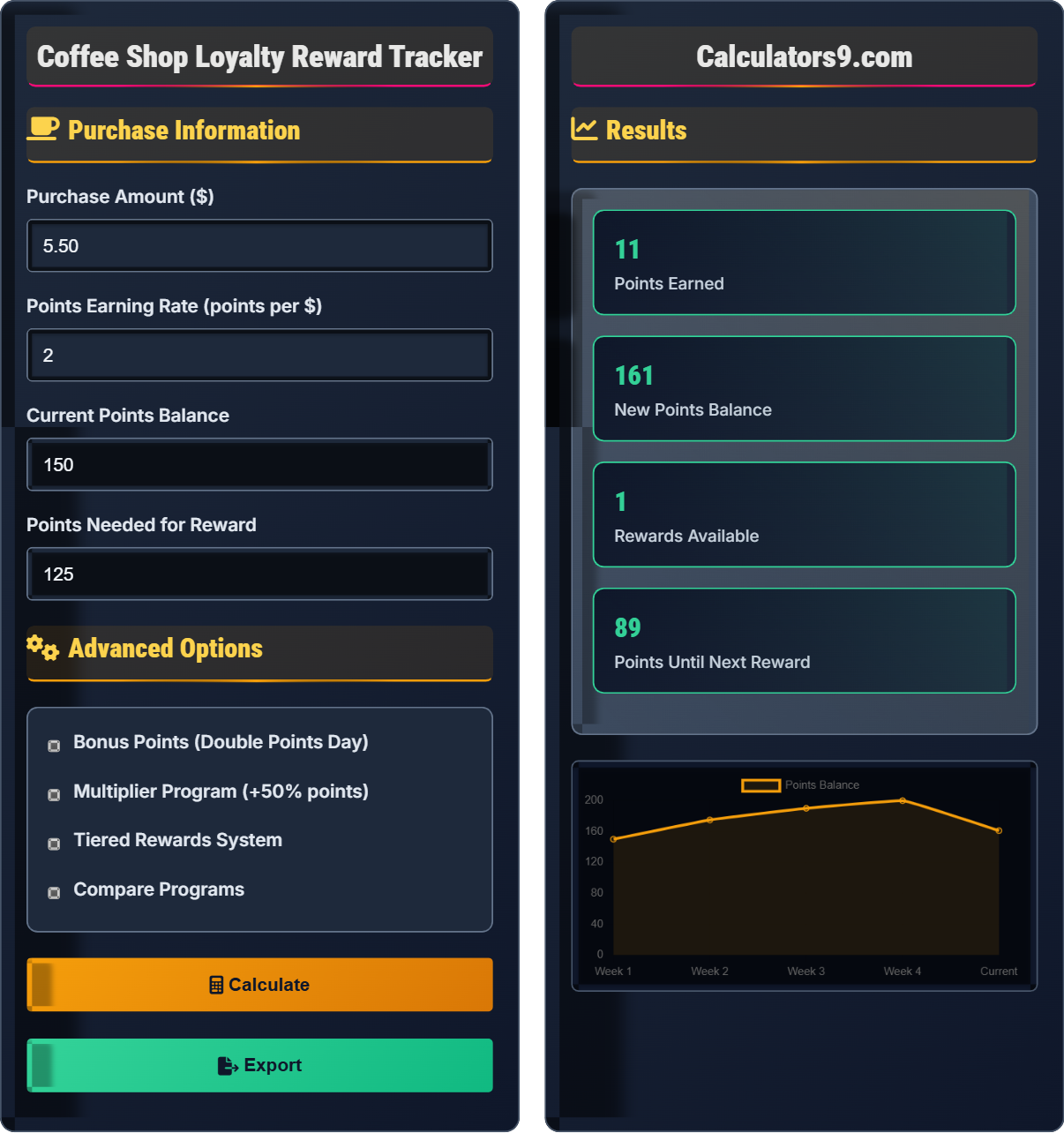
Coffee Shop Loyalty Reward Tracker
Points tracking • Rewards calculator • Customer loyalty program
Loyalty Points Formula:
Show the calculator\( P = V \times R \)
Where:
- \( P \) = Total points earned
- \( V \) = Total purchase value
- \( R \) = Points earning rate (points per dollar spent)
This formula calculates the total points earned based on spending and the loyalty program's earning rate.
Example: Spending $100 with a 2x earning rate gives 200 points.
Redemption follows: \( R = \frac{P}{C} \) where R is rewards earned, P is points, and C is cost per reward.
Purchase Information
Advanced Options
Results
| Date | Transaction | Points | Balance |
|---|
| Goal | Progress | Remaining |
|---|
| Reward | Cost (pts) | Status |
|---|
Comprehensive Coffee Loyalty Guide
Coffee shop loyalty programs reward customers for repeat purchases, encouraging brand loyalty and increasing customer lifetime value. These programs typically award points for each purchase, which can be redeemed for free drinks, food items, or exclusive merchandise. Understanding how these programs work helps maximize rewards.
The standard loyalty points calculation uses the following formula:
Where:
- \(P\) = Total points earned
- \(V\) = Total purchase value
- \(R\) = Points earning rate (points per dollar spent)
Strategies to optimize loyalty rewards:
- Stack promotions: Use bonus point days with existing multipliers
- Group orders: Combine purchases to reach reward thresholds faster
- Time purchases: Align spending with special events or challenges
- Track expiration: Use points before they expire (varies by program)
- Combine programs: Participate in multiple programs strategically
- Focus on one program: Concentrate spending in one program for faster rewards
- Know your threshold: Understand point requirements for rewards
- Use mobile apps: Enable push notifications for special offers
- Link payment methods: Automatically earn points with linked credit/debit cards
- Share with family: Some programs allow account sharing or gifting
Coffee Loyalty Learning Quiz
If a coffee shop awards 2 points for every $1 spent, how many points would you earn from a $6.50 purchase?
The answer is C) 13 points. Using the formula \(P = V \times R\), where P is points, V is value, and R is the rate: \(P = 6.50 \times 2 = 13\) points.
This question tests understanding of the basic loyalty point calculation. The formula multiplies the purchase value by the earning rate. In this case, for every dollar spent, 2 points are earned. So a $6.50 purchase earns 6.50 × 2 = 13 points. This principle applies to all loyalty programs regardless of the earning rate.
Loyalty points: Currency earned through repeat purchases
Earning rate: Points awarded per dollar spent
Point threshold: Points needed to redeem rewards
• Points = Purchase value × Earning rate
• Most programs award points based on dollar amount spent
• Points typically round to whole numbers
• Memorize the earning rate for your favorite programs
• Calculate points mentally during purchases
• Track progress toward reward thresholds
• Forgetting to multiply by the earning rate
• Confusing earning rate with redemption rate
• Not accounting for bonus point promotions
If a coffee shop requires 125 points for a free drink and you currently have 95 points, how many additional purchases of $5.00 (at 2 points per dollar) do you need to make to earn a free drink?
Step 1: Points needed = 125 - 95 = 30 points
Step 2: Points earned per $5 purchase = $5 × 2 = 10 points
Step 3: Purchases needed = 30 ÷ 10 = 3 purchases
Therefore, you need to make 3 additional purchases of $5.00 to earn a free drink.
This problem combines both earning and redemption calculations. First, determine how many more points are needed by subtracting current points from the reward threshold. Then, calculate how many points each purchase will generate. Finally, divide the points needed by points per purchase to find the number of transactions required. This approach works for any loyalty program.
Redemption threshold: Points required to claim a reward
Progress tracking: Monitoring points accumulation toward goals
Accumulation rate: Speed at which points are earned
• Points needed = Threshold - Current balance
• Calculate points per transaction
• Divide needed by per-transaction points
• Track your progress regularly
• Plan purchases to reach rewards efficiently
• Consider combining orders to meet thresholds
• Forgetting to account for current points balance
• Not considering the earning rate in calculations
• Rounding incorrectly when dividing
Sarah has 200 points in a coffee shop loyalty program. The program offers 2 points per dollar spent. The rewards are: 125 points = free drink, 250 points = free food, 500 points = gold tier status. If she makes 3 purchases of $7.00 each, how many rewards can she claim and what will her new point balance be?
Step 1: Points from new purchases = 3 × $7.00 × 2 = 42 points
Step 2: New point balance = 200 + 42 = 242 points
Step 3: Rewards available: 242 ÷ 125 = 1 free drink (with 117 points remaining)
Therefore, Sarah can claim 1 free drink and will have 117 points remaining after redemption.
This example demonstrates how tiered reward systems work. The calculation involves first determining the total points earned from new purchases, adding them to the current balance, and then calculating how many rewards can be claimed based on the redemption thresholds. In this case, Sarah exceeds the threshold for a free drink but not for free food or gold status.
Tiered rewards: Multiple reward levels based on points thresholds
Redemption: Exchanging points for rewards
Point reset: What happens to remaining points after redemption
• Add new points to existing balance
• Divide total by reward threshold to find available rewards
• Remainder points typically carry forward
• Plan purchases to maximize reward claims
• Understand how redemption affects your balance
• Track multiple reward tiers simultaneously
• Not adding new points to existing balance first
• Forgetting to account for remainder points
• Misunderstanding how redemption works
Mike's favorite coffee shop has a "Double Points Day" promotion where all purchases earn twice the normal rate. If Mike normally earns 2 points per dollar and spends $15.00 on a Double Points Day, how many points does he earn? How does this compare to the same purchase on a regular day?
Regular day: $15.00 × 2 points/dollar = 30 points
Double Points Day: $15.00 × 2 × 2 = 60 points
Mike earns 60 points on the Double Points Day, which is 30 more points than a regular day.
This demonstrates the strategic advantage of timing purchases with bonus point promotions. The calculation shows that special events can significantly accelerate point accumulation. In this case, the double points promotion doubled Mike's earnings for the same purchase amount. Understanding these opportunities helps maximize loyalty program benefits.
Bonus points: Additional points earned during special promotions
Multiplier events: Promotions that increase earning rates
Strategic timing: Planning purchases around special offers
• Bonus multipliers apply to the base earning rate
• Calculate base points first, then apply multipliers
• Special events offer the best point accumulation rates
• Follow programs on social media for event announcements
• Combine with existing multipliers when possible
• Not accounting for multiplier in calculations
• Missing special event notifications
• Not maximizing purchases during bonus periods
Which loyalty program offers the fastest point accumulation for a $10 purchase?
The answer is C) 5 points per $1 spent. For a $10 purchase:
A) 1 point/$1: $10 × 1 = 10 points
B) 2 points/$1: $10 × 2 = 20 points
C) 5 points/$1: $10 × 5 = 50 points
D) 10 points/$2: ($10 ÷ $2) × 10 = 50 points
Both C and D offer 50 points, but C has a simpler rate structure.
This question highlights the importance of understanding point earning rates when comparing loyalty programs. The calculation shows that different programs may express rates differently but can result in the same earning potential. For program D, the rate is 10 points per $2, which equals 5 points per $1. Understanding these equivalencies helps make informed decisions about loyalty program participation.
Earning efficiency: Points accumulated per dollar spent
Rate comparison: Converting different expressions to common units
Program evaluation: Assessing which program offers the best value
• Convert all rates to points per dollar for comparison
• Higher rates mean faster accumulation
• Consider redemption thresholds alongside earning rates
• Calculate effective earning rate when comparing programs
• Consider redemption value, not just earning rate
• Factor in convenience and location preferences
• Not converting different rate expressions to common units
• Focusing only on earning rate without considering redemption value
• Not accounting for program restrictions or limitations
Loyalty Basics
Reward system for repeat customers to encourage brand loyalty.
\(P = V \times R\)
Where P=points, V=purchase value, R=earning rate.
- Points accumulate based on spending
- Redeem at predetermined thresholds
- Maximize during bonus events
Maximization Strategies
Optimizing loyalty program benefits through smart participation.
- Time purchases with promotions
- Focus on one primary program
- Track point expiration
- Combine with payment rewards
- Don't overspend for points
- Understand program terms
- Monitor for changes
- Track value of rewards
FAQ
Q: How do I maximize points in coffee shop loyalty programs?
A: To maximize loyalty points:
- Time your purchases: Make purchases during bonus point events, double/triple point days, and special challenges.
- Focus on one program: Concentrate your spending in one program rather than spreading it across multiple programs.
- Use the app: Link payment methods to automatically earn points without needing a physical card.
- Stack promotions: Combine existing multipliers with special events when possible.
- Group orders: Combine purchases with family/friends to reach reward thresholds faster.
The key is strategic timing and concentration rather than random participation.
Q: Do all coffee shops have similar loyalty programs?
A: Loyalty programs vary significantly between coffee shops:
- Starbucks: 2 stars per $1 spent; 25 stars = free drink; 150 stars = free food; tier system (Green/Gold)
- Dunkin': 5 points per $1 spent; 200 points = free beverage; 400 points = free food; multiplier for DD Perks members
- Local cafes: Often simpler systems like 1 point per $1 or punch cards (buy 9, get 1 free)
- Regional chains: Vary widely in earning rates and reward structures
Each program has different earning rates, reward thresholds, and benefits. It's worth comparing programs in your area to find the best value for your spending habits.