Grocery Savings by Store
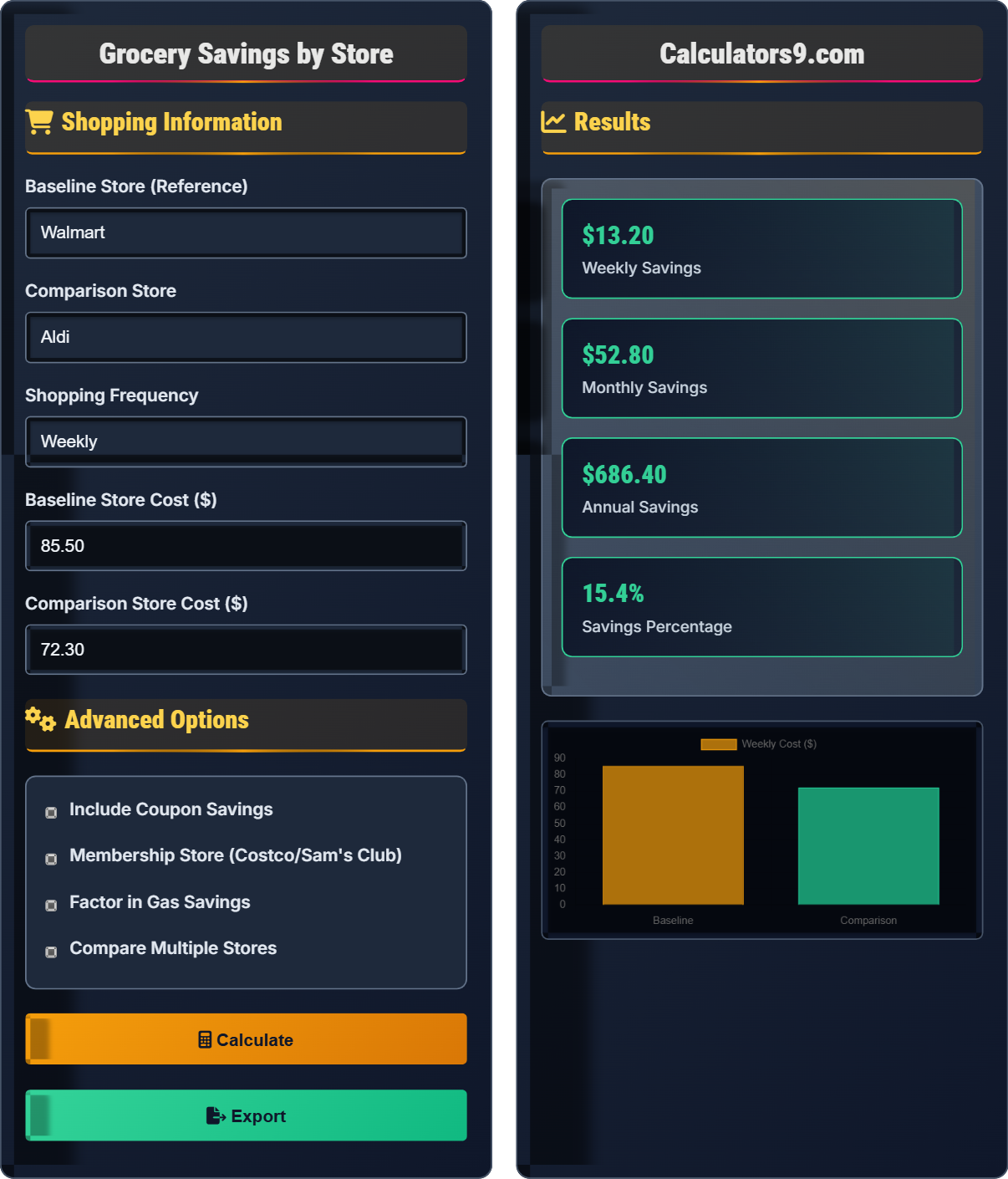
Store comparisons • Weekly budget tracking • Shopping comparison tool
Grocery Savings Formula:
Show the calculator\( S = (P_b - P_s) \times Q \)
Where:
- \( S \) = Total savings
- \( P_b \) = Price at baseline store
- \( P_s \) = Price at savings store
- \( Q \) = Quantity purchased
This formula calculates the savings by comparing prices between stores for the same items.
Example: If milk costs $3.50 at Store A and $2.99 at Store B, buying 2 gallons saves $1.02.
For multiple items: \( S = \sum_{i=1}^{n} (P_{bi} - P_{si}) \times Q_i \)
Shopping Information
Advanced Options
Results
| Store | Cost | Savings | Percentage |
|---|
| Store | Cost | Savings | Percentage |
|---|
| Store | Cost | Savings | Percentage |
|---|
Comprehensive Grocery Shopping Guide
Grocery shopping represents one of the largest household expenses, typically accounting for 10-15% of income. Smart grocery shopping involves comparing prices across stores, utilizing coupons and promotions, and understanding how shopping patterns affect overall costs. Effective comparison shopping can save families hundreds of dollars annually.
The standard grocery savings calculation uses the following formula:
Where:
- \(S\) = Total savings
- \(P_b\) = Price at baseline store
- \(P_s\) = Price at savings store
- \(Q\) = Quantity purchased
Strategies to optimize grocery savings:
- Price matching: Compare prices across stores for regular purchases
- Coupon utilization: Combine digital and paper coupons with sales
- Seasonal shopping: Buy produce in season for maximum savings
- Bulk purchasing: For non-perishables and items with long shelf life
- Store loyalty programs: Take advantage of member discounts and rewards
- Plan meals around sales: Build weekly menus based on store specials
- Shop the perimeter: Fresh items are often cheaper at warehouse stores
- Track unit prices: Compare cost per ounce/liter, not just package price
- Use apps for comparison: Barcode scanning apps show historical prices
- Shop during double coupon days: Maximum savings on promotional items
Grocery Shopping Learning Quiz
If milk costs $3.50 at Store A and $2.99 at Store B, and you buy 2 gallons per week, how much do you save per week by shopping at Store B?
The answer is B) $1.02. Using the formula \(S = (P_b - P_s) \times Q\): \(S = (3.50 - 2.99) \times 2 = 0.51 \times 2 = 1.02\). Therefore, you save $1.02 per week by shopping at Store B.
This question tests understanding of the basic savings formula. The calculation involves finding the price difference between stores, then multiplying by the quantity purchased. This principle applies to any item comparison. The key is to identify the baseline price (higher price) and the savings price (lower price), then multiply by quantity.
Price difference: The variance in cost between two stores for the same item
Quantity purchased: The amount of an item bought in a given period
Savings calculation: The monetary benefit from choosing the lower-priced option
• Subtract lower price from higher price to find difference
• Multiply price difference by quantity purchased
• Always verify unit of measurement matches
• Compare unit prices (per ounce, per pound) for accurate comparison
• Track savings for multiple items to see total benefit
• Consider travel time/cost when comparing distant stores
• Forgetting to multiply by quantity purchased
• Subtracting in wrong order (resulting in negative savings)
• Not accounting for different package sizes
If you save $12.50 per week by shopping at a cheaper store, how much do you save annually? Show your work.
Step 1: Weekly savings = $12.50
Step 2: Weeks per year = 52
Step 3: Annual savings = $12.50 × 52 = $650.00
Therefore, you save $650.00 annually by shopping at the cheaper store.
This problem demonstrates how small weekly savings can accumulate to significant annual savings. The calculation involves simple multiplication but shows the power of consistent cost-saving behaviors. This principle applies to all recurring expenses where small differences compound over time.
Recurring savings: Regular cost reductions that happen consistently
Compounding effect: How small amounts build up over time
Annual accumulation: Total savings over a 12-month period
• There are 52 weeks in a year
• Multiply weekly amount by 52 for annual total
• Consider leap years (add 1 week every 4 years)
• Remember: 52 weeks = 1 year
• Break down annual goals into weekly targets
• Track monthly progress toward annual goals
• Using 50 weeks instead of 52 weeks
• Forgetting to multiply by the correct time period
• Not accounting for seasonal variations in spending
Sarah is considering joining Costco, which costs $60 annually. She expects to save $15 per month on groceries by shopping there. How many months will it take for the savings to offset the membership fee? Is it financially beneficial if she shops there for a full year?
Step 1: Monthly savings = $15
Step 2: Annual membership fee = $60
Step 3: Months to break even = $60 ÷ $15 = 4 months
Step 4: Annual savings = $15 × 12 = $180
Step 5: Net annual benefit = $180 - $60 = $120
Therefore, it takes 4 months to break even, and yes, it's financially beneficial with $120 net savings after one year.
This example demonstrates cost-benefit analysis for membership stores. The calculation shows that even with upfront fees, recurring savings can justify membership if you shop regularly enough. The break-even point is critical for determining whether membership is worthwhile based on your shopping frequency.
Break-even point: When total savings equal the initial cost
Cost-benefit analysis: Comparing expenses to benefits
Membership economics: Value proposition of paid memberships
• Break-even = Membership fee ÷ Monthly savings
• Net benefit = Total savings - Membership fee
• Consider shopping frequency when evaluating membership
• Calculate break-even point before joining
• Factor in non-grocery savings (gas, pharmacy, etc.)
• Consider shared membership with family/friends
• Not calculating break-even point before joining
• Forgetting to account for membership fees in savings
• Overestimating frequency of shopping at membership store
Mike has a $2.00 off coupon for laundry detergent that costs $12.99 at Target. Aldi sells the same brand for $8.99 without a coupon. Which option saves more money? How much does he save by choosing the better option?
Option 1 (Target with coupon): $12.99 - $2.00 = $10.99
Option 2 (Aldi without coupon): $8.99
The better option is Aldi at $8.99, saving $10.99 - $8.99 = $2.00 compared to Target with coupon.
This demonstrates that coupons don't always provide the best value. Sometimes a lower baseline price without a coupon is better than a higher price with a discount. This principle applies to all promotional offers - always compare the final price after discounts, not just the discount amount.
Final price comparison: Comparing costs after all discounts
Coupon effectiveness: Whether a discount actually saves money
Value optimization: Getting the lowest final price
• Always compare final prices after discounts
• A large discount doesn't guarantee the lowest final price
• Consider shipping/handling fees for online purchases
• Calculate final price before deciding
• Look for stores with consistently low prices
• Combine sales with coupons for maximum savings
• Being attracted to large discount percentages without checking final price
• Not comparing with other stores before using coupons
• Assuming all sales are good deals
If you save $8.50 per shopping trip by switching stores, and you shop twice a week instead of once a week, how does your annual savings change?
The answer is B) It doubles. Original weekly trips: 52 trips × $8.50 = $442. New weekly trips: 104 trips × $8.50 = $884. The savings double from $442 to $884, so it doubles.
This question highlights how shopping frequency affects total savings. The relationship is linear - doubling the number of shopping trips doubles the total savings. This principle is important when considering the trade-offs between shopping frequency (convenience) and savings potential.
Linear relationship: When one variable increases proportionally with another
Shopping frequency: How often purchases are made
Savings accumulation: How total savings build over time
• Total savings = Savings per trip × Number of trips
• More frequent shopping increases total savings linearly
• Consider time and transportation costs with frequency
• Balance savings with convenience
• Factor in gas/time costs with frequent shopping
• Consider bulk shopping to reduce frequency
• Assuming savings per trip remains constant regardless of frequency
• Not considering the time cost of additional trips
• Forgetting that more trips mean more opportunities for impulse purchases
Grocery Basics
Comparing prices across stores to maximize savings.
\(S = (P_b - P_s) \times Q\)
Where S=savings, P=prices, Q=quantity.
- Compare final prices after discounts
- Consider unit prices for accurate comparison
- Factor in travel time/cost
Savings Strategies
Optimizing grocery purchases through smart planning.
- Plan meals around sales
- Use apps for price comparison
- Shop seasonal produce
- Combine coupons with sales
- Don't overspend for savings
- Consider quality vs. price
- Factor in convenience
- Track actual savings
FAQ
Q: How do I maximize grocery savings without spending too much time shopping?
A: To maximize savings efficiently:
- Choose 1-2 primary stores: Focus on 2 stores that offer the best combination of low prices and convenience.
- Use grocery apps: Apps like Flipp, Basket, or store apps show weekly ads and digital coupons.
- Plan meals weekly: Build your menu around store sales and seasonal produce.
- Shop once or twice weekly: Balance between fresh food and efficiency.
- Stick to your list: Avoid impulse purchases that negate your savings.
The key is finding the sweet spot between savings and time investment.
Q: Are warehouse stores like Costco worth the membership fee?
A: Warehouse stores are worth the membership if you:
- Shop regularly: Need to shop at least monthly to justify the fee
- Buy in bulk: Have space for large quantities of non-perishables
- Have a large family: Can consume bulk items before expiration
- Shop for multiple categories: Use for groceries, gas, pharmacy, electronics
To calculate if it's worth it: Annual savings > Membership fee. For example, if the membership is $60 and you save $10/month, it breaks even in 6 months. After that, it's pure profit.