Pet Food Cost Estimator
Monthly budgets • Feeding guidelines • Nutrition planning
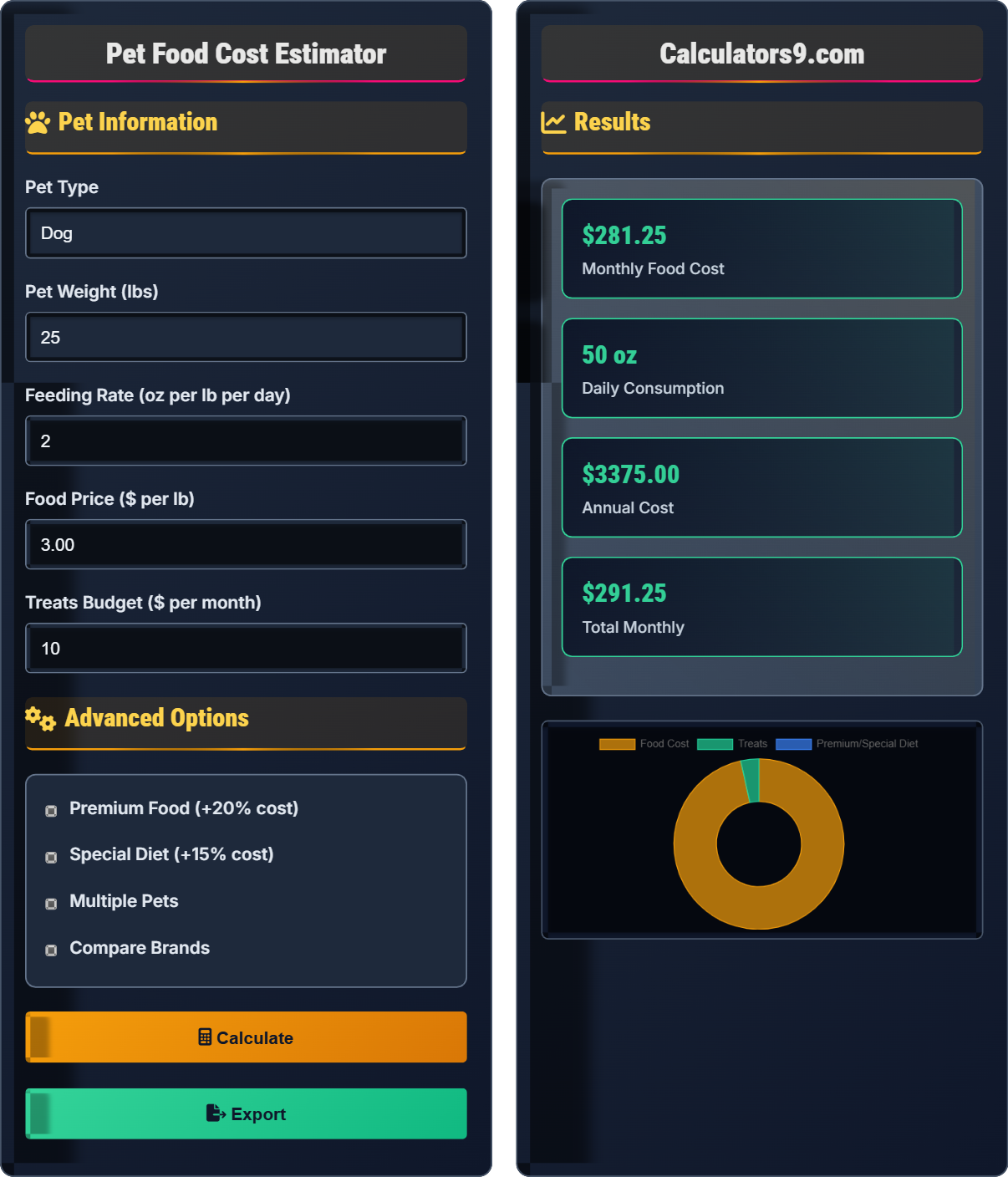
Pet Food Cost Formula:
Show the calculator\( C = W \times R \times P \times D \)
Where:
- \( C \) = Monthly cost
- \( W \) = Pet weight in pounds
- \( R \) = Feeding rate (ounces per pound per day)
- \( P \) = Price per ounce of food
- \( D \) = Days in month (typically 30)
This formula calculates the monthly cost of pet food based on the pet's weight, feeding requirements, and food price.
Example: For a 25 lb dog eating 2 oz per pound per day of food costing $0.10 per ounce:
\( C = 25 \times 2 \times 0.10 \times 30 = \$150 \)
Additional considerations include treats, special diets, and seasonal variations.
Pet Information
Advanced Options
Results
| Day | Food (oz) | Cost |
|---|
| Week | Food (oz) | Cost |
|---|
| Category | Amount | Percentage |
|---|
Comprehensive Pet Food Guide
Pet nutrition is fundamental to maintaining health, longevity, and quality of life. Proper feeding practices depend on the pet's species, age, weight, activity level, and health status. Understanding feeding guidelines helps pet owners provide optimal nutrition while managing costs effectively.
The standard pet food cost calculation uses the following formula:
Where:
- \(C\) = Monthly cost
- \(W\) = Pet weight in pounds
- \(R\) = Feeding rate (ounces per pound per day)
- \(P\) = Price per ounce of food
- \(D\) = Days in month (typically 30)
Pet food categories vary in price and nutritional value:
- Generic: $2-3 per lb (basic nutrition)
- Mid-range: $3-4 per lb (balanced nutrition)
- Premium: $4-6 per lb (higher quality ingredients)
- Prescription: $6-10 per lb (veterinary therapeutic diets)
- Raw/BARF: $8-15 per lb (unprocessed diets)
- Buy in bulk: Purchase larger bags to reduce per-pound costs
- Look for sales: Stock up during promotional periods
- Compare unit prices: Calculate cost per pound across brands
- Subscribe for discounts: Many retailers offer subscription savings
- Consider generic brands: Often nutritionally comparable to premium brands
Pet Food Learning Quiz
What is the recommended daily feeding rate for a healthy adult dog based on its body weight?
The answer is A) 1-3% of body weight. Healthy adult dogs typically require 1-3% of their body weight in food daily. Smaller breeds may need closer to 3%, while larger, less active breeds may need only 1-2%. This range accounts for differences in metabolism and activity level.
Understanding feeding guidelines by percentage of body weight allows for accurate adjustments based on individual pet characteristics. The 1-3% range accounts for metabolic variations between breeds, activity levels, and life stages. This approach prevents overfeeding or underfeeding, which can lead to health problems.
Body weight percentage: Feeding guideline expressed as a fraction of the pet's total weight
Metabolism: The rate at which the body processes nutrients and burns calories
Activity level: The amount of physical exercise and energy expenditure
• Feeding rates vary by breed size and activity level
• Small breeds typically need more calories per pound
• Adjust portions based on body condition score
• Start with manufacturer guidelines and adjust as needed
• Monitor your pet's body condition regularly
• Consult your veterinarian for specific recommendations
• Following package guidelines without considering individual needs
• Feeding the same amount regardless of activity level
• Not adjusting for life stage changes
Calculate the monthly food cost for a 40 lb dog eating 2 oz per pound per day of food that costs $3.50 per pound. Show your work.
Using the pet food formula: \(C = W \times R \times P \times D\)
Given:
- W = 40 lbs
- R = 2 oz per lb per day
- P = $3.50 per lb = $3.50 ÷ 16 = $0.21875 per oz
- D = 30 days
Step 1: Daily consumption = 40 lbs × 2 oz/lb = 80 oz per day
Step 2: Daily cost = 80 oz × $0.21875/oz = $17.50 per day
Step 3: Monthly cost = $17.50 × 30 days = $525.00
Therefore, the monthly food cost is $525.00.
This problem demonstrates the importance of unit conversion in pet food calculations. Since feeding rates are often given in ounces per pound of body weight, but food is typically priced per pound, we must convert between units. The calculation shows how quickly pet food costs can accumulate for larger animals.
Unit conversion: Changing measurements from one unit to another (e.g., pounds to ounces)
Feeding rate: The amount of food required per unit of body weight
Cost per unit: The price of food per standardized measurement
• Always convert units to match before calculations
• Consider daily consumption when calculating monthly costs
• Larger pets have disproportionately higher food costs
• Remember: 1 pound = 16 ounces
• Calculate daily costs first, then multiply by days
• Factor in treats and supplements separately
• Forgetting to convert units between pounds and ounces
• Not accounting for daily feeding patterns
• Using incorrect daily feeding rates
Jennifer has two cats: one weighing 8 lbs and another weighing 12 lbs. The average feeding rate for cats is 2% of body weight per day. If cat food costs $4.00 per pound, what is her monthly food budget for both cats combined?
Step 1: Calculate daily food needs for each cat
Cat 1: 8 lbs × 0.02 = 0.16 lbs per day
Cat 2: 12 lbs × 0.02 = 0.24 lbs per day
Total daily: 0.16 + 0.24 = 0.40 lbs per day
Step 2: Calculate daily cost = 0.40 lbs × $4.00/lb = $1.60 per day
Step 3: Calculate monthly cost = $1.60 × 30 days = $48.00
Therefore, Jennifer's monthly food budget for both cats is $48.00.
This example shows how to scale calculations for multiple pets. The feeding rate remains consistent across similar animals, allowing for simple addition of individual requirements. The calculation demonstrates how pet ownership costs increase with each additional animal. It also highlights the importance of budgeting for multiple pets.
Scaling: Adjusting calculations based on multiple factors
Consistent feeding rate: Similar animals require similar ratios of food to body weight
Combined budget: Total allocation for multiple pets
• Add individual pet requirements to get total needs
• Calculate daily costs before multiplying by days
• Consider separate food requirements for different animals
• Calculate each pet's needs separately, then add together
• Consider bulk purchasing for multiple pets
• Store food properly to prevent waste
• Assuming all pets eat the same amount regardless of size
• Not accounting for individual feeding requirements
• Calculating based on group feeding rather than individual needs
Tom's 30-lb dog has special dietary needs requiring prescription food that costs $8.00 per pound. The feeding rate is still 2% of body weight per day. How much more expensive is this monthly diet compared to regular food costing $3.00 per pound?
Step 1: Calculate daily food requirement = 30 lbs × 0.02 = 0.6 lbs per day
Step 2: Calculate regular food monthly cost = 0.6 lbs/day × $3.00/lb × 30 days = $54.00
Step 3: Calculate prescription food monthly cost = 0.6 lbs/day × $8.00/lb × 30 days = $144.00
Step 4: Calculate difference = $144.00 - $54.00 = $90.00
Therefore, the prescription diet costs $90.00 more per month than regular food.
This demonstrates the significant cost impact of special dietary needs. Prescription diets are often 2-3 times more expensive than regular food, representing a substantial increase in pet ownership costs. While these foods are necessary for health, pet owners should budget accordingly. The calculation shows how medical needs can dramatically affect feeding expenses.
Prescription diet: Therapeutic food formulated for specific health conditions
Special dietary needs: Nutritional requirements due to health conditions
Medical nutrition: Food products designed for therapeutic purposes
• Prescription foods are significantly more expensive than regular food
• Health needs may require costly dietary changes
• Budget for potential increases in feeding costs
• Discuss feeding costs with your veterinarian
• Look for prescription food rebates and coupons
• Consider pet insurance for medical expenses
• Not budgeting for increased costs with special diets
• Switching foods without veterinary guidance
• Assuming all special diets cost the same
Which of the following factors does NOT significantly affect a pet's daily food requirements?
The answer is C) Owner's income level. A pet's nutritional requirements are determined by biological factors such as age, activity level, breed size, and health status. The owner's income level affects what the owner can afford to feed, but not what the pet actually needs nutritionally. The other factors directly influence the pet's metabolic requirements.
This question distinguishes between biological needs and economic constraints. While budget limitations may influence feeding choices, they don't change the pet's actual nutritional requirements. Understanding this distinction helps pet owners make informed decisions about feeding priorities. Proper nutrition is essential regardless of economic circumstances.
Nutritional requirements: Biological needs for essential nutrients
Economic constraints: Financial limitations affecting feeding choices
Biological factors: Physical characteristics determining nutritional needs
• Feeding requirements are based on biological needs
• Economic factors affect affordability, not requirements
• Prioritize nutritional adequacy within budget constraints
• Find nutritionally adequate options within your budget
• Consult veterinarians for affordable alternatives
• Focus on quality rather than expensive brands
• Assuming expensive food is always better
• Feeding based on budget rather than needs
• Not researching affordable but nutritious options
Pet Food Basics
Essential nutrients for animal health and wellbeing.
\(C = W \times R \times P \times D\)
Where C=cost, W=weight, R=rate, P=price, D=days.
- Feed by percentage of body weight
- Adjust for activity level
- Consider life stage needs
Budget Strategies
Optimizing pet food expenses without compromising nutrition.
- Buy in bulk
- Look for sales
- Compare unit prices
- Subscribe for discounts
- Quality vs. cost balance
- Special dietary needs
- Storage and shelf life
- Health impact of cheaper foods
FAQ
Q: How do I determine the right amount of food for my pet?
A: The general rule is to feed 1-3% of your pet's ideal body weight daily, depending on the species and activity level. For dogs: 2-3% for active dogs, 1-2% for less active dogs. For cats: 2-4% depending on activity. However, this is just a starting point. Monitor your pet's body condition and adjust portions to maintain an ideal weight. You should be able to feel their ribs easily but not see them prominently.
Use the formula: \( Daily\ Food\ (lbs) = \frac{Weight\ (lbs) \times Feeding\ Rate\ (\%)}{100} \)
For example, a 30 lb moderately active dog would need approximately 30 × 0.02 = 0.6 lbs of food daily.
Q: Is it worth buying expensive pet food?
A: The value of expensive pet food depends on your pet's specific needs. Premium foods often contain higher quality proteins, better digestibility, and targeted nutrients. For pets with allergies, sensitivities, or health conditions, premium or specialized foods may be worth the investment.
However, for healthy pets, mid-range foods (like those labeled "all life stages") often provide excellent nutrition at reasonable prices. The key is to look at the guaranteed analysis and ingredient list rather than just the price. A food that costs $4/lb but has 25% protein and high digestibility may be more economical than a $2/lb food with 18% protein that isn't as digestible.