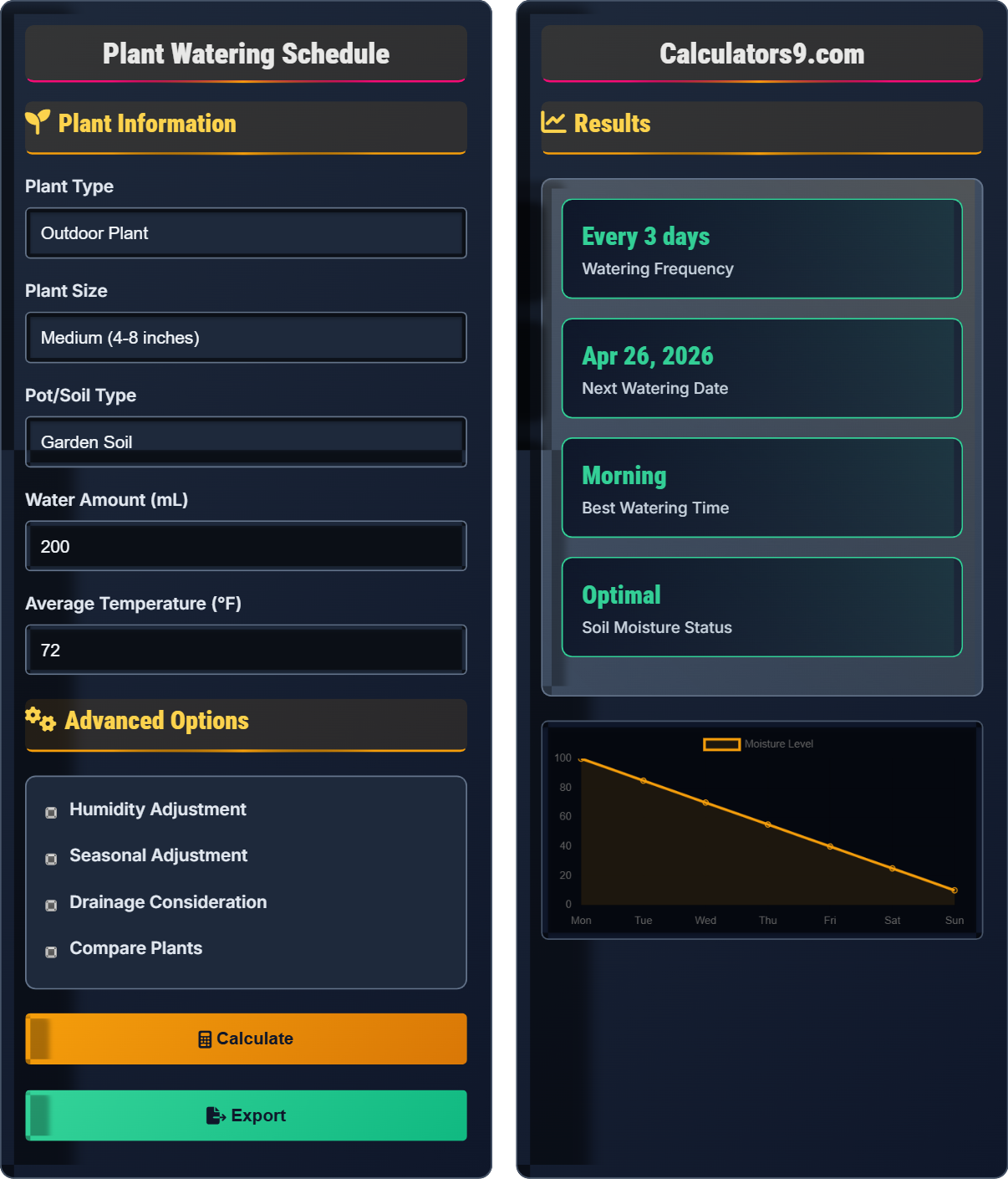
Plant Watering Schedule
Irrigation planning • Plant care tracker • Gardening guide
Watering Frequency Formula:
Show the calculator\( F = \frac{W \times S}{E} \)
Where:
- \( F \) = Watering frequency (days)
- \( W \) = Water requirement (liters)
- \( S \) = Soil retention factor
- \( E \) = Evaporation rate (liters/day)
This formula calculates optimal watering intervals based on plant needs and environmental conditions.
Example: For a plant needing 0.5L water, soil retention of 0.8, evaporation of 0.1L/day: F = (0.5 × 0.8) / 0.1 = 4 days.
Adjust for temperature, humidity, and plant growth stage.
Plant Information
Advanced Options
Results
| Day | Watering | Amount |
|---|
| Tip | Importance | Frequency |
|---|
| Metric | Value | Status |
|---|
Comprehensive Plant Watering Guide
Proper watering is essential for plant health and growth. Different plants have varying water requirements based on their species, size, growing conditions, and environmental factors. Understanding your plant's specific needs and adjusting your watering schedule accordingly can prevent both underwatering and overwatering, which are common causes of plant stress and disease.
The standard watering frequency calculation uses the following formula:
Where:
- \(F\) = Watering frequency (days)
- \(W\) = Water requirement (liters)
- \(S\) = Soil retention factor
- \(E\) = Evaporation rate (liters/day)
Several environmental factors affect watering needs:
- Temperature: Higher temperatures increase evaporation and plant transpiration
- Humidity: Lower humidity increases water loss from plants
- Light: Bright, direct light increases water needs
- Wind: Increases evaporation and transpiration rates
- Soil type: Sandy soil drains faster than clay soil
- Water early morning: Reduces evaporation and prevents fungal diseases
- Water at soil level: Avoid wetting leaves when possible
- Deep watering: Encourages deep root growth
- Check soil moisture: Use finger test or moisture meter
- Adjust for seasons: Reduce watering in fall and winter
Plant Watering Learning Quiz
How often should you water most indoor plants in average conditions?
The answer is C) When top inch of soil is dry. This method ensures plants get water when they need it without risking overwatering. Different plants have different water requirements, so checking soil moisture is more reliable than following a fixed schedule.
This question tests the fundamental principle of watering based on plant needs rather than a fixed schedule. The finger test (checking the top inch of soil) is a reliable method for determining when plants need water. This approach prevents both underwatering and overwatering, which are common causes of plant problems.
Soil moisture: The amount of water present in the soil
Overwatering: Providing more water than plants can absorb
Underwatering: Not providing enough water for plant needs
• Check soil moisture before watering
• Water when top inch is dry
• Adjust frequency based on conditions
• Use your finger to check soil moisture
• Lift pots to gauge weight (lighter = drier)
• Observe plant appearance for signs
• Watering on a fixed schedule regardless of needs
• Assuming all plants have the same water requirements
• Not accounting for seasonal changes
If a plant needs 200 mL of water and you want to water it every 4 days, how much water should you give each time? Show your work.
For a plant that needs 200 mL over 4 days, you would give 200 mL every 4 days.
However, if you want to provide the same total amount but distribute it evenly, you would calculate: 200 mL ÷ 4 days = 50 mL per day.
But for most plants, it's better to water deeply less frequently: Give 200 mL once every 4 days rather than 50 mL daily.
This problem demonstrates the difference between total water requirements and distribution patterns. Deep watering encourages stronger root growth compared to frequent shallow watering. The calculation shows how to adjust watering volume based on frequency, but emphasizes that watering practices should also consider plant biology and root development.
Deep watering: Providing sufficient water to reach deeper roots
Water distribution: How water is spread over timeRoot development: Growth pattern of plant roots
• Deep watering is better than frequent light watering
• Total water needed over time is important
• Consider plant's natural watering patterns
• Water deeply to encourage deep roots
• Allow soil to dry between waterings
• Adjust based on plant responses
• Giving the same amount regardless of frequency
• Not considering plant's natural water needs
• Watering too frequently with small amounts
Sarah waters her tomato plants with 500 mL every 2 days during summer. In winter, evaporation decreases by 60% and plant growth slows. If she maintains the same watering amount, how often should she water the plants in winter?
Summer: 500 mL every 2 days
Winter evaporation is 40% of summer (100% - 60% = 40%)
Winter watering frequency = Summer frequency ÷ 0.4
Winter watering frequency = 2 days ÷ 0.4 = 5 days
Therefore, Sarah should water her tomato plants every 5 days in winter.
This example demonstrates how seasonal changes affect watering needs. Lower temperatures and reduced plant growth in winter decrease water requirements. The calculation shows how to adjust frequency based on environmental changes. This principle applies to all plants and helps maintain proper hydration throughout the year.
Seasonal adjustment: Modifying care routines based on seasonal changes
Evaporation rate: How quickly water evaporates from soilPlant dormancy: Period of reduced growth and water needs
• Reduce watering in cooler months
• Adjust for seasonal temperature changes
• Consider plant growth patterns
• Monitor plants closely during seasonal transitions
• Adjust gradually rather than suddenly
• Research specific plant needs for your climate
• Maintaining summer watering schedule in winter
• Not accounting for reduced evaporation
• Overwatering during dormant periods
Mike's succulent needs watering every 10 days in his home with 40% humidity. If he moves to a more humid environment with 70% humidity, how should he adjust the watering schedule? (Assume higher humidity reduces evaporation by 40%)
Increased humidity reduces evaporation by 40%
New evaporation rate = Original rate × (1 - 0.4) = 60% of original
New watering interval = Original interval ÷ 0.6
New watering interval = 10 days ÷ 0.6 = 16.67 days ≈ 17 days
Therefore, Mike should water his succulent every 17 days in the more humid environment.
This demonstrates how humidity affects plant watering needs. Higher humidity reduces water loss from both soil and plants, extending the time between waterings. The calculation shows how to mathematically adjust watering schedules based on humidity changes. This principle is especially important for sensitive plants like succulents.
Humidity effect: Impact of air moisture on plant water needs
Evaporation reduction: Decreased water loss in humid conditionsWatering adjustment: Modifying schedule based on environmental factors
• Higher humidity = Less frequent watering
• Lower humidity = More frequent watering
• Adjust gradually when moving plants
• Use hygrometer to measure humidity
• Monitor plant responses to humidity changes
• Research humidity preferences for each plant
• Not adjusting for humidity changes
• Assuming same schedule works in all environments
• Overwatering in high humidity conditions
What is the best time of day to water plants?
The answer is A) Morning (6-10 AM). Watering in the morning allows plants to absorb water before the heat of the day, reduces evaporation, and allows any water on leaves to dry before evening, preventing fungal diseases.
This question tests knowledge of optimal watering timing. Morning watering is ideal because it provides moisture during the hottest part of the day while minimizing evaporation. Evening watering can leave plants wet overnight, promoting disease. Midday watering is inefficient due to high evaporation rates.
Optimal timing: Best time to perform a gardening task
Evaporation rate: Speed at which water turns to vaporFungal prevention: Reducing conditions that promote disease
• Water in early morning
• Avoid evening watering
• Prevent leaf wetness overnight
• Water before sunrise if possible
• Water at soil level, not leaves
• Adjust timing based on weather
• Watering during peak sun hours
• Wetting foliage in evening
• Not considering temperature effects
Watering Basics
Providing adequate water without overwatering or underwatering.
\(F = \frac{W \times S}{E}\)
Where F=frequency, W=water requirement, S=soil factor, E=evaporation.
- Check soil moisture before watering
- Water deeply but less frequently
- Adjust for environmental conditions
Care Strategies
Optimizing plant health through proper hydration practices.
- Water in early morning
- Check soil regularly
- Adjust for seasons
- Observe plant signals
- Don't water on a strict schedule
- Consider pot type and drainage
- Monitor for signs of stress
- Research specific plant needs
FAQ
Q: How can I tell if I'm overwatering or underwatering my plants?
A: Signs of overwatering include:
- Yellowing leaves: Especially lower leaves
- Soft, mushy stems: Root rot beginning
- Wilting despite wet soil: Roots can't absorb water
- Foul odor: From decomposing roots
Signs of underwatering include:
- Crispy, brown edges: On leaves
- Slow growth: Or stunted appearance
- Soil pulling away: From pot edges
- Brittle leaves: That fall off easily
Always check soil moisture with your finger before watering.
Q: Do different pot materials affect watering needs?
A: Yes, pot material significantly affects watering needs:
- Plastic pots: Retain moisture longest, require less frequent watering
- Ceramic pots: Moderate drainage, good for most plants
- Terracotta pots: Highly porous, lose moisture quickly, require more frequent watering
- Glazed ceramic: Similar to plastic in moisture retention
Adjust your watering schedule based on pot material. Terracotta pots may need watering twice as often as plastic pots in the same conditions.