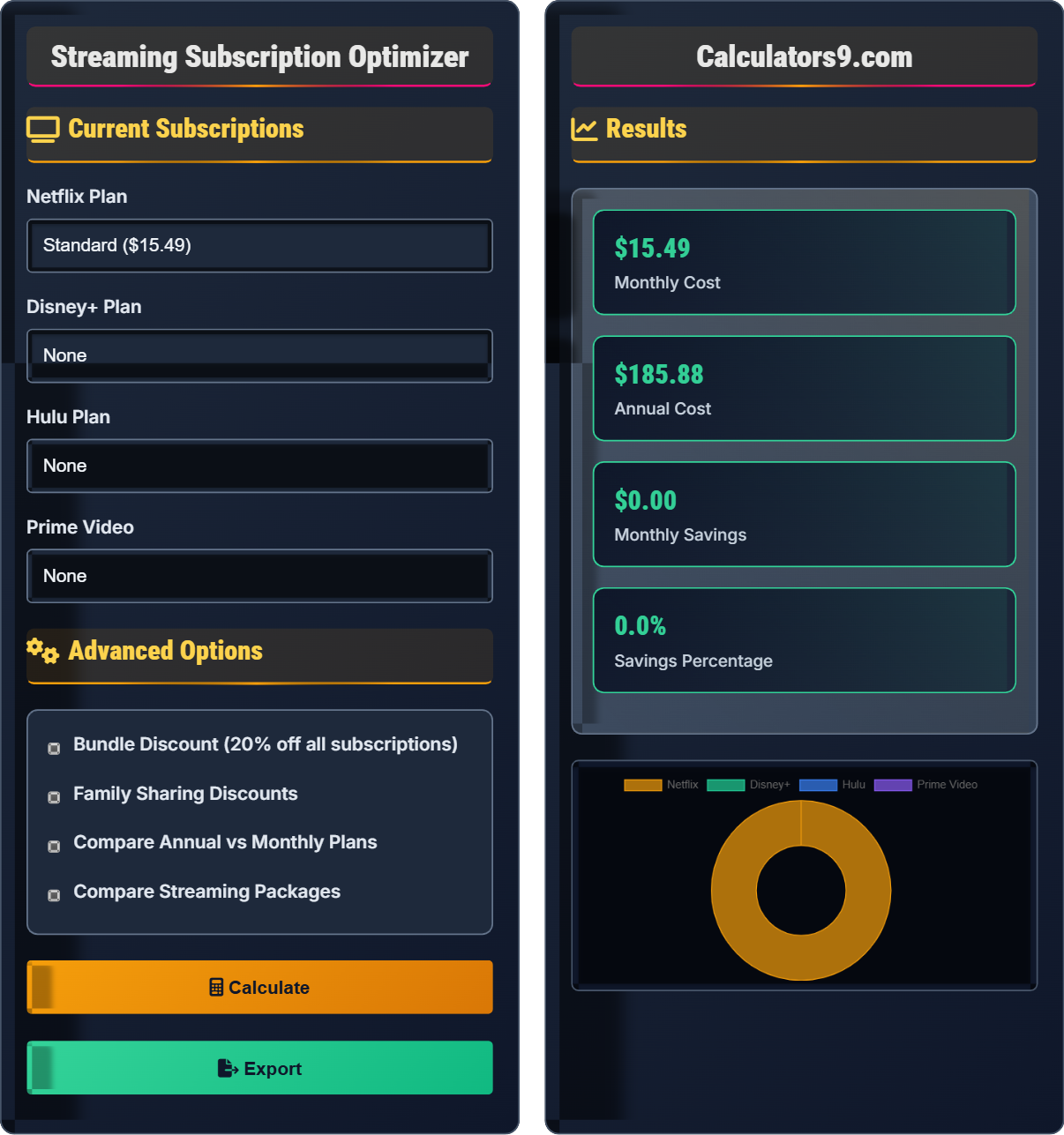
Streaming Subscription Optimizer
Cost tracking • Plan comparisons • Entertainment budget calculator
Subscription Optimization Formula:
Show the calculator\( C = \sum_{i=1}^{n} P_i \times (1 - D_i) \)
Where:
- \( C \) = Total optimized cost
- \( P_i \) = Price of subscription \( i \)
- \( D_i \) = Discount rate for subscription \( i \)
- \( n \) = Number of subscriptions
This formula calculates the total cost after applying discounts and bundling optimizations.
Example: Netflix ($15.99) + Disney+ ($7.99) with 20% bundle discount = $19.18.
Optimization equation: \( O = C_{original} - C_{optimized} \)
Current Subscriptions
Advanced Options
Results
| Service | Plan | Cost | Status |
|---|
| Optimization | Strategy | Savings | Status |
|---|
| Package | Services | Cost | Value |
|---|
Comprehensive Streaming Optimization Guide
Streaming services have revolutionized entertainment consumption, offering access to thousands of movies and TV shows for monthly fees. With dozens of platforms available, optimizing your streaming subscriptions can save significant money while maintaining entertainment value. The average household subscribes to 4-5 streaming services, spending $60-80 monthly.
The standard subscription cost calculation uses the following formula:
Where:
- \(C\) = Total optimized cost
- \(P_i\) = Price of subscription \(i\)
- \(D_i\) = Discount rate for subscription \(i\)
- \(n\) = Number of subscriptions
Strategies to optimize streaming subscriptions:
- Bundle packages: Disney+, Hulu, and ESPN+ bundle for $13.99 (vs. $19.99 separately)
- Family sharing: Split costs with family/friends for multi-person plans
- Annual plans: Save ~10-20% with yearly commitments
- Rotation strategy: Cancel during off-seasons and resubscribe when needed
- Free trials: Take advantage of 7-30 day trials strategically
- Assess usage patterns: Track which services you actually watch
- Plan rotation: Rotate subscriptions monthly based on viewing needs
- Use comparison tools: Apps that track content across platforms
- Take advantage of promotions: Student discounts, free trials, promotional pricing
- Cancel unused services: Review subscriptions quarterly
Streaming Optimization Learning Quiz
If you subscribe to Netflix Standard ($15.49), Disney+ ($7.99), and Hulu with ads ($7.99), what is your total monthly cost before any discounts?
The answer is B) $31.47. Adding the three subscriptions: $15.49 + $7.99 + $7.99 = $31.47. This calculation shows the importance of tracking individual subscription costs to understand your total entertainment spending.
This question tests basic arithmetic skills applied to subscription management. The calculation involves simply adding individual subscription costs. This foundational skill is essential for anyone managing multiple recurring expenses. Understanding your baseline costs is the first step in optimizing your subscription portfolio.
Subscription aggregation: Adding individual recurring costs to find total monthly expenses
Baseline cost: Total cost before applying any discounts or optimizations
Monthly recurring expenses: Regular payments that occur each billing cycle
• Add individual subscription costs to find total
• Track all subscriptions including free trials
• Consider family sharing costs per person
• Keep a spreadsheet of all subscriptions and renewal dates
• Set calendar reminders for trial periods ending
• Use budgeting apps to track recurring expenses
• Forgetting to include all subscriptions in the calculation
• Not accounting for taxes or additional fees
• Confusing monthly and annual billing cycles
If you save $5.00 per month by optimizing your streaming subscriptions, how much do you save annually? Show your work.
Step 1: Monthly savings = $5.00
Step 2: Months per year = 12
Step 3: Annual savings = $5.00 × 12 = $60.00
Therefore, you save $60.00 annually by optimizing your streaming subscriptions.
This problem demonstrates how small monthly savings can accumulate to significant annual savings. The calculation involves simple multiplication but shows the power of consistent cost-saving behaviors. This principle applies to all recurring expenses where small differences compound over time.
Recurring savings: Regular cost reductions that happen consistently
Compounding effect: How small amounts build up over time
Annual accumulation: Total savings over a 12-month period
• There are 12 months in a year
• Multiply monthly amount by 12 for annual total
• Consider seasonal promotions that affect monthly costs
• Remember: 12 months = 1 year
• Break down annual goals into monthly targets
• Track monthly progress toward annual goals
• Using 10 months instead of 12 months
• Forgetting to multiply by the correct time period
• Not accounting for seasonal variations in spending
Sarah currently pays $7.99 for Disney+, $14.99 for Hulu (no ads), and $15.49 for Netflix Standard. She learns about a bundle that includes Disney+, Hulu, and ESPN+ for $13.99. If she adds ESPN+ to her current subscriptions, how much would she save monthly with the bundle compared to her current setup?
Step 1: Current cost = $7.99 + $14.99 + $15.49 = $38.47
Step 2: Bundle cost = $13.99 (includes Disney+, Hulu, ESPN+)
Step 3: Savings = $38.47 - $13.99 = $24.48
Therefore, Sarah would save $24.48 monthly by switching to the bundle.
This example demonstrates the value of bundled subscriptions. The calculation shows that sometimes adding more services can actually reduce total costs through bundling discounts. This principle applies to many subscription services beyond streaming, including software packages and mobile plans.
Bundling: Combining multiple services for a reduced total cost
Cost consolidation: Reducing multiple expenses into a single lower cost
Value optimization: Getting more services for less money
• Compare total costs before and after bundling
• Verify all needed services are included in the bundle
• Consider if additional services in the bundle have value
• Calculate per-service cost in bundles
• Consider if you'll actually use all bundled services
• Watch for promotional bundle pricing that expires
• Not including all current subscriptions in the comparison
• Assuming all bundles are automatically better deals
• Forgetting to evaluate whether added services have value
Mike pays $15.49/month for Netflix Standard individually. His friend offers to add him to their Netflix family plan (4 screens) for $20.00/month total, split equally among 4 people. How much does Mike save annually by joining the family plan instead of keeping his individual subscription?
Step 1: Individual cost = $15.49/month
Step 2: Family share = $20.00 ÷ 4 = $5.00/month
Step 3: Monthly savings = $15.49 - $5.00 = $10.49
Step 4: Annual savings = $10.49 × 12 = $125.88
Therefore, Mike saves $125.88 annually by joining the family plan.
This demonstrates the power of family sharing arrangements. The calculation shows that splitting costs with others can significantly reduce individual expenses. This principle applies to many subscription services that offer multi-person plans at economies of scale.
Family sharing: Distributing subscription costs among multiple users
Economies of scale: Reduced per-unit cost when shared among multiple users
Cost per person: Individual share of a group expense
• Divide total family plan cost by number of users
• Compare to individual plan costs
• Ensure all users have compatible viewing preferences
• Coordinate with friends/family for shared subscriptions
• Use unique profiles to maintain viewing privacy
• Establish clear payment agreements upfront
• Forgetting to divide the total cost by number of users
• Not considering compatibility with other users' preferences
• Assuming all family plans are worth the cost
If an annual streaming plan costs $120 and the equivalent monthly plan costs $12 per month, what percentage discount does the annual plan offer?
Monthly cost annually = $12 × 12 = $144
Annual plan cost = $120
Savings = $144 - $120 = $24
Discount percentage = ($24 ÷ $144) × 100 = 16.67% ≈ 17%
The answer is C) 17%.
This question tests percentage calculation skills in the context of subscription optimization. The calculation involves comparing the cost of paying monthly versus annually. This principle helps consumers understand the actual value of annual subscriptions and make informed decisions about payment frequency.
Annual discount: Money saved by paying for a full year upfront
Percentage calculation: Expressing savings as a proportion of the original cost
Payment frequency optimization: Choosing the most cost-effective billing cycle
• Calculate monthly cost over 12 months first
• Subtract annual cost from monthly equivalent
• Divide savings by original cost and multiply by 100
• Annual plans typically offer 10-20% savings
• Consider your financial situation before committing
• Factor in potential cancellation policies
• Forgetting to calculate the full year of monthly payments
• Dividing by the wrong amount when calculating percentage
• Not considering the opportunity cost of paying upfront
Streaming Basics
Minimizing costs while maintaining desired entertainment value.
\(C = \sum_{i=1}^{n} P_i \times (1 - D_i)\)
Where C=cost, P=price, D=discount, n=subscriptions.
- Compare total costs before and after changes
- Consider value beyond just cost
- Review subscriptions quarterly
Optimization Strategies
Maximizing entertainment value while minimizing costs.
- Bundle services when beneficial
- Use family sharing arrangements
- Choose annual plans for savings
- Rotate subscriptions based on needs
- Don't sacrifice needed content for savings
- Factor in convenience and accessibility
- Consider content library quality
- Track actual usage patterns
FAQ
Q: How can I optimize my streaming subscriptions without losing access to my favorite shows?
A: To optimize without losing favorites:
- Inventory your content: List all shows you regularly watch and note which services host them.
- Use comparison tools: Apps like JustWatch help track where content is available across platforms.
- Plan rotation: Cancel during off-seasons and resubscribe when new episodes arrive.
- Bundle strategically: Group services that host complementary content.
- Consider free trials: Time them with seasons of your favorite shows.
For example, if you love Marvel content, Disney+ is essential. If you enjoy prestige dramas, Netflix might be worth the premium cost.
Q: Is it better to have fewer premium services or more basic services?
A: The optimal mix depends on your viewing habits:
- Heavy viewers: Fewer premium services often provide better value per hour watched
- Casual viewers: More basic services may offer variety without high costs
- Specific interests: Match services to genres you prefer (sports → ESPN+, anime → Crunchyroll)
Calculate your cost per hour: If you spend $50/month and watch 100 hours, your cost is $0.50/hour. Premium services often offer better value for heavy users.