Wardrobe Cost Per Wear
Fashion investment tracking • Style analytics • Clothing value assessment
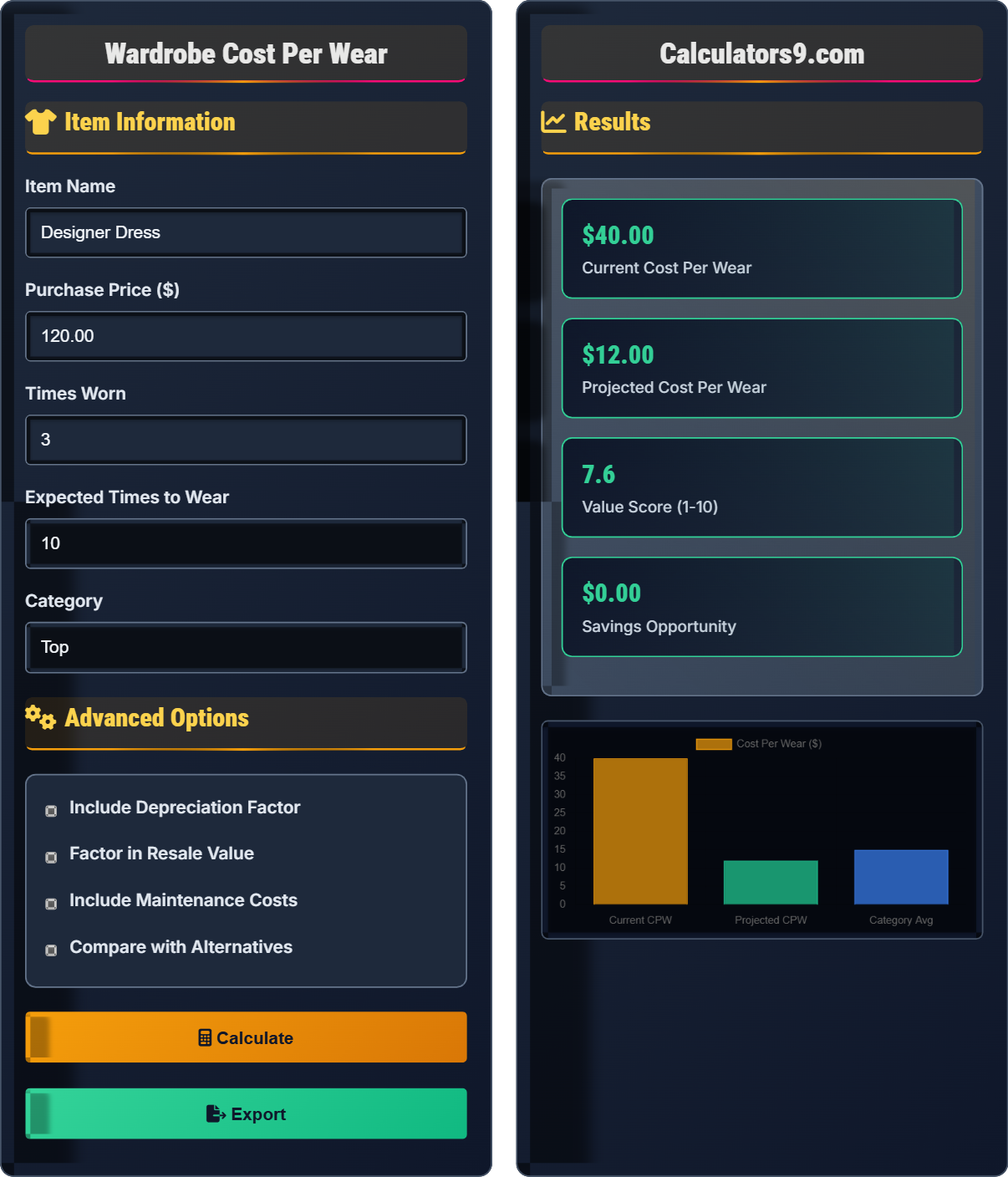
Cost Per Wear Formula:
Show the calculator\( CPW = \frac{P}{U} \)
Where:
- \( CPW \) = Cost Per Wear ($)
- \( P \) = Purchase price ($)
- \( U \) = Number of times worn
This formula calculates the value of clothing based on purchase price divided by usage frequency.
Example: A $100 dress worn 5 times has a CPW of $20.00.
For depreciation: \( CPW = \frac{P}{U_t} \) where \( U_t \) is total expected wears.
Item Information
Advanced Options
Results
| Metric | Value | Status |
|---|
| Date | Occasion | Wear Count |
|---|
| Recommendation | Impact | Priority |
|---|
Comprehensive Wardrobe Value Guide
Cost Per Wear (CPW) is a financial metric that measures the value of clothing items based on purchase price relative to usage. The concept helps consumers make more informed purchasing decisions by quantifying the actual value derived from each garment. A lower CPW indicates better value, while a higher CPW suggests the item may be overpriced relative to its utility.
The standard CPW calculation uses the following formula:
Where:
- \(CPW\) = Cost Per Wear
- \(P\) = Purchase price
- \(U\) = Number of times worn
Strategies to optimize clothing investments:
- Buy less, choose well: Invest in fewer, higher-quality pieces
- Consider versatility: Select items that can be styled multiple ways
- Plan for occasions: Think about when you'll realistically wear items
- Factor in maintenance: Consider cleaning and care costs
- Track usage: Monitor how often you wear purchased items
- Set CPW targets: Determine acceptable CPW ranges for different item types
- Plan purchases: Consider how often you'll realistically wear items
- Invest in classics: Timeless pieces tend to have lower CPW over time
- Shop sales strategically: Focus on items you know you'll wear frequently
- Consider rental options: For special occasion items
Wardrobe Value Learning Quiz
If you buy a jacket for $150 and wear it 10 times, what is the cost per wear?
The answer is B) $15.00. Using the formula CPW = P/U, where P is purchase price and U is times worn: CPW = $150 ÷ 10 = $15.00. This calculation shows the average cost per time the jacket is worn.
This question tests the fundamental CPW calculation. The formula divides the purchase price by the number of times worn. This simple division reveals the actual value derived from each wearing. Understanding this basic calculation is essential for making informed fashion purchasing decisions.
Cost Per Wear (CPW): The average cost of an item per time it's worn
Purchase price: The initial cost of acquiring an item
Usage frequency: How often an item is actually worn
• CPW = Purchase price ÷ Times worn
• Lower CPW indicates better value
• Higher usage reduces CPW
• Divide purchase price by expected wears
• Track actual usage to verify projections
• Consider resale value in calculations
• Forgetting to divide by the number of wears
• Using retail price instead of actual purchase price
• Not accounting for maintenance costs
You're considering two jackets: Jacket A costs $200 and you expect to wear it 40 times. Jacket B costs $120 and you expect to wear it 12 times. Which jacket offers better value based on CPW? Show your work.
Jacket A: CPW = $200 ÷ 40 = $5.00
Jacket B: CPW = $120 ÷ 12 = $10.00
Jacket A offers better value with a CPW of $5.00 compared to Jacket B's $10.00.
This problem demonstrates comparative value analysis using CPW. Even though Jacket A costs more initially, its higher expected usage results in a lower CPW. This illustrates that the most expensive item isn't necessarily the least valuable. The calculation helps quantify the actual value proposition of each option.
Comparative value analysis: Evaluating options based on cost per benefit received
Expected usage: Projected frequency of wearing an item
Value optimization: Choosing options that provide maximum benefit per cost
• Calculate CPW for each option
• Compare CPW values directly
• Lower CPW indicates better value
• Always calculate CPW when comparing items
• Consider actual vs. expected usage
• Factor in durability and quality
• Comparing only purchase prices
• Overestimating expected usage
• Ignoring quality differences
Sarah is deciding between a $300 designer coat she expects to wear 15 times during winter, or three $75 coats she expects to wear 10 times each. From a CPW perspective, which option provides better value? Calculate the CPW for each option.
Designer coat: CPW = $300 ÷ 15 = $20.00
Three regular coats: Total cost = $75 × 3 = $225; Total wears = 10 × 3 = 30
CPW = $225 ÷ 30 = $7.50
The three regular coats provide better value with a CPW of $7.50 compared to the designer coat's $20.00.
This example shows how quantity can sometimes provide better value than quality. The expensive designer coat has a higher CPW despite potentially being of higher quality. The three regular coats, while individually less expensive, result in a lower overall CPW when considering total usage. This demonstrates the importance of factoring in expected usage when making purchasing decisions.
Value comparison: Analyzing options based on benefit per cost
Quantity vs. quality trade-off: Balancing number of items against individual item valueCost optimization: Minimizing cost per unit of benefit received
• Calculate total cost and total expected usage
• Compare CPW across all options
• Consider practical factors beyond CPW
• Consider total wardrobe needs
• Factor in style preferences
• Evaluate durability and maintenance
• Not considering total cost across multiple items
• Focusing only on initial purchase price
• Overlooking practical styling limitations
Mike bought a $400 handbag for a special event. He wore it once, but now realizes he'll likely wear it 4 times total over the next few years. If he can resell it for $200 after all uses, what is the adjusted CPW considering the resale value?
Net cost = Purchase price - Resale value = $400 - $200 = $200
Adjusted CPW = Net cost ÷ Total wears = $200 ÷ 4 = $50.00
Therefore, the adjusted CPW is $50.00 per wear.
This demonstrates how resale value affects CPW calculations. By factoring in the expected resale value, the effective cost of the item is reduced, which improves the CPW. This is particularly relevant for luxury items, designer pieces, or items in good condition that can be resold. The calculation shows that considering resale can significantly improve apparent value.
Net cost: Initial cost minus expected resale value
Resale value: Expected selling price after use
Effective CPW: CPW calculated using net cost
• Net cost = Purchase price - Resale value
• Adjust CPW calculation with net cost
• Consider condition and demand when estimating resale
• Research resale values before purchasing
• Maintain items in good condition
• Consider consignment or rental options
• Not accounting for depreciation in resale value
• Overestimating potential resale value
• Forgetting to factor in selling costs
According to standard CPW value categories, which range represents "Good Value" items?
The answer is B) $5-$15. Items with a CPW between $5 and $15 are considered to provide good value. This range represents items that are reasonably priced relative to their usage frequency.
This question tests knowledge of standard CPW value categories. These ranges provide a framework for evaluating whether a purchase represents good value. Understanding these benchmarks helps consumers make more informed purchasing decisions and set realistic expectations for item value.
Value categories: Standard ranges for evaluating CPW
Value benchmarking: Comparing CPW to standard ranges
Purchase decision framework: Using value categories to guide buying choices
• Excellent: Under $5
• Good: $5-$15
• Fair: $15-$30
• Poor: Over $30
• Aim for items in the $5-$15 range
• Be cautious of items over $30 CPW
• Consider special occasions separately
• Not knowing standard value categories
• Applying the same standards to all item types
• Ignoring the purpose of the item when evaluating value
Wardrobe Value Basics
Cost per time an item is worn to measure value.
\(CPW = \frac{P}{U}\)
Where CPW=cost per wear, P=price, U=times worn.
- Lower CPW = Better value
- Higher usage = Lower CPW
- Consider expected wears
Optimization Strategies
Maximizing clothing value while minimizing costs.
- Buy versatile pieces
- Invest in quality basics
- Track usage patterns
- Consider resale value
- Don't sacrifice quality for low CPW
- Factor in personal style
- Consider maintenance requirements
- Track actual vs. expected usage
FAQ
Q: How can I use CPW to make better fashion purchasing decisions?
A: To use CPW effectively:
- Set benchmarks: Aim for items with CPW below $15 for regular wear items
- Project usage: Honestly assess how often you'll realistically wear items
- Consider versatility: Calculate CPW for different styling possibilities
- Factor in quality: Higher-quality items may justify slightly higher CPW if they last longer
- Track performance: Monitor actual vs. projected usage to improve future estimates
For example, a $100 jacket worn 20 times has a CPW of $5.00, making it an excellent value.
Q: Is it worth buying expensive items if they have good CPW?
A: Yes, expensive items can be worth it if they deliver good CPW:
- Durability factor: Expensive items often last longer, improving long-term CPW
- Quality advantage: Better materials and construction mean more wears
- Versatility benefit: High-quality basics pair well with more outfits
- Resale value: Quality items retain more value for future resale
For instance, a $300 coat worn 50 times has a CPW of $6.00, which is excellent value for a versatile outerwear piece.