Markup Calculator
Pricing markup tool • 2026 rates
Markup Formulas:
Show the calculatorMarkup Percentage = \(\frac{\text{Selling Price} - \text{Cost}}{\text{Cost}} \times 100\)
Selling Price = Cost × (1 + Markup Percentage)
Markup to Margin = \(\frac{\text{Markup}}{1 + \text{Markup}} \times 100\)
Margin to Markup = \(\frac{\text{Margin}}{1 - \text{Margin}} \times 100\)
Where:
- Markup is calculated as a percentage of cost
- Margin is calculated as a percentage of selling price
- Markup and margin represent different perspectives on profitability
These formulas calculate the markup needed to achieve desired profit margins and convert between markup and margin percentages.
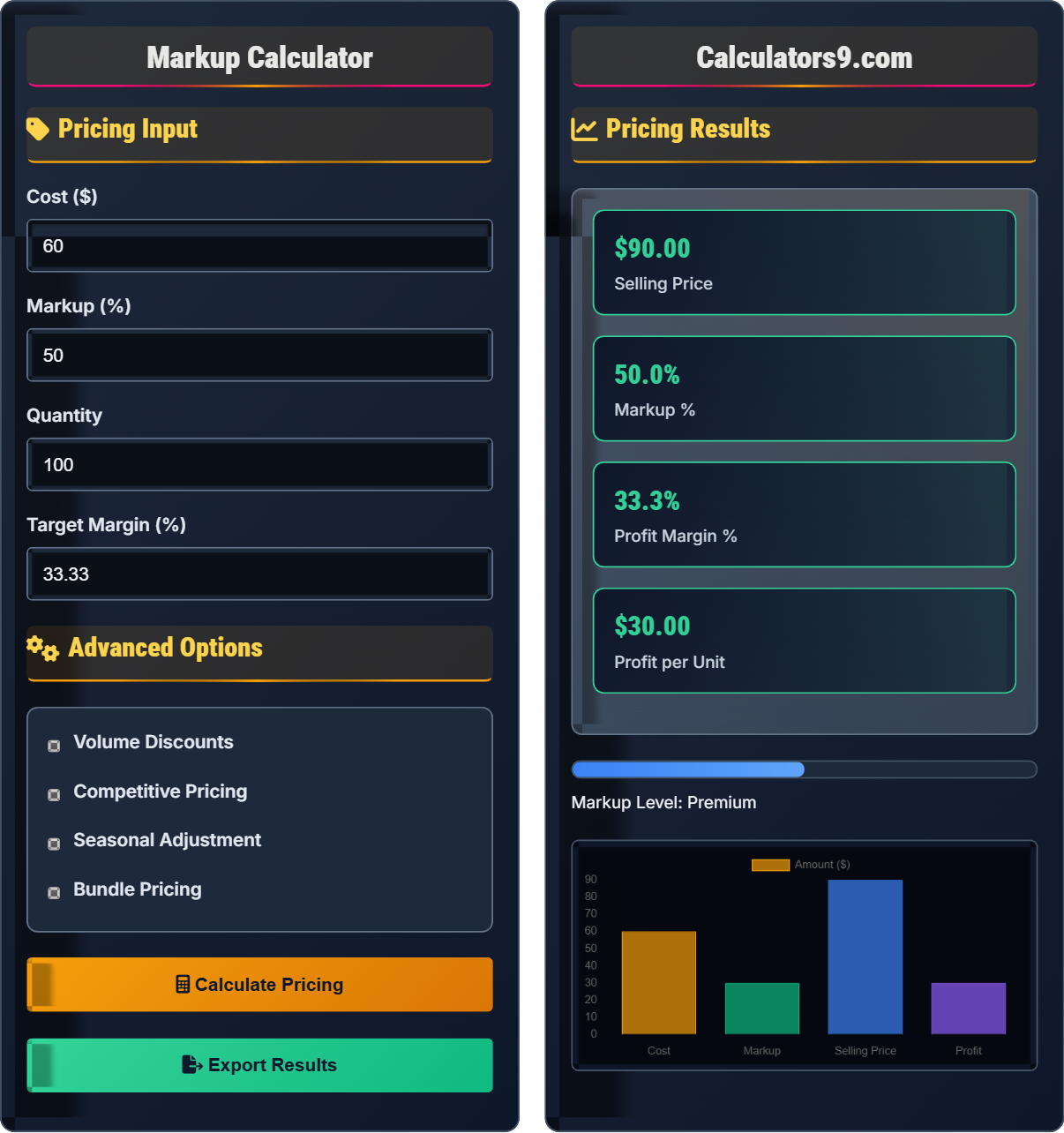
Example: For a product costing $60 with 50% markup:
Selling Price = $60 × (1 + 0.50) = $90
Margin = ($90 - $60) / $90 × 100 = 33.33%
Thus, a 50% markup yields a 33.33% profit margin.
Pricing Input
Advanced Options
Pricing Results
Markup Level: Standard
| Item | Cost | Markup | Selling Price | Profit |
|---|
| Scenario | Price | Markup | Margin | Profit |
|---|
Comprehensive Markup Pricing Guide
Markup is the difference between the cost of a product and its selling price, expressed as a percentage of the cost. It represents the additional amount added to the cost to determine the selling price. Markup is commonly used in retail and manufacturing to ensure profitability. Understanding markup is crucial for setting competitive prices while maintaining healthy profit margins.
The basic markup calculations use the following formulas:
Where:
- Markup is calculated as a percentage of the cost
- Profit Margin is calculated as a percentage of the selling price
- Markup and Margin are related but different concepts
Markup percentages vary significantly across industries:
- Supermarkets: 15-30% markup (high volume, low margin)
- Clothing: 100-200% markup (fashion premium)
- Electronics: 10-30% markup (price-sensitive market)
- Jewelry: 100-400% markup (luxury positioning)
- Restaurants: 300-600% markup (food cost basis)
- Automotive: 5-10% markup (negotiated sales)
- Know Your Costs: Include all direct and indirect costs in your calculation
- Research Competitors: Understand market pricing to remain competitive
- Consider Elasticity: Understand how price changes affect demand
- Test Prices: Experiment with different price points to optimize revenue
- Review Regularly: Adjust prices based on changing costs and market conditions
Markup Fundamentals
Percentage added to cost to determine selling price.
Markup % = \(\frac{\text{Selling Price} - \text{Cost}}{\text{Cost}} \times 100\)
Selling Price = Cost × (1 + Markup %)
- Markup is based on cost
- Margin is based on selling price
- Higher markup doesn't always mean higher profit
Conversion Framework
Markup is cost-based; margin is price-based.
- Markup to Margin: \(\frac{\text{Markup}}{1 + \text{Markup}}\)
- Margin to Markup: \(\frac{\text{Margin}}{1 - \text{Margin}}\)
- Always verify calculations
- Use appropriate rounding
- Same markup yields lower margin
- Always clarify which is being discussed
- Industry may use one term over another
Markup Pricing Learning Quiz
If a retailer uses a 40% markup on cost, what is the equivalent profit margin percentage?
The answer is A) 28.6%. To convert markup to margin, use the formula: Margin = Markup / (1 + Markup). With 40% markup: Margin = 0.40 / (1 + 0.40) = 0.40 / 1.40 = 0.2857 or 28.6%. For example, if cost is $100: Selling Price = $100 × 1.40 = $140; Profit = $140 - $100 = $40; Margin = $40 / $140 = 28.6%.
This problem highlights the difference between markup and margin. Students must understand that markup is calculated on cost while margin is calculated on selling price. The conversion formula shows that markup percentages are always higher than equivalent margin percentages because the denominator (selling price) is larger than cost.
Markup: Percentage added to cost to get selling price
Profit Margin: Percentage of selling price that is profit
Cost: Total expense to acquire or produce the item
• Markup is always higher than equivalent margin
• Same percentage gives different profit amounts
• Clarify which is being used in communication
• Remember: Markup = Cost basis, Margin = Price basis
• Use the conversion formula when switching between them
• Verify with actual numbers to check calculations
• Assuming markup and margin are the same
• Using wrong base for percentage calculation
• Forgetting to convert between markup and margin
Explain how to determine the optimal markup percentage for a new product launch, considering market conditions, competition, and business objectives. Include a mathematical model for analyzing the impact of different markup levels on revenue and profit.
The optimal markup depends on several factors: market demand elasticity, competitor pricing, and business objectives. The revenue optimization model is: Revenue = Price × Quantity = Cost × (1 + Markup) × Quantity(Cost × (1 + Markup)). The optimal markup maximizes profit: Profit = (Price - Cost) × Quantity = Cost × Markup × Quantity. For demand that decreases with price (elastic demand), if quantity = Q₀ × (1 - α × Markup), where α is the sensitivity factor, then: Profit = Cost × Markup × Q₀ × (1 - α × Markup). Taking the derivative and setting to zero: dP/dM = Cost × Q₀ × (1 - 2α × Markup) = 0. Solving: Optimal Markup = 1/(2α). For example, if a 10% price increase reduces demand by 20% (α = 2), optimal markup = 1/(2×2) = 25%. However, if the market is inelastic (α = 0.5), optimal markup = 1/(2×0.5) = 100%.
This problem demonstrates the intersection of economics and mathematics in business decisions. Students learn that optimal pricing isn't just about maximizing markup but finding the balance that maximizes total profit considering demand elasticity. The mathematical model shows how calculus applies to business optimization problems.
Demand Elasticity: Sensitivity of quantity demanded to price changes
Optimal Pricing: Price that maximizes profit or revenue
Price Sensitivity: How demand responds to price changes
• Higher elasticity requires lower markup
• Market research guides elasticity estimates
• Business objectives may override pure optimization
• Start with industry benchmarks
• Test different markups in small markets
• Monitor competitor responses
• Ignoring market demand elasticity
• Setting markup without considering competition
• Not adjusting for market changes
FAQ
Q: How do I handle multiple markups in a distribution chain?
A: In a distribution chain, each level typically adds its own markup. If the manufacturer has a 20% markup and the retailer adds 50%, the final price is: Final Price = Cost × (1 + M₁) × (1 + M₂). For example, if manufacturing cost is $50: Manufacturer price = $50 × 1.20 = $60; Retail price = $60 × 1.50 = $90. The overall markup from cost to consumer is ($90 - $50)/$50 = 80%. However, the effective markup at each stage is different: Manufacturer's margin = ($60 - $50)/$60 = 16.67%; Retailer's margin = ($90 - $60)/$90 = 33.33%. The combined effect is multiplicative, not additive.
Q: What's the difference between markup and gross margin?
A: While often used interchangeably, markup and gross margin have distinct meanings. Markup is calculated as: (Selling Price - Cost) / Cost, while Gross Margin is: (Selling Price - Cost) / Selling Price. For example, if an item costs $80 and sells for $100: Markup = ($100 - $80) / $80 = 25%; Gross Margin = ($100 - $80) / $100 = 20%. The key difference is the denominator: markup uses cost, gross margin uses selling price. This creates a relationship where markup % = Gross Margin % / (1 - Gross Margin %) and Gross Margin % = Markup % / (1 + Markup %).