ROI Marketing Calculator
Marketing ROI calculator • 2026 metrics
Marketing ROI Formulas:
Show the calculator\( ROI = \frac{\text{Revenue from Marketing} - \text{Marketing Investment}}{\text{Marketing Investment}} \times 100 \)
\( ROAS = \frac{\text{Revenue from Marketing}}{\text{Marketing Investment}} \)
\( CPA = \frac{\text{Marketing Investment}}{\text{New Customers Acquired}} \)
\( LTV:CAC = \frac{\text{Customer Lifetime Value}}{\text{Customer Acquisition Cost}} \)
Where:
- ROI = Return on Investment percentage
- ROAS = Return on Ad Spend ratio
- CPA = Cost Per Acquisition
- LTV:CAC = Customer Lifetime Value to Acquisition Cost ratio
These formulas calculate marketing effectiveness, campaign performance, and customer acquisition efficiency.
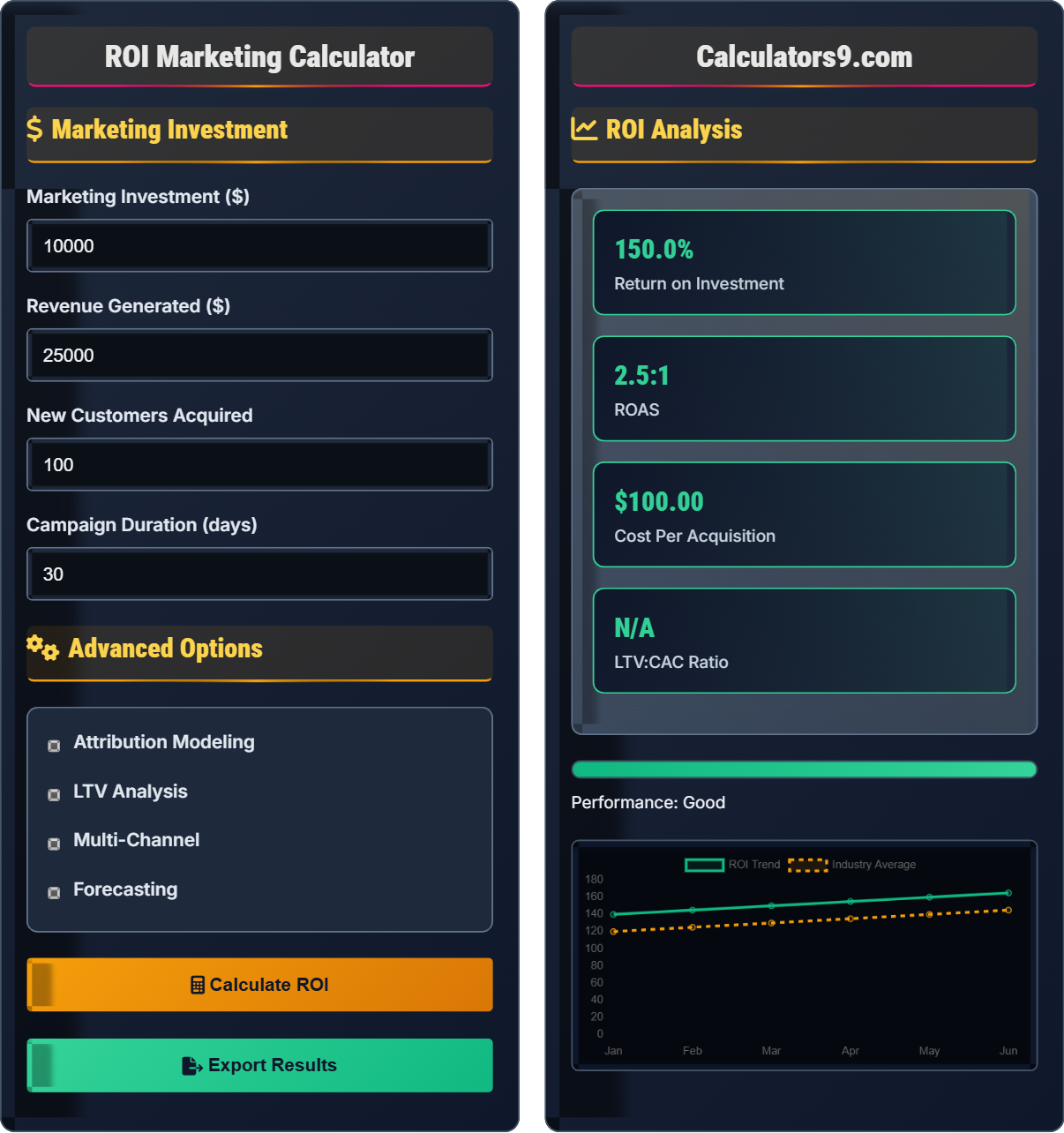
Example: For a campaign with $10,000 investment generating $25,000 revenue:
\( ROI = \frac{25,000 - 10,000}{10,000} \times 100 = 150\% \)
\( ROAS = \frac{25,000}{10,000} = 2.5:1 \)
Thus, the campaign generated 150% ROI with a 2.5:1 ROAS ratio.
Marketing Investment
Advanced Options
ROI Analysis
Performance: Excellent
| Metric | Formula | Value | Industry Benchmark | Interpretation |
|---|
| Channel | Investment | Revenue | ROI | Efficiency |
|---|
Comprehensive Marketing ROI Guide
Marketing ROI (Return on Investment) measures the profitability of marketing investments by comparing the revenue generated to the costs incurred. It's a critical metric for evaluating marketing effectiveness, optimizing budget allocation, and demonstrating marketing value to stakeholders. Marketing ROI helps businesses understand which campaigns, channels, and strategies deliver the best returns, enabling data-driven decision-making for marketing investments.
The basic marketing ROI calculations use the following formulas:
Where:
- Revenue from Marketing = Direct revenue attributed to marketing campaigns
- Marketing Investment = Total cost of marketing activities
- ROAS = Return on Ad Spend (revenue per dollar spent)
- CPA = Cost Per Acquisition of new customers
Marketing ROI expectations vary by industry and channel:
- E-commerce: 300-500% ROI, 4:1 ROAS minimum
- SaaS: 500-1200% ROI, 6:1 ROAS for growth
- Lead Generation: 200-400% ROI, 3:1 ROAS
- Search Ads: 200-300% ROI, 3:1 ROAS
- Social Media: 150-250% ROI, 2.5:1 ROAS
- Email Marketing: 4400% ROI, 44:1 ROAS
- Focus on High-Value Segments: Target audiences with higher LTV potential
- Improve Attribution: Use more sophisticated models to allocate credit accurately
- Optimize Customer Journey: Remove friction and improve conversion paths
- Retargeting Strategies: Re-engage prospects with personalized messaging
- Marketing Mix Optimization: Balance spend across channels for maximum impact
- Data-Driven Decisions: Use analytics to inform strategy and budget allocation
ROI Fundamentals
Measure of profitability from marketing investments.
ROI = \(\frac{\text{Revenue} - \text{Investment}}{\text{Investment}} \times 100\)
ROAS = \(\frac{\text{Revenue}}{\text{Investment}}\)
- Higher ROI indicates better performance
- Context and benchmarks provide meaning
- Attribution affects ROI calculation
Analysis Framework
ROI measures profit; ROAS measures revenue efficiency.
- Track marketing investment
- Attribute revenue to campaigns
- Calculate ROI metrics
- Compare to benchmarks
- Attribution model affects results
- Time horizons impact measurements
- Indirect effects may be missed
Marketing ROI Learning Quiz
A marketing campaign costs $5,000 and generates $15,000 in revenue. What is the ROI?
The answer is A) 200%. To calculate ROI: ROI = (Revenue - Investment) / Investment × 100 = ($15,000 - $5,000) / $5,000 × 100 = $10,000 / $5,000 × 100 = 2 × 100 = 200%. The campaign generated $10,000 in profit on a $5,000 investment, which represents a 200% return on investment. ROI measures the profit relative to the investment, not the total return.
This problem demonstrates the fundamental ROI calculation. Students must understand that ROI measures the profit earned relative to the investment made. The formula is: ROI = (Profit / Investment) × 100. In this case, the profit is $10,000 ($15,000 - $5,000), and the investment is $5,000, resulting in a 200% ROI. This represents a 2:1 profit-to-investment ratio.
ROI: Return on Investment - profit relative to investment
Revenue: Total income generated from marketing
Investment: Total cost of marketing activities
• ROI measures profit relative to investment
• Positive ROI indicates profitable investment
• Compare to industry benchmarks
• Remember: ROI = (Revenue - Cost) / Cost
• Convert to percentage by multiplying by 100
• Compare to alternative investments
• Using revenue instead of profit in numerator
• Not considering time value of money
Explain how different attribution models affect marketing ROI calculations and business decision-making. Include the mathematical framework for each model and discuss the strategic implications of choosing one model over another.
Attribution models distribute conversion credit across touchpoints differently, affecting ROI calculations. Last-click attribution: ROI_i = (Revenue_i / Investment_i) where only final touchpoint gets credit. Linear attribution: ROI_i = (Revenue_total × 1/n_touchpoints) / Investment_i where credit is distributed equally. Time-decay attribution: ROI_i = (Revenue_total × w_i) / Investment_i where weights w_i = (time_since_last_click)^k for decay parameter k. Position-based attribution: ROI_i = (Revenue_total × p_i) / Investment_i where first/last positions get 40% each, middle positions share 20%. For example, if a customer journey has Touchpoint A ($100 spend, 30% influence), Touchpoint B ($200 spend, 50% influence), Touchpoint C ($150 spend, 20% influence) generating $1,000 revenue: Last-click ROI_C = ($1,000 - $150) / $150 = 567%. Linear ROI_A = ($1,000×0.33 - $100) / $100 = 233%. The mathematical models show how credit distribution affects perceived channel performance. Strategic implications: Last-click may over-invest in bottom-funnel channels; first-click may over-invest in awareness; linear treats all channels equally regardless of actual influence. The choice affects budget allocation, channel strategy, and performance optimization. A comprehensive approach uses multiple models to understand different aspects of the customer journey.
This problem demonstrates how attribution modeling affects marketing evaluation. Students learn that the same customer journey can yield different ROI values depending on how credit is assigned to touchpoints. The mathematical framework shows how different weighting schemes alter performance perceptions, impacting strategic decisions.
Attribution Model: Method for assigning conversion credit to touchpoints
Touchpoint: Any interaction point in customer journey
Conversion Credit: Value attributed to each touchpoint
• Attribution affects ROI calculations
• Different models favor different channels
• Use multiple models for comprehensive view
• Test different attribution models
• Consider customer journey complexity
• Align attribution with business goals
• Using single attribution model exclusively
• Not considering journey complexity
• Misaligning attribution with business model
FAQ
Q: How do I calculate ROI for long-term marketing initiatives that don't have immediate revenue impact?
A: For long-term initiatives, use the Customer Lifetime Value (CLV) approach: ROI = (CLV × Customers_Attributed - Marketing_Investment) / Marketing_Investment × 100. Calculate CLV using: CLV = (Average_Order_Value × Purchase_Frequency × Retention_Period) × Gross_Margin. For brand awareness campaigns, track intermediate metrics like brand recall, consideration, or pipeline value. The formula becomes: ROI = (Pipeline_Value × Conversion_Rate_to_Revenue - Marketing_Investment) / Marketing_Investment × 100. For example, if a brand campaign generates $500K in qualified pipeline with 20% conversion rate: Pipeline_Value = $500K × 0.20 = $100K. If investment was $20K: ROI = ($100K - $20K) / $20K × 100 = 400%. The mathematical model incorporates time value of money: NPV = Σ(Cash_Flow_t / (1+r)^t) - Initial_Investment, where r is discount rate. This allows comparison of long-term investments with immediate returns.
Q: What's the difference between ROI and ROAS?
A: ROI (Return on Investment) measures profit relative to investment: ROI = (Revenue - Investment) / Investment × 100. ROAS (Return on Ad Spend) measures revenue efficiency: ROAS = Revenue / Investment. For example, with $1,000 investment generating $3,000 revenue: ROI = ($3,000 - $1,000) / $1,000 × 100 = 200%. ROAS = $3,000 / $1,000 = 3:1. The mathematical relationship is: ROI = (ROAS - 1) × 100, and ROAS = (ROI / 100) + 1. ROI measures profitability (whether you made money), while ROAS measures efficiency (how much revenue per dollar spent). A 3:1 ROAS means $3 revenue per $1 spent, while 200% ROI means you made 2x your investment in profit. Both metrics are important: ROAS helps optimize for revenue efficiency, while ROI ensures profitability. The conversion formulas are: From ROAS to ROI: ROI = (ROAS - 1) × 100. From ROI to ROAS: ROAS = (ROI / 100) + 1.