CPC Calculator
Fast cost per click calculator • 2026 rates
CPC Formula:
Show the calculator\( CPC = \frac{Total\ Cost}{Total\ Clicks} \)
Where:
- \( CPC \) = Cost Per Click
- \( Total\ Cost \) = Total advertising spend
- \( Total\ Clicks \) = Total number of clicks generated
Alternative formulas:
\( Total\ Cost = CPC \times Total\ Clicks \)
\( Total\ Clicks = \frac{Total\ Cost}{CPC} \)
This formula calculates the average cost of each click generated by an advertisement.
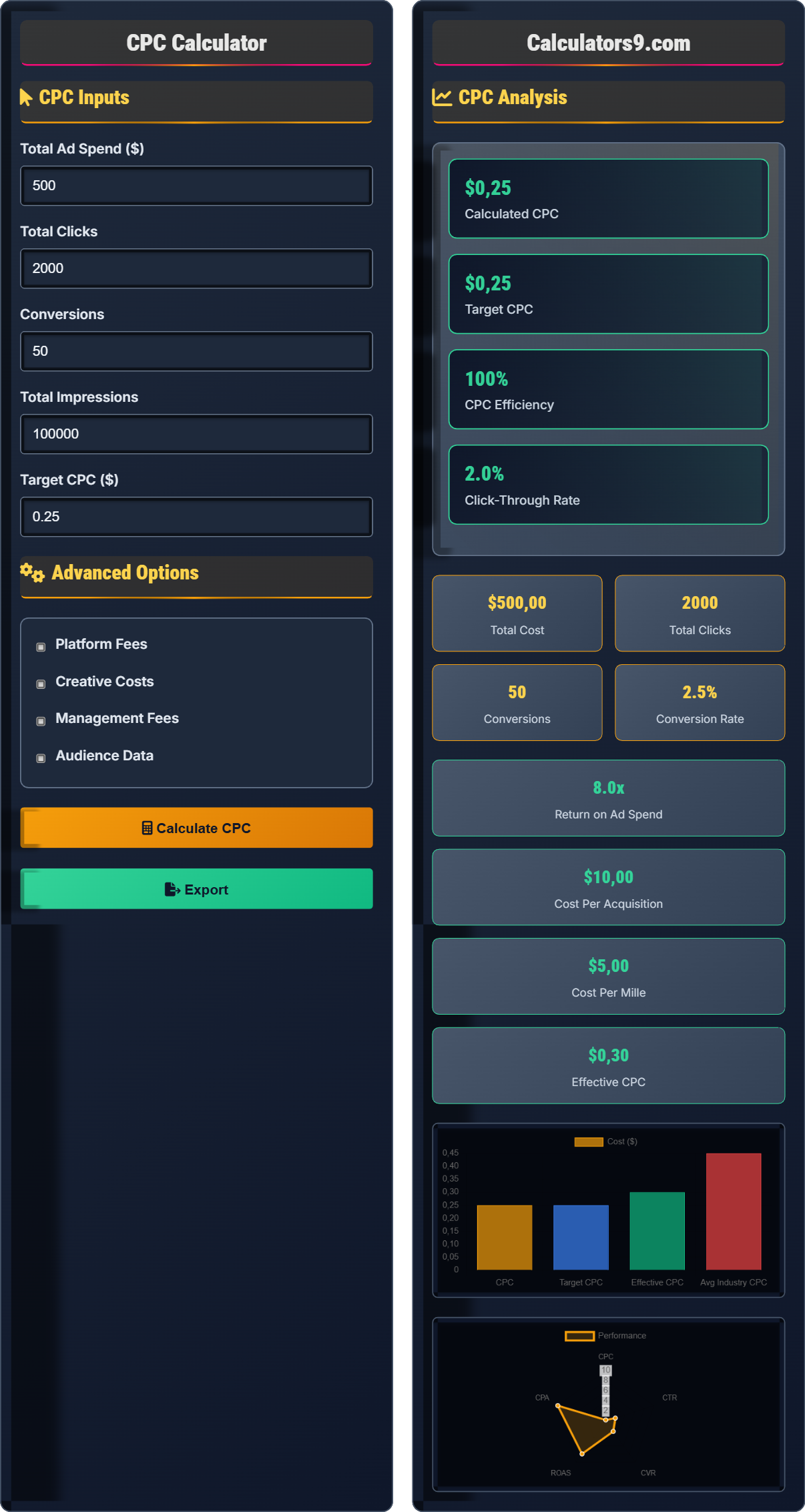
Example: Spending $500 and receiving 2,000 clicks:
\( CPC = \frac{500}{2000} = \$0.25 \)
So it costs $0.25 per click on average for this campaign.
CPC Inputs
Advanced Options
CPC Analysis
Comprehensive CPC Guide
CPC (Cost Per Click) is a metric used in online advertising to measure the cost of each click generated by an advertisement. It's a popular pricing model where advertisers pay only when users click on their ads, making it performance-based rather than impression-based like CPM.
The fundamental CPC calculation uses the following formula:
Where:
- \(CPC\) = Cost Per Click
- \(Total\ Cost\) = Total advertising spend
- \(Total\ Clicks\) = Total number of clicks generated
CPC campaigns should be evaluated alongside other key metrics:
- CTR (Click-Through Rate): Percentage of impressions that resulted in clicks
- CPA (Cost Per Acquisition): Cost for each conversion or goal completion
- ROAS (Return on Ad Spend): Revenue generated per dollar spent
- Conversion Rate: Percentage of clicks that resulted in conversions
- Quality Score: Search engine rating of ad relevance and quality
- Keyword Research: Target high-intent, lower competition keywords
- Ad Quality: Improve ad relevance and landing page experience
- Bid Adjustment: Optimize bids based on time, location, and device
- Negative Keywords: Prevent clicks from irrelevant searches
- Landing Page Optimization: Improve conversion rates for better ROI
CPC Basics
Cost per click in advertising.
\(CPC = \frac{Total\ Cost}{Total\ Clicks}\)
Where CPC=cost per click, Cost=total spend, Clicks=clicks received.
- Lower CPC is generally better
- Quality affects CPC rates
- Competition impacts CPC
Strategies
Focus on improving click quality and conversion rates.
- Improve ad relevance
- Optimize landing pages
- Use negative keywords
- Test different ad copy
- Industry benchmarks vary
- Seasonal fluctuations
- Competition affects rates
- Quality score matters
CPC Learning Quiz
What does CPC stand for in digital advertising?
The answer is B) Cost Per Click. CPC stands for "Cost Per Click," which is a pricing model in digital advertising where advertisers pay each time a user clicks on their ad. This is different from CPM (Cost Per Mille), which charges per 1,000 impressions regardless of clicks.
Understanding digital advertising terminology is crucial for effective campaign management. CPC is a performance-based model that focuses on driving traffic to your website or landing page. The key difference from CPM is that you only pay when users engage with your ad by clicking, making it more directly tied to user interest and intent.
CPC: Cost Per Click - payment model based on clicks received
CPM: Cost Per Mille - payment model based on impressions
Click: User interaction with an advertisement
• CPC = Total Cost ÷ Total Clicks
• Lower CPC indicates better efficiency
• Compare CPC across similar campaigns
• Remember: C=Cost, P=Per, C=Click
• CPC is ideal for traffic generation campaigns
• Consider CTR along with CPC for complete picture
• Confusing CPC with CPM (Cost Per Impression)
• Not adjusting for conversion quality
• Ignoring other performance metrics
If an advertiser spends $300 and receives 1,200 clicks, what is the CPC?
Using the CPC formula: \(CPC = \frac{Total\ Cost}{Total\ Clicks}\)
Given:
- Total Cost = $300
- Total Clicks = 1,200
Step 1: Divide total cost by total clicks = $300 ÷ 1,200 = $0.25
Therefore, the CPC is $0.25, meaning it costs $0.25 per click on average.
This calculation shows the fundamental relationship between spending and traffic generation. A CPC of $0.25 means for every dollar spent, the advertiser receives 4 clicks on average. This metric allows advertisers to compare the efficiency of different campaigns, keywords, or targeting strategies. The key insight is that CPC represents the cost efficiency of acquiring traffic.
Cost Efficiency: How effectively spending generates traffic
Traffic Generation: Driving visitors to a website
Click: Each instance of user engagement
• CPC is calculated as total cost divided by total clicks
• Lower CPC indicates better traffic acquisition efficiency
• Consider CPC alongside conversion metrics
• Practice with simple numbers to understand the concept
• Remember: CPC measures traffic cost efficiency
• Compare CPC across similar campaign parameters
• Dividing clicks by cost instead of cost by clicks
• Not considering click quality
• Ignoring conversion potential of clicks
Campaign A spends $1,000 and gets 2,500 clicks. Campaign B spends $800 and gets 1,600 clicks. Which campaign has better CPC efficiency? If Campaign A wants to achieve the same CPC as Campaign B while getting 3,000 clicks, how much should they spend?
Step 1: Calculate CPC for Campaign A = $1,000 ÷ 2,500 = $0.40
Step 2: Calculate CPC for Campaign B = $800 ÷ 1,600 = $0.50
Step 3: Campaign A has better efficiency at $0.40 CPC vs $0.50 CPC
Step 4: To match Campaign A's CPC with 3,000 clicks:
Required spend = CPC × Clicks = $0.40 × 3,000 = $1,200
Therefore, Campaign A is more efficient, and they would need to spend $1,200 to get 3,000 clicks at their current $0.40 CPC.
This example demonstrates how CPC enables cross-campaign comparisons. Even though Campaign B spent less in absolute terms, Campaign A achieved a lower cost per click, indicating better efficiency. Understanding this allows advertisers to make informed decisions about where to allocate their budgets for maximum traffic efficiency.
Cost Efficiency: Measure of how effectively resources achieve traffic goals
Traffic Comparison: Evaluating different campaigns for traffic generation
Budget Allocation: Distributing spending across campaigns
• CPC allows cross-campaign comparison
• Lower CPC indicates better efficiency
• Consider other metrics alongside CPC
• Always calculate CPC when comparing different campaigns
• Consider traffic quality differences
• Factor in conversion potential
• Comparing absolute costs instead of CPC
• Ignoring traffic quality differences
• Not considering conversion metrics
A marketing manager has a $2,000 budget for a campaign with a target CPC of $0.20. Initially, they get 8,000 clicks at a CPC of $0.25. They optimize the campaign and achieve a 20% improvement in CPC efficiency. Calculate the new CPC, clicks received with the same budget, and additional clicks gained compared to the original performance.
Original performance:
Original CPC = $0.25
Original clicks = 8,000
Original spend = $2,000
After 20% efficiency improvement:
New CPC = $0.25 × (1 - 0.20) = $0.25 × 0.80 = $0.20
With same budget of $2,000:
New clicks = Budget ÷ New CPC = $2,000 ÷ $0.20 = 10,000 clicks
Additional clicks = 10,000 - 8,000 = 2,000 clicks
Therefore, optimization improved CPC from $0.25 to $0.20, increasing clicks from 8K to 10K, gaining 2,000 additional clicks.
This demonstrates the significant impact of CPC optimization. A 20% improvement in efficiency allowed the same budget to generate 25% more clicks. This shows why optimizing targeting, ad quality, and bidding strategies is crucial in digital advertising. The relationship between CPC efficiency and traffic volume is inverse and proportional.
CPC Optimization: Improving cost efficiency of ad campaigns
Traffic Potential: Maximum visitors accessible with given budget
Efficiency Gain: Improvement in cost-effectiveness
• Better CPC = more clicks for same budget
• Small efficiency improvements have large impacts
• Continuous optimization is essential
• A/B test different ad copy
• Monitor CPC trends over time
• Compare CPC across different targeting options
• Not tracking CPC performance over time
• Focusing only on CPC without considering conversions
• Ignoring seasonal CPC variations
Which of the following factors would most likely cause CPC rates to be higher?
The answer is B) High competition for keywords. When many advertisers compete for the same high-value keywords, the auction dynamics drive up the cost per click. This is because the cost per click is determined by an auction system where advertisers bid against each other for ad placement.
CPC rates are primarily driven by supply and demand in the auction system. When demand exceeds supply (many advertisers bidding for the same keywords), prices increase. Factors like ad relevance, quality score, and negative keywords typically help reduce CPC, while competition increases it. Understanding these dynamics helps plan advertising strategies effectively.
Supply and Demand: Economic principle affecting ad pricing
Auction System: Method of determining ad placement costsCompetition: Number of advertisers bidding for same keywords
• More competition = Higher CPC
• Better quality score = Lower CPC
• Relevant ads = Lower CPC
• Target long-tail keywords with less competition
• Improve quality score through ad relevance
• Use negative keywords to reduce irrelevant clicks
• Not accounting for keyword competition levels
• Expecting consistent CPC rates across all keywords
• Failing to improve quality score
FAQ
Q: What's the difference between CPC and CPM?
A: CPC (Cost Per Click) and CPM (Cost Per Mille) are different pricing models:
- CPC: Pay only when someone clicks your ad. Best for traffic generation.
- CPM: Pay for every 1,000 impressions regardless of engagement. Best for brand awareness.
Formula comparison:
\( CPC = \frac{Cost}{Clicks} \)
\( CPM = \frac{Cost}{Impressions} \times 1000 \)
Choose CPC for action-oriented campaigns, CPM for reach and frequency goals.
Q: What is a good CPC benchmark for my industry?
A: CPC benchmarks vary significantly by industry, platform, and targeting:
- Google Ads Search: $1.00 - $3.00
- Google Ads Display: $0.50 - $2.00
- Facebook Ads: $0.50 - $2.00
- LinkedIn Ads: $2.00 - $8.00
More specific benchmarks:
- Retail: $0.45 - $1.50
- Travel: $0.85 - $2.50
- Finance: $1.25 - $3.50
- Healthcare: $1.00 - $3.00
Focus on your campaign's performance relative to your specific goals and ROI rather than just industry averages.