Energy Efficiency Calculator
Sustainable energy savings • 2026 edition
Energy Efficiency Formula:
Show Calculator\( EE = \frac{E_1 - E_2}{E_1} \times 100 \)
Where:
- \( EE \) = Energy efficiency improvement percentage
- \( E_1 \) = Original energy consumption (kWh/month)
- \( E_2 \) = New energy consumption after improvements (kWh/month)
This formula calculates the percentage reduction in energy consumption achieved through efficiency improvements. It can also be expressed as energy savings: \( ES = E_1 - E_2 \), representing the absolute energy saved per time period.
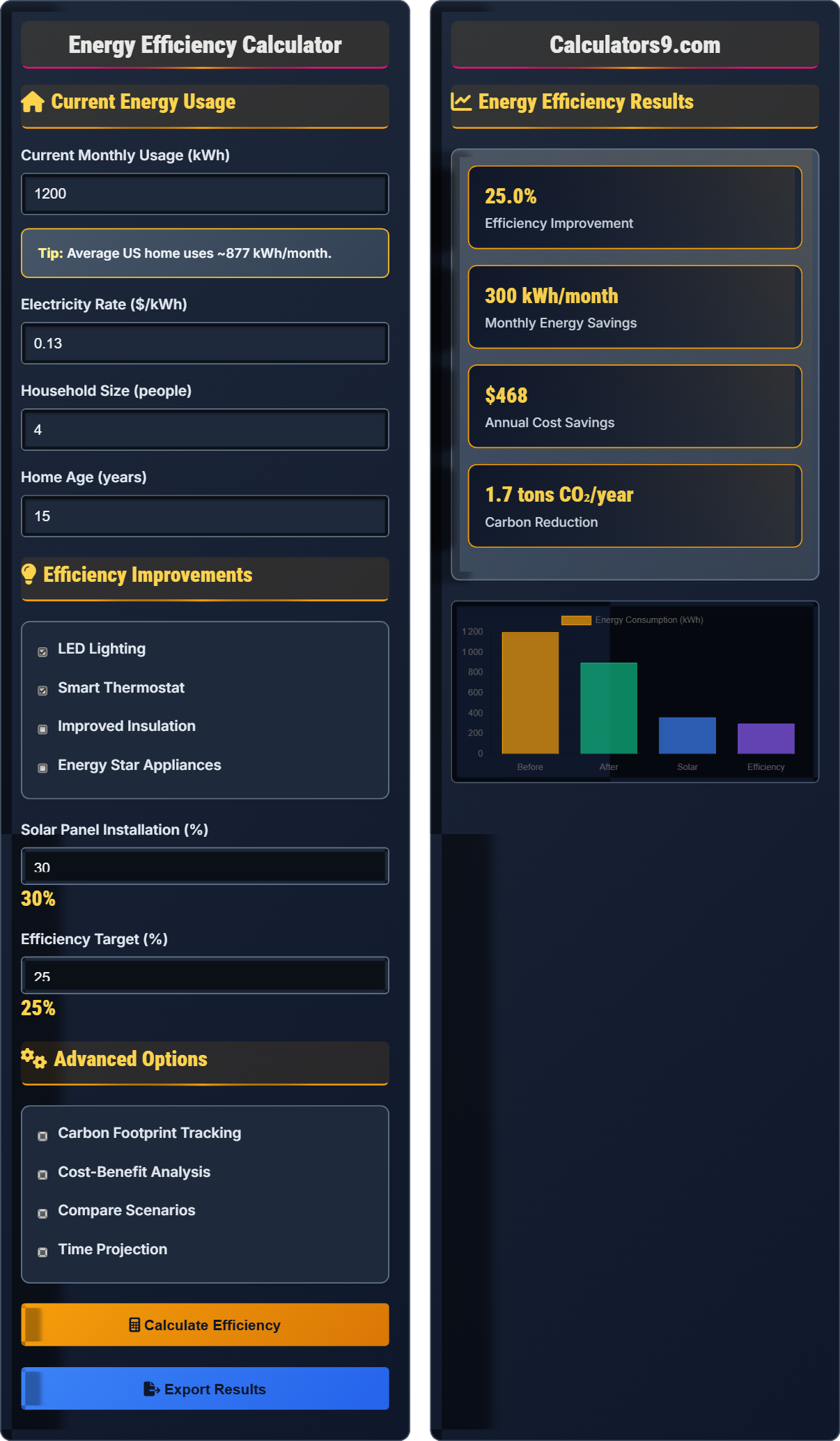
Example: For a home consuming 1200 kWh/month before improvements (\( E_1 = 1200 \)) and 900 kWh/month after (\( E_2 = 900 \)):
\( EE = \frac{1200 - 900}{1200} \times 100 = 25\% \)
Therefore, the energy efficiency improvement is 25%, saving 300 kWh/month.
Current Energy Usage
Efficiency Improvements
Advanced Options
Energy Efficiency Results
| Improvement | Reduction | Monthly Savings | Annual Savings |
|---|
| Benefit | Amount | Equivalent |
|---|
Energy Efficiency Guide
Energy efficiency refers to using less energy to perform the same task or deliver the same service. It involves improving systems, equipment, and behaviors to reduce energy consumption while maintaining or improving performance. Energy efficiency is one of the most cost-effective ways to reduce greenhouse gas emissions and lower utility bills.
The energy efficiency improvement is calculated using the following formula:
Where:
- \(EE\) = Energy efficiency improvement percentage
- \(E_1\) = Original energy consumption (kWh/month)
- \(E_2\) = New energy consumption after improvements (kWh/month)
Energy efficiency provides significant environmental benefits:
- Reduced Emissions: Less energy demand means fewer fossil fuels burned
- Resource Conservation: Preserves natural resources for future generations
- Air Quality Improvement: Reduces pollutants from power plants
- Climate Change Mitigation: Lowers greenhouse gas emissions
- Economic Growth: Creates jobs in green technology sectors
- Behavioral Changes: Turn off lights, unplug devices, adjust thermostat
- Equipment Upgrades: Replace old appliances with efficient models
- Building Improvements: Insulate, seal air leaks, upgrade windows
- Smart Technology: Automate lighting and temperature controls
- Renewable Integration: Combine efficiency with solar/wind power
Energy Efficiency Quiz
What is the primary goal of energy efficiency improvements?
The answer is B) Use less energy to perform the same task. Energy efficiency is about achieving the same results (lighting, heating, cooling, etc.) with less energy input. This differs from energy conservation (doing less) and renewable energy (different source).
Energy efficiency is often confused with energy conservation, but they are distinct concepts. Efficiency focuses on technological improvements to reduce energy intensity, while conservation involves behavioral changes to reduce energy use. Both approaches are important for sustainability.
Energy Efficiency: Using less energy to perform the same function
Energy Conservation: Reducing energy use through behavioral changes
Energy Intensity: Amount of energy required per unit of output
• Efficiency maintains or improves performance while reducing energy
• Technological improvements drive efficiency gains
• Efficiency and conservation can work together
• Remember: efficiency = same output, less energy
• Look for Energy Star labels on appliances
• Confusing efficiency with conservation
• Assuming efficiency always requires expensive upgrades
Calculate the energy efficiency improvement if a home's monthly consumption drops from 1,200 kWh to 900 kWh. Show your work.
Using the formula: \(EE = \frac{E_1 - E_2}{E_1} \times 100\)
Given:
- \(E_1\) = 1,200 kWh (original consumption)
- \(E_2\) = 900 kWh (new consumption)
Calculation: \(EE = \frac{1200 - 900}{1200} \times 100 = \frac{300}{1200} \times 100 = 0.25 \times 100 = 25\%\)
Therefore, the energy efficiency improvement is 25%.
This calculation shows the percentage reduction in energy consumption. The formula compares the energy saved to the original consumption level. A 25% improvement means the home now uses only 75% of its original energy for the same functions.
Energy Efficiency Improvement: Percentage reduction in energy use
Energy Savings: Absolute amount of energy reducedBaseline Consumption: Original energy usage before improvements
• Always divide by original consumption in efficiency calculations
• Efficiency improvement is expressed as a percentage
• Energy savings is the absolute difference
• Remember: \(\frac{\text{Savings}}{\text{Original}} \times 100\)
• Verify: New consumption should be less than original
• Dividing by new consumption instead of original
• Forgetting to multiply by 100 to get percentage
A family reduces their monthly electricity consumption from 1,000 kWh to 750 kWh after implementing efficiency measures. If electricity costs $0.12 per kWh, calculate their monthly and annual cost savings.
Step 1: Calculate energy savings = 1,000 - 750 = 250 kWh/month
Step 2: Calculate monthly savings = 250 kWh × $0.12/kWh = $30/month
Step 3: Calculate annual savings = $30/month × 12 months = $360/year
Therefore, the family saves $30 monthly and $360 annually.
This example demonstrates the financial benefits of energy efficiency. The calculation converts energy savings to monetary savings using the electricity rate. This helps justify efficiency investments by showing clear cost returns.
Utility Rate: Cost per unit of energy consumed
Return on Investment: Financial benefit compared to cost
Payback Period: Time to recover investment cost
• Multiply energy savings by utility rate for cost savings
• Annual savings = monthly savings × 12
• Higher utility rates increase savings value
• Check your utility bill for current rate
• Time-of-use rates affect savings differently
• Forgetting to account for seasonal variations in rates
• Confusing monthly and annual calculations
A business reduces its annual energy consumption by 50,000 kWh. If the local electricity grid produces 0.8 lbs CO₂ per kWh, calculate the annual carbon reduction in tons. (Note: 1 ton = 2,000 lbs)
Step 1: Calculate total carbon reduction = 50,000 kWh × 0.8 lbs CO₂/kWh = 40,000 lbs CO₂
Step 2: Convert to tons = 40,000 lbs ÷ 2,000 lbs/ton = 20 tons CO₂
Therefore, the business reduces carbon emissions by 20 tons annually.
This demonstrates the environmental impact of energy efficiency. The carbon factor varies by region depending on the electricity mix (coal, gas, renewables). Efficiency improvements have a direct, measurable impact on greenhouse gas emissions.
Carbon Factor: Emissions per unit of energy consumed
Grid Mix: Proportion of different energy sources in electricity supply
Carbon Footprint: Total greenhouse gas emissions
• Multiply energy savings by carbon factor for emissions reduction
• Convert units appropriately (lbs to tons)
• Regional carbon factors vary significantly
• Research your local grid's carbon factor
• Renewable energy areas have lower carbon factors
• Forgetting to convert pounds to tons
• Using national average instead of local carbon factor
Which factor has the greatest impact on the return on investment for energy efficiency improvements?
The answer is D) All of the above. Return on investment (ROI) for energy efficiency is calculated as: ROI = (Annual Savings / Initial Cost) × 100. All three factors directly affect this calculation: higher energy savings and electricity rates increase annual savings, while lower initial costs improve the ROI. The payback period is calculated as: Initial Cost ÷ Annual Savings.
This question highlights the multi-factor nature of energy efficiency economics. The ROI formula shows that all three variables interact to determine financial returns. For example, a $1,000 improvement that saves $200/year has a 20% ROI, while the same cost saving $400/year has a 40% ROI.
Return on Investment (ROI): Financial benefit relative to cost
Payback Period: Time to recover initial investment
Net Present Value: Total value of future savings in today's dollars
• ROI = (Annual Savings / Initial Cost) × 100
• Higher savings increase ROI
• Lower costs improve ROI
• Calculate simple payback first: Cost ÷ Annual Savings
• Consider utility rebates that reduce effective costs
• Ignoring electricity rate when estimating savings
• Not accounting for installation costs in ROI
Energy Efficiency Basics
Using less energy to perform the same task or deliver the same service.
\(EE = \frac{E_1 - E_2}{E_1} \times 100\)
Where EE=efficiency improvement, E1=original consumption, E2=new consumption.
- Always divide by original consumption
- Efficiency is expressed as percentage
- Higher savings mean better efficiency
Eco Strategies
Technological improvements and behavioral changes to reduce energy use.
- Equipment upgrades
- Building improvements
- Smart technology
- Behavioral changes
- Initial investment costs
- Payback period
- Local utility rates
- Regional carbon factors
FAQ
Q: How accurate are energy efficiency calculations?
A: Energy efficiency calculations provide reliable estimates based on standardized methods. The formula \( EE = \frac{E_1 - E_2}{E_1} \times 100 \) accurately measures improvement when comparing actual energy consumption:
Where \( EE \) is efficiency improvement, \( E_1 \) is original consumption, and \( E_2 \) is consumption after improvements.
For example, if a home consumed \( E_1 = 1{,}200 \) kWh/month before improvements and \( E_2 = 900 \) kWh/month after, the calculation would be:
\( EE = \frac{1{,}200 - 900}{1{,}200} \times 100 = \frac{300}{1{,}200} \times 100 = 25\% \)
Actual results may vary based on weather, occupancy changes, and equipment performance. However, these calculations provide valuable guidance for energy efficiency planning and investment decisions.
Q: What are the business benefits of energy efficiency?
A: Energy efficiency provides multiple business benefits:
- Cost Reduction: Direct reduction in utility expenses
- Competitive Advantage: Lower operational costs
- Regulatory Compliance: Meeting energy efficiency standards
- Brand Enhancement: Demonstrating corporate responsibility
- Asset Value: Improved property valuations
For example, if a business reduces energy consumption by 100,000 kWh annually at a rate of $0.12/kWh, the direct savings would be \( 100{,}000 \times 0.12 = \$12{,}000 \) annually. If the electricity carbon factor is 0.8 lbs CO₂/kWh, the environmental benefit would be \( 100{,}000 \times 0.8 \div 2{,}000 = 40 \) tons CO₂ reduction.
These combined benefits make energy efficiency a strategic advantage for businesses.