Waste Reduction Calculator
Eco-friendly waste management • 2026 edition
Waste Reduction Formula:
Show Calculator\( WR = \sum{(W_i \times R_i \times C_i)} \)
Where:
- \( WR \) = Total waste reduction
- \( W_i \) = Weekly waste generation for item i
- \( R_i \) = Reduction factor for action applied to item i
- \( C_i \) = Carbon footprint coefficient for item i
This formula calculates the environmental impact reduction achieved through various waste management practices. The reduction factor represents efficiency of each action (recycling, composting, reusing), while the carbon footprint coefficient quantifies environmental benefit per unit of waste diverted.
Example: For 10 lbs of plastic waste (\( W_p = 10 \)) with 80% recycling efficiency (\( R_p = 0.8 \)) and carbon coefficient of 1.5 kg CO₂/lb (\( C_p = 1.5 \)):
\( WR_p = 10 \times 0.8 \times 1.5 = 12 \) kg CO₂ saved
Thus, recycling 10 lbs of plastic would prevent 12 kg of CO₂ emissions.
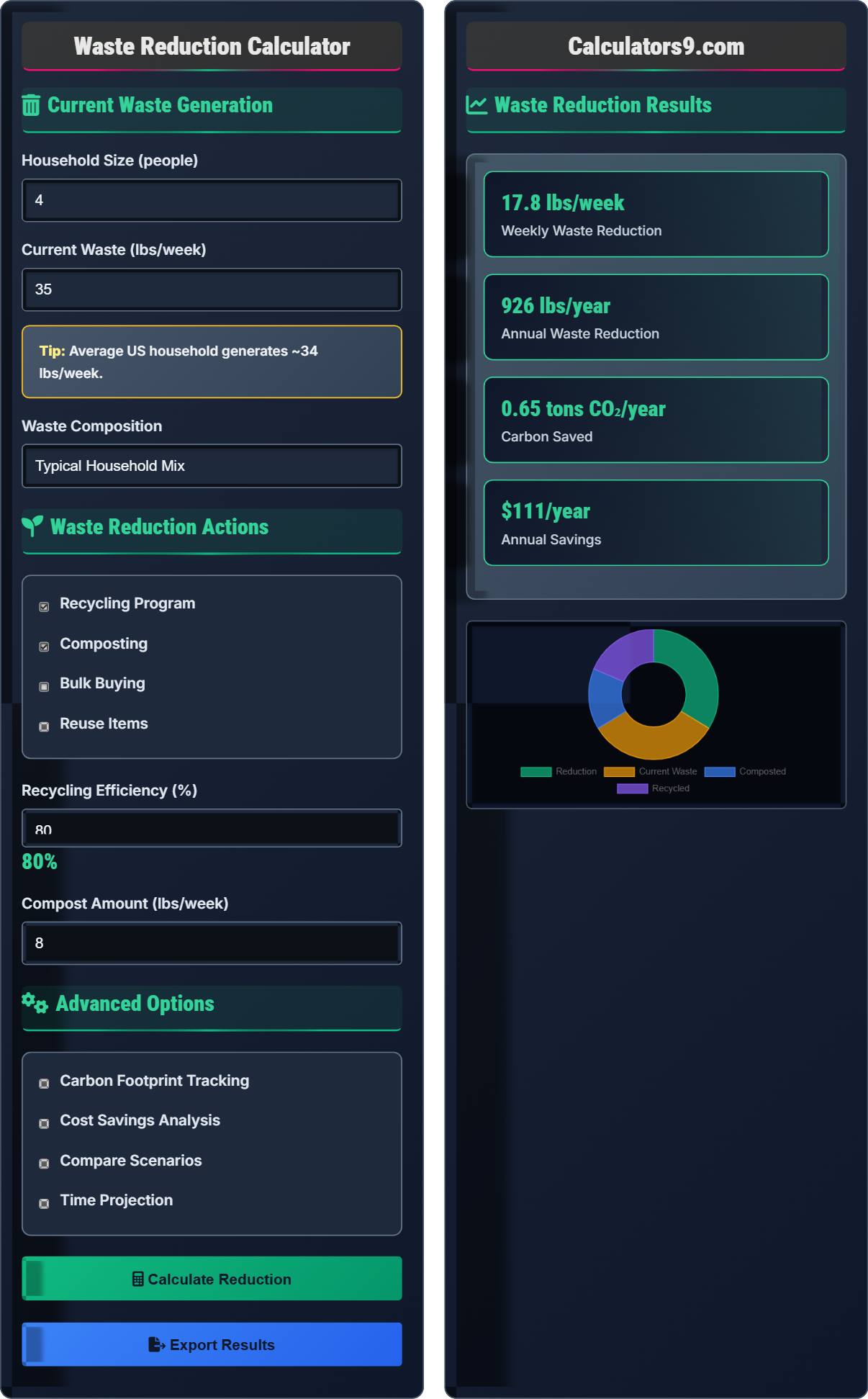
Current Waste Generation
Waste Reduction Actions
Advanced Options
Waste Reduction Results
| Action | Reduction | Efficiency | Impact |
|---|
| Benefit | Amount | Equivalent |
|---|
Waste Reduction Guide
Waste reduction refers to the practice of minimizing the amount of waste generated by individuals, households, and organizations. It encompasses the "reduce, reuse, recycle" hierarchy, with reduction being the most environmentally beneficial approach. Effective waste reduction significantly decreases environmental impact, conserves resources, and reduces disposal costs.
The waste reduction calculation uses the following formula:
Where:
- \(WR\) = Total waste reduction
- \(W_i\) = Weekly waste generation for item i
- \(R_i\) = Reduction factor for action applied to item i
- \(C_i\) = Carbon footprint coefficient for item i
Waste reduction provides significant environmental benefits:
- Resource Conservation: Preserves raw materials and energy
- Carbon Reduction: Decreases greenhouse gas emissions
- Pollution Prevention: Reduces air and water pollution
- Habitat Protection: Minimizes land use for disposal
- Water Conservation: Reduces water usage in manufacturing
- Buy Less: Purchase only necessary items
- Choose Wisely: Select products with minimal packaging
- Repair Instead of Replace: Fix items when possible
- Donate Unwanted Items: Extend product lifecycle
- Use Reusable Alternatives: Bags, containers, and bottles
Waste Reduction Quiz
According to the waste hierarchy, which approach provides the greatest environmental benefit?
The answer is B) Source Reduction. The waste hierarchy prioritizes approaches from most to least beneficial: Reduce, Reuse, Recycle, Recover, Dispose. Source reduction prevents waste from being created in the first place, providing the greatest environmental benefit.
The waste hierarchy is a fundamental concept in environmental science that ranks waste management approaches by their environmental impact. Source reduction (prevention) is at the top because it eliminates waste generation entirely, conserving all the resources and energy that would have been used to create the unwanted material.
Waste Hierarchy: Prioritized approach to waste management: Reduce, Reuse, Recycle, Recover, Dispose
Source Reduction: Minimizing waste generation at the point of creation
Environmental Impact: Effect of human activities on natural ecosystems
• Prevention is always better than remediation
• Higher levels in the hierarchy provide greater benefits
• Each level should complement others, not replace them
• Remember the acronym "3 R's": Reduce, Reuse, Recycle
• Think prevention first when addressing waste issues
• Focusing only on recycling while ignoring reduction opportunities
• Assuming all waste management approaches are equally beneficial
Calculate the annual carbon savings from diverting 500 lbs of mixed paper waste through recycling (efficiency 80%) if paper recycling saves 0.7 kg CO₂ per lb. Show your work.
Using the formula: \(WR = W \times R \times C\)
Given:
- W = 500 lbs (paper waste)
- R = 0.8 (80% efficiency)
- C = 0.7 kg CO₂/lb (carbon coefficient)
Calculation: WR = 500 × 0.8 × 0.7 = 280 kg CO₂
Therefore, recycling 500 lbs of paper saves 280 kg of CO₂ annually.
This problem demonstrates how waste reduction actions translate to measurable environmental benefits. The carbon coefficient represents the emissions avoided by diverting waste from disposal. Multiplying by efficiency accounts for practical limitations in waste processing.
Carbon Footprint: Total greenhouse gas emissions caused by an activity
Carbon Coefficient: Emissions impact per unit of waste
Diversion Rate: Percentage of waste redirected from disposal
• All factors multiply together to determine impact
• Efficiency factors account for real-world limitations
• Carbon coefficients vary by waste type
• Convert units consistently when calculating
• Remember that efficiency reduces actual impact
• Forgetting to apply efficiency factors to calculations
• Using incorrect carbon coefficients for waste types
A family composts 2 lbs of food scraps daily. Food waste produces 1.2 kg CO₂ equivalent per lb when landfilled. If composting prevents 90% of these emissions, how much carbon does the family save annually?
Step 1: Calculate annual food waste = 2 lbs/day × 365 days = 730 lbs/year
Step 2: Calculate potential emissions = 730 lbs × 1.2 kg CO₂/lb = 876 kg CO₂
Step 3: Calculate savings = 876 kg × 0.9 = 788.4 kg CO₂
Therefore, the family saves 788.4 kg (0.79 tons) of CO₂ annually through composting.
This example shows the significant impact of composting organic waste. Food waste in landfills decomposes anaerobically, producing methane, a potent greenhouse gas. Composting allows aerobic decomposition, preventing methane production and creating valuable soil amendment.
Methane Production: Greenhouse gas released from anaerobic decomposition
Aerobic Decomposition: Oxygen-dependent breakdown process
Soil Amendment: Material added to improve soil quality
• Organic waste has high methane potential when landfilled
• Composting prevents methane formation
• Annual calculations require conversion from daily amounts
• Multiply daily amounts by 365 for annual calculations
• Remember that composting efficiency affects actual savings
• Forgetting to convert daily to annual amounts
• Underestimating the climate impact of food waste
A company reduces its packaging weight by 20% across all products. If the company generates 10,000 lbs of packaging waste annually with a carbon coefficient of 0.9 kg CO₂ per lb, calculate the environmental benefit of this reduction.
Step 1: Calculate waste reduction = 10,000 lbs × 0.20 = 2,000 lbs
Step 2: Calculate carbon savings = 2,000 lbs × 0.9 kg CO₂/lb = 1,800 kg CO₂
Step 3: Convert to tons = 1,800 kg ÷ 1,000 = 1.8 tons CO₂
Therefore, the packaging reduction saves 2,000 lbs of waste and 1.8 tons of CO₂ annually.
This demonstrates how businesses can achieve significant environmental benefits through design changes. Packaging reduction has a dual benefit: it reduces material usage and waste generation simultaneously. This approach exemplifies source reduction in the waste hierarchy.
Source Reduction: Eliminating waste at the point of creation
Design for Environment: Creating products with minimal environmental impact
Life Cycle Assessment: Evaluating environmental impacts across product life
• Source reduction provides maximum environmental benefit
• Calculate absolute reductions from percentage changes
• Consider both waste and carbon impacts of changes
• Confusing percentage reduction with absolute quantity
• Failing to account for baseline waste amounts
Which factor has the greatest impact on the environmental benefit of recycling programs?
The answer is B) Participation rate. The environmental benefit of recycling is directly proportional to the amount of material collected and processed. High participation rates maximize the quantity of materials diverted from landfills, providing the greatest environmental benefit. Without participation, no materials are recycled regardless of collection frequency or transportation efficiency.
This question highlights the importance of community engagement in waste reduction programs. Mathematical models show that environmental benefits increase linearly with participation rates. For example, doubling participation from 40% to 80% doubles the environmental benefit, while other factors have more limited impact ranges.
Participation Rate: Percentage of eligible participants who engage in program
Diversion Rate: Percentage of waste redirected from disposal
Program Effectiveness: Measure of program success in achieving goals
• Environmental benefits scale directly with participation
• Programs require minimum participation for viability
• Engagement drives actual environmental outcomes
• Focus on increasing participation before optimizing logistics
• Educational programs often improve participation rates
• Assuming logistical improvements alone drive environmental benefits
• Overlooking the role of public engagement in program success
Waste Reduction Basics
Minimizing the amount of waste generated through conscious consumption and resource management.
\(WR = \sum{(W_i \times R_i \times C_i)}\)
Where WR=waste reduction, Wi=waste amount, Ri=reduction efficiency, Ci=carbon coefficient.
- Prevention is better than treatment
- Higher efficiency increases benefits
- Carbon coefficients vary by waste type
Eco Strategies
Reduce, Reuse, Recycle, Recover, Dispose - in order of environmental preference.
- Source reduction
- Material reuse
- Recycling programs
- Composting systems
- Local regulations
- Infrastructure availability
- Cost-effectiveness
- Community participation
FAQ
Q: How accurate are waste reduction calculations?
A: Waste reduction calculations provide reasonable approximations based on established environmental impact factors. The formula \( WR = \sum{(W_i \times R_i \times C_i)} \) captures the primary factors affecting environmental benefit:
Where \( WR \) is waste reduction, \( W_i \) is waste amount, \( R_i \) is reduction efficiency, and \( C_i \) is carbon coefficient.
For example, recycling 100 lbs of paper (\( W_p = 100 \)) with 80% efficiency (\( R_p = 0.8 \)) and carbon coefficient of 0.7 kg CO₂/lb (\( C_p = 0.7 \)) would save:
\( WR_p = 100 \times 0.8 \times 0.7 = 56 \) kg CO₂
Actual results may vary based on local processing methods, transportation distances, and contamination levels. However, these calculations provide valuable guidance for waste reduction planning.
Q: What are the business benefits of waste reduction?
A: Waste reduction provides multiple business benefits:
- Cost Savings: Reduced disposal fees and material purchases
- Regulatory Compliance: Meeting environmental requirements
- Brand Reputation: Demonstrating corporate responsibility
- Operational Efficiency: Optimizing resource use
- Risk Management: Reducing exposure to resource price volatility
For example, if a company reduces waste by 1,000 lbs annually at a disposal cost of $0.50/lb, the direct savings would be \( 1{,}000 \times 0.50 = \$500 \) annually. Additionally, if the waste reduction corresponds to 0.6 tons CO₂ savings, and carbon credits are valued at $50/ton, the indirect value would be \( 0.6 \times 50 = \$30 \) annually.
These combined benefits make waste reduction a financially attractive sustainability strategy.