Career Change ROI Calculator
Calculate your professional investment returns • 2026 trends
Career Change ROI Formula:
Show the calculator\( ROI = \frac{(Future\ Salary - Current\ Salary) \times Time\ Horizon - Investment\ Costs}{Investment\ Costs} \times 100 \)
Where:
- Future Salary: Projected annual salary after career change
- Current Salary: Current annual salary
- Time Horizon: Years until retirement or career transition
- Investment Costs: Total costs including education, certifications, lost income during transition
This formula calculates the return on investment for changing careers, accounting for salary differences, time value of money, and upfront investment costs.
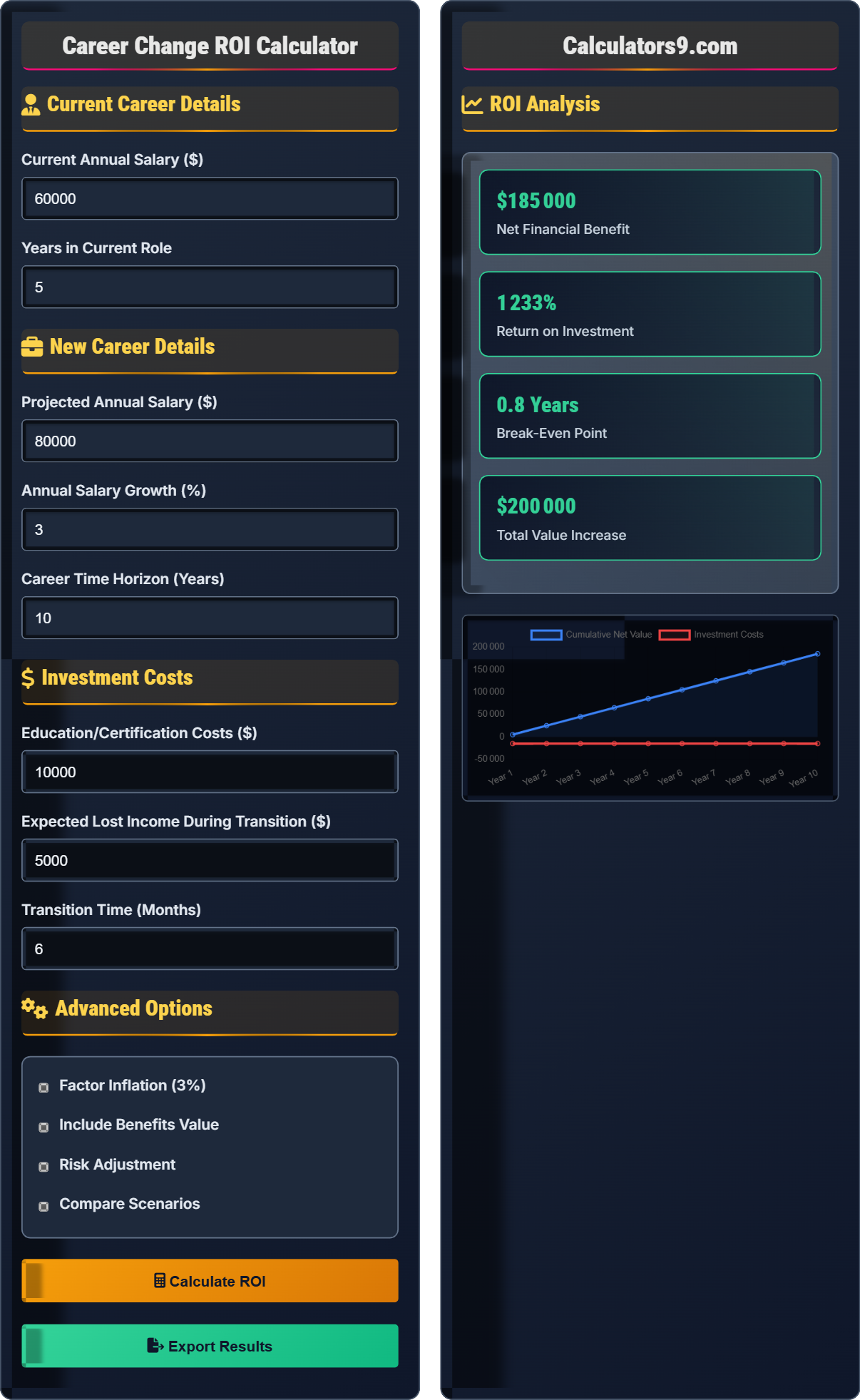
Example: For a current salary of $60,000 transitioning to a projected $80,000 career with $15,000 in investment costs over 10 years:
Annual difference: $80,000 - $60,000 = $20,000
Total benefit over 10 years: $20,000 × 10 = $200,000
Net benefit: $200,000 - $15,000 = $185,000
ROI: ($185,000 ÷ $15,000) × 100 = 1,233%
Thus, the career change would yield a 1,233% return on the investment.
Current Career Details
New Career Details
Investment Costs
Advanced Options
ROI Analysis
| Year | Current Career | New Career | Annual Difference | Cumulative Net |
|---|
| Year | Investment Costs | Cumulative Benefits | Net Value | ROI % |
|---|
Comprehensive Career Change Guide
Career Change ROI (Return on Investment) is a metric that quantifies the financial benefits of transitioning to a new career path relative to the costs and time invested in making that change. It considers factors like salary differences, career growth potential, education costs, and opportunity costs during the transition period.
The standard career change ROI calculation uses the following formula:
Where:
- Future Salary: Projected annual salary in new career
- Current Salary: Current annual salary
- Time Horizon: Number of years until retirement or next career transition
- Investment Costs: Total costs including education, certifications, lost income, and transition expenses
Effective approaches to maximize your career change ROI include:
- Leverage Transferable Skills: Identify skills that apply across industries to reduce retraining needs
- Gradual Transition: Start side projects or part-time work in your target field while maintaining current employment
- Target High-Growth Fields: Focus on industries with strong demand and growth projections
- Network Strategically: Build relationships in your target industry to accelerate job placement
- Upskill Continuously: Stay current with industry trends and emerging technologies
- Break-even Point: Time needed to recoup investment costs through increased earnings
- Long-term Earnings Potential: Total income difference over your remaining career span
- Career Satisfaction: Non-financial benefits like work-life balance and job security
- Industry Stability: Risk of future job displacement or industry decline
- Skills Obsolescence Risk: Likelihood that new skills will remain relevant
Career Change ROI Learning Quiz
Which of the following is NOT a component of career change ROI calculation?
The answer is D) Personal Hobbies. Career change ROI calculation includes current salary, projected new salary, and investment costs (like education and training). Personal hobbies are not financial factors in the ROI calculation.
Understanding the components of career change ROI is crucial because it helps individuals make informed decisions about career transitions. The ROI formula focuses on quantifiable financial impacts. Current salary represents the baseline, projected salary shows potential gains, and investment costs represent the expenses incurred to achieve the career change.
ROI (Return on Investment): A measure of profitability relative to the cost of investment
Investment Costs: Expenses associated with achieving the career change
Time Horizon: The expected duration of the new career
• ROI calculations focus on quantifiable financial metrics
• Investment costs include direct expenses and opportunity costs
• Time horizon affects the total benefit calculation
• Remember: ROI = (Net Benefit ÷ Investment Costs) × 100
• Consider both immediate and long-term salary differences
• Including non-financial factors in the basic ROI calculation
• Forgetting to factor in opportunity costs during transition
Calculate the ROI for a career change where current salary is $50,000, projected salary is $70,000, investment costs are $12,000, and the time horizon is 8 years. Show your work.
Step 1: Calculate annual salary difference = $70,000 - $50,000 = $20,000
Step 2: Calculate total benefit over 8 years = $20,000 × 8 = $160,000
Step 3: Calculate net benefit = $160,000 - $12,000 = $148,000
Step 4: Calculate ROI = ($148,000 ÷ $12,000) × 100 = 1,233.33%
Therefore, the ROI for this career change is 1,233.33%
This problem demonstrates the significant impact of career changes with substantial salary increases. The calculation shows that even with a moderate investment cost, a $20,000 annual salary increase over 8 years results in a very high ROI. This highlights the importance of considering long-term financial implications when evaluating career changes.
Net Benefit: Total gains minus total costs
Annual Salary Difference: The yearly gain from the career change
Time Horizon: Expected duration of the new career
• Always subtract investment costs from total benefits
• Multiply annual differences by the time horizon
• Divide net benefit by investment costs to get ROI ratio
• Calculate annual difference first
• Then multiply by time horizon
• Finally, factor in investment costs
• Forgetting to factor in investment costs
• Calculating ROI without considering time horizon
• Adding investment costs to benefits instead of subtracting
Sarah is considering changing careers from marketing ($45,000 annually) to data science ($65,000 annually). She expects to invest $18,000 in bootcamp tuition and lose $10,000 in income during the 6-month transition. How many years will it take her to break even on this investment?
Step 1: Calculate total investment costs = $18,000 + $10,000 = $28,000
Step 2: Calculate annual salary difference = $65,000 - $45,000 = $20,000
Step 3: Calculate break-even time = $28,000 ÷ $20,000 = 1.4 years
Therefore, Sarah will break even on her investment after 1.4 years in her new career.
Break-even analysis is crucial for understanding the timeline of a career change investment. In this case, Sarah will recover her $28,000 investment in just over a year, making this a financially attractive career change. The break-even point represents the time when the cumulative benefits equal the initial investment costs.
Break-Even Point: Time when cumulative benefits equal initial investment
Opportunity Cost: Income lost during transition period
Total Investment: Direct costs plus opportunity costs
• Break-even = Total Investment ÷ Annual Salary Difference
• Include both direct costs and opportunity costs
• The sooner break-even occurs, the better the investment
• Remember to include lost income as part of investment costs
• A break-even under 2 years is generally favorable
• Forgetting to include opportunity costs in total investment
• Using monthly instead of annual salary differences
• Not considering the transition period in calculations
Mark is evaluating a career change from journalism ($40,000 annually) to software development ($75,000 annually). His investment costs are $15,000, and he expects a 4% annual salary growth in the new role versus 2% in his current role. If inflation is 3% annually, what is the real ROI over 10 years?
Step 1: Calculate nominal salary difference with growth
Current salary after 10 years: $40,000 × (1.02)^10 = $48,759
Future salary after 10 years: $75,000 × (1.04)^10 = $111,328
Step 2: Calculate average annual salaries adjusted for inflation
Real current salary average: $40,000 × [(1.02/1.03)^10 - 1] / [(1.02/1.03) - 1] / 10 ≈ $39,500
Real future salary average: $75,000 × [(1.04/1.03)^10 - 1] / [(1.04/1.03) - 1] / 10 ≈ $78,500
Step 3: Calculate real annual difference = $78,500 - $39,500 = $39,000
Step 4: Calculate real total benefit = $39,000 × 10 = $390,000
Step 5: Calculate real ROI = ($390,000 - $15,000) ÷ $15,000 × 100 = 2,500%
Therefore, the real ROI accounting for inflation is 2,500%.
This demonstrates the importance of adjusting for inflation when evaluating long-term career changes. While nominal salaries grow, inflation reduces purchasing power. However, the significant salary difference still results in a very high real ROI. Adjusting for inflation provides a more accurate picture of actual financial benefit.
Nominal Value: Dollar amounts without inflation adjustment
Real Value: Dollar amounts adjusted for inflation
Purchasing Power: The value of money in terms of goods/services
• Real ROI = (Real Benefits - Investment) ÷ Investment × 100
• Adjust both current and future salaries for inflation
• Higher growth rates in new careers amplify benefits over time
• Use real values for long-term planning
• Consider salary growth differential in career choices
• Factor in inflation when comparing long-term careers
• Using nominal values without inflation adjustment
• Ignoring different growth rates between careers
• Not considering the compounding effect of salary growth
Which of the following factors would most significantly impact the risk-adjusted ROI of a career change?
The answer is B) Stability and growth potential of the new industry. The risk-adjusted ROI heavily depends on whether the new career will provide stable income over the projected time horizon. An unstable industry with declining prospects could result in job loss, negating the financial benefits of the career change. This risk factor significantly impacts the probability of achieving the projected ROI.
Risk assessment is critical in career change decisions. While financial projections might look favorable, they're only valuable if achievable. Industry stability, technological disruption risk, and long-term growth potential directly affect the likelihood of realizing projected benefits. A career with higher risk may need to offer proportionally higher rewards to justify the change.
Risk-Adjusted ROI: ROI calculation that accounts for probability of success
Industry Stability: Consistency of employment and income in an industry
Growth Potential: Future expansion and opportunity in the field
• Higher risk careers require higher projected returns
• Industry stability affects probability of achieving projections
• Technological changes can quickly devalue skills
• Research industry outlook before making career changes
• Consider skills that are transferable across industries
• Factor in risk premium for volatile careers
• Focusing only on financial projections without risk assessment
• Assuming current industry trends will continue indefinitely
• Not considering how automation might affect the new field
Career Change Basics
Financial return on investment in changing careers.
\(ROI = \frac{(Future\ Salary - Current\ Salary) \times Time\ Horizon - Investment\ Costs}{Investment\ Costs} \times 100\)
Where ROI measures financial benefit relative to costs.
- Include all investment costs
- Consider time horizon
- Account for salary growth
Strategies
Time to recover investment costs through salary differences.
- Research market demand
- Choose high-growth fields
- Minimize transition costs
- Maximize skill transferability
- Risk assessment
- Inflation adjustment
- Non-financial benefits
- Work-life balance
FAQ
Q: How do I determine if a career change is financially worth it?
A: To determine if a career change is financially worthwhile, calculate the Return on Investment (ROI) using this formula:
\( ROI = \frac{(Future\ Salary - Current\ Salary) \times Time\ Horizon - Investment\ Costs}{Investment\ Costs} \times 100 \)
For example, if your current salary is $50,000 and projected new salary is $70,000, with $10,000 in investment costs and a 10-year time horizon:
Annual difference: $70,000 - $50,000 = $20,000
Total benefit over 10 years: $20,000 × 10 = $200,000
Net benefit: $200,000 - $10,000 = $190,000
ROI: ($190,000 ÷ $10,000) × 100 = 1,900%
As a general rule, a career change with an ROI above 200% and a break-even time under 2 years is considered financially attractive. However, also consider non-financial factors like job satisfaction, work-life balance, and career growth potential.
Q: What investment costs should I consider when calculating career change ROI?
A: When calculating career change ROI, consider all potential investment costs:
- Direct Costs: Tuition, certification fees, books, supplies
- Opportunity Costs: Lost income during education/training and job search
- Transition Costs: Relocation expenses, new wardrobe, professional networking events
- Time Investment: Hours spent studying, job searching, skill development
- Reduced Productivity: Potential temporary decrease in performance during transition
For example, if you're transitioning to a new field requiring a certification course ($5,000), losing 3 months of income ($12,000), and spending $2,000 on new equipment, your total investment would be $19,000. This comprehensive view ensures you're making an informed decision about the financial impact of your career change.