Job Offer Analyzer
Compare career opportunities • 2026 metrics
Job Offer Comparison Formula:
\( TOC = Salary + Benefits + Bonuses + Equity - Commute\ Cost \)
Where:
- \( TOC \) = Total Offer Compensation
- \( Salary \) = Base annual salary
- \( Benefits \) = Healthcare, retirement, PTO value
- \( Bonuses \) = Annual performance bonuses
- \( Equity \) = Stock options/RSUs value
- \( Commute\ Cost \) = Transportation and time value
For comprehensive comparison:
\( CV = \frac{TOC_1}{Cost\ of\ Living_1} \div \frac{TOC_2}{Cost\ of\ Living_2} \)
Where \( CV \) = Comparative Value, and \( Cost\ of\ Living \) is normalized index.
Example: Offer A has $80,000 salary + $15,000 benefits in NYC (CoL 1.5), while Offer B has $75,000 + $20,000 benefits in Austin (CoL 0.9).
\( TOC_A = \$80{,}000 + \$15{,}000 = \$95{,}000 \)
\( TOC_B = \$75{,}000 + \$20{,}000 = \$95{,}000 \)
\( CV = \frac{\$95{,}000}{1.5} \div \frac{\$95{,}000}{0.9} = \frac{63{,}333}{105{,}556} = 0.60 \)
Thus, Offer B has 60% more purchasing power than Offer A when adjusted for cost of living.
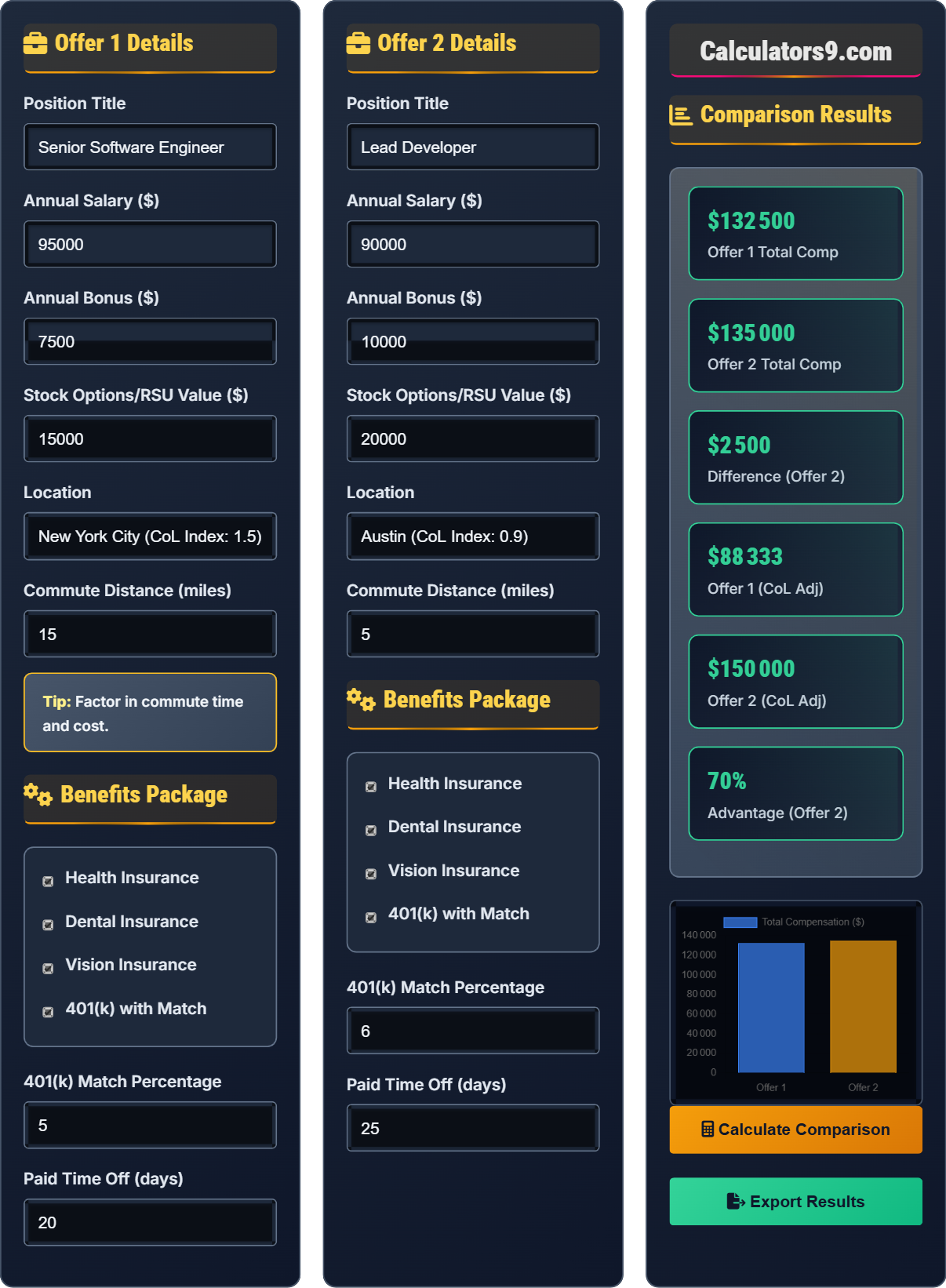
Offer 1 Details
Benefits Package
Offer 2 Details
Benefits Package
Comparison Results
| Component | Offer 1 | Offer 2 | Difference |
|---|---|---|---|
| Base Salary | $95,000 | $90,000 | +$5,000 |
| Bonus | $7,500 | $10,000 | -$2,500 |
| Stock | $15,000 | $20,000 | -$5,000 |
| Benefits | $5,000 | $5,000 | $0 |
| Factor | Offer 1 | Offer 2 | Impact |
|---|
Job Offer Analysis Guide
Total compensation analysis goes beyond base salary to evaluate the complete value of a job offer. This includes direct compensation (salary, bonuses, equity) and indirect compensation (benefits, PTO, professional development). Understanding total compensation helps job seekers make informed decisions about career opportunities.
The comprehensive total compensation calculation uses the following formula:
Where:
- \(TC\) = Total Compensation
- \(S\) = Base Salary
- \(B\) = Bonuses and Incentives
- \(E\) = Equity (Stock Options, RSUs)
- \(BF\) = Benefits Factor (health, retirement, etc.)
- \(CC\) = Commute Costs
When comparing job offers in different locations, adjust for cost of living differences:
For example, if Offer A provides $100,000 in NYC (CoL Index 1.5) and Offer B provides $90,000 in Austin (CoL Index 0.9):
- NYC CoLA = $100,000 ÷ 1.5 = $66,667
- Austin CoLA = $90,000 ÷ 0.9 = $100,000
- Despite lower base salary, Austin offer provides 50% more purchasing power.
- Quantify Benefits: Assign dollar values to benefits (health insurance ~$15,000/year)
- Consider Growth: Evaluate promotion potential and salary progression
- Assess Stability: Company financial health and industry outlook
- Factor Commute: Time and transportation costs impact net value
- Align Values: Consider company culture and mission alignment
Job Offer Analysis Learning Quiz
An offer includes $85,000 salary, $5,000 bonus, $10,000 in stock options, and $8,000 in benefits. What is the total compensation?
Total Compensation = Salary + Bonus + Equity + Benefits
Total Compensation = $85,000 + $5,000 + $10,000 + $8,000 = $108,000
The answer is D) $108,000.
This calculation demonstrates the importance of considering all components of an offer. Many candidates focus solely on base salary, missing significant portions of their total compensation. In this example, non-salary components ($23,000) represent 21% of the total compensation package, which is substantial.
Total Compensation: Complete value of all employment benefits
Equity Compensation: Ownership stakes in the company
Benefits Package: Non-wage compensation provided to employees
• TC = Salary + Bonuses + Equity + Benefits
• Include all quantifiable components
• Consider vesting schedules for equity
• Request detailed benefits breakdown
• Calculate equity value based on company valuation
• Factor in vesting cliffs and schedules
• Only considering base salary
If Offer A provides $110,000 in Boston (CoL Index 1.4) and Offer B provides $95,000 in Denver (CoL Index 1.1), which offer provides greater purchasing power?
Step 1: Calculate Cost of Living Adjusted Values
Boston Adjusted Value = $110,000 ÷ 1.4 = $78,571
Denver Adjusted Value = $95,000 ÷ 1.1 = $86,364
Step 2: Compare Values
Denver provides $86,364 - $78,571 = $7,793 more purchasing power per year.
Offer B in Denver provides greater purchasing power despite the lower base salary.
This example illustrates how location significantly impacts the real value of compensation. Even though Boston offers $15,000 more in salary, the higher cost of living reduces the actual purchasing power. The cost of living adjustment reveals the true economic value of each offer, which is crucial for making informed decisions about geographic relocation.
Cost of Living Index: Measure of relative cost to live in different areas
Purchasing Power: Amount of goods/services money can buy
Real Value: Compensation adjusted for economic conditions
• Adjusted Value = Total Compensation ÷ CoL Index
• Higher CoL Index = Higher living costs
• Compare adjusted values for true comparison
• Use CoL calculators for precise comparisons
• Consider specific expenses (housing, transportation)
• Factor in tax differences between states
• Not adjusting for cost of living differences
• Using national average instead of local index
• Ignoring tax implications of different states
You receive an offer with $90,000 salary and 1,000 stock options. The company is valued at $50 million with 2 million shares outstanding. The options have a strike price of $10. If the company's value doubles in 4 years, what is the current and future value of the equity?
Step 1: Calculate current share price
Current Share Price = Company Value ÷ Total Shares
Current Share Price = $50,000,000 ÷ 2,000,000 = $25 per share
Step 2: Calculate current option value
Current Option Value = (Share Price - Strike Price) × Options
Current Option Value = ($25 - $10) × 1,000 = $15 × 1,000 = $15,000
Step 3: Calculate future value with doubled company value
Future Share Price = ($100,000,000 ÷ 2,000,000) = $50 per share
Future Option Value = ($50 - $10) × 1,000 = $40 × 1,000 = $40,000
The equity is currently worth $15,000 and would be worth $40,000 if the company value doubles.
This example demonstrates how to value equity compensation, which can be a significant portion of total compensation. The key is understanding the relationship between company valuation, share count, and strike price. The potential for equity appreciation makes startup positions attractive despite lower base salaries, but also introduces risk.
Strike Price: Price at which options can be exercised
Share Count: Total number of shares outstanding
Equity Appreciation: Increase in value of ownership stake
• Option Value = (Current Price - Strike Price) × Number of Options
• Only "in-the-money" options have value
• Consider vesting schedules and expiration dates
• Research company valuation and growth prospects
• Understand vesting terms and acceleration clauses
• Consider dilution from future funding rounds
• Not accounting for strike price in valuation
• Assuming all equity will vest and be profitable
• Ignoring the risk of company failure
A job offers $80,000 salary with a benefits package including: $1,000/month health insurance premium paid by employer, 5% 401(k) match on first 6% of salary, and 20 days PTO. How much is the benefits package worth annually?
Step 1: Calculate health insurance value
Health Insurance Value = $1,000 × 12 = $12,000
Step 2: Calculate 401(k) match value
401(k) Match = $80,000 × 5% = $4,000
Step 3: Estimate PTO value
PTO Value = ($80,000 ÷ 260 work days) × 20 days = $307.69 × 20 = $6,154
Step 4: Calculate total benefits value
Total Benefits = $12,000 + $4,000 + $6,154 = $22,154
The benefits package is worth approximately $22,154 annually.
This example shows how to assign monetary values to common benefits. The health insurance value is the employer's contribution to premiums. The 401(k) match is calculated on the employee's salary contribution. PTO value is estimated based on daily salary. Together, these benefits represent 27.7% of the base salary, which is substantial.
Employer-Paid Premiums: Health insurance costs covered by employer
401(k) Match: Employer contribution to retirement account
PTO Value: Monetary equivalent of paid time off
• Benefits Value = Sum of all employer-paid items
• Health insurance: ~$15,000/year for family
• PTO: Daily salary × number of days
• Request benefits summary for accurate calculations
• Consider tax advantages of pre-tax benefits
• Factor in quality of coverage, not just cost
• Not valuing benefits at all
• Overvaluing benefits that aren't used
• Ignoring the tax benefits of pre-tax deductions
When comparing two offers with similar total compensation, which factor should be prioritized for long-term career growth?
The answer is D) All of the above depending on priorities. For long-term career growth, consider:
- Base salary for current financial needs
- Company reputation for future opportunities
- Vacation days for work-life balance and sustainability
Career decisions involve multiple competing factors, and the optimal choice varies by individual circumstances. Early-career professionals might prioritize learning opportunities and reputation, while those with families might value work-life balance. The key is understanding your own priorities and how different factors align with your long-term goals.
Career Capital: Skills, connections, and reputation gained from experience
Opportunity Cost: Value of next best alternative forgone
Personal Priorities: Individual values that guide decisions
• Consider total compensation, not just salary
• Factor in career trajectory and growth potential
• Align choices with personal values and priorities
• Create weighted scoring system for different factors
• Consider 5-year career trajectory
• Factor in remote work possibilities
• Focusing only on immediate financial benefits
• Not considering long-term career impact
• Ignoring work-life balance needs
Compensation Metrics
Complete value of all employment benefits and salary.
\(TC = Salary + Benefits + Bonuses + Equity\)
Where TC=total compensation, Benefits=health, retirement, etc.
- Include all quantifiable benefits
- Adjust for cost of living differences
- Consider tax implications
Best Practices
Systematic approach to comparing job offers.
- Quantify all compensation components
- Adjust for location differences
- Consider growth opportunities
- Factor in personal priorities
- Benefits Value: 20-30% of salary
- Bonus Range: 5-20% of salary
- 401(k) Match: 3-6% of salary
- PTO: 15-25 days annually
FAQ
Q: How do I negotiate benefits that aren't quantified in the offer?
A: To negotiate non-quantified benefits, first assign them monetary value based on industry standards:
- Health Insurance: Family plans cost ~$20,000/year
- 401(k) Match: Typically 3-6% of salary
- PTO: Daily value = (Annual Salary ÷ 260 work days)
- Professional Development: $1,000-5,000 annually
For example, if your salary is \( S = \$80{,}000 \) and you receive 20 PTO days:
\( PTO\ Value = \frac{\$80{,}000}{260} \times 20 = \$307.69 \times 20 = \$6{,}154 \)
Request the employer to specify benefit values in writing to ensure accurate comparison with other offers.
Q: What's the typical range for equity compensation in tech startups?
A: Equity ranges vary by company stage and role:
- Series A: 0.5-2% for ICs, 2-8% for senior roles
- Series B-C: 0.2-1% for ICs, 1-5% for senior roles
- Late Stage: 0.1-0.5% for ICs, 0.5-3% for senior roles
Formula for option value: \( OV = (CV \times \frac{ES}{TS}) - (ES \times SP) \)
Where \( OV \) = Option Value, \( CV \) = Company Valuation, \( ES \) = Employee Shares, \( TS \) = Total Shares, \( SP \) = Strike Price.
For example, if \( CV = \$50M \), \( ES = 10{,}000 \), \( TS = 5M \), and \( SP = \$5 \):
\( OV = (\$50M \times \frac{10{,}000}{5{,}000{,}000}) - (10{,}000 \times \$5) = \$100{,}000 - \$50{,}000 = \$50{,}000 \)
Thus, the equity is worth $50,000 if the company maintains its current valuation.