Salary Converter Calculator
Optimize career compensation • 2026 metrics
Salary Conversion Formula:
\( Annual\ Salary = Hourly\ Rate \times Hours\ per\ Week \times Weeks\ per\ Year \)
Where:
- \( Annual\ Salary \) = Total yearly compensation
- \( Hourly\ Rate \) = Compensation per hour worked
- \( Hours\ per\ Week \) = Standard work hours per week (typically 40)
- \( Weeks\ per\ Year \) = Working weeks per year (typically 52)
For standard full-time employment: \( AS = HR \times 40 \times 52 = HR \times 2080 \)
Example: If the hourly rate is $25 per hour:
\( AS = \$25 \times 40 \times 52 = \$25 \times 2080 = \$52{,}000 \)
Thus, the annual salary equivalent is $52,000.
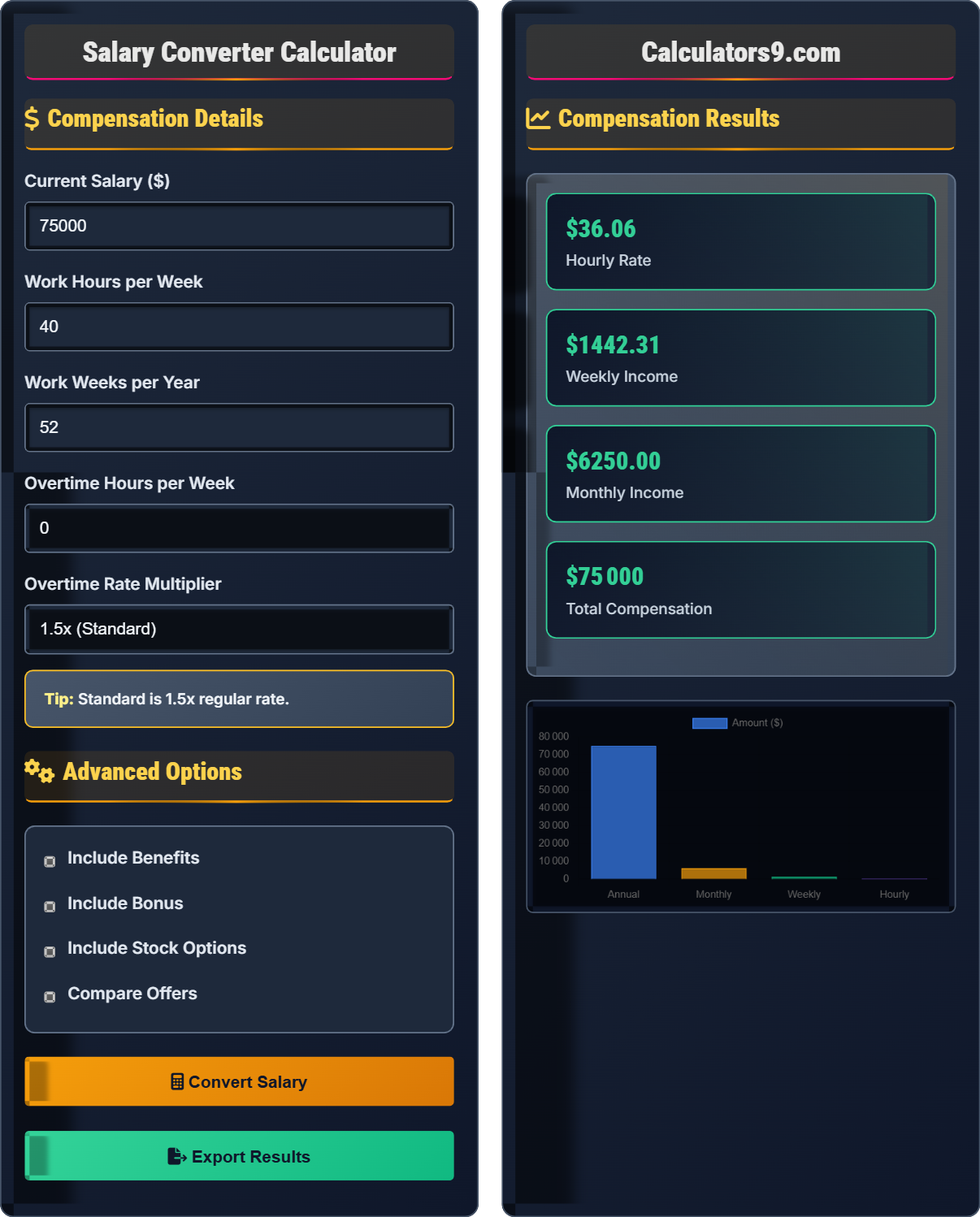
Compensation Details
Advanced Options
Compensation Results
| Metrics | Value |
|---|---|
| Annual Salary | $75,000 |
| Hourly Rate | $36.06 |
| Weekly Income | $1,442.31 |
| Monthly Income | $6,250.00 |
| Component | Amount | Percentage |
|---|
Salary Conversion Guide
Salary conversion is the process of translating compensation between different pay structures (hourly, weekly, monthly, annual) to facilitate comparison between job offers, evaluate total compensation packages, and understand the true value of employment opportunities. This is essential for career planning and negotiation.
The fundamental salary conversion calculations use these formulas:
Where:
- \(Annual\) = Annual Salary
- \(Hourly\) = Hourly Rate
- \(Hours\ per\ Week\) = Standard work hours per week
- \(Weeks\ per\ Year\) = Working weeks per year
Essential metrics to track for effective salary analysis:
- Annual Salary: Base yearly compensation before benefits
- Total Compensation: Salary plus benefits, bonus, equity
- Effective Rate: Total compensation divided by hours worked
- Cost Per Hour: Total compensation divided by billable hours
- Performance Bonus: Percentage-based additional compensation
- Research Market Rates: Know industry standards for your role
- Calculate Total Package: Consider benefits and equity, not just salary
- Understand Billing Rates: For consulting roles, understand client billing
- Negotiate Beyond Salary: Flexible schedule, remote work, development opportunities
- Document Agreements: Get all compensation details in writing
Salary Conversion Learning Quiz
If someone earns $20 per hour and works 40 hours per week for 52 weeks, what is their annual salary?
Annual Salary = Hourly Rate × Hours per Week × Weeks per Year
Annual Salary = $20 × 40 × 52 = $41,600
The answer is B) $41,600.
This calculation demonstrates the standard conversion from hourly wage to annual salary for full-time employment. The formula multiplies the hourly rate by the standard work week (40 hours) and the number of weeks in a year (52). This is the foundation for all salary conversions and is essential knowledge for career planning.
Annual Salary: Total compensation for one year of work
Hourly Rate: Compensation per hour worked
Full-Time: Standard 40-hour work week
• Annual = Hourly × 40 × 52
• Standard work week is 40 hours
• There are 52 weeks in a year
• Remember: 40 × 52 = 2,080 hours per year
• Multiply hourly rate by 2,080 for quick calculation
• Adjust for part-time or different schedules
• Forgetting to account for holidays and vacation time
• Using 50 weeks instead of 52 weeks per year
• Not considering overtime or part-time schedules
If an annual salary is $80,000, what is the equivalent hourly rate for a full-time position?
Step 1: Calculate total working hours per year
Hours per Year = 40 hours/week × 52 weeks/year = 2,080 hours
Step 2: Calculate hourly rate
Hourly Rate = Annual Salary ÷ Total Hours
Hourly Rate = $80,000 ÷ 2,080 = $38.46
The equivalent hourly rate is $38.46.
This demonstrates the reverse calculation from annual salary to hourly rate. The process involves dividing the annual salary by the total number of working hours in a year (2,080 for full-time employment). This is useful when comparing hourly positions to salaried positions or when negotiating contract rates.
Equivalent Rate: Conversion between pay structures
Full-Time Hours: 2,080 hours per year (40×52)
Salary Conversion: Changing between pay structures
• Hourly Rate = Annual Salary ÷ 2,080
• Annual Salary = Hourly Rate × 2,080
• Adjust for actual working hours
• Divide annual by 2,080 for hourly rate
• Use 2,000 for quick approximation
• Consider actual hours worked vs. scheduled hours
• Using incorrect number of working hours
• Not accounting for unpaid time off
• Confusing gross vs. net compensation
An employee earns $30 per hour and works 45 hours per week (5 hours of overtime). Using standard overtime (1.5x rate), what is their weekly income?
Step 1: Calculate regular pay
Regular Pay = 40 hours × $30 = $1,200
Step 2: Calculate overtime pay
Overtime Rate = $30 × 1.5 = $45
Overtime Pay = 5 hours × $45 = $225
Step 3: Calculate total weekly income
Total Weekly Income = Regular Pay + Overtime Pay
Total Weekly Income = $1,200 + $225 = $1,425
The weekly income is $1,425.
This example demonstrates how overtime pay is calculated using the standard time-and-a-half rate. Overtime is typically paid for hours worked over 40 in a week. The overtime rate is 1.5 times the regular hourly rate. This calculation is important for understanding the true value of positions that regularly include overtime.
Overtime Pay: Compensation for hours worked over 40/week
Time and a Half: Standard overtime rate (1.5x regular rate)
Regular Hours: First 40 hours in a work week
• Overtime = Hours over 40 × 1.5 × Regular Rate
• Standard overtime rate is 1.5x regular rate
• Some positions are exempt from overtime
• Calculate regular pay first, then overtime separately
• Some states have different overtime rules
• Consider double time for holidays in some industries
• Calculating overtime on all hours instead of just extra hours
• Not accounting for exempt vs. non-exempt status
• Using wrong overtime multiplier
A job offer includes $90,000 annual salary, $15,000 in benefits, and $10,000 in stock options. If the position requires 50 hours per week, what is the effective hourly rate considering total compensation?
Step 1: Calculate total compensation
Total Compensation = Salary + Benefits + Stock Options
Total Compensation = $90,000 + $15,000 + $10,000 = $115,000
Step 2: Calculate total working hours
Total Hours = 50 hours/week × 52 weeks/year = 2,600 hours
Step 3: Calculate effective hourly rate
Effective Hourly Rate = Total Compensation ÷ Total Hours
Effective Hourly Rate = $115,000 ÷ 2,600 = $44.23
The effective hourly rate is $44.23.
This example demonstrates the importance of considering total compensation rather than just base salary. When comparing job offers, it's crucial to factor in benefits, stock options, and other compensation elements. Additionally, when working more than 40 hours per week, the effective hourly rate decreases even though the annual salary remains the same.
Total Compensation: All forms of payment and benefits
Effective Rate: Total compensation divided by hours workedNon-Cash Benefits: Value of benefits beyond salary
• Total Compensation = Salary + Benefits + Equity
• Effective Rate = Total Compensation ÷ Actual Hours
• More hours = Lower effective hourly rate
• Always calculate total compensation package
• Consider value of benefits in dollar terms
• Factor in actual hours worked for true comparison
• Focusing only on base salary
• Not considering actual hours worked
• Undervaluing benefits and perks
Which statement is most accurate regarding the comparison between contract and salaried positions?
The answer is C) Contract positions require considering overhead costs. Independent contractors must account for their own benefits, equipment, workspace, insurance, and taxes. These overhead costs typically range from 25-40% of their gross income. This is why contractors often charge significantly more per hour than salaried employees.
When comparing contract to salaried positions, it's important to understand that contractors bear costs that employers typically cover for salaried employees. These include health insurance, retirement contributions, equipment, office space, professional development, and self-employment taxes. A contractor charging $70/hour might be equivalent to a salaried employee earning $50/hour when these factors are considered.
Overhead Costs: Business expenses for independent contractors
Self-Employment Tax: Additional tax burden for contractors
Employee Benefits: Employer-provided compensation beyond salary
• Contractor overhead typically 25-40% of income
• Salaried employees receive benefits package
• Self-employment tax is additional 15.3% for contractors
• Factor in 30% overhead for contractor comparisons
• Consider value of benefits in salary negotiations
• Account for job security differences
• Comparing contractor rates directly to employee salaries
• Not accounting for different tax obligations
• Ignoring benefits and security differences
Compensation Metrics
All forms of payment and benefits received for employment.
\(TC = Salary + Benefits + Bonus + Equity\)
Where TC=total compensation, Benefits=health, retirement, etc., Equity=stock options.
- Always consider total compensation package
- Factor in actual hours worked
- Account for tax differences between positions
Best Practices
Strategic approach to maximizing compensation.
- Research market rates thoroughly
- Calculate total compensation package
- Prepare value propositions
- Practice negotiation scenarios
- Hourly Rate: $25-150+
- Annual Salary: $40,000-300,000+
- Benefits Value: 20-40% of salary
- Bonus Range: 5-50% of salary
FAQ
Q: How do I compare a contract position ($75/hour) with a salaried position ($120,000/year)?
A: To compare these positions, you need to account for differences in benefits, taxes, and overhead:
- Contract Position: $75/hour × 2,080 hours = $156,000 gross
- Less Overhead: $156,000 × 30% = $46,800 (for benefits, equipment, taxes)
- Net Equivalent: $156,000 - $46,800 = $109,200
Formula: \( Net\ Equivalent = (Hourly\ Rate \times 2080) \times (1 - Overhead\ Rate) \)
In this case: \( NE = (\$75 \times 2080) \times (1 - 0.30) = \$156{,}000 \times 0.70 = \$109{,}200 \)
The contract position has a higher net equivalent than the salaried position ($109,200 vs $120,000), but consider benefits, security, and other factors.
Q: What's the typical ratio of total compensation to base salary?
A: The ratio of total compensation to base salary varies by organization and industry:
- Technology: 1.25-1.50 (25-50% in benefits/equity)
- Healthcare: 1.30-1.60 (high benefits value)
- Finance: 1.20-1.40 (moderate benefits)
- Manufacturing: 1.15-1.35 (basic benefits)
Formula: \( Total\ Compensation\ Ratio = \frac{Total\ Compensation}{Base\ Salary} \)
For example, if base salary is \( BS = \$100{,}000 \) and total compensation is \( TC = \$130{,}000 \):
\( TCR = \frac{\$130{,}000}{\$100{,}000} = 1.30 \)
This means benefits and other compensation add 30% to the base salary value.