Take-Home Pay Calculator
Optimize after-tax income • 2026 metrics
Take-Home Pay Formula:
\( THP = GP - (Federal\ Tax + State\ Tax + SS + Medicare + Other\ Deductions) \)
Where:
- \( THP \) = Take-Home Pay (Net Pay)
- \( GP \) = Gross Pay (Before deductions)
- \( Federal\ Tax \) = Federal income tax based on brackets
- \( State\ Tax \) = State income tax (varies by state)
- \( SS \) = Social Security tax (6.2% of income up to $160,200)
- \( Medicare \) = Medicare tax (1.45% of all income)
For 2026, Social Security tax applies to first $160,200 of income at 6.2% rate. Medicare tax is 1.45% on all income with additional 0.9% for high earners.
Example: If gross pay is $5,000 monthly with 22% federal tax, 5% state tax, 6.2% SS, and 1.45% Medicare:
\( THP = \$5{,}000 - (\$5{,}000 \times (0.22 + 0.05 + 0.062 + 0.0145)) = \$5{,}000 - \$1{,}732.50 = \$3{,}267.50 \)
Thus, the take-home pay is $3,267.50 per month.
Income Details
Advanced Options
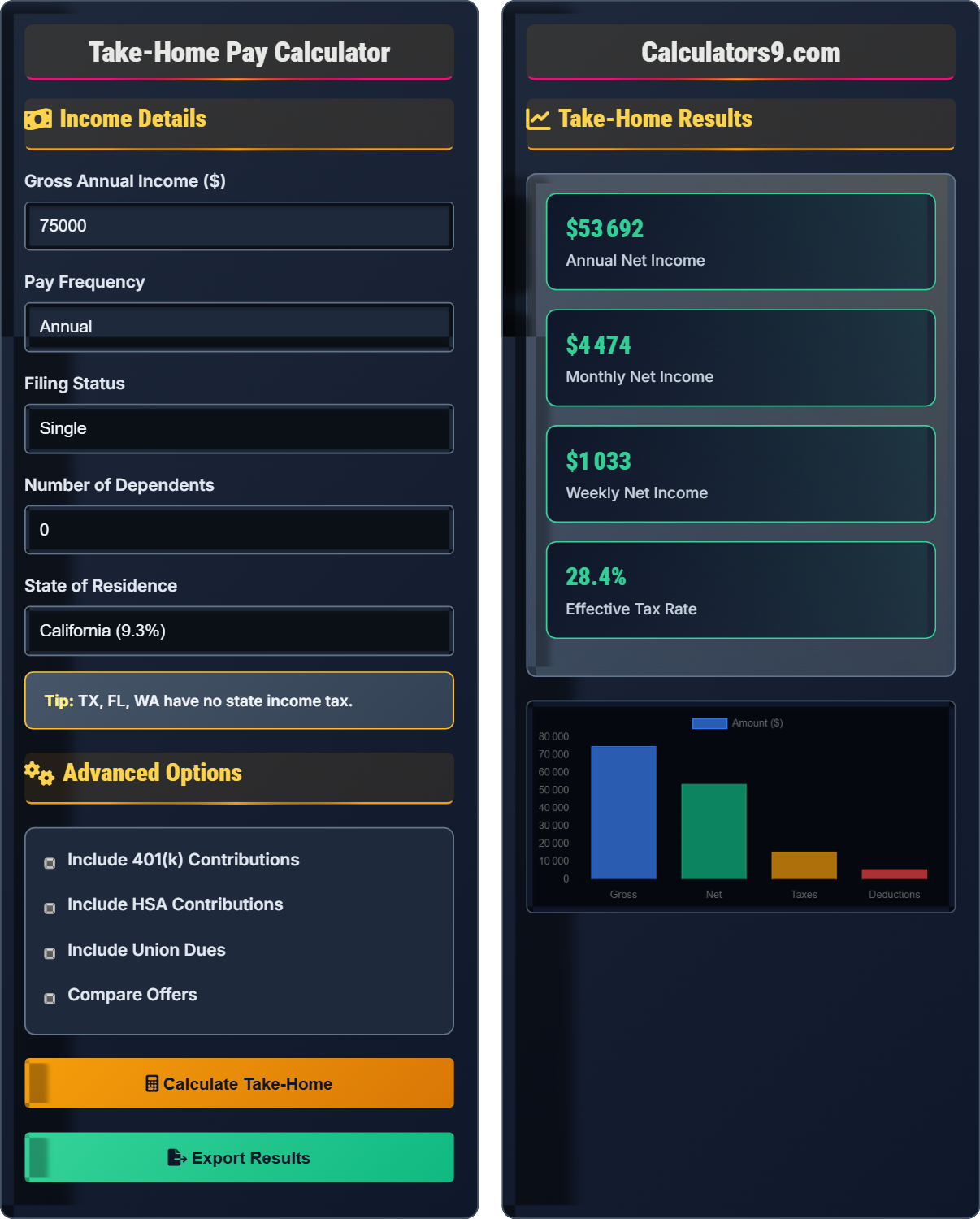
Take-Home Results
| Metrics | Value |
|---|---|
| Gross Annual Income | $75,000 |
| Total Deductions | $16,750 |
| Annual Net Income | $58,250 |
| Effective Tax Rate | 22.3% |
| Category | Amount | Percentage |
|---|
Take-Home Pay Guide
Take-home pay is the amount of money you actually receive after all mandatory and voluntary deductions have been taken from your gross pay. This includes federal income tax, state income tax, Social Security, Medicare, and any additional voluntary deductions like 401(k) contributions or health insurance premiums.
The standard take-home pay calculation uses the following formula:
Where:
- \(THP\) = Take-Home Pay
- \(GP\) = Gross Pay
- \(FT\) = Federal Tax
- \(ST\) = State Tax
- \(SS\) = Social Security (6.2% of income up to $160,200 in 2026)
- \(Med\) = Medicare (1.45% of all income)
- \(Other\) = Voluntary deductions (401k, HSA, etc.)
Essential metrics to track for effective compensation planning:
- Effective Tax Rate: Total taxes paid divided by gross income
- Net Pay Percentage: Take-home pay as percentage of gross pay
- Annual vs. Monthly: Understanding both for budgeting
- Retirement Savings: Impact of voluntary deductions on take-home pay
- State Variations: How location affects net pay
- Maximize Tax-Advantaged Accounts: Contribute to 401(k), HSA, and FSA
- Claim All Deductions: Itemize deductions if beneficial
- Adjust Withholdings: Avoid over-withholding throughout the year
- Consider Location: Factor in state tax differences
- Review Annually: Update withholding after life changes
Take-Home Pay Learning Quiz
What is the Social Security tax cap for 2026?
For 2026, the Social Security tax cap is $160,200. This means Social Security tax (6.2%) is only applied to the first $160,200 of income. Any income above this threshold is not subject to Social Security tax.
The answer is B) $160,200.
The Social Security tax cap is important because it means high earners pay a lower percentage of their total income in Social Security tax. For example, someone earning $200,000 pays Social Security tax on only the first $160,200. This differs from Medicare tax, which applies to all income without a cap.
Tax Cap: Maximum income amount subject to a tax
Social Security: Payroll tax for retirement and disability benefits
Progressive Tax: Tax rate increases with higher income
• Social Security tax: 6.2% on income up to cap
• Medicare tax: 1.45% on all income
• Cap increases annually based on inflation
• Remember: SS tax stops at the cap amount
• Medicare tax continues on all income
• Check annually for updated cap amounts
• Applying SS tax to all income above the cap
• Forgetting about additional Medicare tax for high earners
• Not updating calculations with new cap amounts
If someone has a gross annual income of $80,000 and takes home $60,000 after all deductions, what is their effective tax rate?
Step 1: Calculate total deductions
Total Deductions = Gross Income - Net Income
Total Deductions = $80,000 - $60,000 = $20,000
Step 2: Calculate effective tax rate
Effective Tax Rate = (Total Deductions ÷ Gross Income) × 100
Effective Tax Rate = ($20,000 ÷ $80,000) × 100 = 25%
The effective tax rate is 25%.
The effective tax rate is different from marginal tax rates. It represents the actual percentage of your gross income that goes to taxes and other deductions. This is more meaningful than marginal rates for financial planning because it shows your true tax burden. The effective rate includes all taxes (federal, state, payroll) and voluntary deductions.
Effective Tax Rate: Actual percentage of gross income paid in taxes
Marginal Tax Rate: Tax rate on the last dollar earned
Payroll Taxes: SS and Medicare taxes
• Effective Rate = Total Deductions ÷ Gross Income
• Includes all taxes and deductions
• Lower than marginal rate for most earners
• Use effective rate for budgeting and planning
• Compare effective rates across different locations
• Consider how deductions affect your effective rate
• Confusing effective and marginal tax rates
• Not including payroll taxes in effective rate
• Forgetting about state income tax variations
An individual earns $100,000 annually and moves from California (9.3% state tax) to Texas (0% state tax). If their federal tax rate is 22% and other deductions remain the same, how much more take-home pay will they have annually?
Step 1: Calculate state tax in California
CA State Tax = $100,000 × 9.3% = $9,300
Step 2: Calculate state tax in Texas
TX State Tax = $100,000 × 0% = $0
Step 3: Calculate difference
Additional Take-Home = CA State Tax - TX State Tax
Additional Take-Home = $9,300 - $0 = $9,300
The individual will have $9,300 more in take-home pay annually by moving to Texas.
This example illustrates the significant impact of state income tax on take-home pay. When comparing job offers or considering relocation, state tax differences can have a substantial impact on your net income. High earners in high-tax states may see a significant increase in take-home pay by moving to states with lower or no state income tax.
State Income Tax: Tax imposed by state governments
No-Income Tax States: States that don't tax personal income
After-Tax Income: Income remaining after all taxes
• State tax rates vary significantly
• Some states have no income tax
• Consider all taxes when relocating
• Research total tax burden, not just state income tax
• Consider cost of living differences
• Factor in other state benefits (pensions, etc.)
• Focusing only on state income tax
• Not considering cost of living
• Forgetting about local taxes
An employee earning $70,000 annually contributes 8% to their 401(k). If they're in the 22% federal tax bracket and 5% state tax bracket, how much does the 401(k) contribution reduce their annual tax burden?
Step 1: Calculate 401(k) contribution
401(k) Contribution = $70,000 × 8% = $5,600
Step 2: Calculate tax savings
Federal Tax Savings = $5,600 × 22% = $1,232
State Tax Savings = $5,600 × 5% = $280
Social Security Savings = $5,600 × 6.2% = $347.20
Medicare Savings = $5,600 × 1.45% = $81.20
Step 3: Calculate total tax savings
Total Tax Savings = $1,232 + $280 + $347.20 + $81.20 = $1,940.40
The 401(k) contribution reduces annual tax burden by $1,940.40.
This demonstrates the compound benefit of tax-advantaged accounts. The 401(k) contribution reduces not just federal income tax, but also state tax, Social Security tax, and Medicare tax. This makes the effective cost of the contribution less than the face value. In this case, the $5,600 contribution only costs $3,659.60 after tax savings.
Tax-Advantaged: Contributions reduce taxable income
Pre-Tax: Deducted before tax calculationTax Savings: Reduction in tax liability
• Pre-tax contributions reduce all taxes
• Post-tax contributions only reduce income tax
• Maximize tax-advantaged accounts first
• Contribute enough to get full employer match
• Consider catch-up contributions if 50+
• Use tax savings to increase contributions
• Only calculating federal tax savings
• Forgetting about payroll tax savings
• Not maximizing employer matching
For an individual earning $300,000 annually in 2026, what additional tax applies to income above $200,000?
The answer is A) Additional 0.9% Medicare tax. For high earners (single filers earning over $200,000), there is an additional 0.9% Medicare tax on income exceeding the threshold. This brings the total Medicare tax rate to 2.35% (1.45% + 0.9%) for the excess income.
The additional Medicare tax is an important consideration for high earners. Unlike Social Security tax, which has a wage base limit, Medicare tax applies to all income. The additional 0.9% only applies to income above the threshold ($200,000 for singles, $250,000 for joint filers), making the effective rate progressive for high earners. This tax is also applied to investment income for high earners.
High Earner Tax: Additional tax on high-income earners
Medicare Threshold: Income level triggering additional tax
Net Investment Income: Investment income subject to additional tax
• Additional Medicare tax: 0.9% on income over $200,000 (single)
• Also applies to net investment income
• No cap on Medicare tax
• Plan for higher tax burden on bonus income
• Consider tax-loss harvesting for investment income
• Factor into compensation negotiations
• Forgetting about additional Medicare tax
• Not considering investment income impact
• Miscalculating effective tax rates for high earners
Take-Home Metrics
Actual percentage of gross income remaining after all deductions.
\(Effective\ Rate = \frac{Gross\ Income - Net\ Income}{Gross\ Income} \times 100\)
Where Effective Rate=actual tax burden, Gross=pre-tax income, Net=after-tax income.
- Effective rate is usually lower than marginal rate
- Includes all taxes and deductions
- Varies by income level and location
Best Practices
Strategic approach to minimizing tax burden.
- Maximize tax-advantaged accounts
- Adjust withholdings regularly
- Consider location impact
- Track all deductions
- Effective Rate (Low Income): 10-15%
- Effective Rate (Mid Income): 15-25%
- Effective Rate (High Income): 25-35%
- 401(k) Max: $23,000 (2026)
FAQ
Q: How do I calculate take-home pay if I'm self-employed?
A: For self-employed individuals, the calculation is different due to self-employment tax:
- Self-Employment Tax: 15.3% (12.4% SS + 2.9% Medicare)
- Business Expenses: Deductible before calculating tax
- Quarterly Payments: Required for self-employment income
Formula: \( TakeHome = (Gross - Business\ Expenses) \times (1 - Federal\ Rate - State\ Rate - SelfTax) \)
For example, if gross income is \( GI = \$100{,}000 \), business expenses are \( BE = \$10{,}000 \), federal rate is 22%, state rate is 5%, and self-employment tax is 15.3% on net earnings:
\( Net\ Earnings = \$100{,}000 - \$10{,}000 = \$90{,}000 \)
\( SelfTax = \$90{,}000 \times 15.3\% = \$13{,}770 \)
\( Income\ Tax = \$90{,}000 \times (22\% + 5\%) = \$24{,}300 \)
\( TakeHome = \$90{,}000 - \$13{,}770 - \$24{,}300 = \$51{,}930 \)
Thus, take-home pay would be $51,930 after accounting for self-employment tax.
Q: What's the difference between marginal and effective tax rates?
A: The difference is crucial for financial planning:
- Marginal Rate: Tax rate on the last dollar earned (highest bracket)
- Effective Rate: Average rate paid on all income
For example, if someone earns $50,000 and pays $6,000 in taxes:
\( Marginal\ Rate = 22\% (top bracket) \)
\( Effective\ Rate = \frac{\$6{,}000}{\$50{,}000} \times 100 = 12\% \)
The effective rate is lower because income is taxed at different rates in different brackets. For budgeting and financial planning, the effective rate is more meaningful than the marginal rate.