Dilution Calculator
Chemistry solution preparation • Concentration calculations
Dilution Equation (C₁V₁ = C₂V₂):
Show CalculatorThe dilution equation states that the number of moles of solute remains constant during dilution:
\( C_1V_1 = C_2V_2 \)
Where:
- \( C_1 \) = initial concentration (M)
- \( V_1 \) = initial volume (L)
- \( C_2 \) = final concentration (M)
- \( V_2 \) = final volume (L)
This equation allows calculation of any one variable when the other three are known. It's fundamental for preparing solutions of desired concentrations from stock solutions.
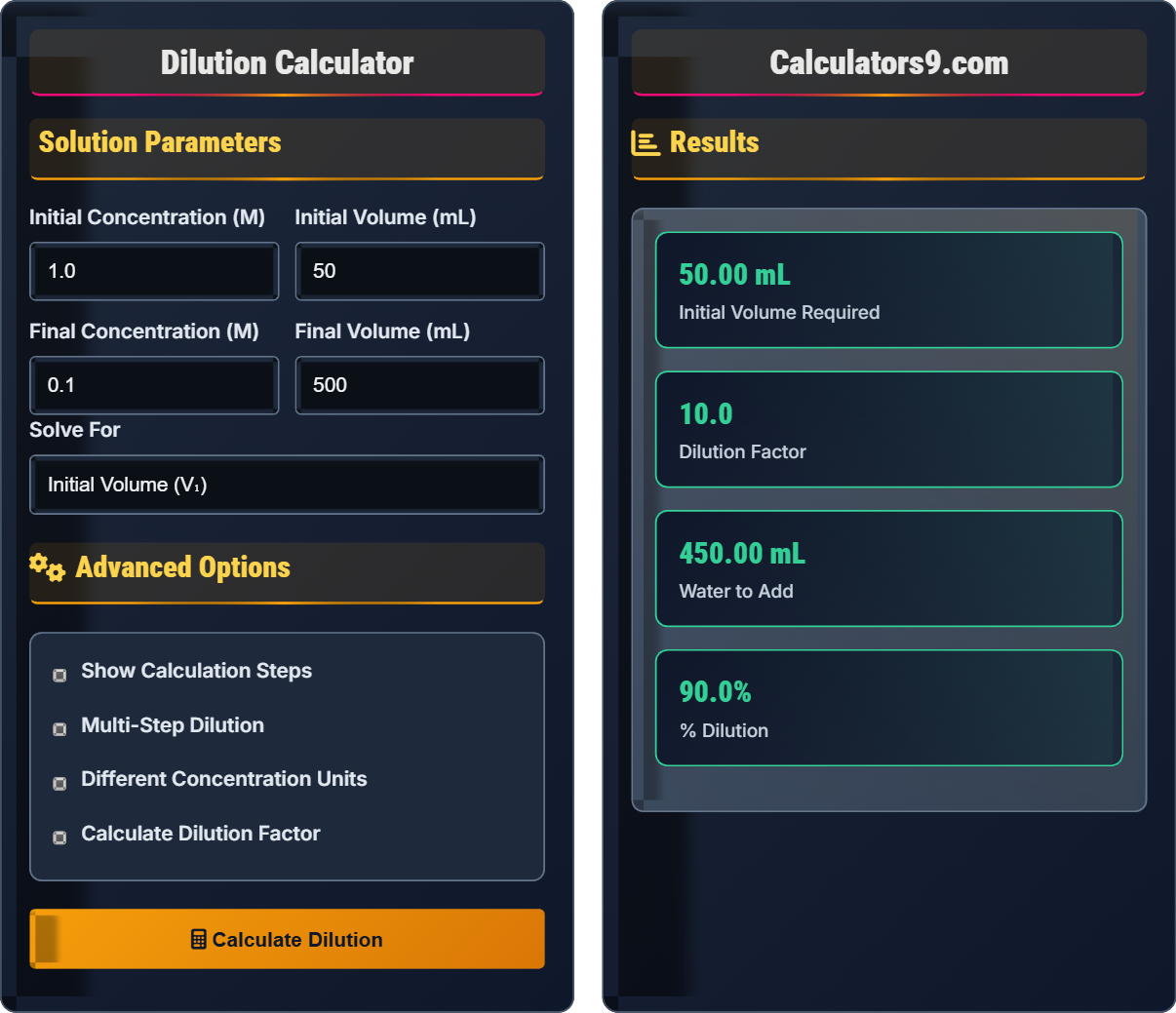
Example: To prepare 500 mL of 0.1 M NaOH from a 1.0 M stock solution:
\( V_1 = \frac{C_2V_2}{C_1} = \frac{0.1 \times 0.5}{1.0} = 0.05 \) L = 50 mL
So 50 mL of 1.0 M NaOH is diluted to 500 mL to obtain 0.1 M NaOH.
Solution Parameters
Advanced Options
Results
Dilution Fundamentals
Dilution is the process of reducing the concentration of a solute in a solution by adding more solvent. The amount of solute remains constant, but the volume increases, resulting in a lower concentration. This is commonly done in laboratories to prepare solutions of specific concentrations from stock solutions.
The fundamental dilution equation is:
Where C₁ and V₁ are the initial concentration and volume, and C₂ and V₂ are the final concentration and volume. This equation is based on the principle that the number of moles of solute remains constant during dilution.
- Always keep units consistent (convert if necessary)
- The number of moles of solute remains constant
- Dilution factor = V₂/V₁ or C₁/C₂
- Never add volumes directly; calculate final volume
Laboratory Applications
The dilution factor is the ratio of the final volume to the initial volume (V₂/V₁) or the ratio of the initial concentration to the final concentration (C₁/C₂). A dilution factor of 10 means the solution has been diluted 10-fold.
For very large dilutions, it's often better to perform multiple smaller dilutions rather than one large dilution. This improves accuracy and is easier to measure. For example, a 1000-fold dilution might be done as three 10-fold dilutions.
- Use volumetric glassware for accuracy
- Always add acid to water, never vice versa
- Mix thoroughly after each dilution
- Allow solutions to reach room temperature
Dilution Learning Quiz
A laboratory needs to prepare 250 mL of 0.05 M HCl solution from a 6.0 M stock solution. How much of the stock solution is needed? Show all calculation steps and explain the reasoning.
We use the dilution equation: \(C_1V_1 = C_2V_2\)
Given:
- \(C_1\) = 6.0 M (initial concentration)
- \(C_2\) = 0.05 M (final concentration)
- \(V_2\) = 250 mL = 0.250 L (final volume)
- \(V_1\) = ? (initial volume to find)
Solution:
Therefore, 2.08 mL of the 6.0 M HCl stock solution is needed.
This problem demonstrates the fundamental dilution equation. The key concept is that the number of moles of solute remains constant during dilution, even though the concentration changes. The equation \(C_1V_1 = C_2V_2\) expresses this conservation of moles.
It's important to keep units consistent throughout the calculation. In this case, we converted mL to L to match the molarity units. Alternatively, we could have kept everything in mL since the units cancel out.
The dilution factor in this case is \( \frac{V_2}{V_1} = \frac{250}{2.08} = 120 \), meaning the solution is diluted 120-fold.
Molarity (M): Moles of solute per liter of solution (mol/L)
Dilution: Process of decreasing concentration by adding solvent
Dilution Factor: Ratio of final volume to initial volume
• Always keep units consistent in the dilution equation
• The number of moles of solute remains constant during dilution
• Concentration and volume are inversely proportional (C₁V₁ = C₂V₂)
• Convert units to match before solving the equation
• Remember: "Concentrated × Volume = Diluted × Volume"
• For quick checks, if concentration decreases by a factor of 10, volume must increase by a factor of 10
• Always verify your answer makes sense (smaller volume needed for concentrated solution)
• Forgetting to convert units (mL to L) when using molarity
• Mixing up C₁ and C₂ or V₁ and V₂ in the equation
• Adding volumes instead of using the dilution equation
• Not accounting for the dilution factor in multi-step processes
A biochemist needs to prepare 100 mL of a 0.001 M solution of enzyme from a 1.0 M stock solution. The pipettes available can only measure volumes accurately down to 10 μL (0.01 mL). Can this dilution be done in a single step? If not, design a multi-step dilution procedure to achieve the desired concentration.
Single-step calculation:
Using \(C_1V_1 = C_2V_2\):
Since 100 μL is greater than the minimum measurable volume (10 μL), technically this dilution could be done in a single step. However, for improved accuracy, a two-step dilution is recommended.
Two-step dilution procedure:
Step 1: Prepare an intermediate solution (e.g., 0.01 M)
Take 100 μL of 1.0 M stock + 9.9 mL water = 10 mL of 0.01 M solution
Step 2: Dilute the intermediate solution to final concentration
Take 10 mL of 0.01 M solution + 90 mL water = 100 mL of 0.001 M solution
This problem highlights the practical limitations of laboratory equipment. Even though the theoretical calculation shows the dilution could be done in a single step, it's often better to use multiple smaller dilutions for accuracy.
Multi-step dilutions reduce the impact of measurement errors and are more practical when dealing with very small volumes. Each dilution step multiplies the error, but using moderate dilution factors at each step keeps the cumulative error manageable.
The choice of intermediate concentrations is flexible - common choices are powers of 10 (10-fold, 100-fold) which are easy to calculate and measure.
Stock Solution: Concentrated solution used as starting material
Intermediate Solution: Solution prepared in a multi-step dilution process
Serial Dilution: Series of sequential dilutions
• For very large dilutions, use multiple smaller dilutions
• Each dilution step introduces some error
• Common dilution factors are 2, 5, 10, or powers thereof
• Always use appropriate glassware for volume measurements
• For 1000-fold dilutions, use three 10-fold dilutions
• Keep dilution factors between 2 and 100 for best accuracy
• Use volumetric flasks for final dilutions, not graduated cylinders
• Attempting to measure volumes below pipette accuracy limits
• Not accounting for cumulative error in multi-step dilutions
• Using beakers instead of volumetric glassware for accurate dilutions
• Forgetting to mix solutions thoroughly between steps
Chemistry FAQ
Q: Why do we use the dilution equation C₁V₁ = C₂V₂ instead of just adding volumes together?
A: The dilution equation C₁V₁ = C₂V₂ is based on the conservation of matter - specifically, the number of moles of solute remains constant during dilution.
When you dilute a solution, you're only adding solvent (usually water), not changing the amount of solute. The relationship between concentration (C) and volume (V) is inverse: if volume increases, concentration decreases proportionally to maintain the same number of moles.
Mathematically: moles of solute = C₁V₁ = C₂V₂
Adding volumes directly would be incorrect because it doesn't account for the conservation of the amount of substance. The dilution equation ensures that the product of concentration and volume (which equals moles of solute) remains constant.
For example, if you have 10 mL of 1 M solution, you have 0.01 moles of solute. If you dilute to 100 mL, the concentration becomes 0.1 M, but you still have exactly 0.01 moles of solute.
Q: What's the difference between dilution factor and dilution ratio, and how do I calculate them?
A: The dilution factor and dilution ratio are related but different ways of expressing the extent of dilution:
Dilution Factor (DF): The ratio of the final volume to the initial volume (V₂/V₁), or equivalently the ratio of the initial concentration to the final concentration (C₁/C₂).
Formula: DF = V₂/V₁ = C₁/C₂
Example: If you dilute 1 mL to 100 mL, the dilution factor is 100/1 = 100.
Dilution Ratio: Expressed as the ratio of the initial volume to the final volume, typically in the form 1:X.
Formula: Dilution ratio = V₁ : V₂ (expressed as 1 : X)
Example: If you dilute 1 mL to 100 mL, the dilution ratio is 1:100.
Relationship: The dilution factor is the reciprocal of the dilution ratio when expressed as a fraction. A 1:100 dilution ratio corresponds to a dilution factor of 100.
In practice, dilution factor is more commonly used in calculations because it directly tells you how much the concentration has changed.