Empirical Formula Calculator
Chemistry calculation tool • Formula determination
Empirical Formula Calculation Method:
Show CalculatorThe empirical formula represents the simplest whole number ratio of atoms in a compound. It is calculated using the following steps:
1. Convert percentage composition to grams (assume 100g sample)
2. Convert grams to moles using atomic masses
3. Divide each mole value by the smallest number of moles
4. Multiply ratios to get whole numbers if necessary
5. Write the empirical formula using the resulting ratios
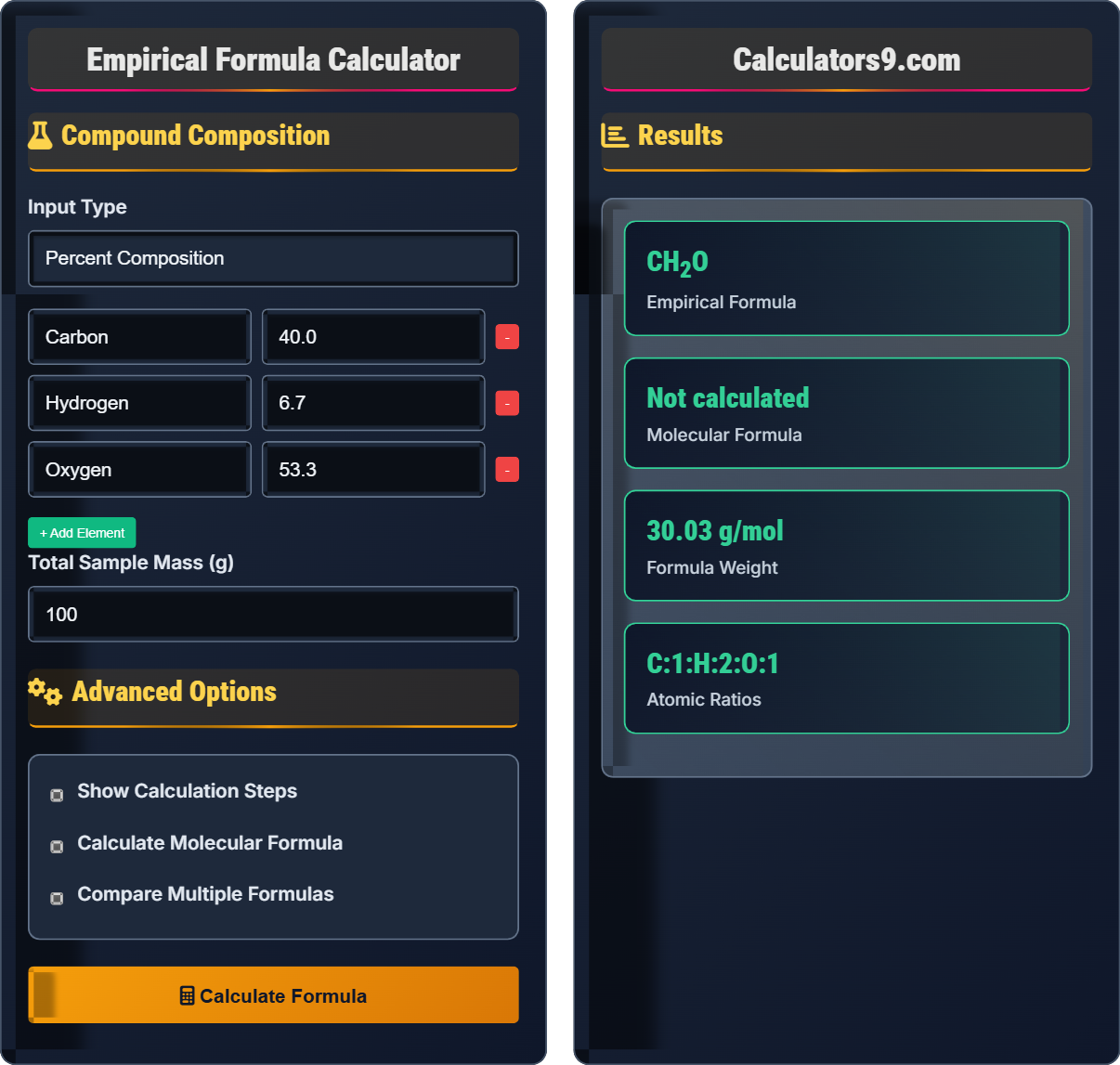
Example: A compound contains 40.0% Carbon, 6.7% Hydrogen, and 53.3% Oxygen.
Step 1: Assume 100g sample → 40.0g C, 6.7g H, 53.3g O
Step 2: Convert to moles → C: 40.0/12.01 = 3.33 mol, H: 6.7/1.008 = 6.65 mol, O: 53.3/16.00 = 3.33 mol
Step 3: Divide by smallest → C: 3.33/3.33 = 1, H: 6.65/3.33 = 2, O: 3.33/3.33 = 1
Step 4: Empirical formula is CH₂O
Compound Composition
Advanced Options
Results
Empirical Formula Fundamentals
The empirical formula of a chemical compound is the simplest positive integer ratio of atoms present in a compound. It doesn't necessarily represent the actual number of atoms in a molecule, but rather the simplest whole number ratio of elements.
The empirical formula is determined through these systematic steps:
- Convert percentage composition to grams (assuming 100g sample)
- Convert grams to moles using atomic masses
- Divide each mole value by the smallest number of moles
- Multiply ratios to get whole numbers if necessary
- Write the empirical formula using the resulting ratios
- Empirical formulas are always expressed in the simplest whole number ratio
- Multiple compounds can have the same empirical formula
- Molecular formula = n × empirical formula (where n is an integer)
- Always verify calculations by checking atomic ratios
Chemical Applications
The empirical formula gives the simplest ratio of elements, while the molecular formula gives the actual number of atoms in a molecule. For example, glucose has the molecular formula C₆H₁₂O₆ but the empirical formula CH₂O.
To find the molecular formula from the empirical formula:
- Calculate the empirical formula weight
- Divide the molecular weight by the empirical formula weight
- Multiply the subscripts in the empirical formula by this factor
- Determining unknown compound compositions
- Structural analysis in organic chemistry
- Stoichiometric calculations
- Quality control in chemical manufacturing
Empirical Formula Learning Quiz
A compound contains 40.0% Carbon, 6.7% Hydrogen, and 53.3% Oxygen. Calculate its empirical formula. Show all steps and explain the reasoning behind each step.
Step 1: Assume 100g of the compound, so we have 40.0g C, 6.7g H, and 53.3g O.
Step 2: Convert grams to moles using atomic masses:
Step 3: Divide each mole value by the smallest number of moles (3.33):
Step 4: The ratio is C₁H₂O₁, so the empirical formula is CH₂O.
This problem demonstrates the systematic approach to finding empirical formulas. We start by assuming 100g of the compound, which allows us to treat percentages as grams. This assumption simplifies calculations without affecting the final result since we're looking for ratios.
Next, we convert grams to moles because chemical reactions occur based on the number of particles (atoms, molecules), not their mass. Atomic masses allow us to make this conversion.
Finally, dividing by the smallest number of moles gives us the simplest ratio of atoms. If the ratios weren't whole numbers, we'd multiply by the smallest factor to achieve whole numbers.
Empirical Formula: The simplest whole number ratio of atoms in a compound
Atomic Mass: The average mass of an atom of an element, measured in atomic mass units (amu)
Mole: A unit representing 6.022 × 10²³ particles (Avogadro's number)
• Always assume 100g of sample when given percentage composition
• Convert mass to moles using atomic masses from the periodic table
• Divide all mole values by the smallest number of moles to get ratios
• If ratios aren't whole numbers, multiply by the smallest factor to make them whole
• Remember the acronym "PERCENT": Percent → Grams → Moles → Find Ratio → Empirical Formula
• When ratios are close to whole numbers (like 1.9, 2.1), round to the nearest whole number
• For ratios like 1.33, multiply by 3; for 1.5, multiply by 2; for 1.25, multiply by 4
• Using molecular weights instead of atomic masses for individual elements
• Forgetting to divide by the smallest number of moles to get the simplest ratio
• Attempting to round ratios too aggressively (like 1.5 to 1 or 2)
• Misplacing subscripts in the final formula (like writing CH2O instead of CH₂O)
A chemist analyzes a compound and finds it contains 2.4g of Carbon, 0.4g of Hydrogen, and 3.2g of Oxygen. What is the empirical formula of this compound? If the molecular weight is known to be 60.05 g/mol, what is the molecular formula?
Part 1 - Finding the empirical formula:
Convert masses to moles:
Divide by the smallest number of moles (0.20):
So the empirical formula is CH₂O.
Part 2 - Finding the molecular formula:
Calculate the empirical formula weight:
Find the multiplication factor:
Multiply the empirical formula by 2: (CH₂O)₂ = C₂H₄O₂
This problem combines two important concepts: finding empirical formulas from mass data and converting to molecular formulas. Unlike percentage composition problems, we don't need to assume 100g here because we're given actual masses.
The process of finding the empirical formula remains the same: convert to moles, find the simplest ratio. However, the second part of the problem introduces the relationship between empirical and molecular formulas.
The key insight is that molecular formulas are simple multiples of empirical formulas. By dividing the known molecular weight by the calculated empirical formula weight, we find how many times larger the molecule is compared to the empirical unit.
Molecular Formula: Shows the actual number of atoms of each element in a molecule
Empirical Formula Weight: The sum of atomic weights for the empirical formula
Multiplication Factor: The ratio of molecular weight to empirical formula weight
• When given actual masses, convert directly to moles without assuming 100g
• Molecular formula = n × empirical formula where n is a whole number
• The multiplication factor n must always be a whole number
• Both empirical and molecular formulas must have whole number subscripts
• Always double-check that the multiplication factor is a whole number or very close to one
• If n is not close to a whole number, recheck your calculations
• Common small molecules have simple ratios (n=1, 2, or 3)
• Assuming 100g when actual masses are provided
• Forgetting to multiply the empirical formula by the multiplication factor
• Using the wrong molecular weight value in calculations
• Rounding the multiplication factor incorrectly
Chemistry FAQ
Q: What's the difference between empirical and molecular formulas, and when would I use each one?
A: The empirical formula represents the simplest whole number ratio of atoms in a compound, while the molecular formula shows the actual number of atoms in a molecule.
For example, hydrogen peroxide has the molecular formula H₂O₂ but the empirical formula HO. Glucose has the molecular formula C₆H₁₂O₆ but the empirical formula CH₂O.
You would use the empirical formula when you only know the percentage composition of a compound and want to determine the simplest ratio of elements. This is often the first step in structural determination.
You would use the molecular formula when you know the exact molecular structure and molecular weight. This is essential for understanding the actual structure, properties, and reactions of the compound.
Mathematically, the relationship is: Molecular Formula = n × Empirical Formula, where n is an integer determined by dividing the molecular weight by the empirical formula weight.
Q: How do I handle cases where the mole ratios aren't perfect whole numbers, like 1.33:2.66:1.00?
A: When mole ratios aren't perfect whole numbers, you need to identify the pattern and multiply by the appropriate factor to get whole numbers.
In your example (1.33:2.66:1.00), recognize that 1.33 ≈ 4/3 and 2.66 ≈ 8/3. To eliminate fractions, multiply all ratios by 3:
- 1.33 × 3 = 4
- 2.66 × 3 = 8
- 1.00 × 3 = 3
Common fractional ratios and their multipliers:
- 0.33 or 1/3 → multiply by 3
- 0.5 or 1/2 → multiply by 2
- 0.67 or 2/3 → multiply by 3
- 0.25 or 1/4 → multiply by 4
- 0.75 or 3/4 → multiply by 4
If you get ratios that don't fit common fraction patterns, recheck your calculations as experimental errors might be present.