Ideal Gas Law Calculator
PV=nRT • Gas Laws • Thermodynamics
Ideal Gas Law:
Show the calculator\( PV = nRT \)
Where:
- \( P \) = Pressure (atm)
- \( V \) = Volume (L)
- \( n \) = Number of moles (mol)
- \( R \) = Gas constant (0.08206 L·atm/mol·K)
- \( T \) = Temperature (K)
This fundamental equation describes the behavior of ideal gases.
Derivations:
\( P = \frac{nRT}{V} \)
\( V = \frac{nRT}{P} \)
\( n = \frac{PV}{RT} \)
\( T = \frac{PV}{nR} \)
Example: 2 mol gas at 273K in 22.4L:
\( P = \frac{(2)(0.08206)(273)}{22.4} = 1.00 \text{ atm} \)
Thus, the pressure is 1.00 atm.
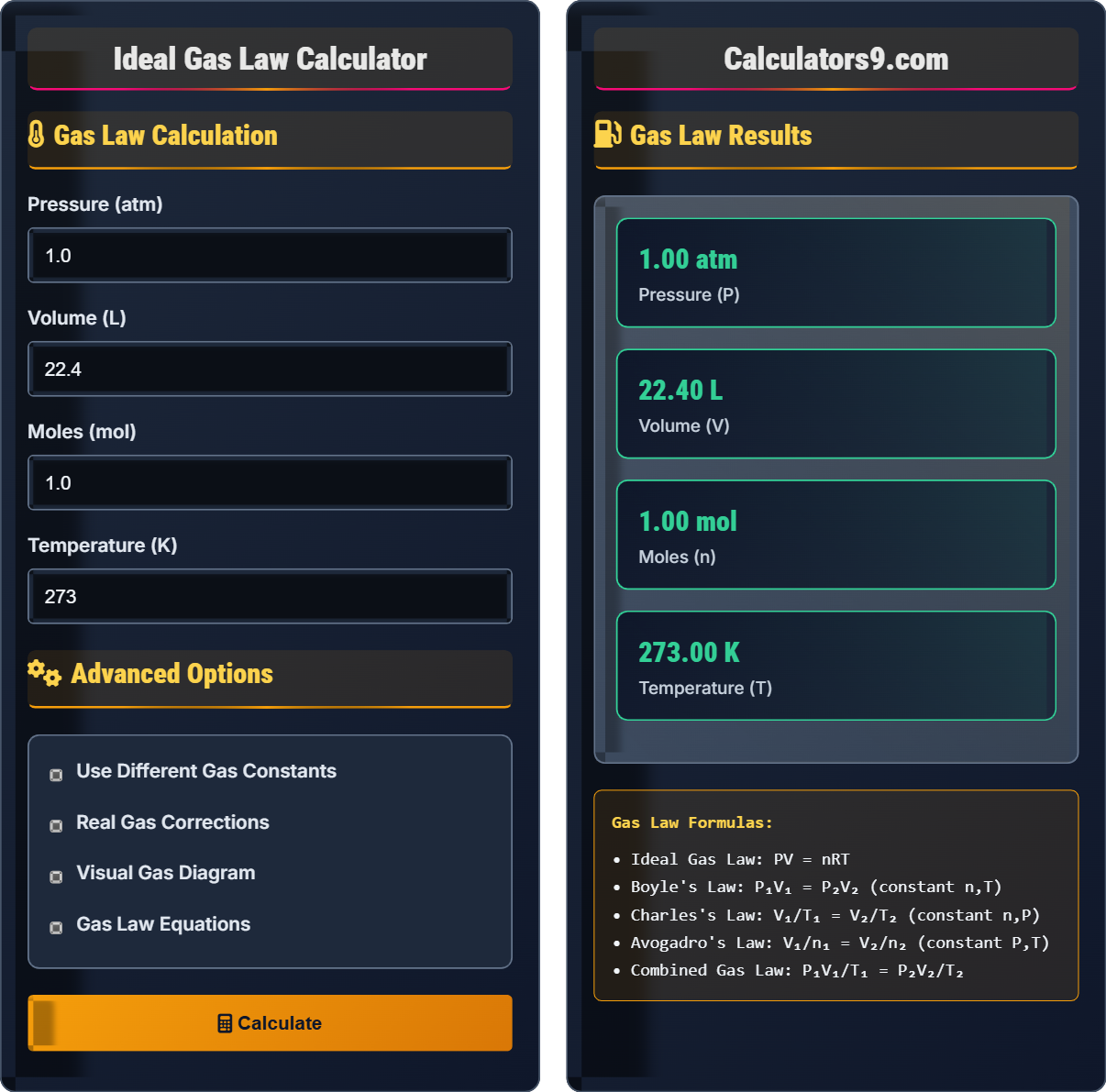
Gas Law Calculation
Advanced Options
Gas Law Results
Comprehensive Ideal Gas Law Chemistry Guide
The Ideal Gas Law (PV = nRT) is a fundamental equation that describes the relationship between pressure (P), volume (V), temperature (T), and amount of gas (n) for ideal gases. It combines four empirical gas laws and assumes that gas molecules have negligible volume and no intermolecular forces. The gas constant R has different values depending on the units used.
The fundamental gas law equations:
Gas law calculations are essential in various fields:
- Industrial: Gas storage and transportation
- Environmental: Atmospheric pressure and climate
- Medical: Respiratory therapy and anesthesia
- Engineering: Combustion and HVAC systems
- Variations: Van der Waals equation accounts for molecular volume and intermolecular forces
- Formula: (P + an²/V²)(V - nb) = nRT
- Conditions: Significant at high pressure and low temperature
- Deviations: Polar molecules show greater deviations
Gas Law Concepts
Hypothetical gas that follows PV=nRT exactly
R = 0.08206 L·atm/mol·K (chemistry standard)
- Temperature must be in Kelvin
- Pressure and volume units must be consistent
- Ideal gas behavior at STP: 1 mol = 22.4 L
Gas Calculations
0°C (273.15K) and 1 atm pressure
- Identify known variables
- Convert temperature to Kelvin
- Select appropriate gas constant
- Solve for unknown variable
- K = °C + 273.15
- Always check unit consistency
- Use Kelvin for temperature
Chemistry Gas Law Learning Quiz
At constant temperature, if the volume of a gas is reduced by half, what happens to the pressure?
The answer is A) Pressure doubles. This is Boyle's Law: P₁V₁ = P₂V₂ (constant n,T). If V₂ = ½V₁, then P₂V₂ = P₁V₁ becomes P₂(½V₁) = P₁V₁. Solving: P₂ = 2P₁, so pressure doubles when volume is halved.
At constant temperature and moles, pressure and volume are inversely proportional. When volume decreases, gas molecules collide more frequently with the container walls, increasing pressure. This inverse relationship is fundamental to understanding gas behavior and has practical applications in breathing, pumps, and engines.
Boyle's Law: P ∝ 1/V at constant n,T
Inverse Proportion: When one increases, the other decreases
Constant Temperature: Isothermal process
• P₁V₁ = P₂V₂ (Boyle's Law)
• P ∝ 1/V (inverse relationship)
• Temperature must be constant
• Remember: P × V = constant (at constant n,T)
• Smaller volume = higher pressure
• Always use Kelvin for temperature
• Forgetting that P and V are inversely related
• Not keeping temperature constant
• Using Celsius instead of Kelvin
A gas occupies 2.0 L at 27°C and 1.5 atm pressure. What volume will it occupy at 127°C and 3.0 atm pressure?
Step 1: Convert temperatures to Kelvin: T₁ = 27°C + 273 = 300K, T₂ = 127°C + 273 = 400K.
Step 2: Use combined gas law: P₁V₁/T₁ = P₂V₂/T₂.
Step 3: Solve for V₂: V₂ = (P₁V₁T₂)/(P₂T₁) = (1.5 × 2.0 × 400)/(3.0 × 300) = 1200/900 = 1.33 L.
Therefore, the gas will occupy 1.33 L at the new conditions.
This problem combines pressure, volume, and temperature changes. The combined gas law is useful when multiple variables change simultaneously. Remember to convert all temperatures to Kelvin. The pressure doubling (1.5 to 3.0 atm) tends to decrease volume, while the temperature increase (300K to 400K) tends to increase volume. The net effect depends on the relative magnitudes of these changes.
Combined Gas Law: P₁V₁/T₁ = P₂V₂/T₂
Standard Temperature: 0°C = 273.15K
Standard Pressure: 1 atm
• Always convert to Kelvin for temperature
• Units must be consistent
• Use combined gas law for multiple variable changes
• Convert all temperatures to Kelvin first
• Check if pressure/volume/temperature increases or decreases
• Predict the result before calculating
• Forgetting to convert Celsius to Kelvin
• Using wrong formula for multiple variable changes
• Mixing up pressure and volume units
FAQ
Q: Why do we use Kelvin instead of Celsius for gas law calculations? What's the difference?
A: We use Kelvin because it's an absolute temperature scale starting at absolute zero (0K = -273.15°C), where molecular motion theoretically stops. Gas laws involve ratios of temperatures, and using Celsius would give meaningless negative ratios when temperatures are below 0°C.
For example, if a gas changes from 0°C to 100°C, using Celsius would suggest a 100-fold temperature increase, but in reality, it's only about a 1.37-fold increase (273K to 373K). The Kelvin scale ensures that temperature ratios are physically meaningful.
Q: When do real gases deviate from ideal gas behavior? How significant are these deviations?
A: Real gases deviate from ideal behavior under high pressure and low temperature conditions. At high pressure, molecular volume becomes significant compared to available space. At low temperature, intermolecular attractions become more significant.
The Van der Waals equation accounts for these: (P + an²/V²)(V - nb) = nRT. Deviations are more pronounced for polar molecules and large molecules. At standard temperature and pressure (STP), most gases behave ideally to within 1% accuracy.