Molar Mass Calculator
Chemical Formula • Atomic Mass • Stoichiometry
Molar Mass Formula:
Show the calculator\( M = \sum (n_i \times A_i) \)
Where:
- \( M \) = Molar Mass (g/mol)
- \( n_i \) = Number of atoms of element i
- \( A_i \) = Atomic mass of element i (g/mol)
This fundamental equation sums the products of atomic masses and their quantities.
Example: Water (H₂O):
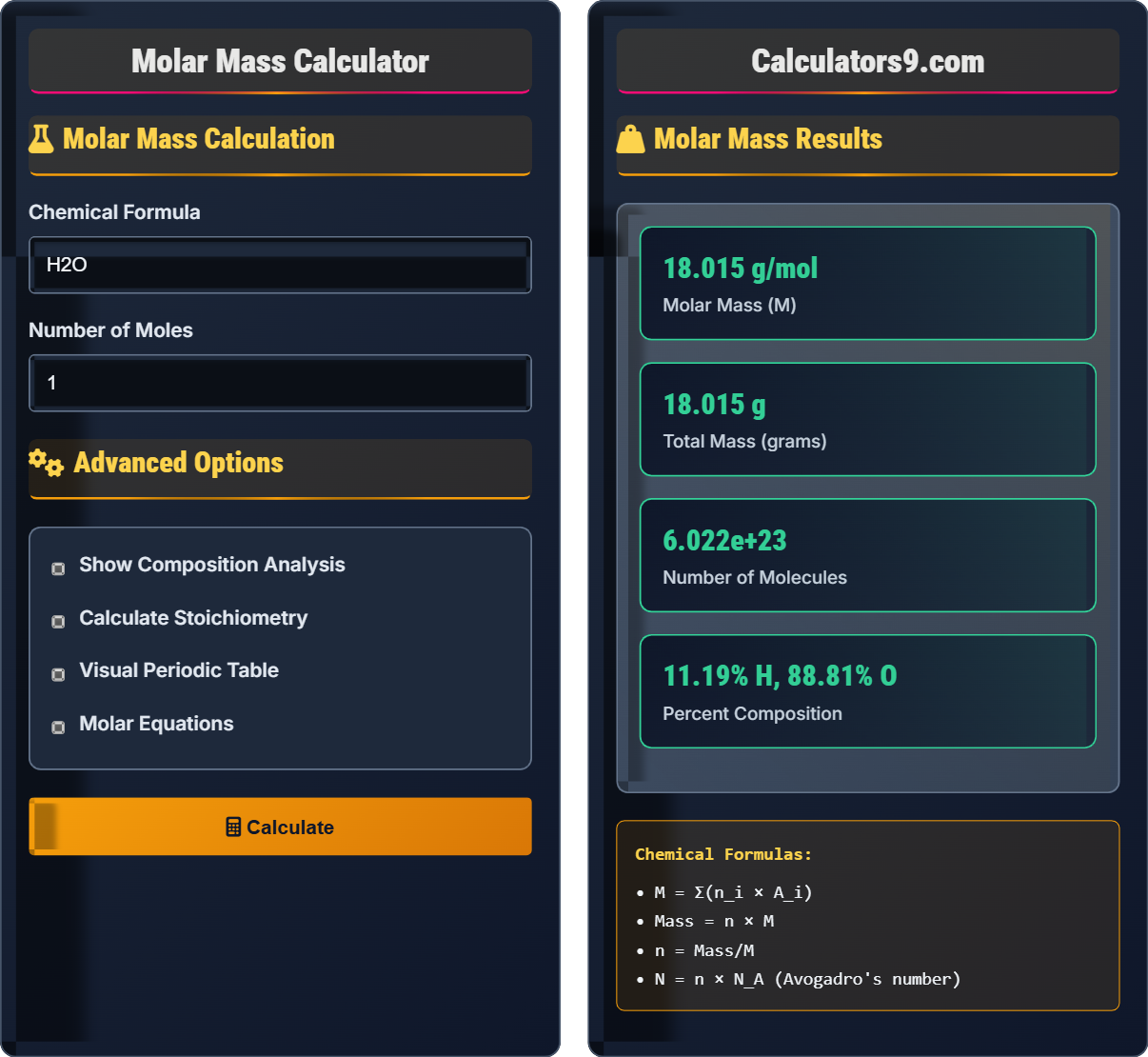
\( M = (2 \times 1.008) + (1 \times 15.999) = 18.015 \text{ g/mol} \)
Thus, the molar mass of water is 18.015 g/mol.
Molar Mass Calculation
Advanced Options
Molar Mass Results
Comprehensive Molar Mass Chemistry Guide
Molar mass is the mass of one mole of a substance, expressed in grams per mole (g/mol). It is numerically equal to the molecular weight or atomic weight of a substance expressed in atomic mass units (amu). Molar mass is fundamental in chemistry for converting between mass and moles of substances in chemical reactions and stoichiometric calculations.
The fundamental molar mass equation:
Molar mass calculations are essential in various fields:
- Stoichiometry: Balancing chemical equations
- Titration: Concentration determinations
- Synthesis: Yield calculations
- Pharmaceuticals: Dosage formulations
- Definition: 6.022 × 10²³ particles per mole
- Significance: Connects macroscopic and microscopic worlds
- Applications: Converting between moles and particles
- Origin: Named after Amedeo Avogadro
Molar Concepts
Mass per mole of substance: M = Σ(n_i × A_i)
N_A = 6.022 × 10²³ particles/mol
- 1 mole = 6.022 × 10²³ particles
- Molar mass numerically equals molecular weight
- Mass = moles × molar mass
Chemical Calculations
(Mass of element / Total mass) × 100%
- Identify elements and their counts
- Find atomic masses from periodic table
- Multiply count by atomic mass
- Sum all contributions
- Subscripts indicate atom counts
- Parentheses multiply enclosed groups
- Round atomic masses appropriately
Chemistry Molar Learning Quiz
What is the molar mass of sulfuric acid (H₂SO₄)? (Atomic masses: H = 1.008, S = 32.06, O = 15.999)
The answer is C) 98.08 g/mol. H₂SO₄ contains: 2 H atoms: 2 × 1.008 = 2.016 g/mol, 1 S atom: 1 × 32.06 = 32.06 g/mol, 4 O atoms: 4 × 15.999 = 63.996 g/mol. Total: 2.016 + 32.06 + 63.996 = 98.072 ≈ 98.08 g/mol.
This problem demonstrates systematic molar mass calculation. For each element in the formula, multiply the number of atoms by the atomic mass, then sum all contributions. The subscripts in the chemical formula (H₂SO₄) indicate the number of each type of atom: 2 hydrogen, 1 sulfur, and 4 oxygen atoms.
Molar Mass: Mass of one mole of substance
Atomic Mass: Mass of an atom relative to carbon-12
Subscript: Number of atoms in formula
• Count all atoms in formula
• Multiply by appropriate atomic mass
• Sum all contributions
• Organize by element
• Keep track of subscripts
• Check that formula is balanced
• Forgetting to multiply by subscript
• Misreading chemical formula
• Using wrong atomic mass values
Calculate the percent composition of carbon, hydrogen, and oxygen in glucose (C₆H₁₂O₆). Also, determine how many grams of glucose contain 2.5 moles of glucose molecules.
Molar mass of glucose: C₆H₁₂O₆ = (6 × 12.01) + (12 × 1.008) + (6 × 15.999) = 72.06 + 12.096 + 95.994 = 180.15 g/mol
Percent composition: Carbon: (72.06/180.15) × 100% = 40.00%, Hydrogen: (12.096/180.15) × 100% = 6.71%, Oxygen: (95.994/180.15) × 100% = 53.29%
Mass of 2.5 moles: Mass = n × M = 2.5 mol × 180.15 g/mol = 450.38 g
This problem combines molar mass calculation with percent composition and stoichiometry. First, calculate the total molar mass by summing contributions from all atoms. Then, find the percentage of each element by dividing its contribution by the total mass. Finally, use the relationship Mass = n × M to find the mass of a given number of moles.
Percent Composition: Mass percentage of each element
Stoichiometry: Quantitative relationships in reactions
Mole: Amount of substance containing Avogadro's number
• % Element = (mass of element / total mass) × 100%
• Mass = moles × molar mass
• Sum of % compositions = 100%
• Always check that percentages sum to 100%
• Use molar mass as conversion factor
• Organize calculations systematically
• Forgetting to account for all atoms
• Using wrong formula for percent calculation
• Not converting units properly
FAQ
Q: What's the difference between molecular weight and molar mass? Are they the same thing?
A: Molecular weight and molar mass are numerically identical but conceptually different. Molecular weight is the mass of one molecule relative to carbon-12 (dimensionless), measured in atomic mass units (amu). Molar mass is the mass of one mole of molecules, expressed in grams per mole (g/mol).
For example, the molecular weight of water is 18.015 amu, and its molar mass is 18.015 g/mol. The numbers are the same, but the units and conceptual meanings differ. In practice, chemists often use these terms interchangeably.
Q: How do I handle hydrates when calculating molar mass? What about compounds with parentheses like Ca(OH)₂?
A: For compounds with parentheses, multiply everything inside by the subscript outside. For Ca(OH)₂: 1 Ca + 2 O + 2 H = 1×40.08 + 2×15.999 + 2×1.008 = 74.09 g/mol.
For hydrates like CuSO₄·5H₂O, treat the dot as addition: calculate CuSO₄ separately (159.61 g/mol) plus 5 H₂O (5×18.015 = 90.075 g/mol), totaling 249.69 g/mol. The water molecules are included in the crystal structure.